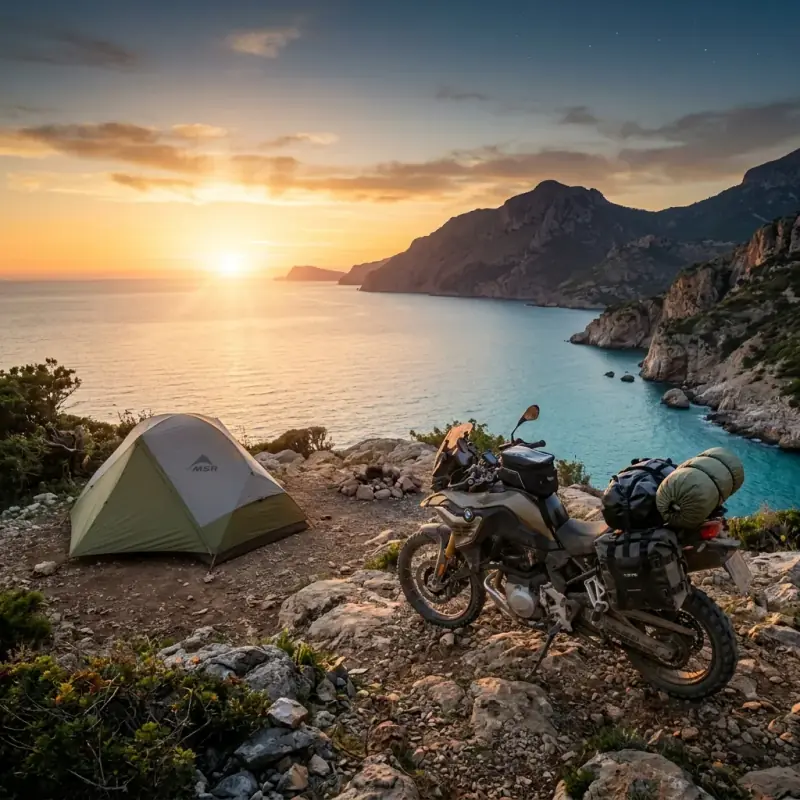
Adventure motorcycle camping is two skills stacked on top of each other: riding a loaded bike to somewhere remote, and being self-sufficient once you stop. Most guides cover one piece — a tent review, a route write-up, a packing list, and leave you to assemble the whole picture yourself. This guide is the map. It walks through every decision that goes into riding out to a quiet bay or a mountain pass and sleeping there, in order, and links to the deep dive on each one when you want the detail.
It’s written for the rider who wants the complete shape of the thing before disappearing into individual gear rabbit holes: what bike, what to wear, how to carry it, what to sleep in, how to navigate, where it’s legal to camp, what to do when something breaks, and which roads are worth all of the above. Nothing here is theoretical filler — every section points to a tested, standalone guide where the specifics live.
The Shape of the Trip
A self-sufficient motorcycle camping trip is a chain, and it’s only as strong as its weakest link. A perfect tent is useless if your luggage ruins the bike’s handling on the descent to the campsite. The best navigation kit doesn’t help if you can’t recover the bike after a drop on a loose climb. The skill is balancing the whole system — bike, gear, weight, shelter, navigation, and route; against how you actually ride and where you actually go.
The rest of this guide breaks that chain into its links, roughly in the order you’d think about them when planning a trip: the machine, what you wear, what you carry, where you sleep, how you eat, how you find your way, how you stay running and safe, and finally the payoff. The routes.
1. Choosing the Bike
The bike is the foundation, and the single most useful principle is that weight matters more than power. A bike you can pick up alone on a loose climb after a low-speed drop is worth far more on a real trip than thirty extra horsepower you’ll rarely use.
Beginners should start honest about skill and terrain. The best beginner adventure motorcycles for 2026 covers the lightweight, forgiving machines that build confidence without punishing mistakes, and shorter riders have a separate set of constraints worth understanding in the best ADV bikes for short riders guide, where seat height, standover geometry, and recovery weight matter more than the brochure number. Women riders weighing ergonomics beyond seat height will find the relevant trade-offs in the best motorcycles for women breakdown.
When you’re ready to compare the middleweights that dominate serious adventure riding, start with the full 650–900cc field, then let the head-to-heads do the heavy lifting: Yamaha Ténéré 700 vs Honda Africa Twin, KTM 890 Adventure R vs Ténéré 700, and the three-way Honda Transalp vs V-Strom 800DE vs Ténéré 700. For specific machines, there’s a long-term Yamaha Ténéré 700 review, a Royal Enfield Himalayan 450 review, and a BMW R 1300 GS Adventure review for riders looking at the flagship end. If your trips lean toward big mileage on tarmac, the best motorcycles for long-distance touring frames the decision around comfort and range rather than off-road agility.
2. Protective Riding Gear
Gear is the layer between you and the road, and on a long trip it has to do more than protect. It has to keep you dry, let you walk around at stops, and breathe in heat. The decision starts at the top: the best adventure motorcycle helmets guide covers the shells, visors, and venting that matter, and helmet fit is also what decides whether an intercom sounds good (more on that below).
For the body, the best adventure motorcycle jackets and best adventure motorcycle pants guides cover the laminated-vs-liner waterproofing decision and the armor that comes with it, and the in-depth Klim Badlands Pro jacket review is the long-term test of where the money goes at the premium end. Hands and feet are easy to underspend on and quick to regret it: see the best adventure motorcycle gloves and the best adventure motorcycle boots, where walkability turns out to matter as much as crash protection. At the other end of the year, riding in heat is its own discipline. For cold and shoulder-season riding, heated motorcycle gear extends the season, and a dedicated adventure motorcycle protection layer — back protectors, chest armor; closes the gaps factory gear leaves open.
Putting a full outfit together within a budget is its own exercise, covered tier by tier in the men’s ADV outfit guide and the women’s ADV outfit guide.
3. Luggage and Packing
How you carry your gear changes the bike more than almost anything else you bolt on. The first decision is soft versus hard: the soft vs hard panniers comparison lays out the crash-behavior, weight, and security trade-offs, and the best adventure motorcycle panniers roundup ranks specific systems by use case. If you’re looking at premium soft luggage, the Mosko Moto Backcountry 35L review works through the wedge-mount approach. A tank bag rounds out the system for the things you need without stopping.
Then there’s the packing itself, which is where most riders go wrong, and it comes down to three numbers worth carrying in your head. Keep total luggage under about 20% of the bike’s wet weight — on a 208 kg Ténéré 700 that is roughly 40 kg of rider gear, tent, water and fuel before you have packed a single souvenir. Keep each pannier under about 10 kg, and keep the two sides within a kilo or so of each other, because a lopsided load shows up as a wandering front end long before it shows up on a scale. And put the weight where it does least harm: heavy low and centered — the bottom of the panniers and the tank bag — with bulky-but-light items (sleeping bag, clothing) up high and at the tail. A bike loaded that way steers almost like a stock one; the same weight carried high and rearward turns every gravel corner into an argument. The how to pack a motorcycle for a two-week trip guide walks through the weight distribution and bag-by-bag layout that makes a loaded bike feel almost stock. The motorcycle camping gear checklist is the master list to pack against so nothing critical gets left in the garage.
4. Shelter and Sleep System
Your shelter-and-sleep system is three pieces working together: tent, sleeping bag, and pad. Get all three right and you sleep through the night; get one wrong and the whole trip suffers.
On tents, the best motorcycle camping tents guide spans everything from a 1.4 kg ultralight to a full bike-garage tent, while the best ultralight tents for motorcycle camping deep dive ranks the lightest picks by the spec that actually matters on a bike — pole length for panniers. For budget riders, the Naturehike Cloud Up 2 review is the long-term test of the value champion, and if you’ve been eyeing a garage-style shelter, the Outlaw motorcycle tent guide explains how those compare.
For the sleep system underneath, the best sleeping bags for motorcycle camping and best compact sleeping pads guides cover warmth, R-value, and packed size. The numbers that decide whether you’re warm at 3 a.m. or shivering. Riders who sleep badly on the ground regardless of pad should read the best motorcycle camping cots guide, and for genuine camp comfort at the end of a long day, a proper camp chair earns its small weight penalty.
5. The Camp Kitchen
Cooking on the road ranges from boiling water for instant coffee to making real meals from raw ingredients, and the gear scales with the ambition. The best portable camp stoves for riders guide covers the canister-vs-liquid decision and the wind problem that catches coastal campers out. Pair the stove with the right pots in the motorcycle camping cookware guide, and when you want to actually eat well rather than just survive, the how to cook on a motorcycle trip guide covers the menu and technique.
6. Navigation, Comms, and Cameras
Finding your way and staying connected is a system of its own. The core decision is phone versus dedicated GPS, which the Garmin Zumo XT2 vs phone navigation comparison settles with real riding scenarios, while the full Garmin Zumo XT2 review covers the unit itself. If you ride with a phone, mount it correctly. The best motorcycle phone mounts guide also explains the under-reported risk of engine vibration permanently damaging a phone camera, and how to prevent it.
For talking to riding partners and hearing turn-by-turn prompts cleanly, the best motorcycle intercom systems guide ranks the field and settles the Cardo-versus-Sena debate head to head, and if you’ve already picked Sena, which Sena to buy sorts its own range. To record the ride, the best motorcycle action cameras guide covers the mounting and stabilization that separate usable footage from a shaky mess.
Keeping all of it charged across multi-day off-grid stretches is its own problem. The motorcycle camping power and charging guide covers the power banks, solar, and wiring that keep your devices alive away from a wall socket.
7. Tools, Maintenance, and Riding Skills
Self-sufficiency means handling the breakdowns that happen far from a workshop. The essential motorcycle tool kit for overlanding covers what to carry — weight-tagged, organized by function, and trimmed to what actually earns its place. For a worked example on a specific bike, the Ténéré 700 roadside maintenance guide shows what you can genuinely fix by the side of a track and what you can’t, with the real torque and chain specs. Tires deserve their own decision. The best adventure motorcycle tires guide covers the 50/50 dual-sport compounds that handle mixed surfaces.
None of the gear matters if the riding skill isn’t there. The off-road riding tips for loaded adventure bikes guide covers body position, line choice, and how a fully loaded bike changes everything on loose terrain.
8. Wild Camping: Legality, Safety, and Security
Wild camping is what makes adventure motorcycle travel feel limitless, but it comes with rules that vary wildly by country and a few real risks worth managing. The legal picture across the continent is mapped in the wild camping in Europe legal guide, with a dedicated Balkans wild camping legal guide and a wild camping in Turkey guide for two of the best regions for it.
Once you’re out there, two concerns matter. Securing the bike is covered in how to secure your motorcycle while wild camping — which, usefully, debunks where theft actually happens, and staying safe when you’re alone and far from help is the subject of the solo motorcycle camping safety guide.
9. Planning and Cross-Border Logistics
The unglamorous groundwork is what turns an ambitious route into a trip that actually happens. The how to plan a long-distance motorcycle trip guide covers budgeting, timing, and logistics from the top down. Before you cross a border, the adventure motorcycle insurance guide and the Europe motorcycle border crossing documentation guide cover the paperwork that keeps a trip from stalling at a checkpoint.
For getting the bike across water, two ferry guides cover the most useful crossings: the UK to Spain motorcycle ferry guide skips a thousand miles of French motorway, and the Italy to Greece motorcycle ferry guide opens up the eastern Mediterranean.
10. The Routes — The Whole Point
Everything above exists to get you here: the roads and bays worth all the preparation. The routes break down roughly by region.
Turkey is where a lot of this site’s riding happens. The Lycian Way motorcycle route and the Turkey section of the Trans Euro Trail are the headline rides, while the remote Turkish bays you can only reach by adventure motorcycle are the payoff for going off the asphalt. Up north, the Black Sea and Kaçkar route and the onward Black Sea to Georgia route cover the green, wet, mountainous coast, and the Cappadocia motorcycle route covers the surreal interior.
Europe and the Balkans open up enormous range. The Trans Euro Trail for beginners is the entry point to the continent’s great off-road network, the riding the Balkans guide frames the region, and specific routes like the Albanian Riviera with wild camping, the Croatia Dalmatian Coast route, and Romania’s Transfăgărășan and Transalpina cover the highlights.
The Mediterranean is the coastal-touring heartland. Start with the best coastal motorcycle routes in the Mediterranean, then go deep on the Amalfi Coast touring rules, the islands of Corsica and Sardinia, the best wild camping bays in the Mediterranean, the top seaside campgrounds in Greece, and coastal camping in Portugal’s Algarve. For something wilder, the Morocco adventure guide crosses into North Africa.
The UK and USA round out the classics. Scotland’s North Coast 500 is the British rite of passage, while California’s Pacific Coast Highway and the cross-country Route 66 anchor most American trips.
Where to Start
If this is all new, don’t try to buy and learn everything at once. Pick a bike you can handle, assemble a basic but complete gear set, and plan one short, achievable trip close to home — a single overnight on a route you know. The first night out teaches more than a month of reading. Then upgrade the pieces that proved themselves and replace the ones that didn’t.
Use this guide as the map it’s meant to be. Follow the link for whichever piece you’re deciding on next, get the detail, then come back for the rest. The whole chain matters, but you only have to forge one link at a time.
Frequently Asked Questions
What do I actually need to start adventure motorcycle camping?
Far less than most beginners assume. A capable-enough bike you can pick up after a drop, protective riding gear (helmet, jacket, gloves, boots), a way to carry luggage low and balanced, a shelter-and-sleep system (tent, sleeping bag, pad), a small stove, water, navigation, and a basic tool kit. You can assemble a complete setup for a fraction of the price of flagship gear and upgrade the pieces that prove themselves over time. The single biggest mistake is buying the most expensive version of everything before you know how you actually ride.
What is the best beginner adventure motorcycle for camping?
Weight matters far more than power. Lightweight middleweights and small-displacement bikes you can recover alone after a drop — Royal Enfield Himalayan 450, Yamaha Ténéré 700, Honda CRF300L Rally, KTM 390 Adventure — are the realistic starting points. The right bike is the one that matches your skill level and the terrain you actually ride, not the one with the biggest spec sheet. Seat height, wet weight, and tank width all matter more than horsepower for a beginner.
Is wild camping on a motorcycle legal?
It depends entirely on the country. Scandinavia and Scotland have right-to-roam laws that make it broadly legal. Most of Turkey and the rural Balkans tolerate it. Germany, France, Italy, Spain, and Portugal restrict or prohibit it without landowner permission. The universal rules are leave-no-trace, no fires in restricted months, avoid private and cultivated land, and stay one or two nights at a single spot. Always check the specific country's rules before relying on wild camping as your accommodation plan.
How much should a fully loaded adventure bike weigh?
Total luggage weight should stay under about 20% of the bike's wet weight, with per-side pannier load under 10 kg. Heavy items belong low and centered — the bottom of the panniers and the tank bag — while bulky-but-light gear like the sleeping bag and tent goes high in the tail bag. Getting weight distribution wrong ruins handling in corners and crosswinds far more than the total weight does.
Do I need a dedicated GPS or is my phone enough?
For occasional fair-weather riding within cell coverage, a phone on a vibration-dampened mount handles most navigation. For high-mileage riders who ride in rain, heat, and remote regions where cellular data fails, a dedicated motorcycle GPS earns its price through sunlight readability, true waterproofing, glove operation, and offline maps that don't disappear at a border. There's also a real, often-overlooked risk: sustained engine vibration can permanently damage a phone camera, which a dedicated unit sidesteps entirely.