
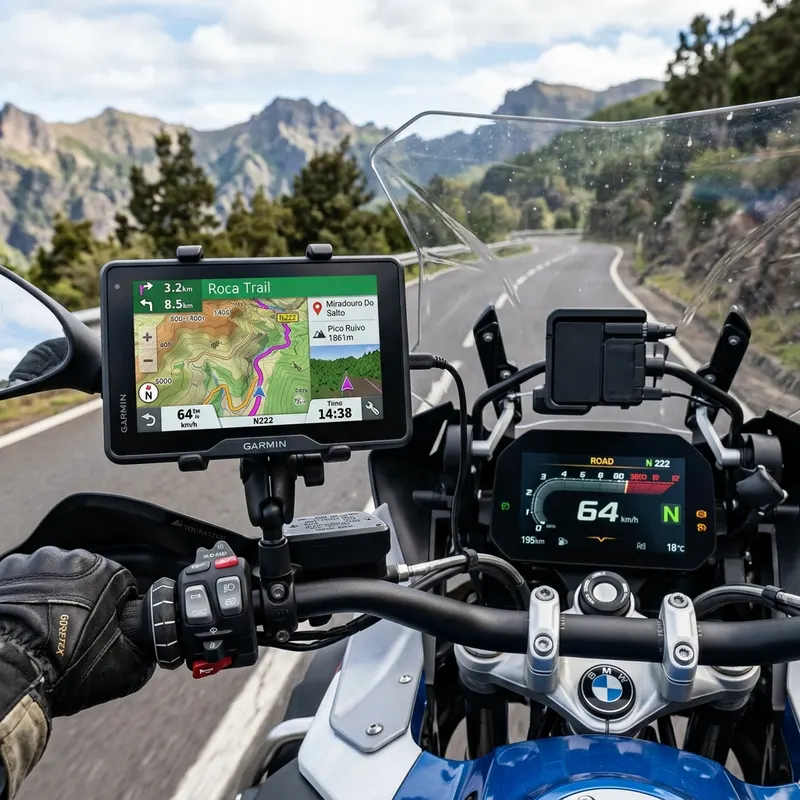
The Garmin Zumo XT2 is the current flagship in Garmin’s dedicated motorcycle GPS line. At $599.99 MSRP it is a real financial commitment in an era when most riders default to phone navigation. The question this garmin zumo xt2 review addresses honestly is whether the Zumo’s specific feature set justifies the price for the modern adventure motorcyclist.
Across thousands of kilometres of long-term owner use in mixed conditions, the Zumo XT2 has earned a strong reliability reputation — handling rain, dust, summer heat, and Bluetooth pairing across multiple helmet comm systems without the dropouts that plague phone-based setups.
Introduction: What $600 Buys in 2026
In 2026 most motorcycle navigation happens on a smartphone running Google Maps, OsmAnd, or a touring-specific app. Phones are powerful, cheap to acquire (already owned), and run better navigation software than any dedicated GPS.
The Zumo XT2 is Garmin’s answer to that: a 6-inch transflective unit built to survive a handlebar rather than a pocket, priced at $600 and now sitting alongside a newer XT3. This review covers what the hardware actually does, where the software still frustrates, and whether the XT2 is the one to buy in 2026.
If what you actually want is the buy-or-don’t decision against the phone you already own, that argument lives on its own page — linked below — and is not repeated here.
The Hardware That Justifies the Price
Four hardware decisions separate the XT2 from general-purpose navigation devices, and they are where the $600 actually goes.
Sunlight readability. The 6-inch transflective screen reads cleanly at 1280x720 resolution in direct sunlight. Transflective LCD technology uses ambient light to brighten the image. The brighter the sun, the clearer the screen. The opposite is true of standard backlit phone screens, which become harder to read as ambient brightness increases.
Weatherproofing. The XT2 is rated IPX7, which corresponds to full submersion for 30 minutes at 1 meter depth. Phones in waterproof mounts achieve IPX4 at best, and only while the mount stays sealed. Heavy rain enters phone charging ports and speaker grilles within 30-60 minutes of sustained exposure.
Glove operation. The capacitive touchscreen is engineered to detect input through standard motorcycle gloves, including thick winter gauntlets. The icons are sized for finger input rather than precision touch. Phone touchscreens require specific touchscreen-compatible glove materials or bare fingers.
Operating temperature range. The XT2 functions from -20°C to +55°C ambient. Phones throttle CPU performance at 35-40°C ambient and shut down at 45-50°C. On a black handlebar mount in summer sun the surface temperature easily reaches 60°C, well beyond phone tolerance.
None of these are headline features, and none show up well on a spec sheet next to a phone’s resolution and processor. They are the parts that decide whether the unit is still readable and operable at hour six of a wet, bright, cold day.
Screen Quality and Glove Usability
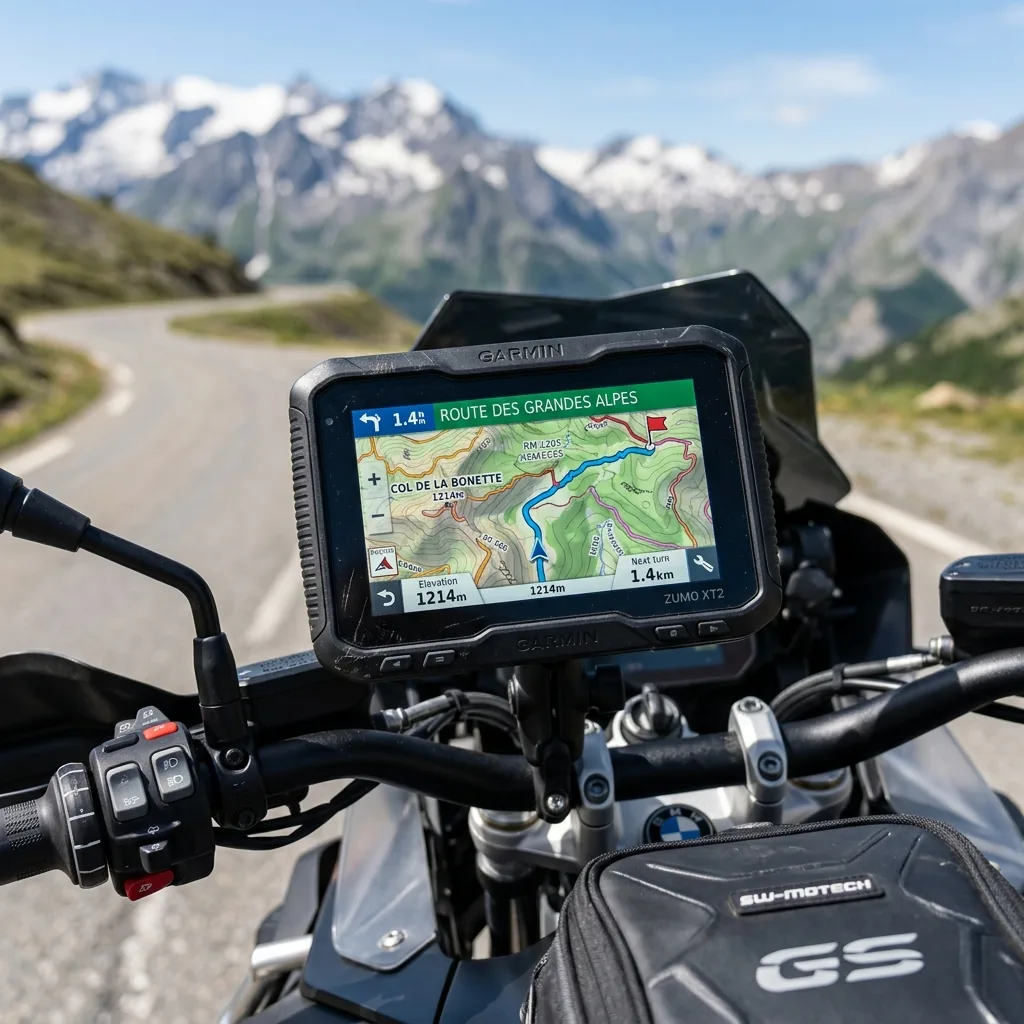
The 6-inch screen is the largest in Garmin’s motorcycle GPS line and the single biggest upgrade over the previous Zumo XT. The transflective LCD produces a usable image at the polar opposites of the lighting spectrum — direct noon sunlight and pre-dawn darkness — without manual brightness adjustment:
The touchscreen interface uses chunky icons sized for gloved input. Standard adventure motorcycle gloves with leather or textile palms register touches cleanly. Heated winter gauntlets work as long as the touchscreen-compatible thread is woven into the fingertips, which is standard on most current winter glove products.
Multi-touch gestures are supported — pinch-zoom, two-finger pan, long-press for context menus. The interface is responsive enough that input feels immediate rather than laggy. Compared to older motorcycle GPS units with resistive touchscreens, the XT2 feels like modern consumer electronics.
Navigation Features: Adventurous Routing and GPX Import
The Zumo XT2’s software differentiates from generic Garmin navigation through two motorcycle-specific features.
Adventurous Routing is a routing mode that biases route generation toward curvy, scenic, and unpaved roads rather than highway efficiency. The rider sets a destination, selects “Adventurous Routing” with sliders for curves, hills, and avoid-major-roads preferences, and the unit computes a route that maximises the selected attributes. Everyday results match the promise — routes consistently favour twisty B-roads, forestry tracks, and historic routes over fastest-time highway sequences.
Tread app integration extends navigation onto a paired smartphone. The Tread app on the phone provides route planning, group ride coordination, and POI sharing that syncs to the GPS unit wirelessly. For group rides with multiple Zumo-equipped riders, the Tread app shows the location of every rider in the group on each rider’s GPS in real-time. For solo riders, the app serves as a more touchscreen-friendly route planning surface than the GPS itself.
GPX import works through three paths: USB to a computer, microSD card insertion, or wireless transfer via the Tread app. Trans Euro Trail GPX files, Backcountry Discovery Route files, and Wikiloc track exports all import cleanly. The unit handles routes of 5,000+ waypoints without performance degradation.
Mounting and Installation
The Zumo XT2 ships with a powered mount that requires hardwiring to the motorcycle’s 12V system. Installation runs 30-60 minutes for an experienced motorcyclist with basic electrical tools. The mount connects to the battery through an inline fuse and switches with the bike’s ignition on most installations.
The mount itself uses a 1-inch ball-and-socket interface compatible with RAM Mount accessories. This means the GPS cradle can be swapped between bikes by changing only the ball-mount on the second bike. The cradle and unit transfer between machines without rewiring.
Importantly, the XT2 fits the original Zumo XT mount. Riders upgrading from XT to XT2 keep the existing wiring and ball-mount, swap only the cradle, and have the new unit running in 5 minutes. The reverse is not true — an XT does not fit in an XT2 cradle, so downgrading or swapping is not symmetric.
Garmin Zumo XT2 Spec List
The published specifications for the Zumo XT2 are listed below for reference comparison.
- Screen size: 6-inch transflective 1280x720 (sunlight readable)
- Waterproof rating: IPX7 full submersion 30 min at 1m
- Internal battery: 4 hours continuous use (powered mount typical)
- Bluetooth: yes — paired with helmet audio and phone simultaneously
- Map coverage: Europe and Middle East preloaded; Americas, Australia, NZ free download
- Weight: 397 g with mount (397 g)
The 6-inch screen is the most consequential spec — riders coming from a 5-inch unit notice the increased information density immediately. The IPX7 rating is the most consequential for adventure motorcycle use, since rain and dust are routine rather than exceptional.
Disclosure: some links below are affiliate links. If you buy through them we may earn a small commission at no extra cost to you.
Check Garmin Zumo XT2 on Amazon →
Check Alternative Listings on Amazon →
Battery and Power Management
Internal battery life of 4 hours covers most riders’ practical needs because the unit spends almost all of its operating time on the powered bike mount. The bike’s 12V system delivers continuous charge while the engine runs, and most riders keep the GPS connected during all riding hours.
The 4-hour internal battery becomes useful in three scenarios. First, planning a route at a café or hotel between riding sessions with the unit removed from the bike. Second, hiking off-bike on a multi-day trip. The XT2 is light enough to carry in a daypack for trail navigation. Third, riding two-up with a pillion where the pillion handles navigation from the back seat with the unit dismounted.
Power management is otherwise unremarkable. The unit charges from the bike’s 12V, the battery handles brief disconnects, and the unit boots in roughly 15 seconds from power-on to navigation-ready.
Is It Worth It Against a Phone?
That comparison has its own page, because it needs more room than a review section can give it: Garmin Zumo XT2 vs phone navigation runs five real riding scenarios, three-year cost of ownership, and the vibration damage warning that applies if you mount a phone instead. If you are leaning phone, a waterproof phone mount is the cheaper starting point.
Pros and Cons
- 6-inch transflective screen is readable in direct sunlight
- IPX7 rating handles real adventure-motorcycle weather without enclosure
- Glove operation works reliably with standard motorcycle gloves
- Bluetooth pairs cleanly with major helmet communicator systems
- GPX import workflow is straightforward across multiple input methods
- Adventurous Routing produces genuinely better motorcycle routes than generic GPS
- $599.99 MSRP is high in a market where phones cover most needs at lower cost
- Audio output volume struggles against highway wind noise with open-helmet riders
- Touring software ecosystem is smaller than phone-based alternatives
- Installation requires hardwiring the mount, which adds 30-60 minutes of setup
- Newer Zumo XT3 is now available — XT2 is no longer the latest hardware
Who Should Buy It
The Garmin Zumo XT2 is the right GPS for adventure motorcyclists who put 8,000+ km per year on the bike, ride frequently in rain or heat, cross international borders where data plans become expensive or unreliable, or use the unit for group ride coordination with other Zumo-equipped riders. For this profile, the Zumo replaces a workflow that phones cannot reliably support.
The Zumo XT2 is the wrong GPS for occasional riders, urban-only riders, and rider profiles where phone navigation has never failed. For these riders the $600 is better spent on better protective gear, professional rider training, or simply ridden in fuel and accommodation budget.
The decision is not whether the Zumo is a good product. It is, by every objective measure. The decision is whether the rider’s actual use profile creates the conditions where the Zumo’s strengths matter. For a meaningful subset of adventure riders, those conditions appear every week.
Disclosure: Some of the links in this article are affiliate links. If you buy gear through them, we may earn a small commission at no extra cost to you, and it never changes a recommendation. Every pick here is chosen from detailed research and the consensus of on-the-road owners — not sponsored placements.
A note on the prices: these are indicative US retail figures as of May 2026, not live quotes. Gear pricing moves constantly and varies by region and retailer — the figure on the linked product page is always the one that counts.
Frequently Asked Questions
Should I buy the Zumo XT2 now that the XT3 is out?
For most buyers, yes. The XT3 launched in February 2026 in a 4.7-inch model at $499.99 and a 6-inch at $599.99, adding an integrated lean-angle gauge and an updated processor. Core navigation, the IPX7 rating, the transflective screen and offline map handling are the same on both. What changed is the XT2's price: retailers clearing inventory have pushed it well below its $599 launch MSRP. Move up to the XT3 only if you specifically want the lean-angle data or the smaller form factor.
Does the Zumo XT2 work with my motorcycle helmet?
Yes, via Bluetooth. The XT2 pairs with the major motorcycle communicator systems — Cardo, Sena, Interphone, UClear — and feeds turn-by-turn voice prompts directly into the helmet speakers. Pairing typically takes one minute through the unit's settings menu. Once paired, the connection re-establishes automatically when both devices power on. The unit can also pair with two phones simultaneously for handling calls and music alongside navigation.
Can I import GPX routes from sites like Trans Euro Trail or Wikiloc?
Yes. The Zumo XT2 imports GPX files via USB connection to a computer, microSD card, or wirelessly through the companion Tread app on a paired smartphone. The unit handles GPX tracks (continuous recorded paths) and GPX routes (waypoint sequences) equally well, and can convert between formats. For TET, BDR, and similar published route systems, the workflow is download GPX from the source website, transfer to the unit, navigate. The Tread app also enables group ride sharing with multiple connected units.
How long does the Zumo XT2 battery last on a long ride?
Internal battery life is roughly 4 hours of continuous use with the screen at full brightness and Bluetooth active. In practice, the unit is almost always mounted on the bike's bar with the supplied powered mount, which draws constant 12V from the bike and removes battery anxiety entirely. The internal battery exists for off-bike use — planning a route at a cafe, checking trail conditions at a stop, or carrying the unit on a hike during a multi-day trip.
Garmin Zumo XT2 vs Zumo XT — what changed?
The Zumo XT2 succeeds the original Zumo XT with several meaningful upgrades. The screen is now 6 inches versus 5.5 inches on the XT, with higher resolution and improved transflective performance in direct sunlight. Wi-Fi is built in for over-the-air map updates. The Tread app integration is deeper. The mount is also slightly different — the XT2 fits the XT mount but not vice versa, so existing XT owners can upgrade the unit without changing the cradle. A newer Zumo XT3 exists for riders who want the latest hardware, but the XT2 remains a strong value at slightly reduced prices on the secondary market.