
There is a version of this question every motorcycle rider has asked themselves, usually in the parking lot of a moto shop while staring at a $600 GPS unit: why am I about to spend the price of a decent helmet on a device that does what my phone already does for free?
It’s a fair question. In 2026 your phone has a brighter screen than the Garmin Zumo XT2 on paper, runs Google Maps with real-time traffic, finds restaurants and reviews, and never needs a $50 mount adapter. The case for a dedicated motorcycle GPS feels increasingly hard to make.
Except the case is more nuanced than either side of this debate admits. Set the Garmin Zumo XT2 against a phone in a Quad Lock mount and read enough long-distance owner reports from both camps, and the honest answer is that both sides are right, for completely different riders.
This guide is the comparison nobody else has written: real specs, the 3-year cost math, the Apple camera damage problem nobody mentions, and five specific riding scenarios with a verdict for each.
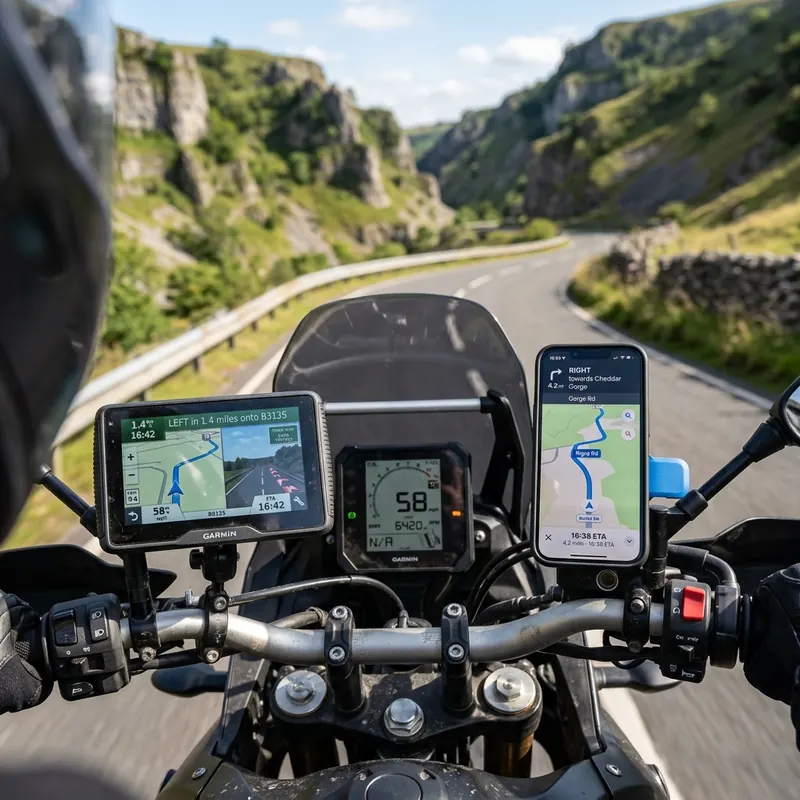
The Garmin Zumo XT2 wins for: multi-day touring, international trips, off-road riding, cold/wet weather, and anyone who has paid for international roaming and regretted it.
Your phone wins for: day rides in familiar territory, urban commuting, real-time traffic and POI search, and budget-constrained riders who do not tour.
Critical 2026 update: The Garmin Zumo XT3 launched February 2026, dropping XT2 prices to ~$400-450 at most retailers. This makes the XT2 the value pick — same hardware, same offline maps, $150-200 less than the XT3.
Disclosure: some links below are affiliate links. If you buy through them we may earn a small commission at no extra cost to you.
Check Garmin Zumo XT2 Price on Amazon →
The Question Every Rider Asks
The argument against a dedicated GPS goes like this: my phone has a sharper screen, smarter routing, better traffic, costs nothing extra, and lives in my pocket anyway. The Garmin Zumo XT2 is a $600 redundant gadget.
That argument holds together perfectly for one specific rider. The urban commuter doing 30 km Sunday rides on familiar roads with cell coverage. For that rider it is true. For anyone else it falls apart on specific specs that smartphone marketing does not highlight: operating temperature, screen technology, vibration tolerance, and offline map storage.
This is not a faith-based argument. Every advantage and disadvantage below is testable and documented. Let’s go through them.
Head-to-Head Specs: What the Data Actually Shows
Screen Readability in Sunlight
The XT2 has a 6-inch transflective LCD rated at 1,050 nits peak brightness. The iPhone 15 has a 6.1-inch OLED rated at 2,000 nits HDR peak. The Samsung Galaxy S24 hits 2,600 nits peak. By the spec sheet, the phones win.
By long-term performance in direct afternoon sun on a black handlebar, the XT2 wins decisively.
The reason is the word “transflective.” A transflective LCD does what its name suggests. It both transmits backlight and reflects ambient light. In bright sun, the sunlight itself illuminates the screen from the front. The XT2 at 1,050 nits often outperforms a 2,600-nit phone because the phone wastes battery fighting the sun while the GPS uses the sun. OLED and AMOLED screens, despite massive peak numbers, wash out in direct overhead light no matter how bright you crank them.
This matters most at noon in summer on a south-facing road. The phone screen becomes a mirror. The GPS stays legible.
Operating Temperature — The Spec Nobody Talks About
| Spec | Garmin Zumo XT2 | Typical Smartphone |
|---|---|---|
| Operating range | -15°C to 55°C | 0°C to 35°C |
| Cold weather behavior | Functions normally | Battery degrades, may shut down |
| Hot weather behavior | Rated for 55°C ambient | Thermal throttles above 35°C |
On a 30°C summer day, the surface temperature of a phone in full sun on a dark handlebar can reach 45-55°C. iPhones shut down at 35°C ambient and will throttle nav apps long before that. The XT2 is engineered to operate at exactly the surface temperatures that kill phones. Cold weather is a similar story — Scottish November rides happen well below the operating range of any iPhone.
This is the single most under-discussed spec in the GPS-vs-phone debate. Phone reviews never mention thermal limits because nobody using a phone normally hits them. Mounted on a handlebar in the sun, you hit them by lunchtime.
Waterproofing: Both Are Rated, But Context Matters
The XT2 is IPX7 — designed for sustained rain, spray, and pressure washing. The iPhone 15 and Galaxy S24 are IP68, technically deeper-rated for accidental submersion. On the spec sheet the phones look better.
In practice the Garmin is built for the use case. IPX7 on a GPS means the manufacturer expects you to ride through a thunderstorm and warranties the device for it. IP68 on a phone means Apple will not honor a warranty claim if you ride through that same thunderstorm and the phone fails — water damage is explicitly excluded from iPhone warranty coverage. The rating is for marketing, not protection.
There is also condensation. A phone in a “waterproof” case develops screen fog from temperature changes. The XT2’s sealed design rarely does. Screen fog is one of the most consistent complaints in phone-mount threads, and one that almost never comes up about the Garmin.
Glove Operability
Phones use capacitive touch tuned for fingertips. Add a winter glove and the screen ignores you. Samsung has a “glove mode” toggle that helps but is unreliable mid-ride. iPhones have no glove mode at all.
The Garmin XT2 uses a touchscreen calibrated for gloved operation. Large UI targets. Big buttons. A simplified menu designed for someone wearing thick winter gear who needs to change a route at 90 km/h in a side wind without taking their hands off the bars.
This is the difference between adjusting your route on the move and having to pull over, remove a glove, and operate a tiny iOS keyboard. After three days of touring, that difference becomes the entire reason you bought the GPS.
The Cost Breakdown: Is the Zumo XT2 Worth $600?
3-Year Total Cost of Ownership
| Cost | Garmin Zumo XT2 | Phone Navigation |
|---|---|---|
| Device | $400-450 (post-XT3 discount) | $0 (already own) |
| Mount | $50-120 (locking RAM/Touratech) | $40-80 (Quad Lock) |
| Vibration dampener | Built-in | $30-40 (required for iPhone) |
| Maps | Free, global | Free (Google) or $20-40/yr (OsmAnd+, Kurviger) |
| Europe roaming, 10-day trip | $0 | $50-150 per trip |
| Camera repair risk | None | $200-400 (OIS repair if not dampened) |
| 3-year total | ~$550-700 | ~$120-700 |
For a rider who never tours internationally and uses a phone vibration dampener, phone navigation can cost as little as $120 over three years. For a rider who does two Europe trips, gets caught once on roaming charges, and skips the dampener until the camera dies, phone navigation can easily exceed the GPS cost.
The math is closer than the $600 sticker price suggests.
The Apple Camera Damage Warning Nobody Mentions
Apple’s own support documentation specifically warns that mounting an iPhone on high-amplitude vibration sources — particularly motorcycle engines — can permanently damage the optical image stabilization (OIS) and closed-loop autofocus systems. The damage manifests as blurry photos, autofocus hunt, and camera errors. Repair cost is typically $200-400 and is not covered by warranty.
The fix is a vibration dampener like the Quad Lock Vibration Dampener — a $30 spring-loaded mount adapter that absorbs handlebar vibration before it reaches the phone. If you mount a phone on a motorcycle without one, you are gambling.
The Garmin Zumo XT2 has no camera to damage. Vibration is a non-issue.
When the Garmin Zumo XT2 Wins
Multi-Day Touring and International Trips
A 10-day Europe trip across three countries used to mean a dedicated international SIM, pre-downloaded Google Maps regions for each country, or eye-watering roaming charges. The Zumo XT2 ships with preloaded European maps and lets you add the rest of the continent free over Wi-Fi before you leave home. Zero data costs en route. Zero hunting for SIM kiosks in foreign airports. Zero “no signal” panic in an Alpine pass.
This is the use case the XT2 was built for. The single Europe trip pays back the device in saved roaming alone.
Remote and Off-Road Riding
The Trans Euro Trail runs through sections of the Balkans, Eastern Europe, and North Africa with zero cell coverage for hours at a time. The TET publishes official GPX files. The XT2 loads them natively, follows them turn-by-turn, and runs the entire route offline. OsmAnd on a phone can do this too, but a phone in 35°C Moroccan sun on a black handlebar may not last through the day.
For an honest comparison of TET-specific navigation, see our Trans Euro Trail beginners guide and the Turkey TET route guide.
Extreme Weather
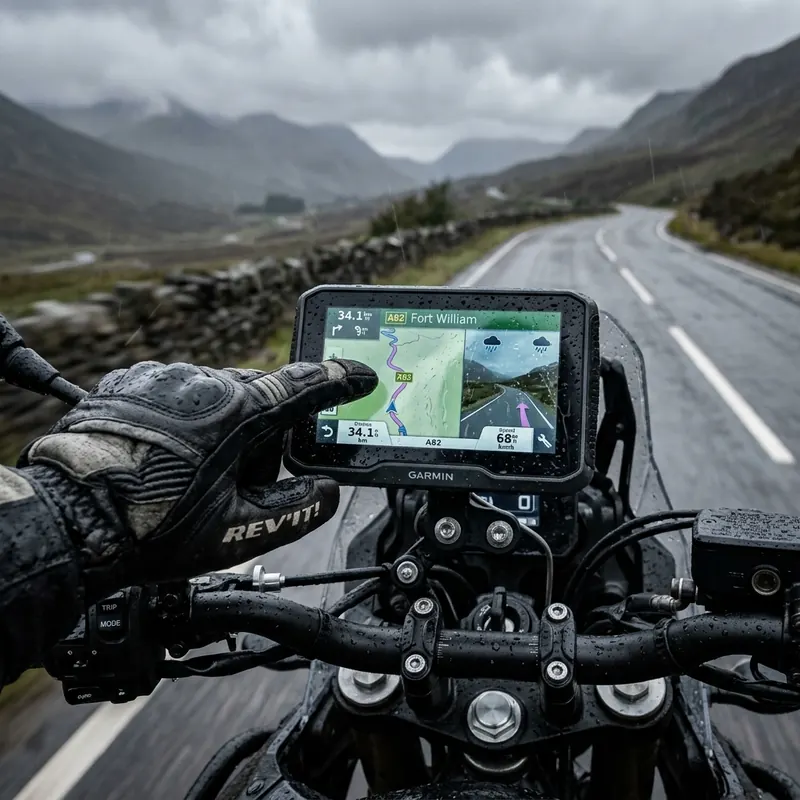
At 2°C in a Scottish November downpour, wearing winter gloves, with breath fogging your visor, the phone is unusable. Battery degrades. Screen does not register glove touches. Condensation fogs the case. The XT2 is rated to -15°C, calibrated for gloved input, sealed against condensation, and wired to the bike so battery is never a concern. There is no contest in this scenario.
Group Ride Tracking Without Cell Coverage
The XT2 supports Group Ride Radio — a feature that lets paired Garmin units share rider positions without cell signal, using a built-in radio. Phone-based group tracking apps (Polarsteps, Sygic) all require cell coverage. For ADV groups riding remote terrain, this is a feature phones structurally cannot replicate.
When Your Phone Is Good Enough
Day Rides in Familiar Territory
You leave the house at 9 AM for a Sunday morning ride to a coffee spot 60 km away. You know the roads roughly. You have cell signal the whole way. Google Maps in a Quad Lock with a vibration dampener does everything you need. Spending $600 to navigate to a familiar route is overkill.
Urban Commuting
Daily city navigation rewards live traffic updates and POI search. Google Maps reroutes around accidents in seconds. The Garmin reroutes more slowly with less granular data. For pure urban use, the phone wins.
Real-Time Traffic and POI Lookup
Need to find an open fuel station, a restaurant with decent reviews, or a hotel with availability tonight? The phone is unmatched. The XT2 has POI data but it is not curated, not reviewed, and not updated in real time. For the social and discovery side of riding, the phone is the better tool.
This is also why most experienced tourers carry both. The GPS handles navigation. The phone handles everything around navigation; booking, finding, photographing, sharing.
5 Real Riding Scenarios — GPS vs Phone
Scenario 1: Multi-Day Europe Tour (10 Days, 3 Countries)
Winner: Garmin Zumo XT2
Crossing Germany to Austria to Slovenia. Cell coverage is patchy in the Alps. Roaming on a non-EU SIM costs $5-15/day. Day 4 finds you on a wet gravel pass at 5°C — phone screen barely visible, charging cable disconnecting from vibration. The GPS maps are pre-loaded for all three countries. Screen legible in rain. Wired to bike. The phone is still useful — for booking that night’s pension, finding the closest fuel, photographing the pass. But it is not navigating. The Garmin does the work; the phone handles everything around it.
Scenario 2: Single-Day Local Ride
Winner: Phone
Sunday morning blast on familiar roads. Maybe exploring a new county road 50 km away. Phone in a Quad Lock with Google Maps does this perfectly. There is signal. You know roughly where you are. You stop for coffee and look up reviews for lunch. The XT2 adds zero value here.
Caveat: If you ride a high-vibration single (KTM 690, older Brit twins), the Apple camera damage warning applies — a vibration dampener is non-negotiable, not optional.
Scenario 3: Remote Offroad — TET Style
Winner: Garmin Zumo XT2 (with caveats)
The TET through remote Balkans or Morocco — no cell coverage for hours. GPX files load natively on the XT2. Screen readable in dust. Device does not overheat at 35°C ambient. Touch works with dirty gloves.
The honest caveat: OsmAnd on Android is excellent for TET navigation and many experienced riders use it as their primary device — we compare it against DMD2, Kurviger and the rest in our offline navigation apps roundup. The dedicated GPS advantage here is less about navigation capability and more about durability, thermal tolerance, and being wired to the bike. On a budget, OsmAnd + a vibration-dampened phone mount is viable. With money for the GPS, it is more relaxing.
Scenario 4: International Border Crossing
Winner: Garmin Zumo XT2
Morocco to Algeria. Serbia to Kosovo. You want to arrive at the border knowing your planned route, with offline maps for the next country already loaded, without burning roaming data at customs. The XT2 has free downloadable maps for every major continent. You do not need a new SIM at each border or pre-configured Google Maps offline regions per country. This is exactly the use case the device is built for.
Scenario 5: Rain + Cold Weather Riding
Winner: Garmin Zumo XT2, decisively
Scottish Highlands. Norwegian fjord roads. Anywhere the temperature drops below 5°C with sustained rain. Winter gloves do not work on phone screens. Phone batteries lose capacity in cold. Phone cases fog with condensation. The XT2 is rated to -15°C, calibrated for thick gloves, sealed against condensation, and wired to the bike. The dedicated GPS is not slightly better here. It is the only thing that works at all.
Verdict Table
| Category | Zumo XT2 | Phone | Winner |
|---|---|---|---|
| Screen in direct sun | Transflective 1,050 nits | 1,400-2,600 nits OLED | XT2 |
| Cold weather (below 0°C) | Rated to -15°C | Throttles below freezing | XT2 |
| Rain resistance | IPX7 (engineered for rain) | IP68 (warranty excluded) | XT2 |
| Glove operability | Designed for it | Unreliable | XT2 |
| Offline maps | Built-in, free global | Pre-download or OsmAnd | XT2 |
| International touring | No roaming costs | Roaming or pre-config | XT2 |
| Real-time traffic | Limited | Google Maps excellent | Phone |
| POI search and reviews | Limited | Google Maps unmatched | Phone |
| Route planning UI | Basic | Phone apps better | Phone |
| Cost (urban only) | $550-700 | $120-200 | Phone |
| Cost (touring) | $550-700 | $300-700+ | Comparable |
| Vibration risk | None | Apple warning applies | XT2 |
| ADV/touring overall | — | — | XT2 |
| Urban/casual overall | — | — | Phone |
Should You Buy the XT2 in 2026, or Wait for the XT3?
The Garmin Zumo XT3 launched February 2026 with three changes from the XT2: a new 4.7-inch model option ($499.99), an integrated lean-angle gauge, and an updated processor. The 6-inch XT3 stays at $599.99. The same MSRP as the XT2 at launch.
What did not change: IPX7 rating, transflective screen technology, offline map storage, Group Ride Radio, glove operability, operating temperature range. The core navigation experience is identical.
The buying calculus in 2026 is straightforward. The XT2 is now the value pick. Retailers are discounting XT2 inventory by $150-200 to clear shelves. You get the same offline maps, same screen, same waterproofing, same touring capability, for $400-450 instead of $600. Unless you specifically want the lean-angle data or the smaller 4.7-inch form factor, the XT2 at discount is the smart purchase.
For long-term durability, everyday battery performance, and what fails after a season, see our full Garmin Zumo XT2 hands-on review.
The Bottom Line
The Garmin Zumo XT2 versus phone navigation is not a debate about which is technically better. It is a debate about what kind of riding you actually do.
If you commute and weekend ride locally, your phone with a Quad Lock and a vibration dampener does everything you need. Save the $400.
If you tour, ride remote, cross borders, or ride in cold/wet weather, the dedicated GPS pays for itself on the first multi-day trip. The Zumo XT2 at post-XT3 discount pricing is the rational buy.
The right answer for most readers of this site — adventure motorcycle camping, multi-day routes, international trips — is the Garmin. The right answer for the urban commuter who occasionally rides to a beach is the phone. Pick based on which rider you actually are, not which one you imagine you might become.
And if you tour and commute equally, the honest answer is what most experienced riders end up doing: carry both. Garmin on the bars for navigation. Phone in the tank bag for everything else. The two tools do different jobs, and the rider who pretends one replaces the other is the rider who gets caught at a border with no map.
Check Garmin Zumo XT2 Price on Amazon →
Check Quad Lock Mount + Vibration Dampener on Amazon →
Disclosure: Some of the links in this article are affiliate links. If you buy gear through them, we may earn a small commission at no extra cost to you. It never changes a recommendation — every pick here is chosen from detailed research and the consensus of on-the-road owners, not sponsored placements.
A note on the prices: these are indicative US retail figures as of May 2026, not live quotes. Gear pricing moves constantly and varies by region and retailer — the figure on the linked product page is always the one that counts.
Frequently Asked Questions
Does the Garmin Zumo XT2 work without a phone or internet connection?
Yes — fully. The XT2 ships with preloaded street and topo maps for your region, and you can download free global maps (North America, Europe, Australia, Africa via Tracks4Africa) over Wi-Fi before you leave. Once loaded, navigation runs entirely offline. The phone-pairing features — smart notifications, Group Ride Radio, weather overlay, Tread app integration — work better with a connected phone, but the core turn-by-turn and GPX following work standalone in any remote region with zero cell coverage.
Will using my iPhone for motorcycle navigation damage the camera?
Potentially yes. Apple has officially warned that high-amplitude vibrations from motorcycle engines — especially single-cylinder and larger V-twin engines — can permanently damage iPhone optical image stabilization and closed-loop autofocus systems. The fix is a vibration dampener between the phone and the bike, typically the Quad Lock Vibration Dampener at $30-40. Mounting an iPhone directly on rigid bar mounts on a high-vibration bike risks $200-400 in OIS repairs not covered by warranty. A Garmin Zumo XT2 has no camera and is designed for exactly this vibration environment.
Is the Garmin Zumo XT2 worth it if I already have Google Maps?
For local day rides on roads with cell coverage, no — Google Maps on a phone in a Quad Lock mount is genuinely adequate and free. For multi-day touring, international trips, off-road riding, or any scenario without reliable cell service, yes. The XT2 wins on offline maps with no roaming costs, transflective sunlight readability, -15°C cold tolerance, glove-friendly touch, and being wired to the bike so battery is never a concern. The honest decision rule: if you ride mostly local commutes and weekend blasts, save the $600. If you tour, ride remote, or cross borders, the XT2 pays for itself in saved roaming costs alone on a single Europe trip.
What navigation app works best for motorcycle riding in Europe without data?
OsmAnd is the standout free phone option — fully offline, OpenStreetMap-based, excellent GPX support for routes like the Trans Euro Trail, with 7 free region downloads (unlimited via the Maps+ upgrade). Google Maps offline mode works but its downloaded areas expire and need periodic re-updating, and it doesn't handle GPX files natively. Kurviger is the best motorcycle-specific routing app for Europe — its Tourer+ tier adds voice navigation and offline maps. For pure offline reliability across multiple countries with no setup hassle, a dedicated Garmin Zumo XT2 with preloaded Europe maps still beats every phone-based option — no app crashes, no cached-region expiry, no battery anxiety.
Should I buy the Garmin Zumo XT2 or wait for the Zumo XT3?
The XT3 launched in February 2026 with a new 4.7-inch model option ($499.99), an integrated lean-angle gauge, and updated processor. The 6-inch XT3 stays at $599.99 — the same MSRP as the XT2 at launch. For most buyers in 2026 the XT2 is now the smart purchase because retailers are clearing inventory at meaningful discounts (often $400-450 vs $599 XT3). Core navigation, IPX7 rating, transflective screen, and offline maps are identical between the two. Skip to the XT3 only if you specifically want the lean-angle data or the smaller 4.7-inch form factor.