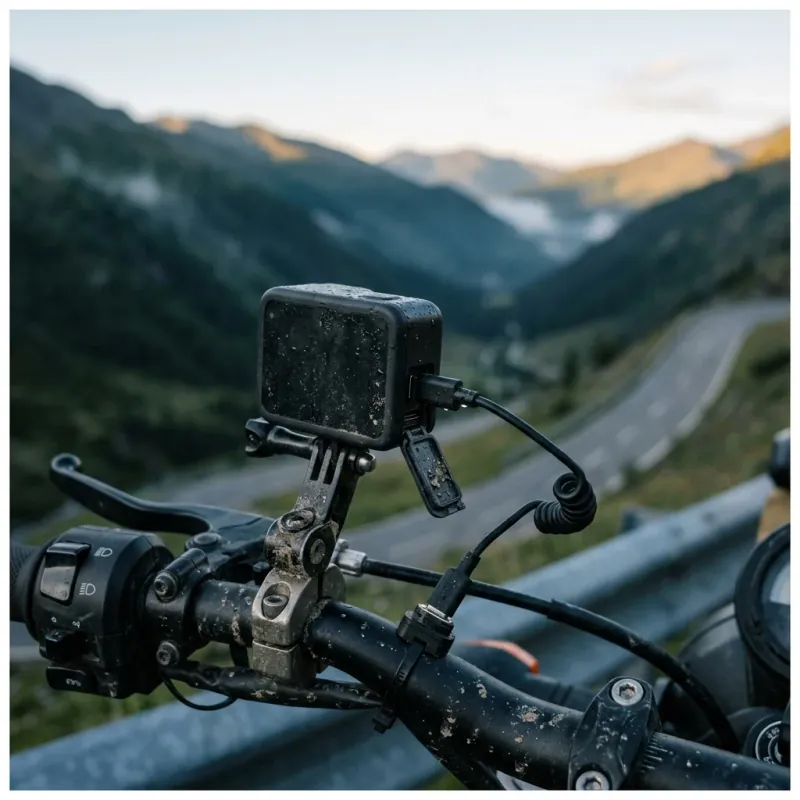
Most rider footage fails for three reasons, and resolution is not one of them. The road judders through the stabilization, the battery quits somewhere on the second pass, or the audio is nothing but wind. A camera that handles those three will make a better ride video in 4K than a spec-sheet champion that doesn’t.
This guide ranks the cameras that matter in late 2026 on what a motorcycle does to a camera: vibration, long days, wind, tunnels and weight on a helmet. It is built from manufacturer spec sheets, independent reviews that include motorcycle footage, and the regulations; we have not mounted these cameras on our own bikes, and nothing below pretends otherwise. If your cockpit already carries a Garmin Zumo XT2 and an intercom, the camera overlaps with both more than most guides admit.
Disclosure: some links below are affiliate links. If you buy through them we may earn a small commission at no extra cost to you.
DJI Osmo Action 6 (Standard Combo)
The big-sensor, long-runtime all-rounder. Check who is selling it before you buy in the US.
Check DJI Osmo Action 6 on Amazon →What Changed Since the First Version of This Guide
This page first ran in June 2026 and was rewritten in September, because the market moved underneath it:
- DJI replaced the Action 5 Pro with the Osmo Action 6 (November 2025). The 5 Pro stays on sale as the value pick.
- GoPro skipped a HERO14 and launched the MISSION 1 series (on shelves from May 28, 2026); the HERO13 Black carries on.
- Insta360 launched the X6 on August 12, 2026, with the X5 still on sale.
A correction, too: the earlier version said the HERO13 Black’s battery can’t be swapped. It can; it uses a removable 1,900 mAh Enduro battery.
How These Are Ranked for Riding
General reviews reward the wrong things for a motorcycle. On a bike the order is:
- Stabilization under vibration. Engine and road buzz is finer and faster than the bumps a hiker makes, and it is where stabilization slips.
- Runtime and swappability. Whether the battery comes out, how long it lasts in the mode you use, and whether bike power drowns the camera.
- Wind audio. Built-in mics lose to the wind on almost every model, so what counts is how easily an external or Bluetooth mic connects.
- Weight on a helmet. Every gram on a chin mount is leverage on your neck. The spread here is 146 g to about 209 g.
- Low light. Tunnels, forest and dusk are where small sensors fall apart.
- Who sells it. A third-party reseller’s warranty can differ from the manufacturer’s.
Resolution comes last. Every camera here shoots at least 5.3K, more than a ride video needs.
The 2026 Motorcycle Action Camera Comparison
7 Cameras for Riders, Side by Side
| Camera | Sensor | Weight | Rated runtime (mode varies)* | Built-in storage | List price | Best for |
|---|---|---|---|---|---|---|
| BEST OVERALLDJI Osmo Action 6 | 1/1.1″ | 149 g | 240 min (1080p24) | 50 GB | No US list | All-rounder |
| GoPro HERO13 Black | 1/1.9″ | 154 g | 90+ min (4K30) | None | $399 (launch) | GPS, intercom audio |
| BEST VALUEDJI Osmo Action 5 Pro | 1/1.3″ | 146 g | 240 min (1080p24) | 47 GB | $319 (DJI store) | Budget |
| GoPro MISSION 1 Pro | 1″ | ~209 g | 3+ h (4K30) | None | $699.99 | Image quality |
| Insta360 X6 | 2× 1/1.1″ | 196 g | 140 min (8K30) | 47 GB | $699.99 | 360 reframing |
| Insta360 X5 | 2× 1/1.28″ | 200 g | 93 min (8K30) | None | $549.99 (launch) | Cheaper 360 |
| Insta360 Ace Pro 2 | 1/1.3″ | 182 g | 180 min (1080p24) | None | $399.99 | Headset pairing |
*Manufacturer ratings, each measured in a different mode, so they are not directly comparable. DJI’s figure assumes 1080p24 with Wi-Fi off; Insta360’s Ace Pro 2 figure assumes 1080p24 in Endurance Mode at 25°C; GoPro’s HERO13 figure assumes 6 m/s of airflow. The Mission 1 Pro weight is Engadget’s measurement (0.46 lb), not a GoPro spec. Prices are manufacturer list, launch or DJI-store prices as labelled, never Amazon prices; DJI has no US list price for the Action 6.
1. DJI Osmo Action 6: Best Overall for Motorcycles
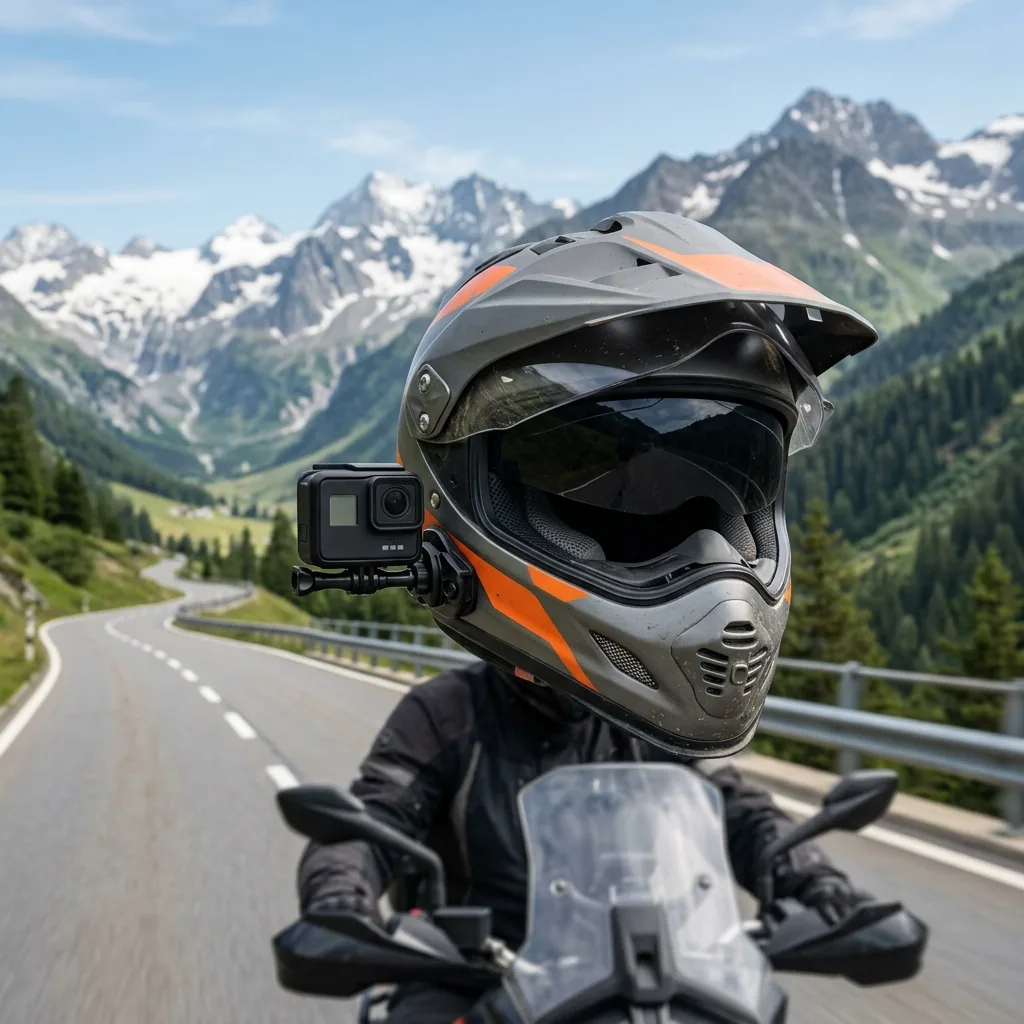
The Action 6 fixes the weakness riders notice most: murky footage the moment the light drops. DJI moved to a 1/1.1-inch square sensor, a big jump from the 5 Pro’s 1/1.3-inch chip, and added a variable aperture from f/2.0 to f/4.0, rare in a camera this size. That sensor earns its keep in tunnels, on forest roads and in the last hour of the day, where smaller sensors smear detail and go noisy.
The rest reads like it was written for touring. The 1,950 mAh battery swaps out and DJI rates it at 240 minutes at 1080p24 with Wi-Fi off; 4K gets less, but among the single-lens cameras only the heavier Mission 1 Pro is rated longer. There is 50 GB of usable built-in storage, so a forgotten or failed microSD card doesn’t end the day. It is waterproof to 20 m without a case, rated from -20°C to 45°C, and weighs 149 g.
Audio is DJI’s quiet advantage. The Action 6 pairs directly with DJI Mic transmitters (Mic 3, Mic 2, Mic Mini), two at a time, with no receiver. Clip one inside your collar and the wind problem mostly goes away. DJI’s magnetic quick-release makes moving between a chin mount and a bar mount a one-second job.
The catch is where you buy it. DJI does not sell the Action 6 on its own US store. On September 18, 2026 the Amazon listing was sold by a third party, DJI Gear Center, not by DJI or Amazon. It is legal to sell in the US, but check the seller’s warranty terms. In Europe and the UK, DJI sells it directly.
Check DJI Osmo Action 6 on Amazon →
- 1/1.1″ sensor for tunnels and dusk
- Swappable battery, 240 min rating
- 50 GB usable built-in storage
- DJI Mic pairs with no receiver
- Not on DJI's US store
- US Amazon seller is third-party
- No built-in GPS
2. GoPro HERO13 Black: The Rider’s GoPro
The HERO13 has the smallest sensor here, 1/1.9-inch, and in dim light it shows. It still takes second place because it does three things for riders the DJI doesn’t.
First, GPS is built in, logging at 10 Hz, and GoPro’s Quik app turns it into speed, altitude and route overlays. Handle those with care: a speed overlay on a public video is evidence of how fast you were going, whoever watches it.
Second, it records your intercom. GoPro’s support page lists the Cardo PackTalk Black as a supported Bluetooth headset, recorded on its own track that Quik lets you pick in the edit. The limits, per GoPro: one headset, about 10 m of tested range, no gain control.
Third, the mount ecosystem is the deepest there is, and the HERO13 takes both folding fingers and GoPro’s magnetic latch mount. The HB-series lens mods add an ultra-wide option.
The 1,900 mAh Enduro battery is removable. GoPro quotes more than 1.5 hours at 4K30, Tom’s Guide measured 90 minutes at 4K60 and Engadget 102 minutes at 4K30. GoPro’s figure assumes 6 m/s of airflow, which a moving bike beats easily, so heat is a standstill problem. For all-day recording, the Contacto magnetic door (HERO9 to HERO13) keeps the camera weatherproof with a USB-C cable attached; the camera runs on USB power, but won’t charge its battery while recording.
A Looping mode (5, 20 or 60-minute loops) matters more than it sounds once you read the European rules below. The HERO13 launched at $399 in September 2024 and weighs 154 g with its battery.
Check GoPro HERO13 Black on Amazon →
- Built-in GPS, 10 Hz overlays
- Records a Cardo PackTalk Black
- Biggest mount ecosystem
- Looping mode, Contacto power door
- Smallest sensor here, weakest in tunnels
- Shorter runtime than the DJIs
- No built-in storage
3. DJI Osmo Action 5 Pro: Best Value
The Action 6 made the 5 Pro cheaper without making it much worse for most riding. It keeps a 1/1.3-inch sensor, the same 1,950 mAh swappable battery and 240-minute rating (1080p24, screens and Wi-Fi off), 47 GB of usable storage, direct DJI Mic 2 pairing, front and rear screens, 20 m waterproofing and a -20°C floor. At 146 g it is the lightest camera here.
You give up the Action 6’s bigger sensor and variable aperture, which shows in low light. You gain simplicity: it launched officially in the US at $349 in September 2024, DJI’s own store listed the Standard Combo at $319 in September 2026, and on September 18, 2026 the Essential Combo we link to was shipped and sold by Amazon.com itself. For daylight riding and an easy purchase, this is the one.
Check DJI Osmo Action 5 Pro on Amazon →
- Lightest here at 146 g
- Same battery and 240 min rating
- Sold by Amazon.com in the US
- Smaller sensor than Action 6
- No variable aperture, no GPS
4. GoPro MISSION 1 Pro: Best Image, Wrong Place for a Helmet
GoPro calls the MISSION 1 series compact cinema cameras, and the Pro backs that up: a 1-inch, 50 MP sensor, 8K60 and a 2,150 mAh Enduro 2 battery rated at over three hours of 4K30. Engadget confirmed three-plus hours at 4K30, nearly double the HERO13, and rode 70 minutes at 8K60 without a thermal shutdown. It is waterproof to 20 m, and it keeps GoPro’s magnetic mount while bringing back pull-down fingers.
Tom’s Guide’s review included motorcycle footage. The good news: the reviewer rated its four-mic array and wind reduction the best of any action camera. The catch: HyperSmooth occasionally showed high-frequency judder where yellow painted lines crossed the road, exactly the fine, fast vibration a bike produces. The reviewer called it rare; check your own footage before a big trip. The oversized buttons also suit thick gloves.
It is fourth rather than first because of weight. Engadget weighed it at 0.46 lb against the HERO13’s 0.35 lb, about 30% heavier and front-heavy, and Tom’s Guide said plainly it is not the best option for a chin or helmet mount. On a chest or bar mount that doesn’t matter. It has no built-in storage, and at $699.99 (the standard MISSION 1 is $599.99) it is the dearest single-lens camera here.
Check GoPro Mission 1 PRO on Amazon →
- 1″ 50 MP sensor, best image here
- 3+ h at 4K30, removable battery
- Best wind handling of the GoPros
- ~209 g, heavy for a helmet
- Rare judder over road markings
- No built-in storage, $699.99
5. Insta360 X6 (and the X5): Best 360 Camera for Riders
A 360 camera records everything around the bike so you choose the angle afterwards: a chase view, a turn to your face, a look back at the rider behind. The selfie stick disappears from the stitched image, which is where the “flying camera” shots in motovlogs come from, and on the bike it records every direction at once.
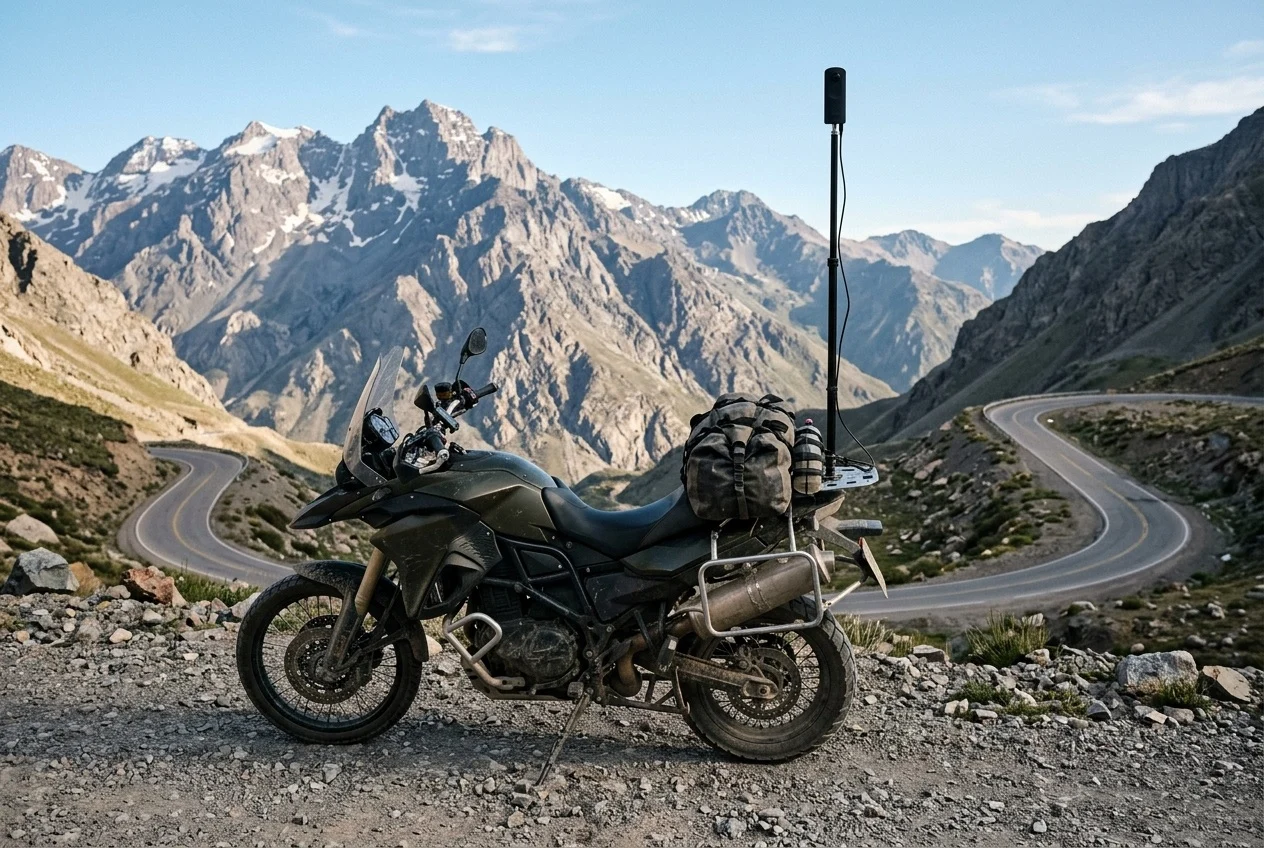
The X6, launched August 12, 2026 at $699.99, uses two 1/1.1-inch square sensors, a 2,600 mAh battery rated at 140 minutes of 8K30, 47 GB of built-in storage, 20 m waterproofing and a -20°C to 40°C range, at 196 g. The lenses are user-replaceable, which matters when a stone flicked up by the car ahead hits a bulbous 360 lens. Engadget recommended it with two caveats: occasional stitch lines where the lenses overlap, and the price next to a GoPro Max 2 at about $300 and a DJI Osmo 360 at about $400.
The X5, launched at $549.99, is still worth a look: dual 1/1.28-inch sensors, a 2,400 mAh battery, replaceable lenses, no built-in storage, and 93 minutes of 8K30 by Insta360’s own comparison. Ultimate Motorcycling’s review is the best rider account of either camera. The wind guard filtered much of the noise at 70 mph, a palm gesture let a gloved rider start recording, and voice control worked through Sena and Cardo headsets. Two snags: the invisible selfie stick doesn’t hide a power cable running up it, and the USB-C cover came off during spirited riding on bike power.
A 360 is the most work in the edit and the least sharp when reframed. The 7,680 pixels of an 8K 360 frame wrap all the way around you, so a normal flat view cropped out of it keeps roughly a quarter of them, which is closer to 2K than to 8K. Buy one because you want the angles, not the resolution.
- Choose every angle after the ride
- X6: 140 min 8K30, 47 GB built in
- Replaceable lenses on both
- Heaviest edit, largest files
- Reframed 360 is softer than flat
- X6 is $699.99
6. Insta360 Ace Pro 2: Best for Headsets and Low Light on a Budget
The Ace Pro 2 is still Insta360’s flagship single-lens camera (an Ace Pro 3 was only a rumour at the time of writing). Its 1/1.3-inch sensor and Leica co-engineered 157° lens are strong in low light for the money, and the 2.5-inch flip screen makes framing on the bars easy.
For riders the standout is audio. It ships with a snap-on wind guard, and Insta360 publishes the broadest official motorcycle headset list here: the Sena 5R and Spider ST1, and the Cardo Edge, Spirit and Freecom 2X, recorded on a second track. A Road Mode with pre-recording keeps the moments before you press the button.
The trade-offs: no built-in storage, a 1,800 mAh battery rated at 180 minutes only in 1080p24 Endurance Mode, and 182 g, heavier than both DJIs. It is waterproof to 12 m, rated from -20°C to 45°C, and lists at $399.99.
Check Insta360 Ace Pro 2 on Amazon →
- Widest official headset list
- Snap-on wind guard included
- Flip screen, Road Mode pre-record
- No built-in storage
- 182 g, heavier than the DJIs
The Helmet Question Most Camera Guides Skip
A chin mount gives the best point of view, and it is also a modification to a safety device. That is less settled than camera brands or forum consensus suggest.
ECE helmet regulations have said since 22.03 in 1988 that nothing should be fitted to a helmet unless it is designed not to cause injury and the helmet still meets the standard with it attached. ECE 22.06 made that concrete by creating two accessory approvals. SA (Specific Accessory) means a device tested on that specific helmet, such as a helmet maker’s own integrated intercom. UA (Universal Accessory) means a UA-approved helmet tested to accept UA-approved devices within set size and weight limits. Fitting anything that is neither, and a clamp-on or stick-on camera mount is neither, sits outside the helmet’s approval.
Bennetts BikeSocial looked into this in February 2026 and found the first UA helmet (Schuberth’s Concept) and a couple of UA intercoms, but no UA action camera; DJI and Insta360 had no plans to share. A UK motorcycle solicitor it spoke to had never seen a rider prosecuted over a helmet accessory, but could see one raised in an injury claim, where an insurer arguing even a few percent of contributory negligence could cut a serious-injury payout substantially.
What that means in practice:
- A bar, frame or chest mount avoids the question, at the cost of more vibration on the bars or a lower view from the chest.
- If you helmet-mount, clamp rather than stick. A chin-bar clamp leaves no adhesive on the shell and keeps the camera off the dome.
- Keep it light. On a helmet, the 146-154 g DJIs and HERO13 make more sense than the MISSION 1 Pro or a 360 on a stick.
- Read your helmet’s manual. It is the document an insurer would read too.
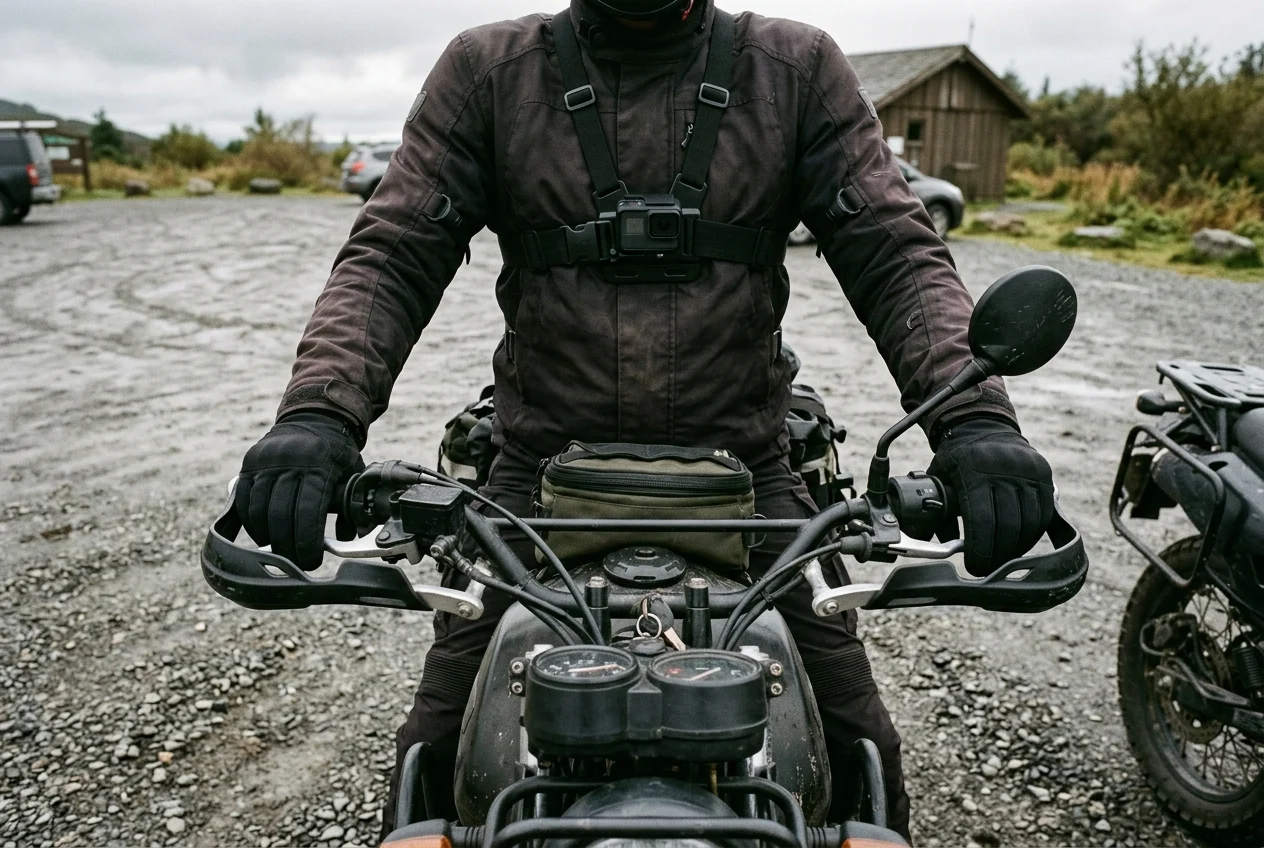
If you go the chest route, most harnesses use the GoPro-style two-prong mount: the GoPros fit directly and the others through an adapter. The view sits lower and takes in the bars and dash, and it is where a heavy camera like the MISSION 1 Pro belongs.
Check Action Camera Chest Mounts on Amazon →
Filming in Europe: Where a Running Camera Is a Legal Question
Riding with a camera is legal almost everywhere. Recording continuously, and publishing what you recorded, is where European data-protection rules come in, and they vary by country:
| Country | Recording while riding | Publishing footage |
|---|---|---|
| Germany | Short, event-based (loop) | Blur faces and plates |
| Austria | Accident-only, loop, low-res | Not authorised |
| Portugal | Strictest reading (Law 58/2019) | Avoid |
| France | Private use | Blur faces and plates |
| Spain | Allowed if not distracting | Anonymise first |
| Italy | Private use, loop preferred | Restrictions apply |
Austria catches riders out. Its data protection authority treats most dashcam setups as unlawful surveillance and allows recording only to document an accident, with automatic overwriting and the view limited as far as possible; the ÖAMTC adds that even a lawful recording doesn’t entitle you to publish it. Portugal’s law is read strictly enough that 2025 press coverage warned tourists a visible camera could draw police attention. Germany, per a 2025 motorcycles.news summary, accepts short, event-related loop recordings but not continuous filming.
This is where loop modes earn their place. The HERO13’s Looping mode, Insta360’s loop and dashcam recording and the Ace Pro 2’s Road Mode keep only a rolling window, far closer to what these regulators describe than a camera recording all day. None of this is legal advice; check the country you are riding into, not the one you left.
Wind Noise, and Recording Your Intercom
Built-in microphones lose to the wind at road speed on almost every action camera, and software cleanup gives up at motorway pace. The fixes that work all move the microphone:
- Wireless mic inside the collar. The DJI Action 6 and 5 Pro take DJI Mic transmitters directly. The cleanest voice track here.
- Your intercom as the microphone. The HERO13 and Ace Pro 2 record a paired headset (models listed above). Expect telephone quality: fine for commentary, poor for anything else.
- Record the intercom separately. Cardo’s app has recorded Packtalk Edge, Neo and Custom conversations since 2023, leaving the camera’s audio for the engine and road.
- A physical wind guard on the Ace Pro 2 or X5, or the MISSION 1 Pro’s four-mic array, the best Tom’s Guide heard on a bike.
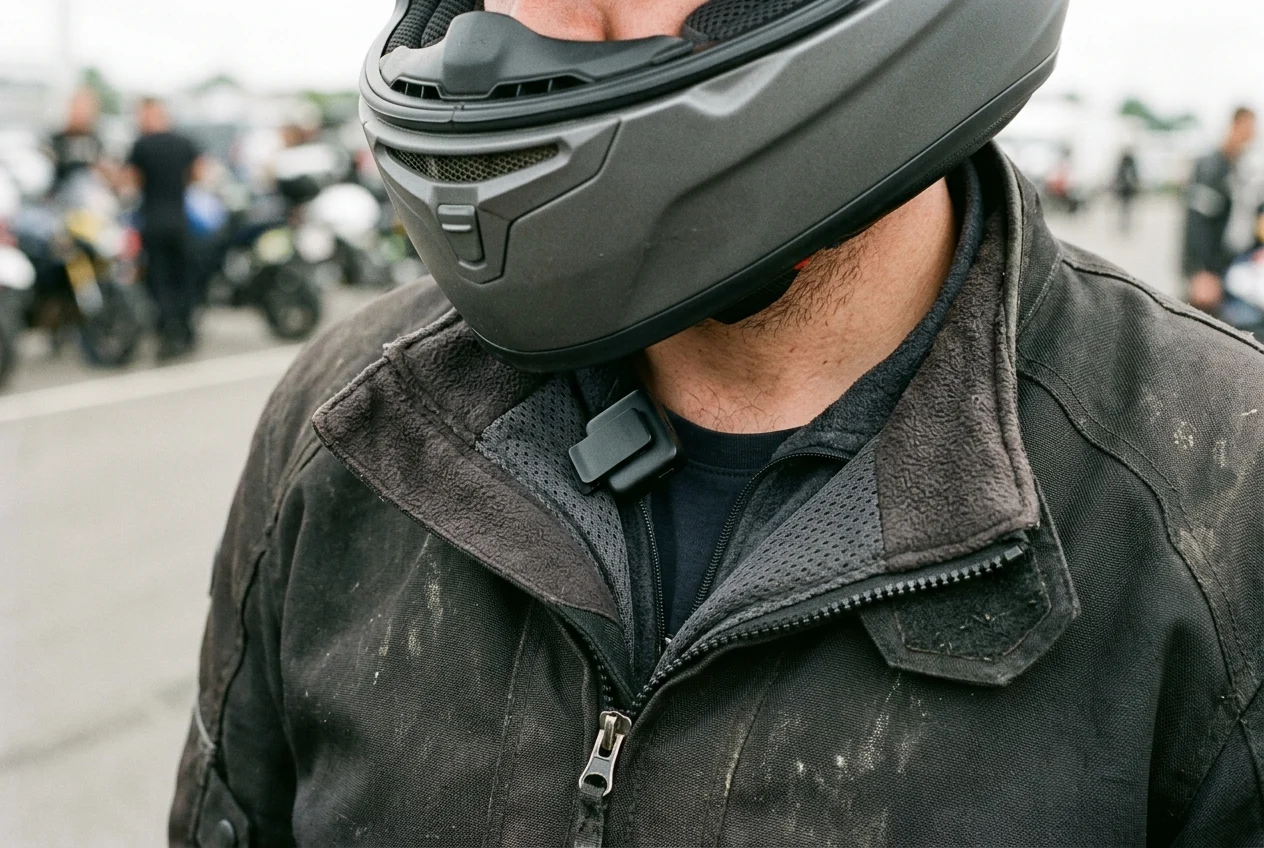
A chin mount also sits in calmer air than the handlebars, one argument for the helmet that the section above complicates.
Power, Heat and Cold on the Bike
Every runtime figure is a lab figure. Each brand rates a gentle mode in ideal conditions; shoot 4K with the screen on and the numbers fall.
Bike power usually costs waterproofing. DJI’s manual says the Action 6 is not waterproof with the USB-C cover open; the HERO13’s Contacto door is the exception. Either way, a hardwired USB-C socket beats a cigarette-lighter plug that vibration works loose. Our motorcycle charging guide covers the bike-side setup.
Heat is a standstill problem. Airflow at speed keeps cameras cool. Traffic queues in August are where they overheat.
Cold is temporary. The DJIs, the X6 and the Ace Pro 2 are rated to -20°C, but any lithium battery delivers less while cold and recovers as it warms. Keep the spare in an inside pocket, not the tank bag; our heated glove guide covers the same battery physics.
Storage. Buy a UHS-I microSD card rated V30 or faster; that is what DJI specifies for the Action 6, and GoPro asks for V30 with an A2 rating on the HERO13. UHS-II cards work but these cameras can’t use the extra speed. A slow card drops frames on exactly the day it matters, which is where the DJIs’ and X6’s built-in storage earns its keep as a backup.
Before You Post It: Check the GPS Tag
Action cameras and phones write GPS coordinates into the file, and a still pulled from a clip can carry the exact spot it was taken to within a few metres.
That matters to riders who camp. A wild camp on a quiet bay stays quiet because nobody can find it, and a photo with its coordinates intact publishes the location whatever the caption says.
Instagram, Facebook and X strip that data on upload, so a normal social post is fine. Everything else keeps it: a file sent on WhatsApp as a document, an email attachment, a forum upload, your own site, a Discord post. That is where camp spots leak.
It takes ten seconds to check with any EXIF viewer; pick one that works in the browser rather than uploading the file somewhere to be cleaned. We run a browser-based one ourselves. Disclosure: it is our own site, not a recommendation we were paid for, and there are plenty of alternatives. Leave no trace applies to the file too.
Verdict
For most riders in 2026 the DJI Osmo Action 6 is the one to buy, once US buyers have checked the seller. Pick the HERO13 Black for GPS and intercom recording, the Action 5 Pro to spend less, the Insta360 X6 or X5 if you will reframe 360 footage, the Ace Pro 2 for headset pairing, and the MISSION 1 Pro for the best image, carried on your chest.
Whatever you choose, vibration, runtime and wind come first and resolution last, and think about the mount for the helmet’s sake as well as the footage. Then ride somewhere worth filming: the Amalfi Coast by motorcycle and our Mediterranean coastal routes are good places to start.
A note on the prices: these are manufacturer list or launch figures, not live quotes, and they were read on the makers’ own stores in September 2026 (launch prices are dated inline where they matter). Prices and availability change constantly — check the current figure through any link before buying.
Frequently Asked Questions
What is the best action camera for motorcycle riding in 2026?
For most riders, the DJI Osmo Action 6: a large 1/1.1-inch sensor for tunnels and shade, a swappable battery rated at up to 240 minutes, 50 GB of built-in storage and receiver-free DJI Mic pairing. Choose the GoPro HERO13 Black for GPS overlays and intercom recording, or the Insta360 X6 for 360 footage. US buyers should note that DJI doesn't sell the Action 6 on its own US store, so Amazon listings come from third-party resellers.
Can I record my intercom conversation on an action camera?
With the right pairing, yes. GoPro lists the Cardo PackTalk Black as a supported headset for the HERO13 Black, recorded on its own audio track. Insta360 lists the Sena 5R and Spider ST1 and the Cardo Edge, Spirit and Freecom 2X for the Ace Pro 2. Expect phone-call audio quality. Cardo's app can also record Packtalk Edge, Neo and Custom conversations without the camera.
Is it legal to put a camera on a motorcycle helmet?
It is a grey area rather than a clear yes. ECE helmet rules have long said nothing should be fitted unless the helmet still meets the standard with it attached, and ECE 22.06 added UA and SA approvals for tested accessories. In February 2026 Bennetts BikeSocial found no UA-approved action camera. A UK solicitor told Bennetts he had never seen a rider prosecuted over one, but that it could come up in an injury claim. A bar or chest mount avoids the question.
How do I stop wind noise on a motorcycle action camera?
Fix it at the microphone, not in the edit. The biggest improvement is a small wireless mic under your jacket collar, out of the airflow; after that, recording your intercom headset, or a camera with a physical wind guard. Where the camera sits matters too, since a chin mount is in calmer air than one on the handlebars.
Can I run an action camera off my motorcycle's power all day?
Yes, but you usually give up waterproofing. DJI's manual says the Action 6 isn't waterproof while its USB-C cover is open. The GoPro HERO13 runs on USB power without charging its battery, and GoPro's Contacto magnetic door keeps it weatherproof with the cable attached. For touring, a hardwired USB-C socket plus a spare battery in an inside pocket works best.
Do I need a 360 camera for motorcycling?
Only if you will actually reframe the footage. A 360 like the Insta360 X6 records everything around you, so you choose the angle later and hide the selfie stick. The cost is bigger files, a heavier edit and the price: $699.99 for the X6, with the GoPro Max 2 and DJI Osmo 360 as cheaper options. For a clean forward view, a single-lens camera is simpler.
Is 4K enough, or do I need 8K for ride videos?
4K is enough for almost every ride video. Higher resolution matters when you crop hard or shoot 360, because a 360 spreads its pixels around the whole sphere and a reframed 8K 360 clip is far softer than flat 8K. For a forward-facing camera, stabilization, sensor size and audio decide the result long before resolution.