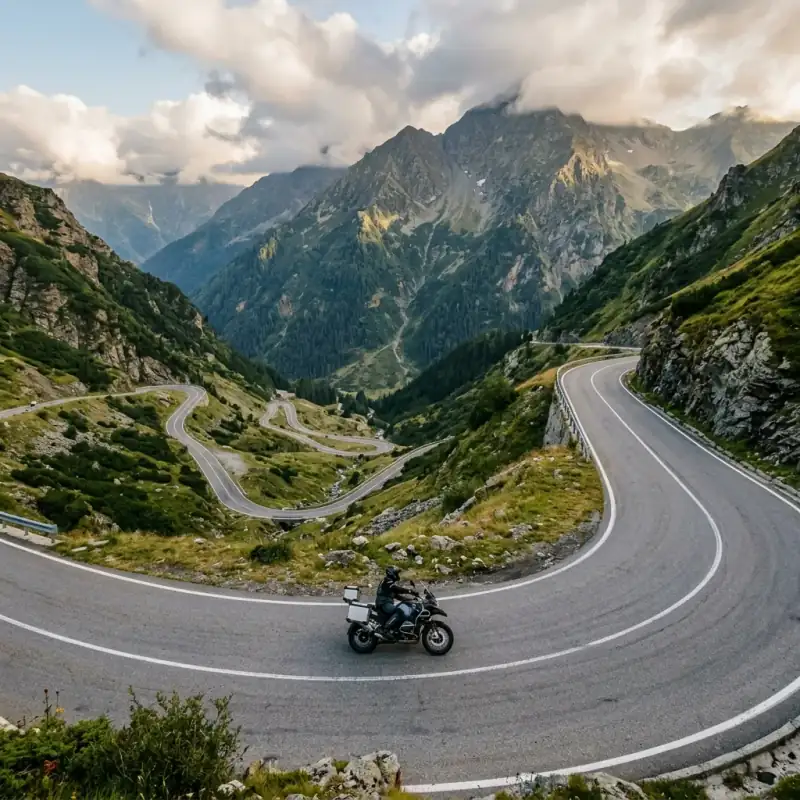
There’s a video, and you’ve probably seen it: a motorcycle threading a ribbon of perfect tarmac that coils up a green mountainside in impossible loops, while a voiceover calls it “the best road in the world.” That’s the Transfăgărășan, and the hype — fuelled by a famous Top Gear episode back in 2009 — is mostly deserved. But here’s what the video doesn’t show you: the same hairpins on a Saturday afternoon in August, nose-to-tail with rental cars, moving at walking pace.
So this isn’t another breathless road description. It’s the honest guide to riding Romania’s two legendary passes. The Transfăgărășan and the higher, quieter, arguably better Transalpina — as a single loop from Sibiu, and getting them at their best. When to ride (early-morning weekdays, not weekend afternoons), how cold 2,000 m gets even in July, where to fuel, and what to pack. Ride them right and they live up to the hype. Ride them wrong and you’ll spend the day in traffic.
The Two Passes at a Glance
| Transfăgărășan (DN7C) | Transalpina (DN67C) | |
|---|---|---|
| Length | ~90 km mountain section (~150 km total) | ~148 km (Novaci ↔ Sebeș) |
| High point | ~2,042 m at Bâlea Lake | Pasul Urdele ~2,145 m — Romania’s highest road |
| Character | Tight, dramatic hairpins; busy; iconic | Higher, more flowing, quieter, fewer guardrails |
| Opens (snow-dependent) | ~late June/July → Oct/Nov | ~late May/June → Oct |
| Connects | Cârțișoara (N) ↔ Curtea de Argeș (S) | Sebeș (N) ↔ Novaci (S) |
The whole loop runs roughly 470–600 km depending on the connector roads you choose, and Sibiu is the natural base — central, with an old town worth an evening, an airport, and somewhere to leave half your luggage while you ride the passes light.
One small but real money-saver: motorcycles are exempt from Romania’s rovinietă road-tax vignette, so you don’t need to buy one. Don’t let a border kiosk or petrol station upsell you.
Transfăgărășan vs Transalpina, and Why You Ride Both
Treat these as two separate trips and you’ve missed the point. They’re an hour or two apart and they’re different enough that doing both is the whole experience:
- The Transfăgărășan is the showman — theatrical, tight, climbing through dense switchbacks to the drama of Bâlea Lake and its tunnel. It’s the icon, and it’s busy because of it.
- The Transalpina is the better ride for a lot of riders — higher, more open and flowing, with long sweeping curves, far fewer cars, fewer guardrails, and a wild, remote feel up around Pasul Urdele.
Ride the famous one for the bucket-list photo and the history; ride the quieter one for the riding. Done as a loop, you get both without having to pick a favourite.
The Loop: A 2–3 Day Itinerary from Sibiu
- Day 1 — Sibiu → Transfăgărășan → south. Head to Cârțișoara and climb the Transfăgărășan early to beat the crowds. Over the top at Bâlea Lake, down the dramatic southern side past Vidraru, with Poenari Castle and Curtea de Argeș at the bottom. Overnight south, or loop back.
- Day 2 — Transalpina → Sibiu. Cross to the Transalpina (via Novaci or Sebeș depending on your overnight), ride the higher, quieter pass over Pasul Urdele, and return to Sibiu.
- Day 3 — buffer / weather day. Build in a spare day. Mountain weather closes passes and ruins views with no notice; a buffer means a bad-weather day doesn’t cost you the whole trip.
What to See Along the Way
- Bâlea Lake. The glacial lake at ~2,040 m at the top of the Transfăgărășan, with a cable car, the nearby Bâlea waterfall, and Romania’s highest road tunnel just below.
- Vidraru Dam & Lake. The big dam and the flowing southern hairpins on the Transfăgărășan’s quieter side.
- Poenari Castle. The real fortress of Vlad the Impaler (the historical “Dracula”), reached by climbing 1,480 steps, near the southern end.
- Pasul Urdele. The summit of the Transalpina and the highest tarmac in Romania.
- The everyday surprises — sheep, donkeys and cattle on the road, and stalls near the tops selling local cheese and honey. Slow down for all of them.
When to Go, and How to Dodge the Crowds
Both passes are summer roads. The Transfăgărășan typically opens late June/July and the Transalpina a little earlier, both closing with the first heavy snow around October/November (dates move with the weather — check before you ride). July to mid-September is the reliable window.
But the timing that actually matters is the day and hour. The Transfăgărășan’s fame is its own worst enemy: on weekend afternoons in peak season the famous hairpins clog with tourist traffic and become a slow crawl. Ride it early on a weekday morning and you can have those same loops almost to yourself. The Transalpina is quieter at any time, so save the busy pass for the quiet hours and the quiet pass for whenever suits.
Riding Tips & Hazards
This is where the honest guide earns its keep. The roads themselves are easy — paved, well-graded, any bike copes. The hazards are everything else:
- Altitude cold. Above 2,000 m it can be 10–15°C colder than the valley, windy, and wet when the valley is baking. Pack layers — a warm mid-layer, waterproofs, and proper gloves, and add them at the top. This is the number-one mistake riders make here.
- Tourists braking mid-hairpin. Cars stop dead for photos in the worst possible places. Ride at a pace that assumes the vehicle ahead will brake suddenly.
- Gravel and rockfall. Especially on the Transalpina, expect the occasional patch of gravel, potholes, or rockfall debris mid-corner.
- Animals on the road. Sheep, cattle and dogs wander freely. Treat blind corners accordingly.
- Police speed checks are common; ride to the limits.
- Cable-car congestion at Bâlea turns the summit into a busy car park; the riding, not the top, is the point.
What Bike and What to Pack
Any road-going motorcycle handles both passes — sports bike, tourer, or adventure bike, fully loaded is fine. It’s tarmac, not off-road, so you don’t need a big ADV machine or knobbly tyres.
What you do need is the right kit for fast-changing mountain weather. The single best preparation for these roads is layering for the cold at altitude:
- A four-season or layerable setup from the adventure riding pants guide and a good jacket, so you can add warmth at the summit.
- For shoulder-season trips (June or October), heated grips or a liner make the cold tops comfortable rather than something to endure.
- A solid helmet and gloves; see the adventure helmets guide and gloves guide.
- Navigation: both passes are obvious, but a Garmin Zumo XT2 or a good phone setup is handy for the connector roads and finding fuel, and there’s no fuel on either pass, so fill up in Cârțișoara, Curtea de Argeș, Sebeș or Novaci and tank up at every chance.
Getting There & Combining the Trip
Fly into Sibiu or Bucharest and rent locally, or ride in if you’re already touring Europe. The passes slot neatly into a bigger trip: they’re a natural extension of a Balkans tour or a run west to the Alps and the Stelvio if you can’t get enough hairpins — our ultimate Europe adventure motorcycle routes guide lays out how the continent’s great rides connect, and the planning fundamentals are covered in how to plan a long-distance motorcycle trip.
If you’re crossing borders to get here, the Europe border-crossing documentation guide covers the paperwork, and if you’re camping along the way, read the Europe wild-camping legal guide and the Balkans wild-camping guide before you pitch — rules vary by country and it’s worth knowing where you stand. A capable long-distance touring bike makes the ride in as good as the passes themselves.
FAQ
The five questions riders ask most about these roads — when the Transfăgărășan opens, which pass is better, how cold the summits get, whether you need an adventure bike, and where to base and camp; are answered in full at the top of this page.
The short version: ride both passes as a loop from Sibiu, go on a weekday morning in July–September, pack for cold at 2,000 m even in summer, and fuel in the valleys because there’s none on the passes. Do that, and the “best road in the world” hype mostly holds up — with the quieter Transalpina as the ride you didn’t see coming.
Conditions, opening dates and local rules change — treat this as a planning guide, not live information, and check current pass status and regulations before you ride.
Frequently Asked Questions
When does the Transfăgărășan open, and when is the best time to ride it?
The Transfăgărășan's high mountain section is closed by snow for most of the year and typically opens around late June or early July, staying open until the first heavy snows in October or November — the dates shift year to year with the weather, so check before you commit. The Transalpina opens a little earlier, usually late May to June. The best time to ride is from July to mid-September when both are reliably open. But the bigger timing question is day and hour, not month: ride the Transfăgărășan early on a weekday morning to have it to yourself, because by weekend afternoons in peak season the famous hairpins turn into a slow-moving car park of tourists.
Which is better — the Transfăgărășan or the Transalpina?
They're different rides, which is exactly why you should do both as a loop. The Transfăgărășan (DN7C) is the famous one — tight, dramatic, theatrical hairpins climbing to Bâlea Lake, more iconic but far busier. The Transalpina (DN67C) is higher (Pasul Urdele at about 2,145 m is Romania's highest road), more flowing and open, much quieter, with fewer guardrails and a wilder, more remote feel. If you only had time for one and wanted the icon, the Transfăgărășan; if you wanted the better ride, many riders quietly prefer the Transalpina. Do both and you don't have to choose.
How cold does it get at the top of these passes, even in summer?
Much colder than you expect. Both passes top out above 2,000 m, and at that altitude the temperature can be 10–15°C lower than in the valleys — so a 30°C day in Sibiu can mean single digits, wind and cloud at Bâlea Lake, and the weather can flip from sun to cold rain in minutes. Riders regularly get caught out in summer kit, shivering at the summit. Pack layers you can add at the top: a warm mid-layer, waterproofs, and good gloves. This is genuinely the most common mistake on these roads — treating a July mountain pass like a July valley road.
Do I need an adventure bike or 4x4 to ride the Transfăgărășan and Transalpina?
No — both passes are fully paved and any road-going motorcycle handles them comfortably. You'll see everything from sports bikes to fully loaded tourers up there. The surface on the Transalpina can be a little rougher in patches and there's the occasional pothole or gravel from rockfall, so an adventure or touring bike is comfortable, but it's not off-road and you don't need knobblies or a big ADV machine. What matters far more than the bike is your guard for hazards: tourists braking mid-hairpin, animals on the road, and weather, rather than the terrain itself.
Can you wild camp along the route, and where should I base myself?
Base yourself in Sibiu — it's central to both passes, has a beautiful old town, an airport, and plenty of accommodation, which makes it the natural hub for riding the loop over two or three days (Brașov is a workable alternative). For camping, there are campsites and guesthouses near the passes (Cârțișoara and Porumbacu de Sus for the Transfăgărășan, mountain cabanas like Bâlea Lac up top), and Romania has wild-camping options too, though rules and etiquette vary — check our Europe wild-camping guide before pitching. Note there's no fuel on either pass, so fill up in the valley towns and don't plan to camp somewhere expecting to refuel nearby.