
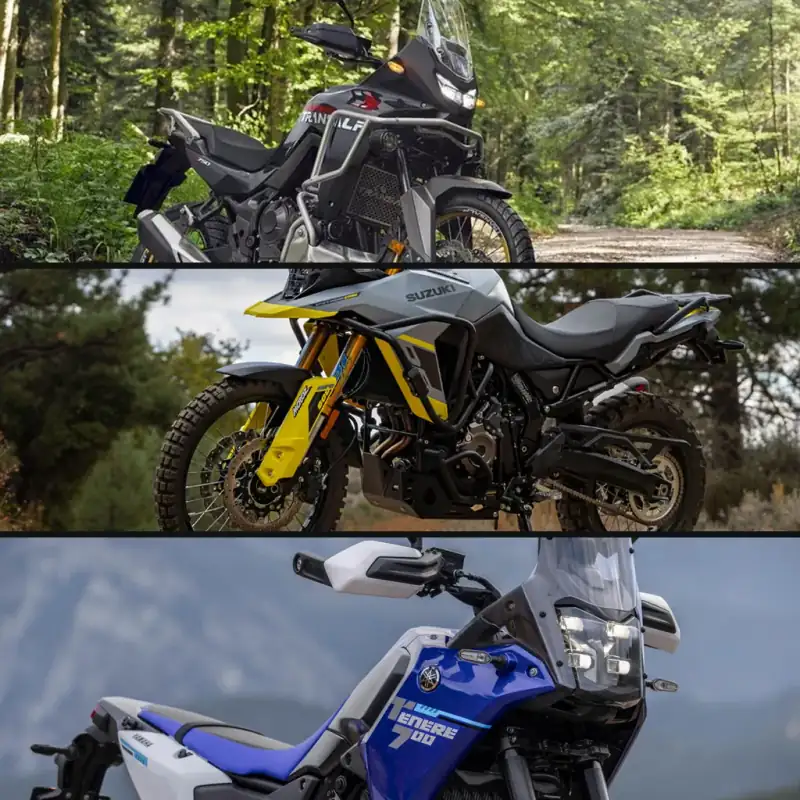
The middleweight adventure class is where the real fight is in 2026. Above it, the big-bore flagships keep getting heavier and more expensive — our BMW R 1300 GS Adventure review covers the top of that pile. But the sweet spot — bikes light enough to enjoy off-road, cheap enough to actually buy, and capable enough to cross a continent — lives here, in the 700–800cc twins. And three bikes define it: the Honda Transalp XL750, the Suzuki V-Strom 800DE, and the Yamaha Ténéré 700.
They take three different routes to the same destination. The Honda is the powerful, well-priced all-rounder, and for 2026 it got a serious tech upgrade. The Suzuki is the long-legged comfort tourer that still handles rough roads. The Yamaha is the analogue off-road purist that’s built a cult following by keeping things simple. This Honda Transalp vs Ténéré 700 vs V-Strom comparison puts all three side by side on power, weight, suspension, electronics and price, and tells you plainly which one fits which rider.
Introduction: Three Routes to the Same Class
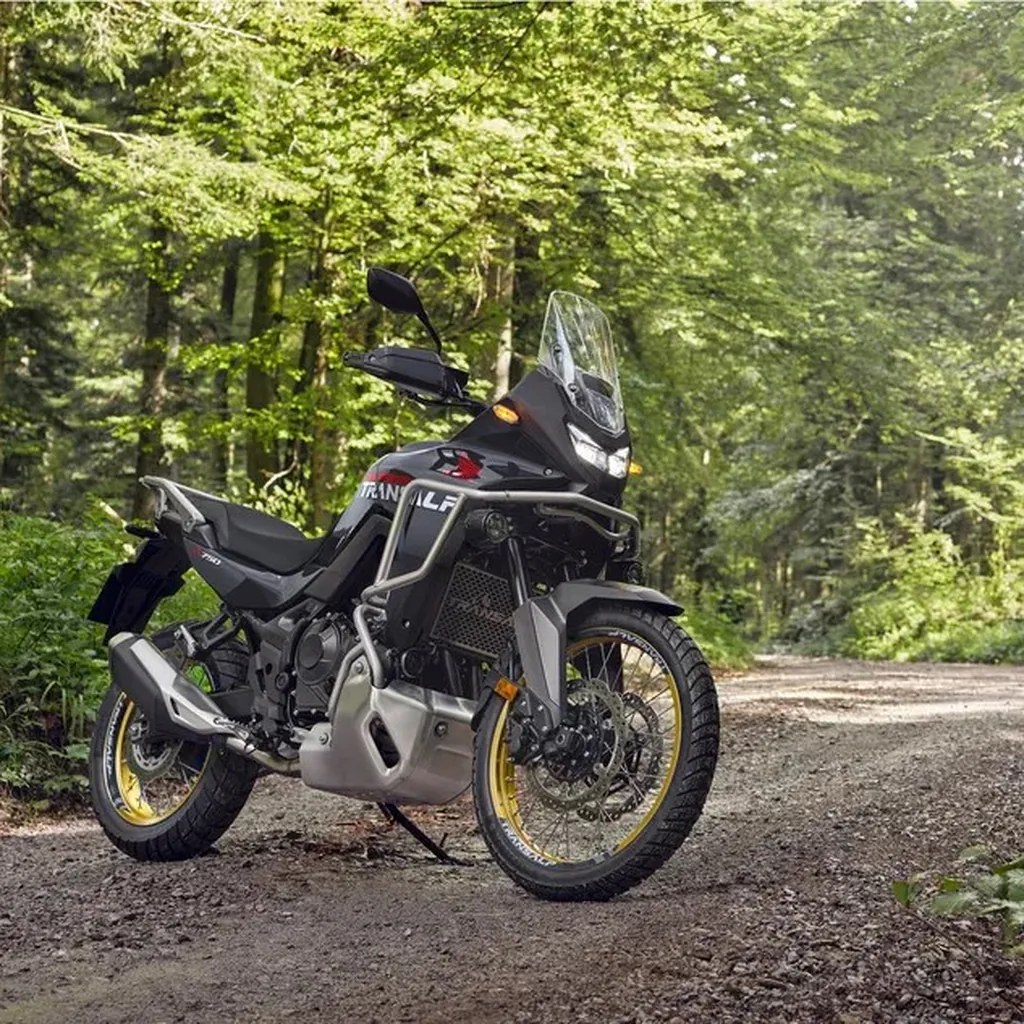
These bikes don’t just differ on a spec sheet. They have different personalities, and they’re built for different riders.
The Honda Transalp XL750 revived a legendary name in 2023 and undercut everyone on price. It’s the most powerful of the three, one of the lightest, and after a quiet but significant 2026 update it’s also the most technologically advanced. Honda’s pitch: one bike that does the commute, the tour and the occasional trail without drama.
The Suzuki V-Strom 800DE is the comfort-and-distance choice with genuine off-road intent. The “DE” means longer-travel suspension, a 21-inch front wheel and switchable rear ABS, sitting above the road-focused standard V-Strom 800. It’s the heaviest here, but it carries that weight as stability.
The Yamaha Ténéré 700 is the purist’s bike. Minimal electronics, an honest analogue feel, the tallest ground clearance, and the CP2 engine that riders love. It’s the one the hardcore off-road crowd keeps coming back to, and Yamaha has barely needed to change it.
Engine and Power: 91 vs 83 vs 72 hp
On paper, the Honda wins the numbers game. The Transalp’s 755cc parallel twin makes around 91 hp at 9,500 rpm and 55 lb-ft of torque, the most power here, and it’s an eager, revvy engine that loves to be worked.
The V-Strom’s 776cc twin makes around 83 hp at 8,500 rpm but the most torque of the trio at 58 lb-ft, delivered lower down, which suits its touring-and-trails brief, pulling cleanly from low revs whether loaded two-up or grinding up a gravel climb.
The Ténéré’s 689cc CP2 makes the least on paper, around 72 hp at 9,000 rpm, but this is the engine everyone falls for. Its 270-degree crank gives it a torquey, characterful, almost V-twin feel, and in a bike this light it never feels underpowered where it matters. Numbers don’t capture why people love the CP2; you have to ride it.
Weight: The Number That Decides Off-Road
This is where the class splits. Kerb weights:
- Yamaha Ténéré 700: 208 kg
- Honda Transalp XL750: 216 kg (2026 E-Clutch; the 2025 model was 210 kg)
- Suzuki V-Strom 800DE: ~230 kg
The Yamaha is the lightest of the three and the Honda sits 8 kg behind it — close enough that both feel light and flickable. Worth knowing where those 8 kg came from: the E-Clutch that became standard on the 2026 Transalp added 6 kg over the 2025 bike, so this is one of the rare cases where a convenience feature shows up on the scales. The Suzuki is 22 kg above the Yamaha, and you feel every one of them off-road, at walking pace, and the moment you have to pick the bike up out of a rut.
On tarmac and at touring speeds the difference fades, and the V-Strom turns its mass into welcome stability. But if your riding includes real dirt, the lighter pair have a meaningful, every-single-day advantage. Weight is the first thing to weigh up; see our notes on handling a loaded bike in the off-road riding tips for adventure bikes guide.
Suspension and Off-Road Ability
The Suzuki leads on raw travel: 220mm front and rear, fully adjustable, the most generous numbers here, which is what makes it composed over bad surfaces despite its weight.
The Yamaha pairs 210mm/200mm of travel with the tallest ground clearance of the three at 240mm, the spec that most directly determines how far you can push before something grounds out. Combined with its light weight and simple electronics, that’s why the Ténéré remains the off-road favourite.
The Honda used to be the weak link here: the first-generation Transalp’s suspension was widely criticised as too soft. The 2026 update fixes exactly that, fitting fully adjustable Showa suspension and adding a skid plate as standard. It’s now a capable trail bike rather than a road bike that tolerates dirt, even if the Yamaha still edges it for outright off-road feel.
Electronics: The 2026 Transalp Changes the Story
For years the Ténéré’s pitch was simplicity — minimal rider aids, switchable ABS, and not much else to get between you and the bike. Plenty of riders consider that a feature, not a flaw, especially off-road.
The Suzuki sits in the middle: traction control, multiple power modes, switchable rear ABS, and a clear dash; well-judged for touring and light trails.
The 2026 Honda Transalp now leads this category decisively. It gets Honda’s E-Clutch as standard — an electronic system that operates the clutch for you, so you can pull away and shift without touching the lever, while still being able to use it manually if you want. Add six riding modes (two fully customisable), five-level traction control with wheelie control, and three levels each of power and engine braking, and the Honda has gone from class-average to class-leading on tech in a single model year. Whether you want all that is personal; purists won’t. But it’s there if you do.
ADV Spec Comparison
| Spec | Honda Transalp XL750 | Suzuki V-Strom 800DE | Yamaha Ténéré 700 |
|---|---|---|---|
| Engine | 755cc parallel twin | 776cc parallel twin | 689cc CP2 twin |
| Power | ~91 hp @ 9,500 rpm | ~83 hp @ 8,500 rpm | ~72 hp @ 9,000 rpm |
| Torque | 55 lb-ft @ 7,250 | 58 lb-ft @ 6,800 | 50 lb-ft @ 6,500 |
| Kerb weight (full tank) | 216 kg | 230 kg | 208 kg |
| Seat height | 850 mm | 855 mm | 875 mm |
| Ground clearance | 210 mm | 220 mm | 240 mm |
| Suspension travel (F/R) | 200/190 mm | 220/220 mm | 210/200 mm |
| Front wheel | 21” | 21” | 21” |
| Standout tech (2026) | E-Clutch, 6 modes, adj. Showa | Long-travel susp., switchable ABS | Minimalist, switchable ABS |
| Approx. price (US) | ~$10,199 | from ~$11,799 | ~$10,999 |
Price and Value
The Honda is the value leader at around $10,199, and given the 2026 update piled on adjustable suspension, E-Clutch and a skid plate without a big price jump, it’s the strongest value here on paper.
The Yamaha sits at $10,999, which buys you a proven, beloved platform and the lowest-complexity ownership of the three.
The Suzuki starts at $11,799 and climbs from there for the higher-spec Adventure trim with luggage and extras. The most expensive way into the class, justified if you value its touring comfort and suspension travel.
Who Should Buy the Honda Transalp XL750?
The road-biased all-rounder who wants one bike to do everything and the best value doing it. Commuters, tourers, and riders who do some trails but spend most of their time on tarmac. The 2026 E-Clutch and adjustable suspension make it the easiest to live with and the most modern-feeling, and a strong shout for a first big ADV. If you want maximum capability per dollar, this is it.
Who Should Buy the Suzuki V-Strom 800DE?
The distance rider who still wants to leave the pavement. Long suspension travel, the most torque, real two-up comfort and rock-solid stability make it the best straight-up tourer here — as long as you can live with the extra weight when the going gets tight. If your year is mostly big miles with chunks of gravel, the V-Strom earns its keep.
Who Should Buy the Yamaha Ténéré 700?
The off-road rider and the purist. Lightest feel, tallest ground clearance, simplest electronics, and the engine everyone loves. It’s the one to pick if dirt is the point, if you value mechanical honesty over rider aids, and if you’re tall enough to get along with the seat height. For the deeper dive, see our Ténéré 700 long-term review and the Ténéré 700 vs Africa Twin comparison.
Verdict
There is no loser in this group — which is exactly why the middleweight class is so good right now. Pick by use case:
- Best all-rounder and best value: Honda Transalp XL750, stronger than ever after its 2026 update.
- Best for serious off-road: Yamaha Ténéré 700.
- Best for long-distance comfort with rough-road ability: Suzuki V-Strom 800DE.
Decide honestly how you actually ride — not how you imagine you’ll ride, and the right bike picks itself. For the full 650–900cc field beyond these three — including the KTM 890 Adventure R, Tiger 900 and BMW F 900 GS — see our best mid-size adventure motorcycles guide, and for where the middleweights sit against the bigger flagships, read on in our best long-distance touring motorcycles guide.
A note on the prices: US MSRP for the 2026 model year, checked against the manufacturers’ own US sites on 1 September 2026, and excluding destination and dealer charges. MSRP moves with model-year updates and dealer pricing — confirm the current figure before you budget.
Frequently Asked Questions
Which is the best middleweight adventure bike in 2026 — Transalp, V-Strom 800DE or Ténéré 700?
There's no single winner — it depends on how you ride. The Honda Transalp XL750 is the best all-rounder and best value, especially after its 2026 update added E-Clutch and fully adjustable suspension. The Yamaha Ténéré 700 is the off-road purist's pick: lightest feel, tallest ground clearance, simplest electronics. The Suzuki V-Strom 800DE splits the difference with the longest suspension travel and the most touring comfort, at the cost of being the heaviest of the three. Road-biased all-rounder: Transalp. Serious dirt: Ténéré. Long-haul comfort with rough-road ability: V-Strom.
How much power does each bike make?
The Honda Transalp XL750 leads with around 91 hp at 9,500 rpm from its 755cc parallel twin. The Suzuki V-Strom 800DE makes around 83 hp at 8,500 rpm from a 776cc twin, with the most torque of the three at 58 lb-ft. The Yamaha Ténéré 700 makes the least on paper — around 72 hp at 9,000 rpm from its 689cc CP2 twin — but its character and light weight make it feel livelier than the figure suggests, especially off-road.
What changed on the 2026 Honda Transalp?
Quite a lot, and it addresses the first-generation bike's main weaknesses. For 2026 the Transalp gets fully adjustable Showa suspension (the original was criticised as too soft), Honda's E-Clutch as standard (automatic clutch operation with no lever needed for pull-away or shifts), a standard skid plate, six riding modes with two customisable, five-level traction control with wheelie control, and new colours. It's a meaningful upgrade that sharpens the Transalp's position as the value all-rounder.
Which middleweight ADV is best for off-road?
The Yamaha Ténéré 700, for most riders. It has the tallest ground clearance (240mm), the lightest, most flickable feel, and the simplest, least intrusive electronics — which off-road riders tend to prefer. The Suzuki V-Strom 800DE is a close second thanks to its long 220mm suspension travel front and rear and switchable rear ABS, though its weight works against it in tight going. The 2026 Transalp closed the gap with adjustable suspension and a standard skid plate, but it's still the most road-biased of the three.
Which is the lightest, and does it matter?
The Ténéré 700 is the lightest at 208 kg and the Transalp follows at 216 kg for the 2026 E-Clutch model; the V-Strom 800DE is notably heavier at around 230 kg. It matters most off-road and at walking pace, where every kilo counts when you're picking the bike up or balancing through ruts — that's a real point in the Yamaha's and Honda's favour. On the road and at touring speeds, the difference largely disappears, and the V-Strom's weight buys you stability and comfort.
What do these bikes cost in 2026?
Roughly: the Honda Transalp is the value pick at around $10,199, the Yamaha Ténéré 700 sits at $10,999, and the Suzuki V-Strom 800DE starts at $11,799 and climbs from there for the top-spec Adventure version. Prices vary by market and year, and the Transalp's keen pricing combined with its 2026 tech upgrades makes it the strongest value of the three on paper.
Are these good first big adventure bikes?
All three are popular first big ADVs, and each is approachable in its own way. The Transalp's low weight, smooth power and (for 2026) E-Clutch make it arguably the easiest to live with for a newer rider. The Ténéré is simple and unintimidating but tall, which can be a confidence issue for shorter riders. The V-Strom is the most road-comfortable and forgiving on tarmac but the heaviest to manage at a standstill. If you're stepping up, also read our guide to the best beginner motorcycles before deciding.