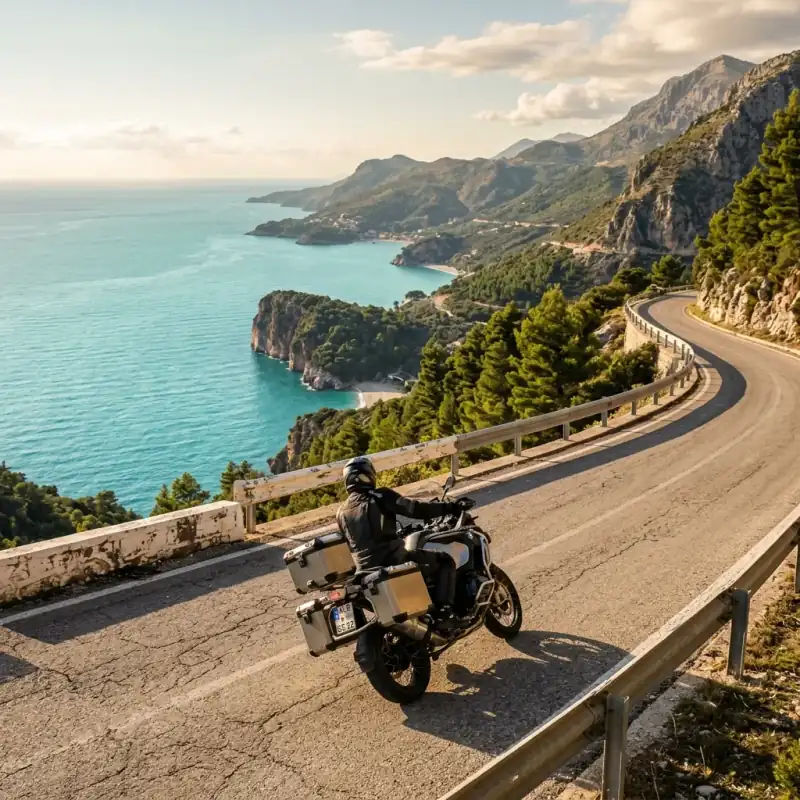
You come over the top of the Llogara Pass at a thousand metres, pine forest at your back, and the whole Ionian coast just falls away beneath you: a long drop of hairpins ending in water so turquoise it doesn’t look real. Somewhere down there, between two headlands, is a cove with a flat patch of shingle big enough for a tent and nobody else in sight. That’s the Albanian Riviera, and it’s the best coastal motorcycle road in the Balkans that almost nobody has ridden yet.
For years the Riviera was the Mediterranean’s open secret: wilder than Croatia, cheaper than Greece, and rougher around the edges than both. That’s changing fast. The SH8 coastal road has been rebuilt end to end, the Corfu ferry makes it a half-hour hop from Greece, and word is spreading. The window where you can still wild camp a bay to yourself is open, but it won’t stay open forever.
This Albanian Riviera motorcycle route guide is built for that window. It covers the SH8 ride from Vlorë to Sarandë, the Llogara descent that anchors the whole trip, where to find fuel and food, and the string of bays where pitching a tent for the night is still tolerated. If you’re stitching the Riviera into a longer Balkans tour, it slots straight onto the routes in our Balkans motorcycle riding guide.
Why the Albanian Riviera Is the Balkans’ Best-Kept Coastal Road
The Adriatic and Ionian coasts give riders two very different experiences. Croatia’s Dalmatian coast, covered in our Croatia Dalmatian coast motorcycle guide, is polished, busy, and strict about where you sleep. The Albanian Riviera, an hour’s ferry south, is the rougher, cheaper, emptier cousin, and that’s exactly its appeal.
The road doing the work is the SH8, the coastal highway running roughly 110 km from Vlorë in the north down to Sarandë in the south. A few years ago this was a patchy, potholed ordeal. Today it’s been resurfaced end to end, the Llogara Tunnel has been bored through the mountain, and the whole route rides like a proper coastal touring road, without the traffic that chokes the equivalent roads in Italy or Croatia in summer.
What hasn’t changed is the coastline itself. Between the pass and Sarandë, the SH8 threads past a near-continuous run of bays. Some have a beach club and a road down to them; many have nothing but a goat track and a stretch of empty shingle. The 30 km between Palasa and Lukova alone holds dozens of small coves reachable only on foot or by boat. This is the heartland of Albanian wild camping, and it’s the reason to bring a tent rather than book hotels.
The Route at a Glance
| Day | Stage | Distance | Highlight |
|---|---|---|---|
| 1 | Vlorë → Dhërmi via Llogara | 50 km | The Llogara Pass descent |
| 2 | Dhërmi → Himara | 25 km | Gjipe canyon bay, Livadhi |
| 3 | Himara → Borsh | 35 km | Porto Palermo, Borsh beach |
| 4 | Borsh → Sarandë / Ksamil | 40 km | Pulëbardha, the turquoise south |
Total: roughly 150 km of riding spread across four short days. The distances are tiny. You could blast Vlorë to Sarandë in a single afternoon. The point is not to. Each stage is two hours of riding at most, leaving the rest of the day for the bays, the swimming, and finding the night’s camp before the light goes.
If you’ve ferried in from Corfu, simply run this itinerary in reverse from Sarandë north to Vlorë, then carry on into Montenegro.
Llogara Pass and the Descent to the Coast
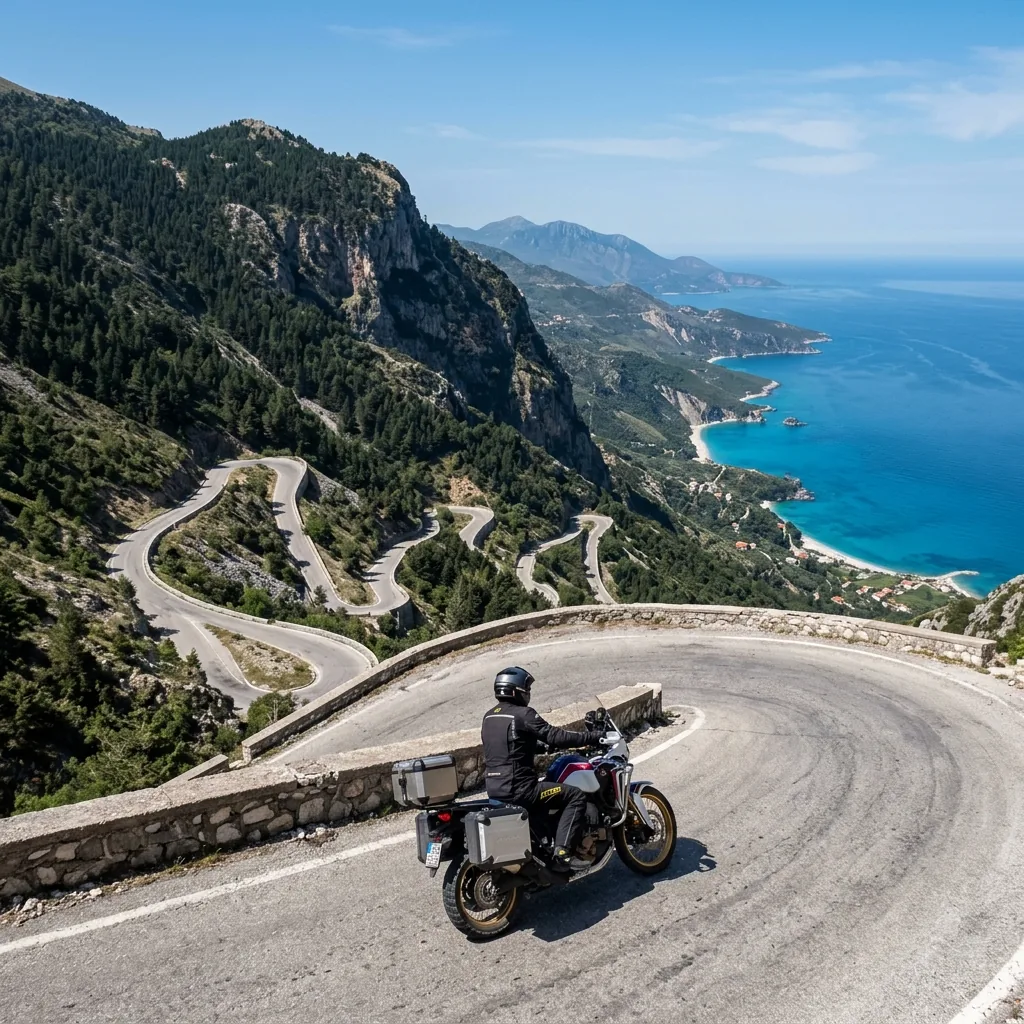
This is the stage you came for. Leaving Vlorë, the SH8 climbs steadily inland and up into the Llogara National Park, a cool belt of pine forest that feels a world away from the coast you’re about to drop onto. The road tops out around 1,000 metres at the pass itself, where there are a couple of roadside restaurants and a viewpoint that hands you the entire Riviera in one glance: the Karaburun peninsula, the islands, and the long curve of coast running south.
Then it falls off the mountain. The descent is a cascade of well-surfaced hairpins dropping a thousand metres to sea level, and it’s one of the best motorcycle roads in this corner of Europe. Take it steady: the surface is good but the corners are tight and blind, tour buses crawl down at 15 km/h and can’t pull over, and the gradient is relentless on your brakes.
The newer Llogara Tunnel lets you skip all of this in about seven minutes. Keep it in your back pocket for bad weather or a tired evening, but on a clear day the pass road is the whole reason to be here. Ride the top.
At the bottom you reach Palasa and Dhërmi, the first proper Riviera beaches and the gateway to the coves further south. Either makes a good first night.
Gjipe: The Canyon Bay
If the Albanian Riviera has one signature wild-camp spot, it’s Gjipe — a small beach wedged at the mouth of a dramatic canyon between Dhërmi and Vuno, where a seasonal river meets the Ionian. You can’t ride to it. The track in is rough, and the final approach is a walk down the canyon or a short boat hop from Dhërmi, which is exactly why it stays special.
Camping on Gjipe is permitted and common; in season there’s a small beach bar and a low-key campsite vibe, with plenty of people pitching tents and staying the night under the cliffs. Leave the bike securely parked at the top of the track — see our guide to securing a motorcycle when wild camping before you walk away from it, and carry down only what you need for the night.
This whole stretch, from Palasa down to Lukova, is the densest run of campable coves on the coast. Many have no facilities at all: no water, no shade, no shop. Pulling a discreet bivouac on one of them — pitched late, broken down early — is the purest version of what the Riviera offers, and it’s the approach we’d default to anywhere the rules are uncertain, as laid out in our Balkans wild camping legal guide.
Himara and Livadhi: The Riviera Base
Himara is the natural hub of the Riviera and the place to base yourself for a night with a roof, a proper meal, fuel and an ATM. It’s a working coastal town rather than a resort strip, with the old hilltop village of Himara Fshat above and a string of beaches below.
The pick of them is Livadhi, just down the hill: a long beach that strikes the Riviera’s characteristic balance between organised beach clubs at one end and open, undeveloped “wild” space at the other. It’s an easy place to swim out the heat of the day, then decide whether you’re camping rough further south or taking a cheap guest house in town.
Himara is also your last reliable resupply before the quieter south. Top up the tank, fill your water, and stock the panniers, because the coves between here and Borsh have spectacular isolation and very little else. If you’re new to cooking on the road, our guide on how to cook on a motorcycle trip covers the compact kit that earns its space here.
Porto Palermo and Borsh
South of Himara the coast empties out. Porto Palermo is the standout: a near-circular bay sheltering a small island crowned by Ali Pasha’s castle, with rough paths leading off to remote coves like Livadhi i Harimit where the isolation is the whole point and facilities are nonexistent. It’s a postcard, and outside of peak weekends it’s quiet.
Further down, Borsh is Albania’s longest beach: more than seven kilometres of wide, open shingle backed by olive-covered hills rising toward Borsh Castle. The water is calm and clear, and the sheer length of the bay means it never feels crowded the way the smaller coves do. There’s organised camping at the northern end with showers and a flat place to pitch, and quieter wild stretches to the south where you can pull off and pitch on your own. For many riders, a free shower and a flat, legal pitch make Borsh the easiest comfortable night on the whole Riviera.
Road notes for the south: the SH8 stays good but watch for livestock, the odd unlit vehicle, and gravel washed onto the road after rain. Fuel is sparse between Himara and Sarandë, so don’t run the tank low.
Pulebardha and Ksamil: The Turquoise South
The final stage runs down toward Sarandë, the Riviera’s southern city and the ferry port for Corfu. Just before town, Pulëbardha (“Seagull Beach”) is a small cove tucked between cliffs with some of the clearest, most improbably turquoise water on the coast. It’s a short, steep run off the main road and worth the detour.
Beyond Sarandë lies Ksamil, a cluster of tiny islands and shallow bays that’s become the Riviera’s most developed and photographed spot. It’s busy and built-up compared to the wild coves to the north, but it’s the easy option for a last night with markets, restaurants and accommodation on tap, and it’s the launch point for the Butrint ruins and the Corfu ferry.
From Sarandë you’ve got choices: catch the ferry to Corfu and carry on through Greece, or turn the bike around and ride the SH8 back north, over Llogara again, and on into Montenegro and the wider Balkans.
What to Pack and How to Camp the Riviera
The Riviera rewards a light, self-sufficient setup. The coves have no water and no shade, so you carry both. A few specifics that matter here:
- Carry water. Most wild coves have no fresh source. Fill up in Himara, Borsh or Sarandë and carry enough for the night plus cooking.
- Stove, not fire. Open fires are a serious wildfire risk on this coast in summer and can land you in legal trouble. A small gas-canister stove cooks dinner and packs tiny; see our portable camp stove guide.
- Shade. Midday sun on an exposed shingle cove is brutal. A tarp or a tent with a good vestibule earns its weight.
- Leave no trace. Take every scrap of rubbish out with you. The reason these bays are still open to campers is that the people before you packed it all out; keep that going.
For the full kit list, our motorcycle camping gear checklist covers everything from sleeping system to repair kit.
Final Word
The Albanian Riviera is one of those rare places still ahead of the crowd: a rebuilt coastal road, half-hour ferry access from Greece, prices a fraction of Croatia or Italy, and bays where you can still pitch a tent and watch the sun drop into the Ionian with nobody else around. The SH8 and the Llogara descent would be worth the trip on their own. The wild coves are what make it the best-value coastal motorcycle tour in Europe right now.
Ride it soon, ride it light, and pack it all out. The next rider’s empty bay depends on it.
If the Riviera is one stop on a longer trip, our ultimate Europe adventure motorcycle routes guide covers how it chains into the Balkans, Greece and the wider Mediterranean coast.
Frequently Asked Questions
Is the Albanian Riviera safe to ride a motorcycle on in 2026?
Yes, with the usual coastal-road caution. The SH8 between Vlorë and Sarandë was modernised end to end and the surface is good. The real hazards are slow tour buses on the Llogara hairpins (you can sit behind one for 5–15 minutes — overtake only on clear straights), unlit tractors and mopeds after dark, and livestock on the road in the southern stretches. Don't ride the Riviera at night. Daytime, it's one of the easier big coastal roads in the Balkans.
Is wild camping legal in Albania?
There is no law against wild camping in Albania, and it's widely tolerated along the Riviera coast and in the mountains. In most places you won't be disturbed if you pull up discreetly for the night, particularly on the quieter coves away from organised beach clubs. The practical limits are the same as anywhere on the Mediterranean: avoid pitching in the middle of a busy managed beach in July–August, take all your rubbish out, and use a gas stove rather than an open fire — the summer wildfire risk is serious and fires can become a legal matter.
How do I get to the Albanian Riviera by motorcycle?
Two main ways. From the south, the Corfu–Sarandë ferry runs daily, takes 30–90 minutes depending on the vessel, and carries motorcycles — ideal if you're already touring Greece. From the north, you ride in via Vlorë, which connects to Montenegro and the rest of the Balkans. Many riders make it a loop: ferry from Corfu to Sarandë, ride north up the SH8 to Vlorë, then continue into Montenegro or back south.
When is the best time to ride the Albanian Riviera?
May and June are ideal — warm but not yet baking, wildflowers still out, the sea swimmable, and the coast far quieter than peak season. September is the other sweet spot: stable warm weather, fewer crowds, and water still warm from summer. July and August bring 35°C-plus heat, packed beaches, higher prices and the strictest municipal attention on the popular coves. Avoid full winter — the coast is rideable but many beach businesses close and the Llogara Pass can get cold and wet.
Can I ride the Llogara Pass, or should I take the new tunnel?
Ride the pass. The Llogara Tunnel (open since the recent road upgrades) turns the 40-minute mountain crossing into about seven minutes, which is useful in bad weather or if you're short on time. But the old SH8 pass road over the top is the single best piece of riding on the Riviera — a cascade of hairpins dropping from pine forest at 1,000 metres straight down to the turquoise coast. Take the pass on the way in for the views; keep the tunnel in mind as the bad-weather bailout.
How much does a Riviera motorcycle trip cost?
It's one of the cheapest coastlines in Europe. Wild camping with self-cooked meals, you can ride the whole Riviera for well under €30 a day including fuel — Albania is inexpensive across the board. Mixing in the odd guest house in Himara or Sarandë and eating in beach tavernas, budget €40–60 a day. Fuel is cheaper than Western Europe, and a two-week camping trip including the Corfu ferry can come in under €400 per person if you cook your own food.