
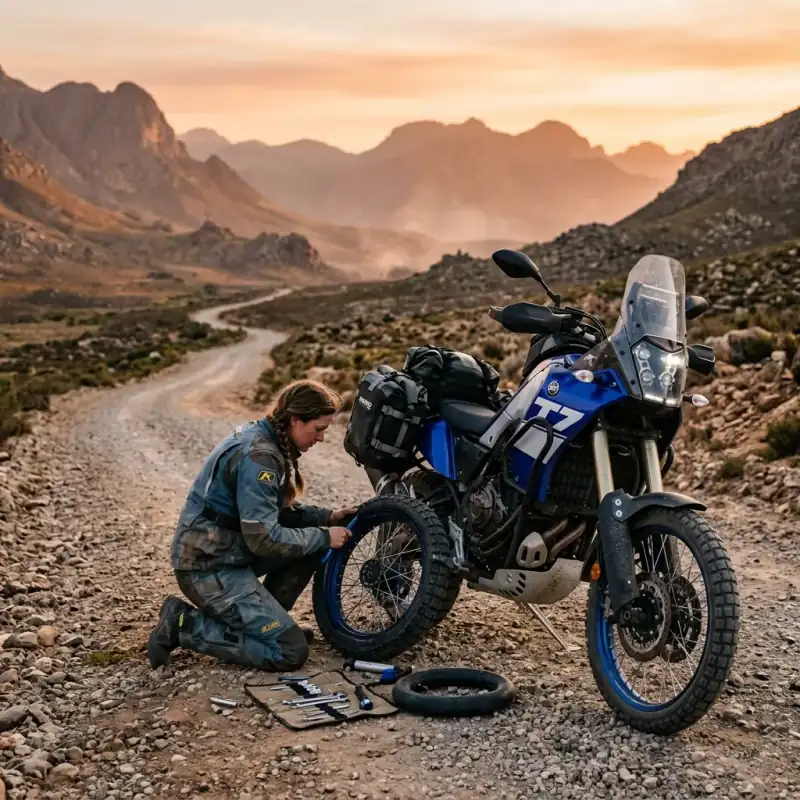
I have never planned a breakdown. Nobody has. They arrive on the one stretch of the day where there’s no phone signal, the sun is dropping, and the nearest town is a name on a map two valleys away. The first time it happens on a remote track there are usually ten minutes of sitting on a rock feeling sorry for yourself before the obvious lands: out here, you are the mechanic. There is no one else.
This guide is about that moment, worked through the bike this site covers most closely as the example. The Yamaha Ténéré 700. It’s the honest version: what you can genuinely fix on a T7 by the side of a track, what you can’t, and what to carry so the difference between a one-hour delay and a three-day rescue is decided before you leave home. If you want the full spares philosophy, I’ve written a companion piece. The off-road motorcycle tool kit checklist, and this guide leans on it. Here, the focus is the bike.
A quick honesty note that runs through everything below: I’ve confirmed the numbers against the Ténéré’s manual where I quote them, and I’ve flagged the few that genuinely vary between model years. Where I’m not certain something applies to your exact bike, I say so. Honesty beats completeness when you’re 200 km from a hospital.
The Mindset: Limp-Home, Not Concours
The single most useful idea in field repair is that you are not trying to fix the bike properly. You are trying to restore enough function to ride it carefully to a place where it can be fixed properly. A repair that holds for 60 km of gentle riding is a complete success. A repair that’s perfect but takes four hours of daylight you don’t have is a failure.
That distinction decides what goes in your tool roll and how you use it. You almost certainly won’t carry a torque wrench off-road. They’re heavy and only a handful of fasteners truly need one. So when the manual says a bolt wants a specific torque, the field reality is: snug it firmly by feel to a safe limp-home tightness, ride gently, and re-torque it to the real number at the next paved-road stop or workshop. I’ll give you the real torque figures throughout this guide so you know the target. But I’ll also tell you plainly when “good enough to get home” is the actual goal.
One more thing the T7 won’t do for you: the bike ships with only a minimal tool kit in the compartment under the seat. It’s enough to wiggle a few fasteners, not enough for a serious field repair. Building your own kit isn’t optional on this bike.
Flats & Tubes — The Big One
Here is the fact that surprises people, and it’s the spine of this entire guide: the stock Ténéré 700 runs inner tubes.
The T7 rolls on spoked wheels — a 21-inch front and an 18-inch rear, and the stock rims are set up for tubes. That single detail changes how you handle the most common breakdown on any adventure trip. On a tubeless bike, a nail in the tread is a five-minute job: ream the hole, push in a sticky plug from the outside, re-inflate, ride away, wheel never leaves the bike. On a tube-type T7, a tubeless plug kit is useless. The air isn’t held by the tire sealing against the rim. It’s held by the tube inside. Plugging the tread does nothing.
So the real fix is the longer one, and you should know the shape of it before you ever need it:
- Get the wheel off the bike. Rear is the harder one. You’re dealing with the axle and the chain adjusters.
- Break the bead. The tire is clamped onto the rim by air pressure and a stiff carcass; you have to push the tire sidewall down off the rim’s bead seat. On a stiff dual-sport tire this is the part that humbles people. Levering, kneeling on it, sometimes using the sidestand or a bead-breaking tool.
- Lever one side of the tire off with tire irons, working around the rim a little at a time, careful not to pinch the tube.
- Patch or replace the tube. A patch if the hole is findable and the tube is otherwise good; a fresh spare tube if it’s torn or the valve is damaged. Carrying a spare tube is faster and more reliable by the road than chasing a patch in the wind.
- Refit the tire, get the tube seated without pinching it, and inflate. A pinched tube means you did all that work for a second flat.
The honest part: this is a real job. Forty minutes minimum if you’re practised, longer if you’re not, and it takes genuine upper-body effort to break the bead and lever a stiff ADV tire. The first time you do it should be on your garage floor on a calm afternoon — not at dusk in a crosswind with the light going.
What that means for what you carry
Because the T7 is tube-type, your puncture kit looks different from a tubeless bike’s:
- Two or three sturdy tire irons (levers); a single lever fights you the whole way.
- A spare tube, sized correctly for the 21” front and the 18” rear. Some riders carry one tube that can get them home on either end in a pinch; better is one of each if you have the space.
- A patch kit as backup to the spare.
- A way to break the bead — at minimum strong levers and technique, ideally a compact bead-breaking method you’ve practised.
- A real pump. A 12V compressor off the battery inflates a tire in a few minutes; a hand pump works but is hard graft after a long day. Either way, you need to get back to the cold pressures the manual specifies (more on those below).
- A valve-core tool and a spare valve, cheap and tiny.
For the specific tools and weights, the overlanding tool kit guide breaks the whole roll down. Two items worth a direct mention:
Disclosure: some links below are affiliate links. If you buy through them we may earn a small commission at no extra cost to you.
Check Tire Spoons + Chain Breaker on Amazon →
Check 12V Tire Compressors on Amazon →
The pressures, set cold
Set these with the tire cold, every time — heat from riding inflates the reading and you’ll end up under-pressure. From the manual:
| Use | Front | Rear |
|---|---|---|
| Road (solo or with passenger) | 220 kPa / 2.20 bar / 32 psi | 250 kPa / 2.50 bar / 36 psi |
| Off-road | 200 kPa / 2.00 bar / 29 psi | 200 kPa / 2.00 bar / 29 psi |
Stock rubber from the factory is the Pirelli Scorpion Rally STR (front 90/90-21, rear 150/70 R18), with the Michelin Anakee Wild as an approved alternative fitment in the same sizes. Both are tube-type on the stock wheels.
”Should I just go tubeless?”
Plenty of T7 owners get tired of the wheel-off ritual and convert. Your options, presented as owner choices, not stock:
- Tubeless conversion kits that seal the spoked rim so it holds air without a tube; then a trailside plug actually works.
- Aftermarket sealed tubeless wheels.
- Heavy-duty tubes or a mousse insert to reduce puncture frequency (a mousse trades the puncture problem for a stiffer ride and a harder fit).
I’m not going to quote prices or push a specific kit here. They vary by market and change often, and I’d rather you verify current options than trust a figure here that went stale months ago. The point is just to know the menu exists. Out of the box, plan around tubes.
Chain — Check It, Adjust It, Carry the Link
After punctures, the drive chain is the next most likely thing to need attention on a loaded ADV bike, and it’s one of the easier wins by the road.
Slack. The T7 wants 43.0–48.0 mm of slack, measured at the end of the drive chain guard, with the bike upright and no weight on it, transmission in neutral. Too tight is worse than slightly loose — a chain pulled drum-tight stresses the gearbox output bearing and the rear shock travels through its stroke yanking it tighter still. Adjust at the swingarm adjusters and keep the alignment marks equal on both sides so the rear wheel stays square; a misaligned wheel eats the chain and the tire and makes the bike track oddly.
The torque numbers, for honesty. Done properly, the rear axle nut is 105 N·m (77 lb·ft) and the adjuster locknuts are 16 N·m (12 lb·ft). Out on a track you won’t have a torque wrench. The field reality: tighten the axle nut as firmly as you can with the tools in your roll. That big axle nut wants to be properly tight — ride gently, and re-torque to 105 N·m at the next opportunity. This is exactly the limp-home-versus-proper distinction: get it safe enough to roll, fix it right when you can.
Cadence. Clean, lube, and re-check slack and alignment every 1,000 km (600 mi), and again after rain, water crossings, washing, or a hard off-road day. Off-road riding in grit shortens that interval in practice; riders routinely re-lube mid-day after a dusty section.
The catastrophic version. A chain that’s thrown or snapped — usually a stone wedged between chain and sprocket, yanking it sideways off the teeth — leaves the bike dead still. This is why a 525 master link belongs in the spares bag: the T7’s chain is 525 size (Yamaha’s spec is 525VZ2), so the spare link must match. With a chain breaker and a spare link you can rejoin a chain in 15–20 minutes; without one, a snapped chain is the end of the ride until recovery. If the chain is merely damaged rather than broken, sometimes the limp-home move is to remove the bad link and run a slightly shorter chain very gently to the next town; ugly, but it rolls.
Check Motion Pro Chain Tools on Amazon →
Fasteners & Vibration — The Quiet Killer
Nothing dramatic happens here, which is exactly why it strands people. A big single-purpose ADV trip is hours of vibration and corrugation, and bolts back themselves out one tiny turn at a time until something falls off or starts knocking. The fix is boring and effective: know which fasteners loosen, check them, and use threadlocker where it belongs.
On a loaded T7, the usual suspects:
- Sprocket bolts (front and rear); high-consequence if they walk out.
- Subframe and luggage-rack hardware — racks and pannier frames carry weight over bumps and work loose; a lost pannier mount on a corrugated road is a genuinely bad day.
- Bash plate / skid plate bolts; directly in the firing line of vibration and impacts.
- Footpeg, lever-pivot, and brake-caliper-mount hardware; anything that takes repeated load.
Carry medium-strength (blue) threadlocker and put a drop on the vibration-prone threads — bolts that should stay put but that you might still need to remove later. Avoid high-strength (red) in a field kit; it often needs heat to break loose and you won’t have a torch on a trail. A two-minute walk-around with your tool roll at the morning fuel stop, hand-checking the bolts above, catches most of this before it becomes a repair.
A bash plate that actually protects the cases is one of the best vibration-and-impact upgrades on this bike, and the radiator guard discussion below pairs with it.
Check Adventure Skid Plates on Amazon →
Levers, Controls & Crash Damage
Drop a tall adventure bike on loose ground, and you will, that’s what it’s for, and the damage is almost always the same small list: a snapped clutch or brake lever, a bent shift lever, a cracked hand guard, a broken mirror. None of it stops the engine. All of it can stop you if you’re not carrying the bodge kit.
- A snapped clutch or brake lever is the classic. A spare lever weighs nothing and turns a trip-ender into a five-minute swap. If you didn’t bring one, a lever snapped partway can sometimes be filed smooth and ridden carefully — a stub of clutch lever is enough to feather the clutch to the next town if you’re gentle. The clutch lever free play, for reference when you set up a new one, is 5.0–10.0 mm.
- A bent shift lever can often be bent back with a bit of leverage against a rock or the bike itself — careful, cold metal cracks. Enough to select gears is enough to get home.
- Broken guards and mirrors are cosmetic until a sharp edge is flapping into a control. Zip-tie or tape it out of the way.
The field-bodge kit that handles 90% of crash aftermath is small and cheap: a fistful of heavy-duty zip ties, a couple of metres of Gorilla-grade tape wrapped around a pencil, a small spool of safety/bailing wire, and a multi-tool with real pliers and a wire cutter. Zip ties hold a cracked pannier mount or a flapping fender; wire splices a snapped cable or lashes a broken bracket to the subframe; tape covers a smashed lens. Pack a spare clutch and brake lever in a separate little spares bag too, so a single tip-over never decides the trip.
Electrical No-Start Basics
When the starter does nothing, the instinct is to fear the worst. Usually it’s something dumb and free. Work the simple causes before you panic, and keep your diagnosis general — I’m deliberately not going to quote a fuse map, because the ratings and locations vary by model year and I’d rather you read your own manual than trust a number I invented.
The common no-start culprits on a bike like this:
- The kill switch. Bumped to “off” in a drop or while fussing with gloves. Embarrassing how often this is it. Check it first.
- The sidestand switch. The bike won’t crank in gear (or sometimes at all) with the stand down, and a bent, muddy, or unplugged sidestand switch after an off can mimic a dead bike. Stand up, neutral, try again; inspect the switch if it persists.
- A blown fuse. Carry the spare fuses your manual lists, and know where the fuse box is before you need it in the dark. A spare fuse is grams and pennies; a blown one with no spare is a tow.
- The battery. A weak or flat battery cranks slowly or only clicks. Connections corroded or loose? Clean and tighten. Don’t plan around a bump-start or a jump: Yamaha’s Ténéré 700 owner’s manual prints neither procedure and says to have a discharged battery charged, so carry a multimeter to check it and a way to charge it instead.
- A fall. The T7’s lean-angle sensor stops the engine in a turnover, and Yamaha says the bike will crank but not start until you turn the power off and back on.
The full symptom-first order, with the voltage numbers and what other makers say about jump-starting, is in our motorcycle won’t start guide.
I’m not listing a battery part number here either, that’s the kind of detail to confirm against your exact bike rather than take on faith.
Fluids & Cooling
You rarely repair fluids on the trail, but you check them, and you avoid making a hot day worse.
- Engine oil. The T7 takes SAE 10W-40, API SG or higher, JASO MA. The JASO MA part matters: avoid “Energy Conserving” oils and diesel “CD+” specs, because the wet clutch can slip on them. Engine and gearbox share the same oil. Capacity is 2.30 L for an oil change without the filter, 2.60 L with the filter cartridge. On the trail you’re just checking the level at the sight glass and topping up if it’s low; carry a small amount on a long remote trip.
- Coolant. Yamalube coolant, or an ethylene-glycol antifreeze suitable for aluminium engines mixed 1:1 with distilled water; reservoir is around 0.25 L, the full system about 1.60 L, changed every 3 years. The thing that matters off-road: the radiator is exposed and gets hit by stones and branches, which is exactly why a radiator guard is worth fitting before a rough trip. And the safety rule, no exceptions: never open a hot radiator cap. Let it cool, drape a rag over the cap, and release the pressure slowly. Scalding coolant under pressure is a genuine injury, not a theoretical one.
- Brake fluid. DOT 4, both ends, changed every 2 years (hoses every 4). Don’t mix fluid types. Trailside, you’re checking the level and the pad thickness, not bleeding brakes in the dust.
- Spark plug. For reference if you carry a spare: NGK LMAR8A-9, gapped 0.8–0.9 mm, torqued to 13 N·m — or about a quarter to half turn past finger-tight if you’ve no torque wrench.
The Field Tool Kit for a T7
I’ll keep this short because the full overlanding tool kit checklist does the heavy lifting, with weights and the reasoning behind each item. The T7-specific headline is the one from the top: the stock under-seat kit is minimal and you must build your own. Match the sockets and wrenches to the fasteners your bike actually uses, carry the tube-type puncture gear, and bring the spares that turn a dead bike into a moving one.
The Field Kit Checklist
- Tire irons / spoons, 2–3 (300 g)
- Spare inner tube sized to the T7 wheels (300 g)
- Tube patch kit and spare valve (60 g)
- 12V compressor or a capable hand pump (550 g)
- Spare 525 master link matched to the chain (30 g)
- Chain breaker tool (200 g)
- T-handle and sockets sized to your bike’s fasteners (350 g)
- Spare clutch and brake levers (150 g)
- Heavy-duty zip ties, assorted (80 g)
- Gorilla-grade tape wrapped on a dowel (100 g)
- Safety / bailing wire, small spool (50 g)
- Medium-strength (blue) threadlocker (20 g)
- Spare fuses to your manual’s list (5 g)
- Multi-tool with pliers and wire cutter (250 g)
Where all this lives matters too — weight low and central, not on the tail. If you want to sanity-check your load and lateral balance before you ride out, run it through the Pack My Bike tool. A starter kit is a faster way in than buying piecemeal:
Check CruzTOOLS Road Tech Kits on Amazon →
If you’re still deciding whether the T7 is your bike for this kind of riding, my Ténéré 700 vs Africa Twin comparison digs into how it behaves loaded and off-road.
The Jobs That Are NOT Roadside Jobs
Honesty means admitting the limits. Some maintenance is a workshop or careful-home task, and pretending otherwise gets people stranded doing the wrong thing in the wrong place. On the T7, do these before you leave, not on the trail:
- Valve-clearance checks. On the CP2 engine this means removing the fuel tank and the airbox and measuring shims — not a job you do kneeling by a track. And the interval genuinely varies between published sources, so verify it against your own model-year maintenance chart rather than trusting a single figure.
- Throttle-body synchronisation. A balancing job with gauges, done in a workshop.
- Air-filter service. The airbox sits under the fuel tank, so swapping the disposable paper element is a tank-off job — fine in a garage, not on a trail. Inspect and replace more often in dusty conditions, but plan it as a before-you-go task.
For reference on the scheduled side: first service at 1,000 km, then majors every 10,000 km up to 50,000 km before the cycle repeats, with annual checks of brakes, lights, clutch and diagnostics. Get the big stuff done and the bike honestly checked before a remote trip, and the tool roll only ever has to handle the surprises.
Where Field Reliability Actually Gets Tested
All of this is theory until you’re somewhere it matters. The places this kind of self-sufficiency matters most are long, thinly-populated routes. The kind where the next workshop is a full day away. If you’re planning that sort of riding, the Turkey TET route guide is exactly the terrain where carrying the right tube and a master link stops being optional, and the wild camping in Turkey guide covers staying out there comfortably once you’ve made camp. For everything you sleep under and cook on, the motorcycle camping gear checklist is the companion to this one.
The Ténéré 700 is a good bike to be stranded with, because most of what fails on it is fixable by a calm rider with a sensible kit and a bit of practice. The flat will be a tube job, not a plug. The chain wants a 525 link and a gentle hand to limp home. The torque numbers are the target, not the trailside requirement. And the jobs that aren’t roadside jobs, you’ve already done in the garage. Know the difference before you ride out, and the middle of nowhere stops being a place you fear and becomes just another stretch of road you’re equipped for.
A note on the links above: some are affiliate links, and if you buy gear through them we may earn a small commission at no extra cost to you. It helps fund the research behind these guides. Every spec in this article is drawn from the Yamaha Ténéré 700 manual; where I wasn’t certain a figure applied to your exact model year, I said so. Always cross-check torque values and intervals against your own bike’s manual before you wrench on it.
Frequently Asked Questions
Can you fix a Ténéré 700 flat with a tubeless plug kit?
No — not on a stock bike. The T7's spoked 21-inch front and 18-inch rear wheels are set up for inner tubes, so a plug pushed into the tread does nothing because the air is held by the tube inside, not the tire-to-rim seal. A real roadside fix means getting the wheel off, breaking the bead, levering one side of the tire off, and patching or swapping the tube. Some owners convert to a sealed tubeless rim setup or run heavy-duty tubes or a mousse, but those are aftermarket choices, not how the bike leaves the factory.
What chain does the Ténéré 700 use and what's the correct slack?
The T7 runs a 525-size chain (Yamaha specs it as 525VZ2), so carry a 525 master link as your spare. Slack is 43.0–48.0 mm measured at the end of the chain guard with the bike off its stand, no weight on it, and the transmission in neutral. Adjust at the swingarm adjusters and keep the alignment marks equal on both sides. Always verify the figure against your own model-year manual.
What's the realistic goal of a trailside repair far from help?
Limp-home, not concours. The aim is to restore enough function to ride carefully to the nearest village or workshop, not to produce a perfect factory repair on the side of a track. You almost certainly won't have a torque wrench in your tool roll, so you fasten by feel to a safe limp-home tightness, ride gently, and re-torque properly to spec at the next real stop.
Which Ténéré 700 jobs are NOT roadside jobs?
Valve-clearance checks, throttle-body synchronisation, and air-filter service. On the CP2 engine the airbox sits under the fuel tank and valve work needs the tank and airbox off plus shim measurement — that's a workshop or experienced-home job. Do these before a big trip, not on the trail. Treat the valve-check interval as 'verify against your model-year maintenance chart' because published figures vary.
What should I service on a T7 before a remote trip rather than on the road?
Set the chain slack and lube it, check tire condition and cold pressures, confirm brake-pad thickness and DOT 4 fluid level, top the engine oil to the sight glass, check the coolant, replace a dirty air filter, and confirm your spares actually fit your bike. Pre-trip prep is where you prevent the breakdowns; the tool roll is only for the ones you didn't catch.