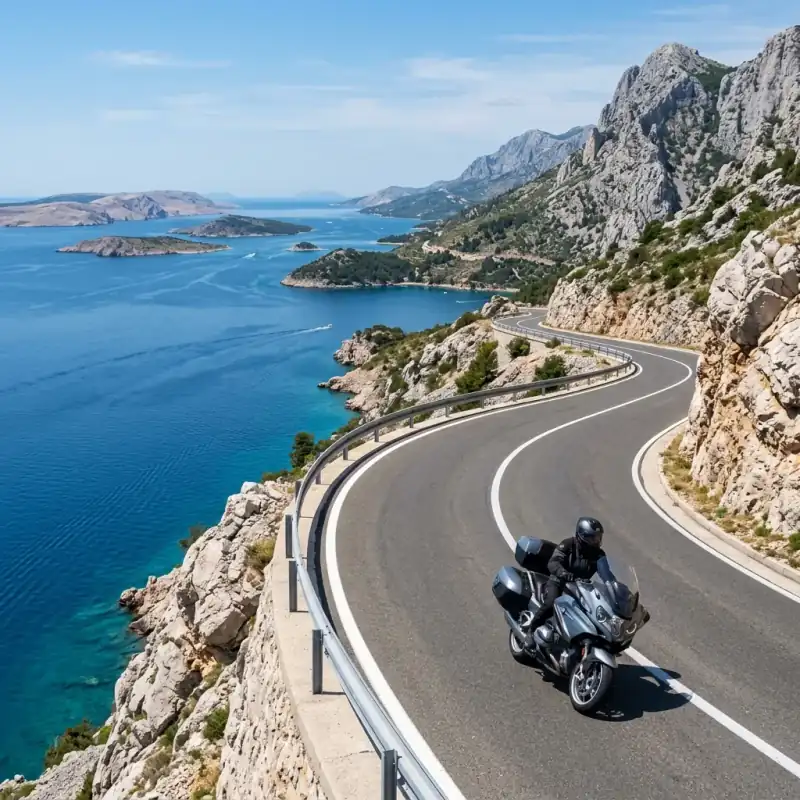
There’s a 40-kilometre stretch of the Croatian coast, between Karlobag and Tribanj, where the road, the rock and the sea line up into something close to a perfect motorcycle road. The Velebit mountains drop straight into the Adriatic, the tarmac is smooth, the curves are endless medium-speed sweepers, and the islands sit out on the water like stepping stones. This is the D8 Adriatic Highway, the Jadranska Magistrala, and it’s the reason riders have been pointing their bikes at Dalmatia for decades.
It’s also a coast with one big catch, and you should know it before you load the panniers: wild camping in Croatia is flatly illegal, and unlike the looser coasts to the south, it’s enforced. So this Croatia motorcycle route Dalmatian coast guide does two jobs. It maps the riding (the best of the D8, the Biokovo cliffs, the island hops) and it tells you straight where you can actually sleep, because getting that wrong on this coast costs real money.
If you’re building a wider Adriatic loop, this pairs naturally with our Albanian Riviera motorcycle guide an hour’s ferry to the south, where the camping rules are a great deal more relaxed.
The D8: One of Europe’s Great Coastal Roads
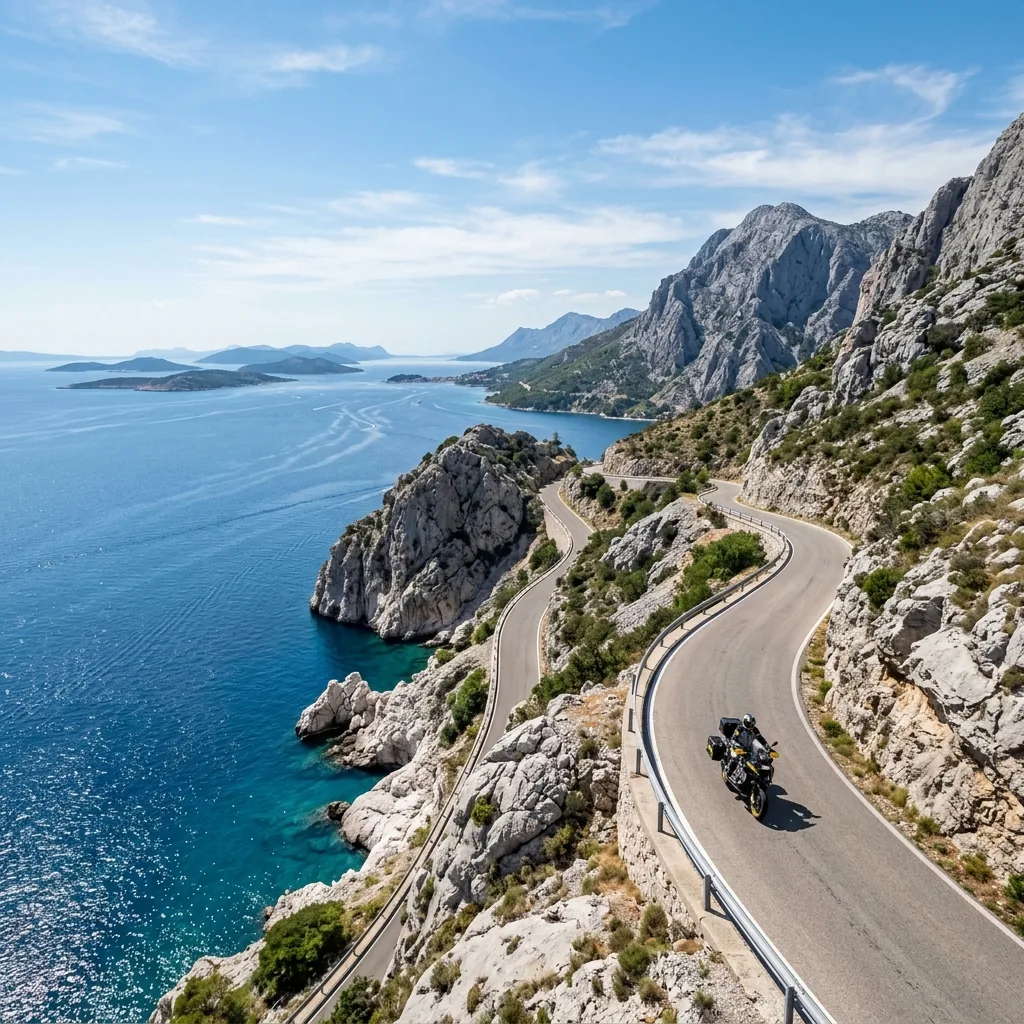
The D8, officially the Jadranska Magistrala or Adriatic Highway, runs roughly 650 km down the length of the Croatian coast, from the Istrian north to the Dubrovnik south. For touring riders it’s the single most famous road in the country, and for good reason: it spends most of that distance balanced between sea cliffs and the Adriatic, with one island-studded view after another.
You don’t need to ride all 650 km. The road has a clear highlight reel. The most celebrated section runs between Senj in the north and the Maslenica bridge further south, and the best of it, the part riders come back for, is the Karlobag to Tribanj stretch. Here the bare grey wall of the Velebit massif rises on one side and the sea drops away on the other, the surface is well-maintained, and the rhythm is flowing 60–90 km/h sweepers rather than anything frantic. Frequent pull-offs let you stop for the photo without holding up traffic.
The trade-off is summer. Outside July and August the D8 is quiet and a joy. In peak season it fills with holiday traffic, caravans and tour coaches, and the same corners that sing in June become a slow grind in August. Ride the shoulder seasons if you possibly can.
The Makarska Riviera and Biokovo
The other unmissable D8 section is further south: the Makarska Riviera, where the road runs along the foot of Mount Biokovo. The mountain’s grey cliffs rise sharply on the inland side while the Adriatic glitters below, and the stretch combines smooth tarmac, flowing curves and a string of pull-offs looking out over the islands of Brač and Hvar.
Makarska itself makes a good base — a proper coastal town with fuel, food, accommodation and campsites nearby, and the riding either side of it is some of the most rewarding on the whole coast. For the adventurous, the toll road up Biokovo itself climbs to over 1,700 metres for a view that takes in the entire central Dalmatian coast and, on a clear day, the far side of the Adriatic. It’s narrow and slow, but unforgettable.
This southern run also positions you for the island ferries and for pushing on toward Split, Korčula and eventually Dubrovnik.
Paklenica and the National Parks
Where the D8 meets the Velebit’s southern end, Paklenica National Park at Starigrad is the obvious off-the-bike stop — a pair of dramatic limestone gorges cutting back into the mountains, with walking trails and Croatia’s most famous big-wall climbing. It’s also, conveniently, home to one of the coast’s best-known campsites.
A word of warning that applies to all of Croatia’s parks — Paklenica, Plitvice Lakes, Krka. They have zero tolerance for camping outside official sites. Pitch a tent in a national park here and you’re looking at a guaranteed fine, not a quiet word. The good news is that the official sites are excellent, and at Paklenica the campsite sits right beside the park entrance.
This is the central tension of riding Dalmatia: the scenery practically begs you to throw down a tent on a headland, and the law says absolutely not. Which brings us to the part of this guide that matters most.
Where to Actually Sleep: Croatia’s Camping Reality
This is the part that saves you money. Wild camping in Croatia is illegal. Croatian law prohibits pitching a tent, parking a camper, or sleeping overnight in any public area not designated for camping, and it makes no exception for a discreet one-night bivouac. The ban applies to both public and private land.
The fines are not trivial: roughly €200 to €1,300 depending on where you are and who catches you, with the coast, the tourist zones and the national parks all enforced hard. Police patrol regularly through the May–September high season, and the Dalmatian coastal cities — Split, Zadar, Dubrovnik, and the islands of Hvar and Korčula run effectively zero tolerance for unauthorised overnight stays. This is the opposite of the situation just south in Albania or across much of the Balkans, and it catches a lot of riders out. Our Europe-wide wild camping legal guide lays out how sharply this varies country to country.
So what do you do instead?
- Use official campsites. Croatia has over 300 of them, many right on the coast, ranging from big resort sites to small family-run RV parks. Motorcycle-friendly pitches commonly start around €22 a night, and the infrastructure (showers, power, shade, somewhere to lock up) is good. This is the legal and practical answer.
- Camping Paklenica at Starigrad is a popular Dalmatian base, sitting beside the national park with standard and sea-view pitches.
- Ask a landowner. It is legal to stay a night or two on private land if the owner gives permission, and they shouldn’t charge you for it. In rural areas, away from the tourist coast, this is a real option and enforcement is far lighter inland.
- Inland is looser than the coast. If you really need to rough it, the strict enforcement is concentrated on the coast, the islands and the parks. The rural interior is barely policed by comparison, but it’s still technically illegal, so judge accordingly.
If your heart is set on falling asleep in a quiet bay with the bike beside the tent and no campsite fees, ride south to the Albanian Riviera, where that’s still tolerated. On the Dalmatian coast, the smart play is to enjoy the riding by day and pay for a legal pitch by night.
Riding the Islands
Dalmatia’s islands are half the appeal, and you can take the bike across. Jadrolinija and other operators run frequent car ferries from the mainland to Hvar, Brač, Korčula and the rest, and motorcycles are carried cheaply, often loaded first and waved off first, which is a small joy in itself.
The island roads are quieter and twistier than the mainland D8, and a couple of days hopping between them is the kind of riding that lodges in the memory. Two practical notes: book ferries ahead in July and August, when they fill, and remember that the islands are exactly where wild-camping enforcement is harshest. Plan every island night around an official campsite or a room.
Practical Notes for the Trip
- Documents and kit: helmets compulsory; carry licence, registration and insurance (a Green Card only for bikes registered outside the Multilateral Agreement area). Tolls apply on the inland A1, but the coastal D8 is free.
- Fuel: the coast is well-served with stations through the towns; no big gaps on the D8 itself.
- Season: late May–June and September are the sweet spots. July–August means heat, heavy traffic and peak prices.
- Money: Croatia uses the euro, and campsites, fuel and tolls are all straightforward to pay by card.
- Planning the bigger trip: if Dalmatia is one leg of a longer tour, our guide on how to plan a long-distance motorcycle trip covers the logistics of stringing coasts and ferries together.
Final Word
The Dalmatian coast gives you one of the finest coastal roads in Europe (the D8’s Karlobag sweepers and the Biokovo cliffs are worth a trip on their own) wrapped around a camping situation you have to take seriously. Wild camp here and you risk a four-figure fine; use the excellent official sites and you get a great-value, legal, beautiful tour.
Ride the D8 in the shoulder season, pay for your pitch, and save the free wild nights for the coast an hour’s ferry to the south. Do that, and Dalmatia is hard to beat.
If Dalmatia is one leg of a longer summer, our ultimate Europe adventure motorcycle routes guide covers how it links to the Alps, the Balkans and the rest of the Mediterranean coast.
A note on the costs: these are ballpark planning figures as of June 2026, not quotes. Ferry fares, campsite rates, fuel and tolls all move with the season and the operator — check current prices before you build a budget on them.
Frequently Asked Questions
Is the D8 Adriatic Highway good for motorcycles?
It's one of the best-loved coastal roads in Europe for riders. The D8 (Jadranska Magistrala) runs about 650 km down the Croatian coast, clinging to cliffs above the Adriatic with flowing curves, good tarmac and constant sea views. The most celebrated section is between Senj and the Maslenica bridge, and the very best of it is the Karlobag–Tribanj stretch — medium-speed sweepers with frequent pull-offs. Traffic is light outside July–August; in peak summer the coast clogs up badly.
Is wild camping legal in Croatia?
No. Croatian law prohibits any form of wild camping — pitching a tent, sleeping in a vehicle, or staying overnight anywhere not designated as a campsite, on both public and private land. This applies to bivouacs too. Fines run from roughly €200 up to €1,300 depending on source and location, and enforcement is real and regular on the coast, in tourist areas and in national parks, where police patrol through the May–September season. The honest answer for Croatia is: use official campsites.
Where can I legally camp on the Dalmatian coast?
Croatia has over 300 official campsites, many right on the coast, and they're the legal and practical answer. They range from large coastal resorts to small family-run sites, with motorcycle-friendly pitches commonly available from around €22 a night. Camping Paklenica at Starigrad, beside Paklenica National Park, is a popular Dalmatian base. You can also legally camp on private land if the owner gives permission. What you can't do is rough-camp the coast or islands — that's where the fines come from.
When is the best time to ride the Dalmatian coast?
Late May to June, and September into early October. You get warm, stable weather, swimmable sea and — critically — far less traffic than the July–August crush, when the D8 and every coastal town jam with holiday traffic and campsite prices peak. Spring and autumn also mean cooler riding over the exposed coastal sections and easier campsite availability. Winter is rideable but many coastal businesses and campsites close.
Do I need anything special to ride a motorcycle in Croatia?
Helmets are compulsory. Carry your licence, V5/registration and valid insurance (a Green Card only if the bike is registered outside the Multilateral Agreement area, which covers the EU, the UK, Switzerland, Serbia, Bosnia and Montenegro among others), and check your policy covers Croatia. Dipped headlights are required at all times in some conditions, and the usual European kit — reflective vest, the bike's documents — is worth having. Tolls apply on the A1 motorway inland, but the coastal D8 itself is toll-free.
Should I ride the coastal D8 or the inland A1 motorway?
Both, for different reasons. The A1 motorway inland is fast and gets you down the country quickly — useful for covering distance to reach the good bits. The coastal D8 is the scenic prize and the reason you brought the bike: slower, twistier, hugging the sea. The classic approach is to use the A1 to skip the dull transit legs and drop onto the D8 for the celebrated sections like Senj–Karlobag–Tribanj and the Makarska Riviera.
Can I take a motorcycle to the Croatian islands?
Yes. Jadrolinija and other operators run car ferries from the mainland to the major Dalmatian islands (Hvar, Brač, Korčula and others) and motorcycles are carried — usually cheaply and often loaded first. The islands add beautiful, quieter riding, but note that wild camping is enforced especially hard on the islands, so plan island nights around official campsites or accommodation. Book ferries ahead in peak summer.