
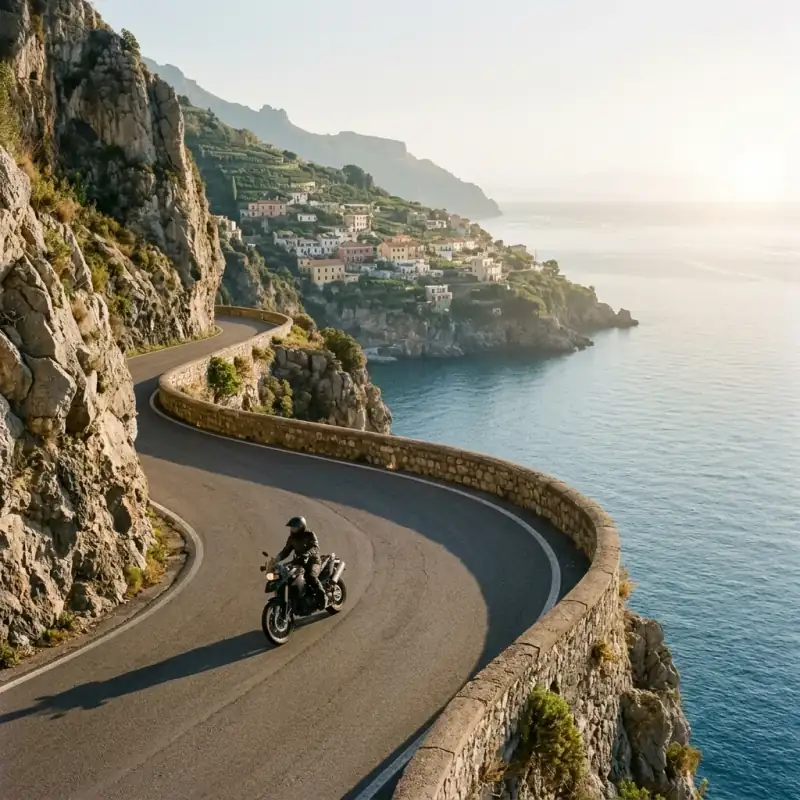
The SS163 is a different road before 10:00. From mid-morning in summer, coaches and buses fill the hairpins between Vietri and Positano and meet each other on blind bends, and a motorcycle spends much of the 40-odd km queuing behind them. Be on the coast road by 07:00 and the traffic is thin, the air is cooler and the sun is coming up over the Gulf of Salerno.
This guide is about riding that version of the road. It covers the rules that decide where a motorcycle can and can’t go in 2026, the odd/even plate restriction and the town-by-town ZTL gates, checked against the municipalities’ own documents rather than repeated from other guides. Then the timing, the parking, the fuel and the mountain roads that turn a coast ride into a proper day. We haven’t ridden it ourselves; everything below comes from official notices, road-operator bulletins, local reporting and mapping data.
The Road: What the SS163 Actually Is
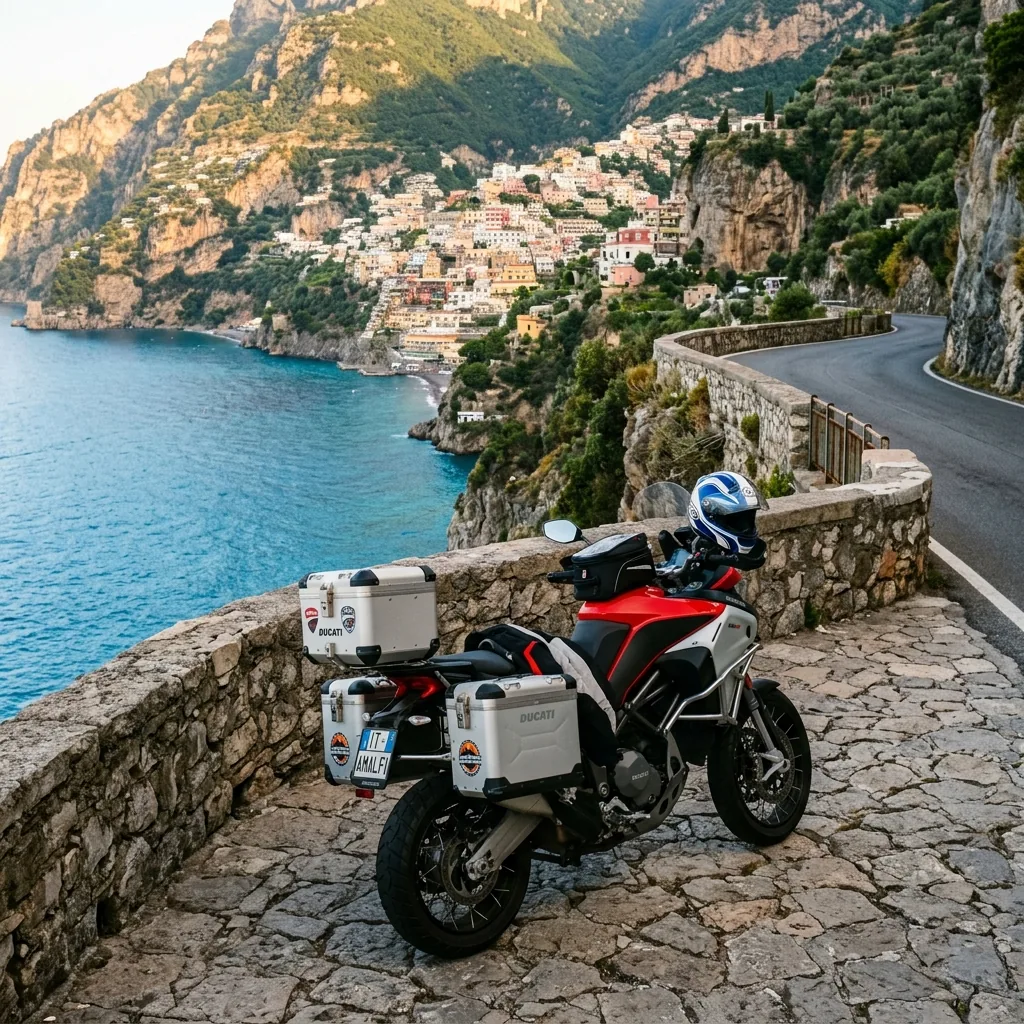
The Strada Statale 163 “Amalfitana” is 50.4 km long. It starts at Meta, on the Sorrento side, where it leaves the SS145, climbs over the ridge at Colli di San Pietro, drops down to Positano and then follows the coast east through Praiano, Furore, Conca dei Marini, Amalfi, Atrani, Minori, Maiori and Cetara to Vietri sul Mare, where it meets the SS18. Work started in 1832, the road was finished in 1850, and it was formally opened in 1853 under Ferdinand II of the Two Sicilies.
The part everyone means by “the Amalfi Coast road” is the roughly 40 km between Vietri and Positano, and that is also the stretch covered by the plate rule below. Mapping software will tell you it takes under an hour. It won’t, once you add the stops, the photo pull-ins and whatever is coming round the next bend.
What makes it hard is width. ANAS, the state road operator, describes the carriageway as under six metres in places, with rock faces right against the road and long runs of repeated bends and pinch points. That is why its ordinances (n. 337/2019 and 340/2019) keep campers and caravans off the Vietri-Positano stretch through the day and restrict large tour coaches in season. Local police do enforce it; coastal news has reported campers stopped and fined at Atrani.
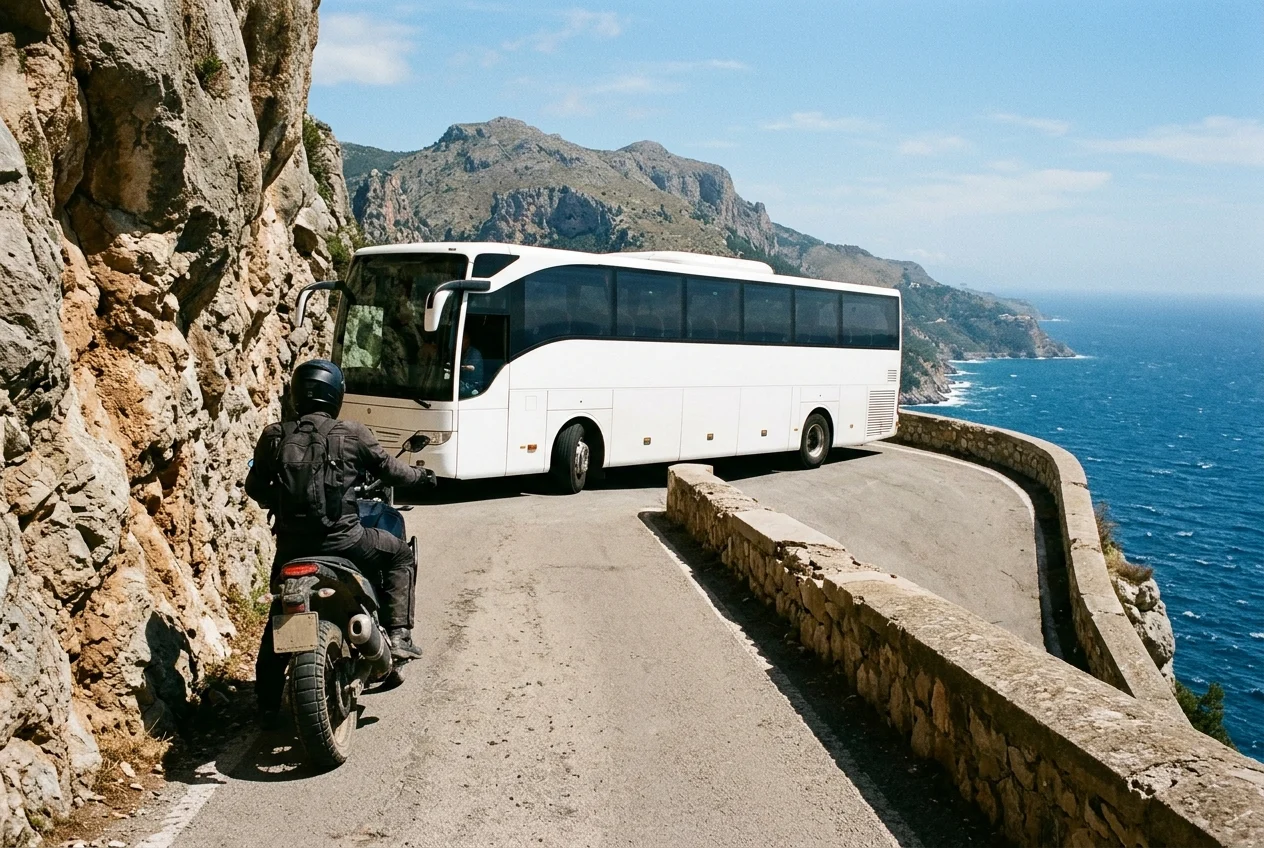
For a motorcycle, that narrowness is the whole point. A bike fits where a coach has to reverse. But the buses have not gone away. The public SITA buses and smaller tour minibuses still run the road all day, and meeting one on a blind hairpin is the single most important thing to be ready for.
Rule 1: The Odd/Even Plate Restriction (Motorcycles Are Exempt)
To cap summer car traffic, ANAS runs an alternating-plate restriction on the SS163 between Vietri sul Mare and Positano. It does not apply to motorcycles, scooters or any two-wheeled vehicle. The Amalfi municipality’s notice for 2026 states it directly.
The 2026 calendar, from the Amalfi municipality’s notice and local tourism sources:
| Period (2026) | Days active | Hours |
|---|---|---|
| 30 Mar - 6 Apr | Every day | 10:00-18:00 |
| 24 Apr - 2 May | Every day | 10:00-18:00 |
| June and July | Sat, Sun, holidays | 10:00-18:00 |
| August and September | Every day | 10:00-18:00 |
| October | Sat, Sun, holidays | 10:00-18:00 |
How it works for cars: on odd-numbered dates, vehicles whose plate ends in an odd digit are banned; on even dates, even digits are banned. It is the last number on the plate that counts. Italian plates end in two letters, so on a plate like AB 123 CD the digit that matters is the 3.
Exempt, besides two-wheelers: residents of the 14 coast municipalities, vehicles displaying a disability permit with the holder on board, taxis and hire-with-driver cars, emergency and police vehicles, and several groups with paperwork, including hotel guests with a reservation, non-resident workers and non-resident property owners. A car caught on the wrong day faces a fine of roughly €80 to €340, the same highway-code band as a ZTL fine.
Why a rider should still care:
- If anyone in your group is in a car, a support vehicle or a partner in a hire car, the rule applies to them. Check the plate before planning the day.
- Hire-car logistics bite on arrival days. If you collect a rental bike and your luggage follows by car or taxi, the timing matters.
- It shifts traffic, it doesn’t remove it. Cars with the wrong plate can still drive before 10:00 and after 18:00. On daily-restriction days in August and September, don’t expect the early slot to be as empty as it is in May.
Rule 2: ZTL Zones, Town by Town
A ZTL (zona a traffico limitato) is a restricted-traffic zone, usually a historic centre, and in these towns entry is increasingly policed by cameras that read plates. Each municipality decides for itself whether motorcycles are exempt, so “bikes can go anywhere” is not a safe assumption. A ZTL fine runs to roughly €80-€340 per passage past an active gate, cut by 30% if paid within five days, so riding in and out twice is two fines. On a hire bike, it arrives through the rental company months later.
Positano
Positano’s ZTL covers Via Pasitea, Piazza dei Mulini and Via Cristoforo Colombo, the one-way loop that runs down through the town, and access is recorded by electronic gates. According to the municipality’s own portal guide (version 1.2, 20 May 2026), the vehicles that must register and pay to enter are vehicles with six or more seats including the driver and buses up to 7.70 m long and 2.20 m wide, Euro 3 or cleaner; larger buses can’t enter at all. A van pays €5 per transit (or €100 a month), and a bus pays €60 to €90 per transit depending on its emissions class, within 72 hours of entering.
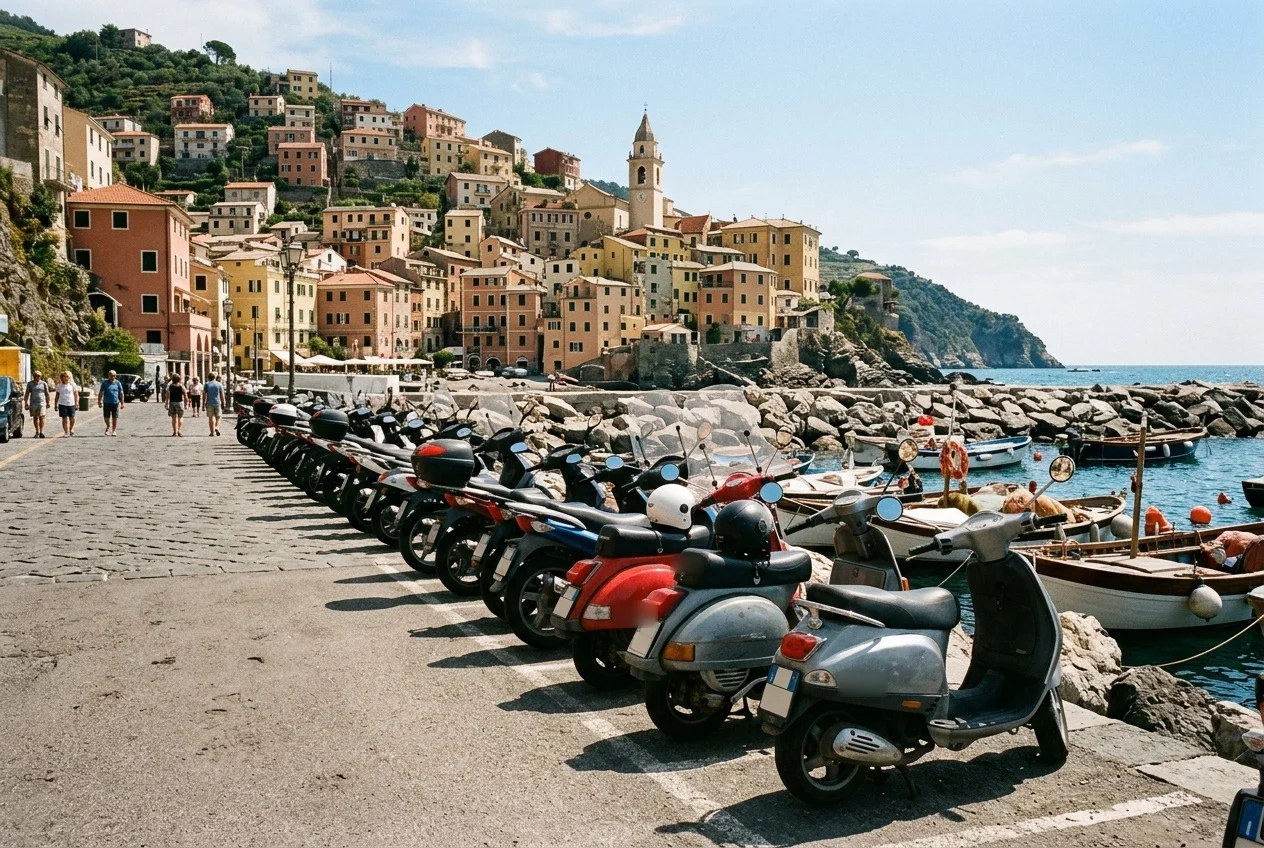
Motorcycles are not on that list. For a rider, Positano’s problem is parking, not access. A local scooter-rental operator’s parking guide points riders to the motorcycle bays along Viale Pasitea, and contrasts two-wheeler rates of a few euros with car parking at around €10 an hour. Treat that as indicative, since it comes from a business that rents scooters, but the direction is right: on a bike, Positano is reachable. Just don’t leave the bike on the SS163 above town, where there is no room for it.
Amalfi
This is the one that catches visitors, and the earlier version of this guide got it wrong. Amalfi has a formal ZTL, set out in the town’s traffic regulation (approved by council resolution 149 of 23 November 2022, updated April 2023). In plain terms it is the historic spine behind the cathedral, Piazza Duomo, Via Lorenzo d’Amalfi and Via Pietro Capuano, plus the streets that feed them. (The full list: Via Mansone I, Piazza Duomo, Via Lorenzo d’Amalfi, Via Pietro Capuano, Piazza Spirito Santo, Via Cardinale Marino del Giudice, Via Casamare, Via delle Cartiere and Largo Ex Saponiera.)
The regulation lists who may enter: residents with a green permit, authorised medical staff, disability permit holders, and a set of service categories such as suppliers, taxis and emergency vehicles, mostly with time limits. There is no exemption for a visitor’s motorcycle. The one route in for a traveller is a hotel inside the ZTL that has its own garage: the hotel registers your plate with the town’s mobility company. On top of that, stopping of any kind is banned around the clock on Via Mansone I, Piazza Duomo, Via Lorenzo d’Amalfi and Via Pietro Capuano, and a new permit system started on 1 January 2026.
So park outside the centre. The regulation names the public pay car parks: Luna Rossa, Flavio Gioia I and II, Darsena, Piazzale dei Protontini and the outer side of the harbour pier, all a short walk from Piazza Duomo.
Vietri sul Mare
The searches for “Vietri ZTL” are about the hillside, not the coast road. In autumn 2025 Vietri approved a new ZTL for its upper hamlets of Raito and Albori, with an electronic gate at Raito, police checks at Albori, and a trial period to settle hours and access. The SS163 through Vietri itself is not part of it. If your hotel is up in Raito or Albori, ask it how guests’ vehicles are handled.
Everywhere else
Maiori, Minori, Ravello, Praiano and the rest have their own centres, pedestrian areas and parking rules, and they change. The practical habit: read the sign before the gate. A ZTL sign with “varco attivo” means the camera is live; the white panel underneath lists who is exempt, and if it doesn’t say motocicli, assume you are not.
Italian Road Rules That Catch Visiting Riders
A few national rules matter more here than on a motorway:
- Dipped headlights on, always. Italian law (article 152 of the highway code) requires motorcycles to ride with dipped beams at all times, in towns and in daylight, unlike cars.
- Filtering is tolerated, not written into law. Italy has no rule that explicitly allows riding between lanes; it falls under the general overtaking and lane rules, and local scooters doing it in a Naples queue are not proof it is legal. On the SS163 the question barely arises: behind a coach on a blind hairpin, you wait. Don’t pass on a bend or across solid lines to escape a bus queue.
- Non-EU licence? Carry an International Driving Permit. Rental companies and Italian police can ask for one alongside your licence; our border crossing documents guide covers the paperwork.
- Parking lines mean different things. Blue lines are paid parking, yellow lines are reserved (residents, disabled permits, loading), and on this coast white lines are often signed for residents too. Read the sign, not the paint.
- Never block a driveway or a bend. A “passo carrabile” sign marks a driveway; parking in front of one, or anywhere on the narrow SS163, invites a ticket or a tow.
- The ferries won’t carry the bike. The coastal fast ferries such as Travelmar take foot passengers only, so you can’t hop a stretch of the road by boat with the motorcycle.
Road Closures: Check Before You Ride
The SS163 is cut into unstable cliffs, and in 2026 it closed three times that made the news:
- February: a landslide between km 47+250 and 47+350, on the Cetara side near the Vietri end, closed the road on 6 February. It reopened on 10 February with traffic lights and one lane, while about three weeks of rock-face work went on.
- Late July: rock fell from a private cliff at km 9.7, Tordigliano, on the Vico Equense side above Positano. The road shut on 27-28 July, reopened with alternating one-way traffic on 29 July and to two-way traffic on 30 July, after protective netting went in.
- 13 September: a night-time hillside fire above Positano was followed by debris on the road between km 16.0 and 16.8. ANAS closed it to clear the slope, reopened it with alternating traffic, and restored normal two-way traffic from 17:00 the same day.
None of these lasted long, but any of them would wreck a day ride from Sorrento or Salerno. Check ANAS traffic news or a local news site the morning you set out, and know the inland alternatives below. When the coast road is shut on one side, the mountain roads are how you get around it.
The SS163, Section by Section
Distances below are approximate road distances from routing data, not official figures.
Vietri sul Mare to Maiori (about 15 km)
The eastern end starts at Vietri, the ceramics town, and climbs along the cliffs past Cetara, about 5 km in, a fishing village known for anchovies and colatura. It then drops to Maiori, the longest beach on the coast. This is the gentlest section and the best warm-up: wider in places, easier hairpins and more room to stop. Vietri has a 24-hour fuel station, the last easy fill before the coast road going west.
Maiori to Amalfi (about 6 km)
A short, pretty run through Minori, quieter than its neighbours and good for a coffee, then past Atrani, a tiny village tucked into a gorge, and into Amalfi. Remember the ZTL: park at the harbour car parks and walk up to the Duomo.
Amalfi to Positano (about 18 km)
The most photographed and most demanding stretch. It passes Conca dei Marini, the bridge over the Fiordo di Furore (a narrow sea gorge worth a pull-in if there is space), and Praiano, about 8 km from Amalfi, before the long run into Positano. It is continuous hairpins between rock and drop, with the sea straight below. Speeds are low, lines matter, and every blind bend should be ridden as if a bus is on the other side of it, because sooner or later one is.
Positano to Meta (about 15 km)
West of Positano the SS163 leaves the coast and climbs over the ridge at Colli di San Pietro, then descends to Meta on the Sorrento side, where it joins the SS145 towards Sorrento or Naples. It is quieter and less dramatic, and it is the stretch that closed at Tordigliano in July. Older guides, including an earlier version of this one, describe the road running out to Punta Campanella. It doesn’t; that is the SS145 side of the peninsula.
The Mountain Roads: Better Riding, Fewer Buses
The Lattari Mountains behind the coast carry some of the best riding in the region, and they double as your escape routes when the coast road is shut or jammed.
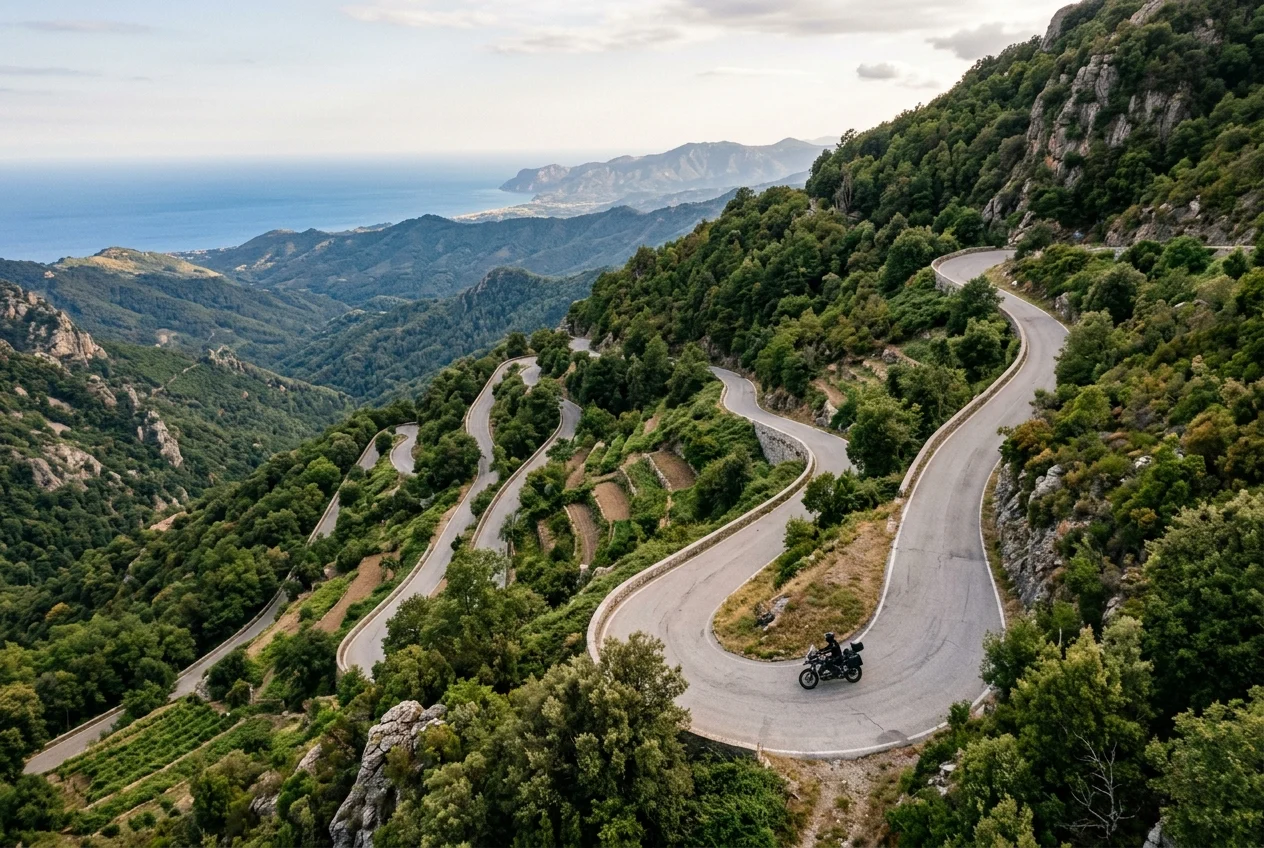
The Agerolina (ex-SS366, now a regional road). It leaves the SS163 at Vettica Minore, just west of Amalfi, and climbs 30.6 km through Conca dei Marini, Furore and Agerola before dropping through Pimonte and Gragnano to Castellammare di Stabia, where it meets the SS145. It includes four tunnels, the longest of them, Palombella, 916 m. It is tight, steep and far calmer than the coast. At Agerola, the Bomerano hamlet is the start of the Path of the Gods walk, if you want to see the coast from above on foot.
The Valico di Chiunzi (SP 2). The pass sits at 656 m between Tramonti and Sant’Egidio del Monte Albino. From the coast, take SP 2/b up from Maiori through Tramonti, cross the pass, and descend by SP 2/a through Corbara towards the Naples side, with views back to the sea and across to Vesuvius. At the top the road also forks towards Ravello through Cesarano, which makes a loop possible.
Ravello (ex-SS373). The branch road up from the coast near Castiglione to Ravello is short, twisty and worth it for the town and its gardens. Combined with Chiunzi it makes a coast-and-mountain loop of a few hours.
None of these roads is covered by the SS163 plate rule, and all of them are better company than the coast road at midday.
Fuel and Parking
Fill up before the coast road. OpenStreetMap, checked in September 2026, shows only a handful of pumps directly on the SS163 between Vietri and Positano: two at Positano, one between Furore and Conca dei Marini, and the 24-hour station at Vietri. There are more in the hill towns, around Ravello, above Maiori towards Tramonti and on the Agerola and Gragnano side. Small stations keep short hours, so the easy rule is to fill in Salerno or Vietri riding west, or in Meta or Sorrento riding east.
Parking. In Amalfi, use the named public car parks by the harbour. In Positano, look for the motorcycle bays along Viale Pasitea. Everywhere, never leave a bike on the carriageway of the SS163; there is rarely a verge, and police ticket and tow.
When to Ride
The weather and the plate calendar point the same way. Average daily highs for Salerno, at the eastern end of the coast:
| Month | Avg high (Salerno) | Rain days | Plate rule for cars |
|---|---|---|---|
| April | 20.4°C | 10 | Easter period (to 6 Apr) |
| May | 24.6°C | 7 | 24 Apr - 2 May |
| June | 28.5°C | 5 | Weekends, holidays |
| July | 31.2°C | 4 | Weekends, holidays |
| August | 31.3°C | 5 | Every day |
| September | 28.3°C | 7 | Every day |
| October | 23.9°C | 9 | Weekends, holidays |
Late April to May is the pick: comfortable riding temperatures, spring flowers and fewer visitors, with the sea still cool at around 19°C in May. Avoid the Easter week and the 24 April to 2 May holiday stretch if you want the quietest road. September into early October is the other window: the sea at around 25°C, settled weather, but daily plate restrictions and plenty of people until late September. July and August are the hardest months, with average highs above 31°C, the most traffic and the highest prices. From November to March, many hotels and restaurants close and storms are more likely, though the roads are quiet.
Within the day, ride early. Before 10:00 the road is at its emptiest and coolest, and the low sun on the sea is the light you came for. The evening from around 17:00 is the second window, as day-trippers head home.
Luggage and Where to Stay
Keep it narrow. Wide hard cases and big top boxes are the thing that turns a hairpin into a problem, especially when a bus has pushed you towards the wall. Soft luggage or slim cases work best, and the easiest answer of all is to leave the luggage at a base and ride the coast unloaded. Our soft vs hard panniers guide explains the trade-offs.
Where to base yourself:
- Salerno (east). A proper city with more parking and cheaper rooms, and the SS163 starts minutes away at Vietri. Less romantic, very practical.
- Amalfi town (middle). Central and walkable, but remember the ZTL: unless your hotel is inside it with a garage, the bike lives in a harbour car park.
- Sorrento (west). Just off the SS163 at Meta. Good for Positano, the Capri ferries and the Naples side, and usually cheaper than Positano.
- Positano itself only if your hotel includes parking. The town is reachable on a bike, but parking is scarce and expensive.
Disclosure: some links below are affiliate links. If you buy through them we may earn a small commission at no extra cost to you.
Check Compact Soft Panniers on Amazon →
Guided Tour or Self-Ride? Planning a Short Two-Up Trip
Most packaged guided Amalfi tours run seven to nine days; Italy Moto Tours’ Amalfi Dream Ride, for example, is an eight-day loop out of Rome. For a long weekend there are two realistic routes: ask an operator to build a private short tour (most will quote one even if it isn’t on the website), or rent a bike and ride it yourself with this guide.
Budget anchors. A Multistrada-class bike rents for roughly €55–100 a day in Italy, often with a helmet included; watch for mileage caps and the deposit. Bundled guided tours commonly work out at around €300–500 per person per day, and Italy Moto Tours’ eight-day Amalfi trip is about $10,000 for a couple, all in. A private tour for two is quoted case by case and sits above group rates.
Why guided suits a nervous passenger. The SS163 is narrow and shared with full-size coaches meeting on blind hairpins. A local guide sets the pace and line, handles parking and lunch stops, and often brings a support van for the luggage, which a nervous passenger can also ride in for any stretch. Some operators only run the van above a minimum group size (Italy Moto Tours notes four riders), so ask how luggage works on a two-person booking.
For a first-time pillion:
- Do a short shakedown ride together at home before you fly, so the first time on the back isn’t on a cliff road.
- Hours of switchbacks can bring on motion sickness: eat lightly, look up and out toward the corner rather than down, and stop when needed.
- Fit an intercom. Being able to say “slow down” or “pull over at the next viewpoint” changes the trip. Our intercom guide compares them.
- Choose a touring or adventure bike, not a low sportbike, for two people and luggage on this road.
A relaxed three-night shape: fly into Naples, the gateway airport (roughly 1h20 to the coast off-peak, much longer on summer afternoons). Ride the SS163 from a Sorrento or Salerno base on day one, loop the quieter Lattari mountain roads on day two, and keep day three short.
Rental small print: a big bike needs a full, unrestricted licence (carry an International Driving Permit if your licence is non-EU); many firms set a minimum age, often 25 for the bigger bikes, and hold a sizeable deposit; ask what the damage excess is; and check whether jackets, gloves and back protectors are included, since helmets usually are and the rest often isn’t.
Operators to research (a starting list, not endorsements; we haven’t toured with them): Italy Moto Tours caters for couples riding two-up; HP Motorrad rents a large Ducati and BMW range and runs tours; All Routes Italy runs guided Amalfi tours; Mototouring bundles guide, hotels and ferries in southern Italy. Mad or Nomad keeps a wider directory of Italian rental and tour companies.
Adding the Ducati Museum? It’s in Bologna, roughly 640 km and six to seven hours’ drive from the Amalfi Coast. On a short trip, don’t ride between them: spend a night in Bologna, then take the high-speed train or a domestic flight to Naples. Factory tours run on limited days and sell out, so book online.
Amalfi Coast Riding Checklist
- Know the plate calendar if anyone in your group is travelling by car
- Save the Amalfi ZTL street list and park at the harbour
- Headlights on, always; it’s the law for motorcycles in Italy
- Ride before 10:00 or after 17:00, midweek if possible
- Narrow luggage, or none: leave it at the hotel
- Fuel in Salerno, Vietri, Meta or Sorrento before the coast road
- Check ANAS traffic news for landslide closures the morning you ride
- Have the Agerola or Chiunzi road ready as a plan B
If you plan to film the ride, read our motorcycle action camera guide first. It covers the helmet-mount question and how Italy and its neighbours treat riders who record the road.
Related Guides
- Best coastal motorcycle routes in the Mediterranean: Amalfi against the other great coast roads
- Europe motorcycle border crossing documents: the paperwork for riding into Italy
Disclosure: Some links in this article are affiliate links. If you buy gear through them, we may earn a small commission at no extra cost to you.
Frequently Asked Questions
Are motorcycles exempt from the Amalfi Coast plate restrictions?
Yes. The odd/even plate rule on the SS163 between Vietri sul Mare and Positano does not apply to motorcycles, scooters or any two-wheeler; the Amalfi municipality's 2026 notice says so directly. It runs 10:00 to 18:00 on its active days. Be careful not to stretch the exemption: it covers the plate rule only, and some town-centre ZTLs, including Amalfi's, still apply to a visitor's motorcycle.
Which days does the SS163 plate rule apply in 2026?
30 March to 6 April and 24 April to 2 May, then Saturdays, Sundays and holidays in June and July, every day in August and September, and weekends and holidays in October, always 10:00 to 18:00. On odd dates, cars whose last number is odd are banned; on even dates, even ones. Italian plates end in letters, so it is the last number on the plate that counts, not the last character.
Can I ride a motorcycle into Positano?
Yes. Positano's camera-controlled ZTL covers Via Pasitea, Piazza dei Mulini and Via Cristoforo Colombo, and the municipality's own May 2026 portal guide says the vehicles that must register and pay are those with six or more seats and small buses. Motorcycles are not on that list. The real limit in Positano is parking, not access.
Can I ride into Amalfi town's centre?
Not as a visitor. Amalfi's historic centre, from Piazza Duomo along Via Lorenzo d'Amalfi and Via Pietro Capuano, is a ZTL whose regulation lists residents, medical staff, disability permit holders and a few service categories, with no exemption for a tourist's motorcycle. The exception is a hotel inside the ZTL with its own garage, which registers guests' plates. Everyone else parks in the public car parks by the harbour.
What time of day should I ride the SS163?
Early. Before about 10:00 the road is quieter and cooler, and the light on the sea is at its best; late afternoon into evening is the other good window. Midday is when coaches, public buses and day-trippers fill the hairpins. On August days, when the plate rule runs daily, expect some cars with the banned plate to use the hours just before 10:00 and after 18:00.
Is the SS163 open? It seems to close a lot.
It closes more than visitors expect. In 2026 alone a landslide near Cetara shut it in February, rockfall at Tordigliano, west of Positano, closed it for two days at the end of July, and debris after a hillside fire near Positano closed it for part of 13 September. Check ANAS traffic news or local news the morning you ride, and know your inland alternatives over the mountains.
Is the SS163 too much for a less experienced rider?
It is paved throughout and not technical in the off-road sense, but it is narrow, blind and busy. ANAS describes the carriageway as under six metres wide in places, and you will meet buses on hairpins. A rider comfortable on Alpine or Pyrenean passes will be fine. Someone whose riding is mostly main roads should practise on tight mountain hairpins first, or ride it very early.