
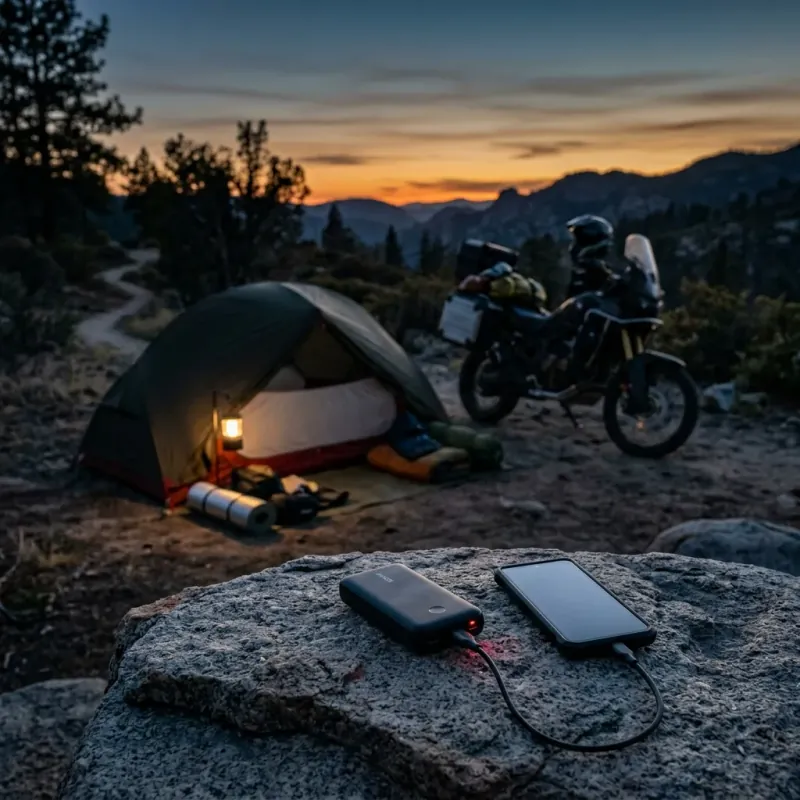
There’s a specific kind of quiet panic that comes from watching your phone hit 4% as you’re trying to find a remote bay you’ve never been to, with the light going. No map, no offline notes, no photos, and if something goes wrong, no way to call anyone. Power isn’t a luxury on a camping trip. It’s the thing that quietly underpins navigation, safety and every photo you’ll actually keep.
The trouble is most “best power bank” lists are written for backpackers and ignore the one advantage a motorcycle gives you: a running engine that can charge things all day. So this guide is built around how riders actually stay powered — two layers, and a bit of maths so you buy the right size instead of guessing.
Nitecore NB10000 Gen 4
Compact, affordable and reliable. The no-brainer pick for most moto campers.
Check Nitecore NB10000 Gen 4 on Amazon →The Two-Layer System
Think about power in two layers and the whole thing gets simple.
Layer one is the bike. Your engine is a generator. A hardwired USB charger wired to the battery (through a fuse) keeps your phone, GPS and intercom topped up the entire time you’re moving, which on a touring day is most of the day. You arrive at camp with full devices instead of empty ones.
Layer two is the power bank. When the engine’s off — at camp, in the tent, on a rest day. The power bank covers you. It’s your reserve, not your main supply.
Run both and you basically never think about charge again. Run only a power bank and you’ll spend evenings rationing it. The picks below cover both layers: four banks for layer two, and a proper bike-side charger for layer one.
The Battery Maths Worth Knowing
Two numbers stop you from buying the wrong thing.
Real capacity is about 60–70% of the printed number. A 10,000 mAh bank is rated at the cells’ 3.7 V, but your phone charges at 5 V, and the conversion loses energy as heat. So that 10,000 mAh delivers roughly 6,000–7,000 mAh to your phone — call it one and a half charges. A 20,000 mAh bank gives you about three. Size accordingly: 10,000 if you recharge daily, 20,000 if you can’t.
And if you ever fly to a rental: airlines measure in watt-hours, where Wh = (mAh ÷ 1000) × 3.7. So 10,000 mAh = 37 Wh and 20,000 mAh = 74 Wh — both under the 100 Wh carry-on limit, both fine. Anything over 100 Wh needs approval; over 160 Wh is banned. Carry-on only, never checked, and the Wh number has to be printed on the bank.
Power & Charging Compared — Side by Side
5 Picks — Side by Side
| Item | Capacity / Output | Weatherproof | Price | Rating |
|---|---|---|---|---|
| Best for MotoNitecore NB10000 Gen 4 | 10,000 mAh · 22.5 W | IPX7 | $ | |
| Most CapacityAnker 737 PowerCore 24K 140W | 24,000 mAh · 140 W | No | $$$ | |
| ELECOM NESTOUT 10000mAh rugged power bank | 10,000 mAh · 20 W | IP67 (submersible) | $$ | |
| YONHAN SAE-to-USB-C motorcycle charger | Bike-side · 60 W | Waterproof | $ | |
| INIU 45W 10000mAh power bank | 10,000 mAh · 45 W | No | $ |
1. Nitecore NB10000 Gen 4 — Best for Motorcycle Camping
The Nitecore NB10000 Gen 4 is the one most riders should just buy and stop thinking about. It’s 10,000 mAh in a carbon-fibre body that weighs 143 g — around half what a typical bank of this capacity weighs — with two USB-C ports and 22.5 W output, enough to fully charge a modern phone once and top it up again before you’re back in the saddle. It’s genuinely slim, and the IPX7 rating means a shower landing on an open tank bag is a non-event, which is not something most banks this size can claim.
It won’t win a spec sheet fight. The output is modest next to a laptop-class bank, and while IPX7 shrugs off a downpour, the X in that rating means no dust protection at all — trail grit and fine ash are not covered. But that’s fine. Its job is to refill a phone and a headlamp at camp, not charge a laptop. Paired with a hardwired bike-side charger for the riding day, this covers the overnight reserve layer for the cost of a decent dinner. For most riders doing a week or less with daily charging opportunities, this is simply enough.
Disclosure: some links below are affiliate links. If you buy through them we may earn a small commission at no extra cost to you.
Check Nitecore NB10000 Gen 4 on Amazon →
- 143 g carbon fibre — half the usual weight
- Dual USB-C, one charge per night
- IPX7 — rain on the tank bag is fine
- Modest 22.5 W output — not for laptops
- IPX7 covers water, but not dust or drops
2. Anker 737 PowerCore 24K — Most Capacity
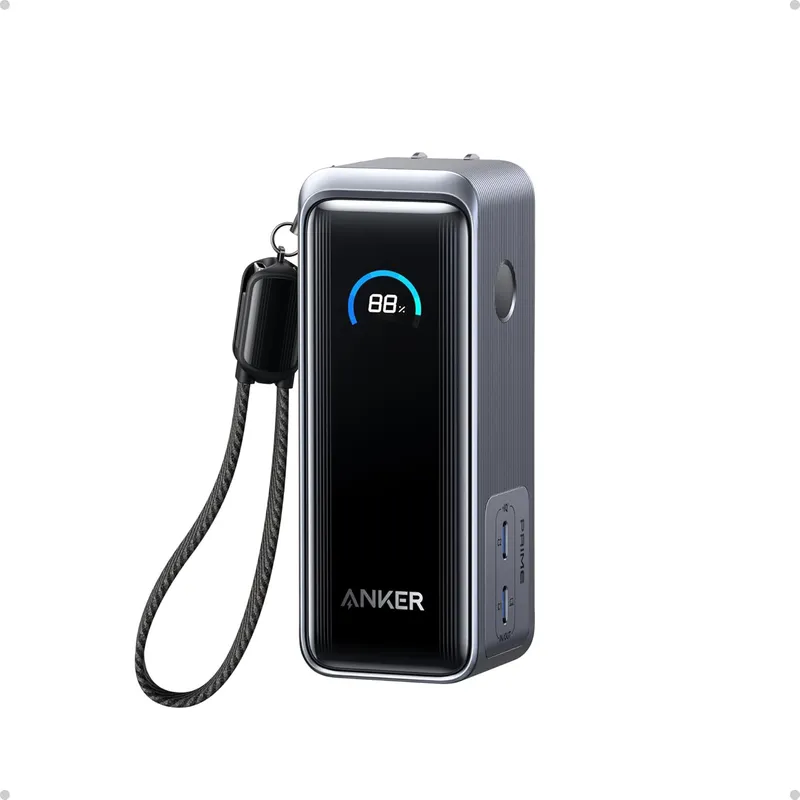
When you carry a laptop, can’t recharge nightly, or just want to stop worrying entirely, the Anker 737 PowerCore 24K is the heavyweight. At 24,000 mAh it delivers roughly three and a half full phone charges in real use, and the 140 W max output will fast-charge a laptop and a phone simultaneously without slowing either down. A smart LED display shows you exactly what’s going in and out, and it refills itself in around 90 minutes at high wattage.
It’s heavier and pricier than the NB10000, and it’s not weatherproof, so it lives in a dry bag or pannier rather than out on the tank. But for a long trip with serious electronics — GoPro, intercom, GPS, laptop — or for the rider who’d rather carry one substantial bank than nurse two small ones, this is the dependable choice. (Camera draw varies a lot between models; the helmet camera comparison covers which ones actually last a riding day.) At 88.8 Wh it’s still under the 100 Wh carry-on limit, so it flies legally in your hand luggage.
Check Anker 737 PowerCore on Amazon →
- ~3.5 phone charges; fast-charges laptops too
- 140 W out, smart display, fast self-recharge
- Flight-legal at 88.8 Wh
- Heavier and pricier than a basic 10k
- Not weatherproof — keep it in a dry bag
3. ELECOM NESTOUT — Best Rugged / Waterproof
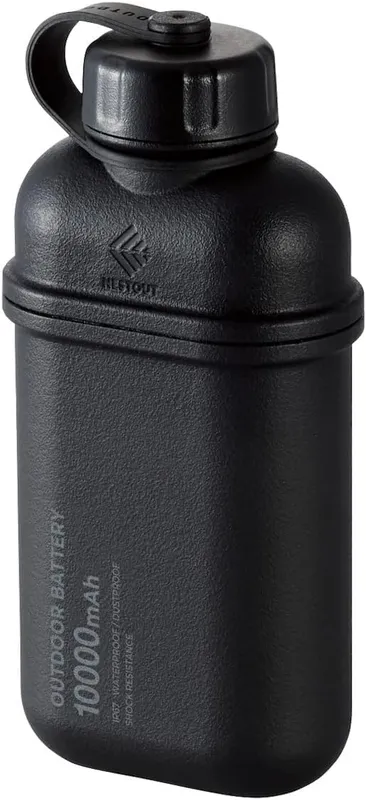
If you ride in genuinely wet, dusty, drop-it-on-rocks conditions, the ELECOM NESTOUT 10000mAh rugged power bank is built for the abuse. It carries an IP67 rating — properly submersible, dust-sealed — in a shockproof shell, with 20 W USB-C output and even a ¼-20 tripod thread on the base for clipping on the brand’s modular lantern and light accessories.
It’s a bit heavier and pricier than a bare 10,000 mAh bank, and that’s the trade for the sealing. But this is the one you can leave clipped to the outside of a bag in the rain, fish out of a muddy pannier, or set down on a wet rock at camp without a second thought. For hard off-road and bad weather, peace of mind is worth the few extra grams.
- IP67 — submersible and dust-sealed
- Shockproof, genuinely rugged
- Tripod mount + modular light accessories
- Heavier and dearer than a basic 10k
- 20 W output is modest
4. YONHAN SAE-to-USB-C — Best Bike-Side Charger
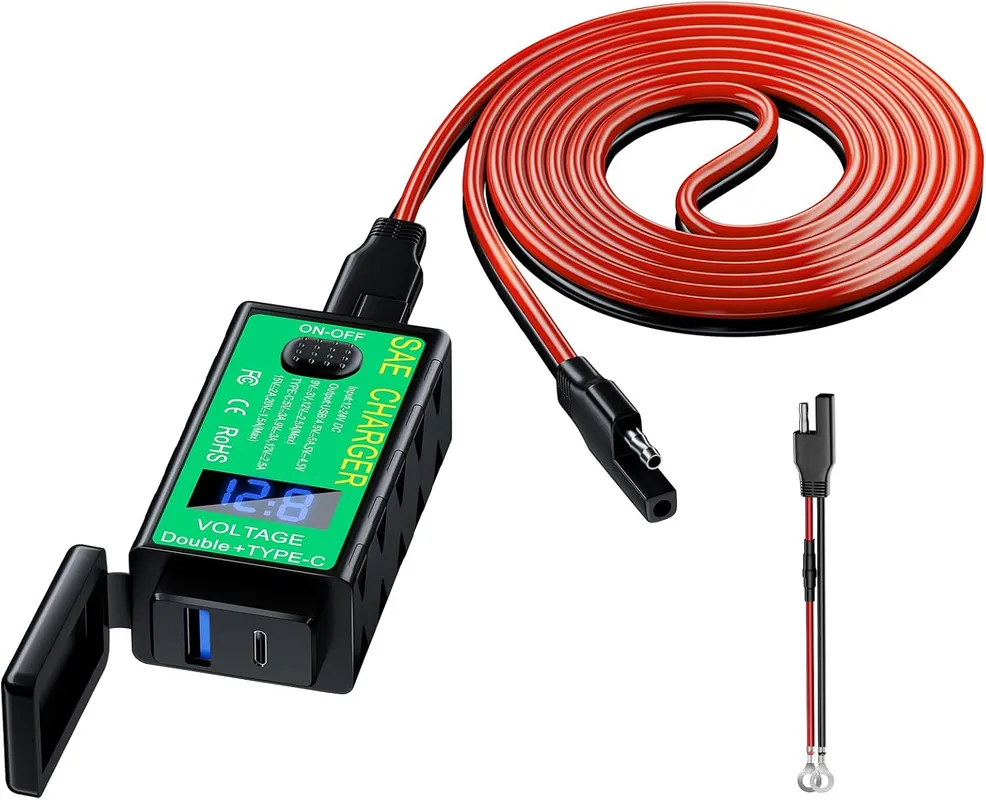
This is layer one. The part that charges while you ride. The YONHAN SAE-to-USB-C motorcycle charger wires to your battery (ideally off an SAE pigtail with an inline fuse) and gives you dual ports — USB-C Power Delivery and Quick Charge 3.0, 60 W total — plus a little LED voltmeter so you can actually see your system voltage. It’s waterproof, has an on/off switch, and the SAE quick-disconnect means you can unplug it for winter or a battery tender in seconds.
The voltmeter is the underrated bit: glance down at a red light and you’ll know if your accessories are pulling more than the bike is making before you flatten the battery (if it has already gone flat, our motorcycle won’t start guide explains what the voltage numbers mean). Wiring it is a ten-minute job — SAE lead to the battery, fuse inline, route the port somewhere weatherproof near the bars. For long-distance riders this is the single highest-value upgrade here, because it makes the power banks a backup rather than a lifeline.
Check YONHAN Charger on Amazon →
- Charges everything while you ride
- USB-C PD + QC3.0, 60 W, built-in voltmeter
- Waterproof, SAE quick-disconnect
- Needs a (simple) wiring install
- Mind your stator's spare wattage on small bikes
5. INIU 45W — Best Budget
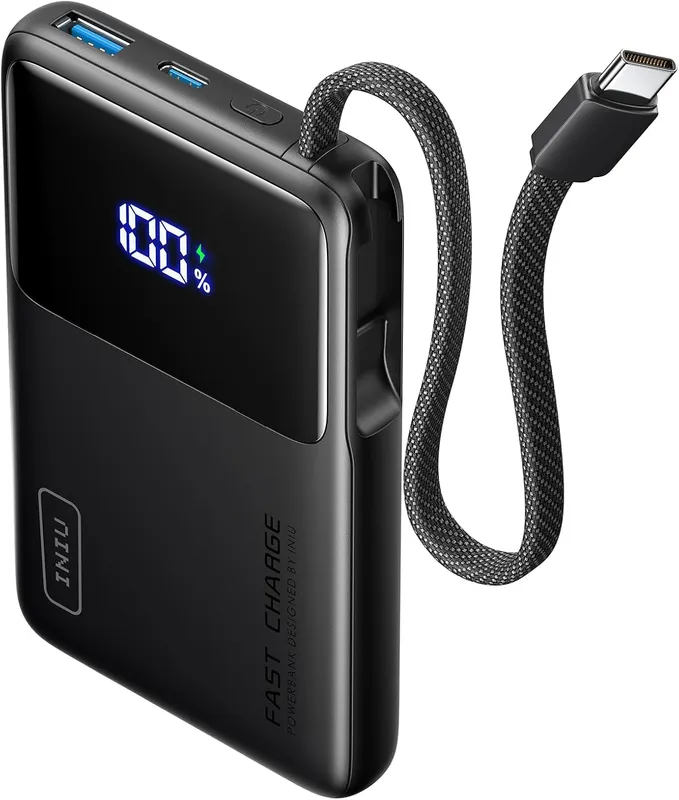
The INIU 45W 10000mAh power bank is the easy, cheap pick that doesn’t feel cheap. It’s genuinely slim, has a built-in USB-C cable so there’s one fewer thing to forget, pushes a respectable 45 W of PD fast-charging, and comes with a long warranty. For a rider who wants a reliable one-night reserve without overthinking it, this is plenty.
It’s not weatherproof and it’s not big, so keep it in a dry bag and treat it as a top-up bank rather than a multi-day supply. But as a first power bank, or a backup to your backup, it’s hard to spend your money better.
Check INIU Power Bank on Amazon →
- Slim, with a built-in USB-C cable
- 45 W PD fast charging
- Cheap, long warranty
- Not weatherproof
- One-night capacity only
How to Choose: A Quick Buying Guide
- Run two layers. Hardwire a charger for while you ride; carry a power bank for camp. That combination is what makes power a non-issue.
- Size by the real number. A 10,000 mAh bank ≈ 1.5 phone charges; 20,000 mAh ≈ 3. Recharge daily → 10k; can’t → 20k.
- Match the bank to the weather. Light and simple → Nitecore NB10000 or INIU. Big loads → Anker 737. Wet and rough → NESTOUT.
- Watch your stator on a small bike. USB ~20 W, grips ~37 W, heated jacket ~55 W — add them up against your surplus, and see our heated gear guide before loading a small ADV bike.
- Keep it all reachable. A tank bag with a phone window plus a hardwired port is the cleanest cockpit, and don’t forget the gear checklist so the cables actually make it into the panniers.
FAQ
The questions riders ask most — real charges from a 10,000 mAh bank, flying with a power bank, whether USB and heated grips will flatten your battery, PD vs Quick Charge, and whether you need bike-side charging; are answered in full at the top of this page.
The short version: run the two-layer system, size the bank by its real capacity, and for most riders the Nitecore NB10000 Gen 4 plus a hardwired YONHAN charger covers everything. Step up to the Anker 737 PowerCore 24K for big loads, the NESTOUT for foul weather. And if charging on the road interests you at a bigger scale, our electric adventure motorcycle touring reality check looks at whether the bike itself can go electric yet.
Prices and availability change constantly. The figures here are approximate guides, not live quotes. Check the current price through any link before buying.
Disclosure: Some links in this article are affiliate links. If you buy gear through them, we may earn a small commission at no extra cost to you.
Frequently Asked Questions
How many phone charges do you really get from a 10,000 mAh power bank?
Around one and a half full charges for a modern phone — not the two-and-a-bit the number suggests. The rated capacity is measured at the cells' 3.7 V, but your phone charges at 5 V (or higher), and converting between them wastes energy as heat. In practice a 10,000 mAh bank delivers roughly 6,000–7,000 mAh to your device. So a 10,000 mAh pack is a one-night-and-top-up size; if you can't recharge it daily, step up to 20,000 mAh, which gives you roughly three phone charges before it's empty.
Can I take a power bank on a plane?
Yes, if it's under 100 watt-hours and it's in your carry-on. Airlines measure power banks in watt-hours (Wh), not mAh: the formula is Wh = (mAh ÷ 1000) × 3.7. So a 10,000 mAh bank is 37 Wh and a 20,000 mAh bank is 74 Wh — both well under the 100 Wh limit and fine to carry on with no approval. Between 100 and 160 Wh you need airline approval (usually two units max); over 160 Wh is banned from passenger flights. Power banks are not allowed in checked luggage, and the Wh figure must be printed on the bank or you can be stopped at security. If you fly to a rental or tour, this matters.
Will adding a USB charger and heated grips drain my motorcycle's battery?
Only if you ask for more than the charging system can make. A typical bike's stator puts out around 238 watts (roughly 17 amps at 14 volts), and fuel-injected bikes sit around 240–285 watts — but the bike's own lights and electronics already use a chunk of that, so only the surplus is yours. As a rough guide: USB charging draws about 20 W, heated grips about 37 W, a heated jacket about 55 W. Run high beam, grips and all your charging at once and you can be near the limit on a small bike. Add a heated jacket on top and you'll be drawing more than you're making, slowly flattening the battery. Fit an inline voltmeter so you can see system voltage — if it sags below about 12 V at idle, you're over budget.
What's the difference between USB-C PD and Quick Charge?
PD (Power Delivery) is the universal USB-C fast-charging standard that works across phones, tablets and laptops, and the latest version pushes serious wattage. Quick Charge (QC) is Qualcomm's proprietary standard, mainly for phones with Snapdragon chips. PD has become the default — if you buy a charger with USB-C PD you're covered for almost everything, and most chargers worth buying do both anyway. Don't overpay for a 100 W charger to feed a phone that only draws 20–45 W; match the output to what you actually charge.
Do I need bike-side charging or is a power bank enough?
For a weekend with light electronics, a power bank you top up off the bike each day is plenty. The moment you're running a phone for navigation all day plus a GPS, an intercom and an action camera, you'll want bike-side charging — a hardwired USB feed that keeps everything topped up while you ride, with the power bank as your in-tent reserve for the evening. The two-layer setup (hardwired charging while moving, power bank when stopped) is what keeps long trips stress-free, and it's how most experienced overlanders run it.