
Picture a gas station stop in a mountain downpour, the temperature down to 8°C, water streaming off your visor — and an intercom that won’t turn on because the rain has found its way past the aging rubber seals of a cheap headset. All that’s left in the helmet is static and wind noise. It’s the scenario nearly every long-distance rider runs into eventually, and it’s the reason the comm unit you choose matters more than its price tag suggests.
If you are spending more than 20 days a year sleeping in a tent and riding trails, a reliable comm unit isn’t a luxury. It is a critical safety tool. But when you look at the top tier of the market, you are essentially forced to choose between two giants: the Cardo Packtalk Edge and the Sena 50S. (If you also want to see how these two stack up against budget options, start with the broader best motorcycle intercom systems roundup.)
This cardo packtalk edge vs sena 50s comparison digs into how the two units actually differ in the conditions that matter to adventure riders — dusty trails, summer heat and all-day rain — drawing on each unit’s specifications, the manufacturers’ own claims, and the consensus from hundreds of long-term owner reports and rider-forum threads. It breaks down what works, what doesn’t, and which one is the better buy for your hard-earned money.
Cardo Packtalk Edge Features
Before getting into how they stack up against each other, here is what each unit actually brings to the helmet. The Cardo Packtalk Edge is the absolute peak of Cardo’s hardware lineup. It’s sleek, has no physical antenna to snap off in a crash, and ditches the old-school locking clip for something far more elegant.
The key cardo packtalk edge features that define it:
- Air Mount System: A revolutionary magnetic mounting bracket. You simply slide the Packtalk Edge close to the helmet mount, and high-strength magnets pull it into place and lock it. Detaching it requires pressing a small tab, meaning it won’t fall off even during hard off-road crashes.
- IP67 Waterproofing: Unlike many electronics that claim to be “weather-resistant,” the Packtalk Edge is fully waterproof. It can handle heavy mud, dust storms, and being submerged in water without failing.
- Sound by JBL: Partnered with JBL, Cardo equips this unit with premium 40mm speakers and custom audio profiles optimized specifically for wind noise inside a helmet.
- DMC 2.0 (Dynamic Mesh Communication): Cardo’s second-generation mesh technology provides a stable network for up to 15 riders with a range of up to 1.6 km (1 mile) between riders, automatically healing the connection if someone falls behind.
- Bluetooth 5.2: Built on the modern Bluetooth 5.2 protocol, which improves pairing speed, power efficiency, and connection stability to your phone and GPS.
Sena 50S Features
Sena has owned the motorcycle comm space for over a decade now, and the 50S is their crown jewel. That classic mechanical jog dial on the side? Riders who’ve used it swear they’ll never go back to buttons.
The sena 50s features that keep this unit in the conversation:
- Sound by Harman Kardon: Sena’s partnership with audio pioneer Harman Kardon brings redesigned 40mm speakers and an entirely new microphone capsule that significantly reduces background wind noise.
- Jog Dial Interface: A large, physical wheel that you turn to adjust volume and click to access menus. It is arguably the easiest interface to use when wearing thick winter riding gloves.
- Multi-Channel Open Mesh: Sena’s Mesh supports up to 9 different channels in Open Mesh mode, allowing you to switch channels just like a walkie-talkie and talk to an unlimited number of riders within range.
- Included WiFi Adapter: The charging cable doubles as a WiFi antenna. When you plug the Sena 50S into wall power at night, it automatically connects to your home network and installs firmware updates without needing a computer.
- Pop-Up Antenna: A mechanical antenna that folds flush against the body when not in use, but can be flipped up to extend the range in open terrain.
Deep-Dive Face-Off
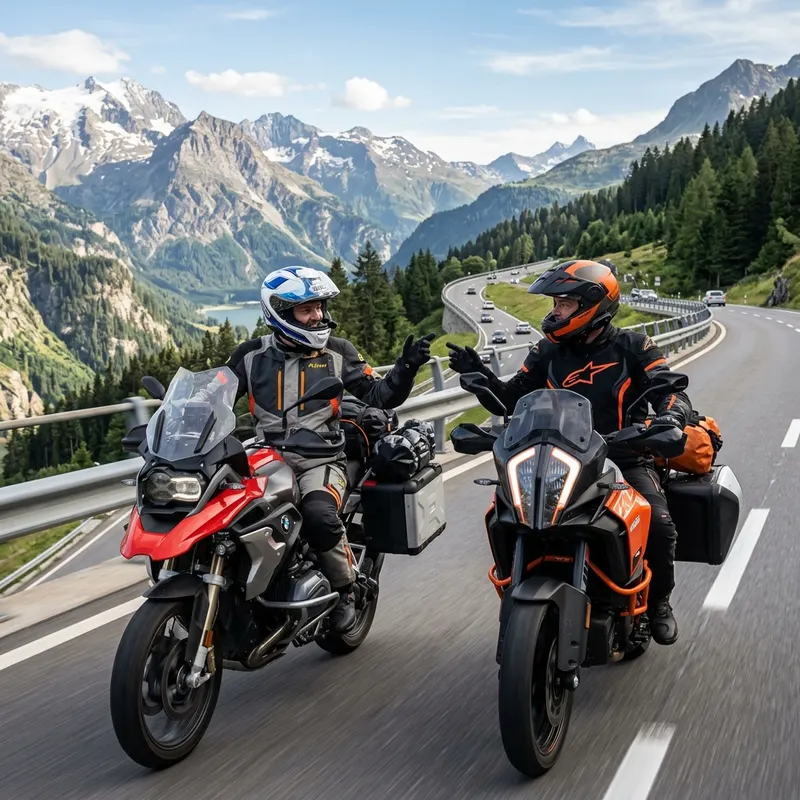
Spec sheets are great for bar arguments. But what actually matters is how these units behave when you’re soaking wet, covered in dust, or trying to hear your buddy warn you about a pothole at 90 km/h.
Durability & Waterproofing
This is the single biggest differentiator between these two units, and for all-weather riders it is often the deciding factor.
The Cardo Packtalk Edge is IP67 certified waterproof. No rubber flaps to worry about sealing correctly. The USB-C port is internally sealed. Owners report riding through six-hour downpours and hosing the mud off a helmet with the unit still attached, without it ever missing a beat.
The Sena 50S is only “water-resistant.” It doesn’t carry an official IP rating. Sena has improved the seals over the years, and the 50S will survive a light shower without drama. But get caught in a true downpour, and water can sneak behind the clamp pins or past the rubber USB-C cover. Owners have reported Sena 50S units shorting out during heavy mountain storms. If you go Sena, push that rubber charging port cover firmly into place every single time, and seriously consider pocketing the unit when the sky opens up.
Audio Quality: JBL vs. Harman Kardon
Both of these units sound fantastic compared to the tinny, cheap speakers of the past, but they have distinctly different audio profiles.
Cardo’s JBL speakers are warmer and have much better bass response. For riders who listen to a lot of music while cruising at 100 km/h, the Cardo sounds richer. The bass doesn’t get completely washed out by the rumble of the engine.
Sena’s Harman Kardon speakers are tuned for high-mid clarity. The vocal range is extremely sharp. When communicating over the intercom, the voices of your riding partners sound crisp and clean, almost like they are standing next to you. However, for music, the Sena can sound a bit flat compared to the warm tones of the Cardo.
Mounting & Usability: Air Mount vs. Jog Dial
This is where you really feel the personality difference between the two brands.
Cardo uses the Air Mount, and honestly, it’s brilliant. You slide the unit near the helmet bracket, magnets grab it, and it clicks into place. You can do it blindly with one gloved hand in a second or two. The buttons on the Packtalk Edge, though, are relatively small and flat. Finding them with heavy winter gloves takes practice, and many owners end up relying on voice commands (“Hey Cardo, volume up”) more than they expected.
Sena uses the classic Jog Dial. Turning the big wheel to adjust volume is incredibly satisfying and simple, even with the thickest winter gloves. You don’t have to feel around for flat buttons; you just swipe your palm against the side of your helmet. The downside is the mounting bracket itself, which uses a traditional plastic clip that can wear out or feel stiff over time.
Mesh Stability and Reconnection: DMC vs. Mesh 3.0
When you are riding off-road, you naturally spread out to avoid dust. Sinks, turns, and trees block line-of-sight, causing riders to fall out of intercom range.
Cardo’s Dynamic Mesh Communication (DMC) is the gold standard for group stability. It builds a web-like network where if rider 3 drops out of range, the signal reroutes through rider 2. When rider 3 catches up, they’re automatically back in the conversation. No button presses, no stopping the bike. It just works.
Sena’s mesh is also very good and supports Multi-Channel Open Mesh. Worth knowing before you compare spec sheets: the 50S no longer runs Mesh 2.0. Sena pushed Mesh 3.0 to the 50S and 50R as a free firmware update announced in April 2025, so a 50S bought years ago runs the same protocol as Sena’s 2026 flagship once you update it through the app. This is incredibly useful for large group rides or rallies where you don’t know everyone. You can set your Sena to Channel 1, and anyone within 1.2 miles on Channel 1 can talk to you. The downside is that Sena’s auto-reconnection is slightly slower than Cardo’s, and if you are riding near the limit of the range, the audio can become choppy before it drops completely.
The App War: Cardo Connect vs. Sena Motorcycles
Here Cardo pulls ahead by a noticeable margin.
Cardo Connect feels like an app designed by people who actually ride. The home screen shows your device status, battery level, and connected riders in a clean, dark-themed dashboard. Tapping into audio settings, you get three JBL-tuned EQ presets: Bass Boost, Voice, and High Volume. Bass Boost is the preset most owners favor for long highway stretches. The 40mm JBL drivers push out warm low-end that survives engine rumble. Voice mode strips away the bass and prioritizes mid-range clarity, which is what you want during a group intercom chat. There is no multi-band graphic equalizer with manual sliders, though, which is a shame if you are an audio nerd who wants to fine-tune specific frequencies. Firmware updates happen over the air, right through the app. You tap “update,” set your phone next to the helmet, and walk away. Five minutes later, it is done. No cables, no desktop software, no nonsense.
Sena Motorcycles takes a more utilitarian approach. The interface is clean but feels clinical — white backgrounds, basic toggle switches, menus that look like they were designed for quick function rather than visual appeal. The EQ options include Bass Boost and Music Enhance presets, plus the ability to independently balance volume levels across different audio sources (intercom, GPS, music). That per-source volume mixing is actually something Cardo lacks, and it is useful when your Garmin navigation voice keeps drowning out your riding playlist. Firmware updates on the Sena 50S can happen three different ways: through the app over Bluetooth, via the Sena Device Manager desktop software, or automatically through the included WiFi Adapter. The WiFi method is the killer feature here. You plug the 50S into wall power at night, it sniffs your home network, and installs the update silently while you sleep. Zero effort.
The bottom line: Cardo Connect wins on design and feel. The app is prettier, faster, and more intuitive. But Sena wins on update flexibility and per-source audio mixing. If you are the type of rider who just wants to set it and forget it, Cardo’s app is the better daily driver. If you want granular control over how loud your GPS is versus your music, Sena gives you that lever.
Voice Commands at 100 km/h: “Hey Cardo” vs. Phone Assistants
Picture this: your gloves are caked in dried mud, your visor is half-fogged, and you need to skip a track or answer a call. You’re not pulling over for that. Both units offer voice activation, but the way they handle it couldn’t be more different.
The Cardo Packtalk Edge has a built-in wake word: “Hey Cardo.” You say it, the unit chirps, and you issue a command — “volume up,” “play next track,” “call a contact.” It works brilliantly in town. At 60 km/h with a full-face helmet and the visor closed, owners report the recognition rate is close to perfect. But push past 100 km/h with a crosswind blasting from the left, and things start to fall apart. The microphone picks up turbulence, and “Hey Cardo” sometimes needs two or three attempts before it registers. A common fix is installing a proper chin curtain and using a denser foam mic cover, which brings the recognition rate back to about 80% even at highway speed. Still, on the windiest days, most riders give up on voice and just press the button.
The Sena 50S does not have its own proprietary wake word. Instead, it routes to your phone’s native assistant — “Hey Siri” on iPhone, “Hey Google” on Android. The advantage is that you get the full power of a phone assistant: send texts, get weather, launch Spotify playlists by name. The disadvantage is that the voice recognition chain is longer — your voice goes through the Sena’s mic, over Bluetooth to your phone, into the cloud, and back. At highway speeds, the extra latency and the wind-noise interference compound. Owners report that on a fast coastal highway, Siri recognizes maybe 6 out of 10 commands at 100 km/h, and Google Assistant slightly better at roughly 7 out of 10. But both demand almost shouting with deliberate enunciation.
The honest take: If you mainly need volume control, track skipping, and basic phone calls, the Cardo’s native “Hey Cardo” is faster and more reliable because the processing happens locally on the device. If you need a full-fat smart assistant that can read your WhatsApp messages or find the nearest gas station, the Sena’s passthrough to Siri or Google is more capable, but less consistent at speed.
Universal Pairing: Making Cardo Talk to Sena (and Vice Versa)
This is one of the most common questions riders ask, and the answer is frustrating: it works, but barely.
Cardo uses DMC. Sena uses its own Mesh (3.0 on a current-firmware 50S). These are completely proprietary mesh protocols. They cannot talk to each other natively. What you can do is fall back to standard Bluetooth Intercom mode, which essentially treats the other brand’s unit as a phone call. Here is the setup process, step by step:
Step 1 — Disconnect everything. Turn off both units’ mesh modes. Disconnect them from phones and GPS devices. You want a clean Bluetooth slate.
Step 2 — Put Cardo in pairing mode. Open the Cardo Connect app, go to the Intercom tab, and tap “Pair” on an empty slot. Select “Non-Cardo device” when prompted. The unit starts blinking rapidly.
Step 3 — Put Sena in Universal Intercom mode. Hold the Jog Dial for about 10 seconds until you hear “Configuration Menu.” Rotate until you hear “Universal Intercom Pairing.” Click to confirm. The Sena starts scanning.
Step 4 — Wait. This is the painful part. Sometimes they find each other in 15 seconds. Sometimes it takes two full minutes of both units flashing at each other like confused fireflies. Owners report it can take several attempts before the pairing sticks. Once it does, the audio quality is decent — clear enough for turn-by-turn callouts, but noticeably compressed compared to a native Cardo-to-Cardo or Sena-to-Sena link.
Step 5 — Designate a bridge rider. If you have a mixed group (say, 3 Cardo users and 3 Sena users), one Cardo and one Sena rider must stay within roughly 90 meters of each other. They act as the bridge. If the bridge riders fall too far apart, the entire cross-brand link collapses, and everyone on the other brand goes silent. On narrow mountain switchbacks, that means the two bridge riders have to stay within visual range of each other at all times.
The long-term verdict: Universal pairing is a backup plan, not a primary communication strategy. If your riding group is split between brands, someone needs to switch. The quality loss and the range limitations make cross-brand bridging a compromise you tolerate, not one you enjoy.
Real-World Reports: Vibration, Fog, and Heat
Spec sheets are written in air-conditioned offices. Here is what owners consistently report from real-world use, in the three conditions that separate good gear from marketing copy: vibration, fog, and heat.
Hard Off-Road — Air Mount Under Vibration
On brutal dirt tracks — football-sized rocks, deep ruts, and sections where the front wheel bounces so hard your teeth rattle — the obvious worry is that Cardo’s magnetic Air Mount will shake loose. Owner reports are near-unanimous that it doesn’t. The mounting bracket is the real hero: the magnets align directionally, so vibration pushes the unit into the mount rather than away from it. Riders describe checking it compulsively at every water stop on rough terrain and finding it hasn’t budged.
The Sena 50S survives the same vibration, but owners note its plastic slide-in clamp can start making a faint clicking sound after an hour on rough terrain — usually a tiny piece of grit lodged between the clamp rail and the body, cleared out easily enough with a toothpick. It’s a small thing, but it points to a real pattern: mechanical clamps invite debris in a way that sealed magnetic mounts simply don’t.
High Country — Altitude, Fog, and Mesh Stability
Consider high country like the Ayder–Elevit–Çamlıhemşin triangle, climbing to about 2,500 meters. The same terrain covered in the Black Sea & Kaçkar motorcycle route guide. Fog rolls in above 1,800 meters and stays; visibility can drop to maybe 30 meters. At that point, a reliable intercom isn’t a luxury. It’s a lifeline. This is exactly where Cardo’s DMC earns its reputation: owners report it holding a group of four together flawlessly, with a lead rider vanishing into a fog bank around a blind switchback and his audio staying crystal clear — “pothole on the left, gravel patch, slow down” coming through without a single break. The auto-reconnect is reported to kick in reliably when someone falls back by more than a kilometer on steep sections.
The Sena, by owner accounts on similar terrain, can drop the connection on the steeper switchbacks where dense tree cover and mountain ridges block line-of-sight. It typically reconnects within about 20 seconds — fine on paper, but those 20 seconds of silence in thick fog at 2,400 meters feel much longer than they are.
Coastal Heat — Sweat, Buttons, and Touchscreens
Riding in 38°C heat surfaces something no spec sheet mentions. As sweat builds up and gloves get damp, owners report the Cardo Packtalk Edge’s flat capacitive buttons become increasingly unreliable — a press that doesn’t register, then suddenly registers twice and jumps the volume from comfortable to ear-splitting. The common workaround is to abandon the buttons in the heat and switch entirely to “Hey Cardo” voice commands for volume, which handle sweat far better than the capacitive surface does.
The Sena 50S’s Jog Dial has no such problem. It is a mechanical wheel — moisture does not affect it. Owners can spin it with wet gloves, sweaty fingers, even a hand half-cramped from gripping the clutch lever in traffic. The physical, tactile feedback of the wheel turning is unbeatable in hot conditions, and it is the one scenario where the Sena’s old-school design philosophy clearly beats Cardo’s modern touch approach.
One more heat-related note: owners report both units running for roughly 11 hours in extreme heat before dying — short of Cardo’s stated 13-hour figure, which appears to assume moderate temperatures. Extreme heat shortens runtime noticeably, and the same likely applies to extreme cold.
Pros & Cons Box
To make your decision easier, here is a direct summary of each unit’s strengths and weaknesses:
- IP67 Certified Waterproof (highly durable in downpours)
- Magnetic Air Mount is incredibly easy to mount and secure
- Warmer, richer bass response from 40mm JBL speakers
- Highly reliable DMC 2.0 automatic mesh reconnection
- Modern Bluetooth 5.2 protocol and over-the-air updates
- Cardo Connect app is polished and intuitive
- Native "Hey Cardo" voice commands work locally without phone lag
- Flat buttons are difficult to feel with thick winter gloves
- Capacitive buttons lose reliability when wet from sweat or rain
- Universal pairing setup with other brands can be clunky
- Maximum group size is limited to 15 riders in DMC mode
- No multi-band graphic EQ — only three JBL presets
- Jog Dial interface is the easiest control wheel to use with gloves
- Mechanical dial works flawlessly in heat, sweat, and rain
- Harman Kardon speakers provide crystal-clear voice comms
- Open Mesh mode allows connection to unlimited riders
- Included WiFi Adapter makes firmware updates completely automatic
- Per-source volume mixing (GPS vs. music vs. intercom)
- Very popular brand (highly likely your friends already own a Sena)
- Only water-resistant (no official IP waterproof rating)
- Audio profile for music lacks bass compared to JBL
- Pop-up antenna is a mechanical point that can break in a crash
- Voice commands rely on phone assistants — slower at highway speed
- Plastic clamp can collect debris on off-road trails
Choosing Guide
If you are still struggling to decide between the packtalk edge or sena 50s, ask yourself these questions about your riding style:
Choose the Cardo Packtalk Edge if...
- You ride in the rain, mud, and dust without worrying about your gear.
- You want a magnetic mount that snaps on securely in a second.
- You listen to music on long highway stretches and appreciate rich, bassy sound.
- Your core riding group (up to 15 people) already uses Cardo systems.
Choose the Sena 50S if...
- You ride in massive groups or attend large rallies where Open Mesh is used.
- You prefer a large, physical dial over buttons for adjusting settings.
- Your friends, riding club, or tour guides already primarily use Sena intercoms.
- You want an easy way to charge and update your unit automatically via WiFi.
Technical Specifications Comparison
Numbers talk. Here are the official specs from both manufacturers, side by side:
| Technical Spec | Cardo Packtalk Edge | Sena 50S |
|---|---|---|
| Bluetooth Version | Bluetooth 5.2 | Bluetooth 5.0 |
| Waterproof Rating | IP67 Certified Waterproof | Water-Resistant Only |
| Audio Tuning | Sound by JBL (40mm) | Sound by Harman Kardon (40mm) |
| Mesh System | DMC 2.0 (Dynamic Mesh) | Mesh 3.0 Intercom (via firmware update) |
| Max Mesh Riders | 15 riders | 24 (Group Mesh) / Unlimited (Open Mesh) |
| Antenna Type | Internal (No moving parts) | External Pop-Up Mechanical Antenna |
| Mounting Style | Magnetic Air Mount | Standard Mechanical Slide-in Clamp |
| Battery Life | Up to 13 hours | Up to 16 hours (Bluetooth) / 13 hours (Mesh) |
| Charging Port | USB-C | USB-C |
| Firmware Updates | Over-The-Air (Cardo Connect App) | Automatic via Included WiFi Adapter |
Ready to Upgrade Your Riding Communication?
Whether you go Cardo or Sena, you're getting a seriously capable unit. Click below to check current prices, real customer reviews, and dual-pack options on Amazon.
Compare Cardo Packtalk Edge & Sena 50S on Amazon →Affiliate Disclosure & Support
Disclaimer: If you click on an affiliate link and make a purchase, we may earn a small commission from the retailer at no extra cost to you. As an Amazon Associate, we earn from qualifying purchases. This helps support the site and keeps our gear reviews 100% honest and free of sponsored influence. Thank you for your support!
Frequently Asked Questions
Is the Cardo Packtalk Edge fully waterproof?
Yes. The Cardo Packtalk Edge is officially IP67 certified. It can be completely submerged in water and continues to function perfectly in torrential downpours. It does not require any rain cover.
Does the Sena 50S package include the WiFi adapter?
Yes. The Sena 50S comes packaged with the Sena WiFi Adapter. Once configured through the Sena app, it automatically downloads and installs firmware updates whenever the device is plugged in to charge.
Can Cardo and Sena intercoms talk to each other?
Yes, they can connect via Universal Bluetooth Pairing, which essentially treats the other brand as a mobile phone. However, they cannot directly join each other's native Mesh networks (DMC vs Sena Mesh).
Which has better sound quality, Cardo's JBL or Sena's Harman Kardon?
Both sound incredible compared to older intercoms. Cardo's JBL setup offers warmer bass and cleaner high-end for music, while Sena's Harman Kardon system provides sharper mid-tones, making vocal communication slightly clearer in noisy helmet environments.