
Read enough owner threads about cheap intercoms and the same story repeats: a bargain headset that pairs reliably in the driveway, drops the connection somewhere on day one of a long trip, and spends the rest of the tour being fiddled with at fuel stops. Two things come out of that pattern. Audio quality does scale fairly steeply with price. And a unit that drops connections is worse than no unit at all, because the time goes into troubleshooting instead of riding.
This guide weighs the field the way it actually gets used — the Cardo Packtalk Edge in mountain rain, the Sena units on multi-day coastal trips, and the budget boxes in between — drawing on each unit’s published specs and the consensus from long-term owner reports.
One correction worth making up front, because most 2026 roundups get it backwards: Mesh 3.0 is not a reason to buy Sena’s newest headset. Sena shipped Mesh 3.0 to the 50S and 50R as a free firmware update in April 2025, and the 30K and Spider ST1 run it too. Almost the whole mesh range is on the current protocol. What the new 60 series actually adds is Wave Intercom — a cellular channel that ignores range entirely — plus more battery and better speakers. That is a narrower upgrade than the marketing implies, and it changes which unit is the sensible buy.
Below is the honest version: the best motorcycle intercom systems worth recommending to a friend, with notes on what they’re actually like to live with. All prices are manufacturer list as of August 2026; street prices run lower and are noted where the gap is wide.
Cardo Packtalk Edge
The best audio here, the most mature firmware, and mesh that reconnects fast. Caps at 15 riders.
Check Cardo Packtalk Edge on Amazon →Why Intercom Choice Matters More Than You Think
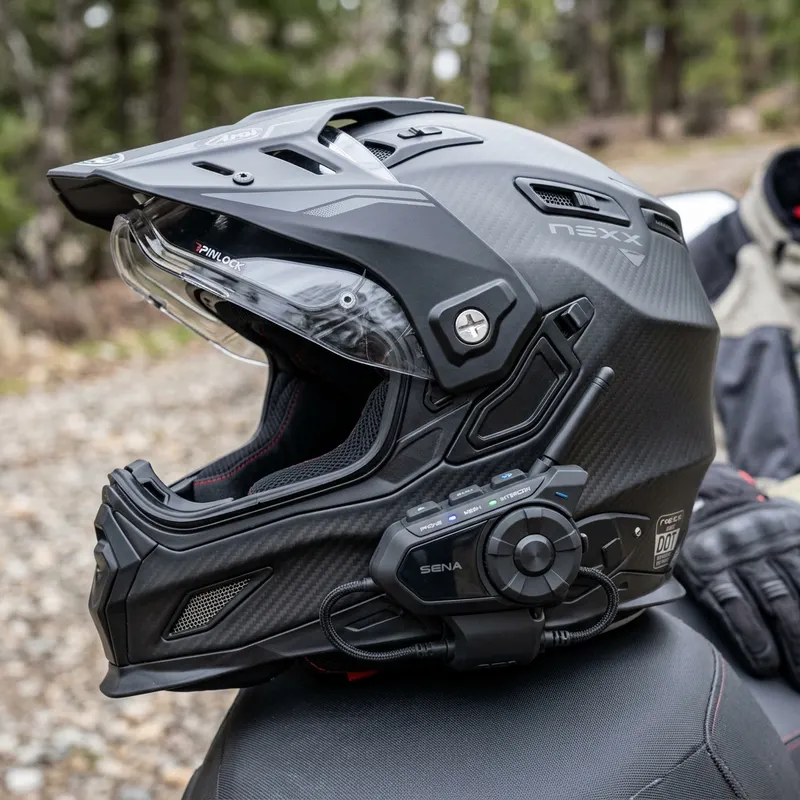
A good intercom disappears. You forget it’s on your helmet. You hit a button, the bike behind you hears you, you keep riding. The voice prompts are clean, the music doesn’t distort at highway speeds, and the unit reconnects automatically when you pull out of a tunnel.
A bad intercom is the opposite. You spend the ride troubleshooting. You miss a turn because the GPS voice cut out. You yell into the mic three times because your partner can’t hear you over wind noise. By day two, you turn it off and ride in silence; which means you wasted the better part of $400.
The gap between good and bad is mostly in three places: audio quality (speakers and DSP), mesh reliability (how the units find each other when conditions change), and wind noise rejection (the mic). Battery life, app features, and waterproofing all matter, but those three are the ones that decide whether you keep the intercom on your helmet after the first long trip.
One thing worth knowing before you turn the volume up to beat the wind: Binnington, McCombe and Harris, measuring the motorcyclist’s acoustic environment for the British Journal of Audiology, put wind noise at around 90 dB(A) by 40 mph and climbing steeply from there, which is why cranking an intercom to overcome it is a bad trade for your hearing. Filtered earplugs do the opposite job — they drop the wind while leaving speech intelligible, so you can run the intercom quieter. Our guide to the best motorcycle earplugs covers which types work with a headset.
Cardo vs Sena: The Core Difference
Cardo and Sena both make mesh-networking intercoms in the same $380-500 list-price band, and on paper they look identical. The differences show up in how each company prioritizes its engineering.
Cardo’s bet is audio. The Packtalk Edge ships with JBL-tuned 40mm speakers and a custom EQ profile developed with JBL’s engineers. The result is the cleanest music reproduction in the category — actual bass, clear vocals, almost no distortion at full helmet volume. The DMC (Dynamic Mesh Communication) network is mature, reconnects fast, and handles 15 riders in a single group.
Sena’s bet is the ecosystem — and group size. The Sena 50S ships Harman Kardon speakers that sound very good but a touch flatter than the JBL tuning, and it holds 24 riders in a group mesh against Cardo’s 15. For organised rides and clubs, that ceiling is the whole argument.
Sena also does something Cardo doesn’t: it keeps updating old hardware. The 50S/50R backport described above is the clearest example, and it cuts both ways — good for anyone who already owns one, awkward for Sena’s own upsell. Cardo, by contrast, ships firmware less often, and owners report its releases occasionally taking features away rather than adding them.
The line that does matter in Sena’s range is mesh versus Bluetooth, and it sits at $239. The Spider ST1 is the cheapest true mesh unit. Everything below it — the $189 Vortex, the $169 5S — is a two-rider Bluetooth headset no matter how modern it looks. The Vortex in particular is easy to misread: it is new, it has 27 hours of battery, and it is not a mesh device. If you have already settled on Sena, our guide to the best Sena intercom for each rider sorts the whole range by what actually differs.
If you care most about music and small-group reliability, Cardo. If you care most about big-group mesh or want the brand that keeps old units current, Sena. Both are excellent. There is no wrong answer. The Packtalk Edge vs Sena 50S head-to-head further down goes deeper on the two units most people cross-shop.
Best Motorcycle Intercom Options List 2026
6 Intercoms — Side by Side
| Intercom | Network | Speakers | Max Group | Price | Rating |
|---|---|---|---|---|---|
| Editor's PickCardo Packtalk Edge | DMC Mesh | JBL 40mm | 15 riders | $439.95 | |
| Newest TechSena 60S | Mesh 3.0 + Wave | Harman Kardon 40mm (2nd gen) | 24 riders (unlimited on Wave) | $439 | |
| Sena 50S | Mesh 3.0 (firmware) | Harman Kardon 40mm | 24 riders | $379 | |
| Cardo Packtalk Pro | DMC Mesh + Crash Detect | JBL 45mm | 15 riders | $499.95 | |
| Best ValueCardo Spirit | Bluetooth | Cardo 32mm | 2 riders | $109.95 | |
| Fodsports M1-S Pro | Bluetooth | Generic 40mm | 8 riders | $75 |
1. Cardo Packtalk Edge — The One to Beat
The Packtalk Edge is the unit most serious riders end up on. Cardo lists it at $439.95, and it is routinely discounted — RevZilla was showing $395.96 in August 2026, and it goes lower on sale. It replaces the older screw-clamp Cardos, and owners say the upgrade is felt the first time you use it.
The headline feature is the Air Mount — a magnetic cradle that replaces the old screw-clamp design. You slide the intercom onto the helmet base, the magnets snap it into place, and the connection is rock solid. Removing it for charging takes one second instead of unscrewing a clamp in the rain. Small thing. Changes the experience.
The JBL audio is the headline you can hear. Music sounds like music at highway speed. The bass is present without being muddy, the vocals are forward without being shrill. Voice prompts from Google Maps come through clear at 130 km/h (81 mph) with the visor down. On the Packtalk Edge, podcasts stay listenable on long touring days, which is where cheap headsets tend to fall down — the common complaint about budget units is speakers that distort once you turn them up far enough to beat wind noise.
DMC mesh handles the network side. If your group has 3 riders and one falls off the back, the mesh reroutes through the rider in the middle. When the dropped rider catches back up, the network re-stitches automatically in 3-4 seconds. Old Bluetooth intercom chains break and require manual repair. DMC just works.
Range is rated at 1.6 km (1 mile) between two units, up to 8 km (5 miles) in a 15-rider chain. In long-term mountain riding with line-of-sight broken by terrain, owners report reliable comms at maybe 400-600 meters between two bikes; about three switchbacks. Good enough for any real group ride.
Disclosure: some links below are affiliate links. If you buy through them we may earn a small commission at no extra cost to you.
Check Cardo Packtalk Edge on Amazon →
- JBL speakers — cleanest audio in the category
- Magnetic Air Mount makes daily handling effortless
- DMC mesh reconnects in seconds when riders drop
- IP67 rating handles real rain
- ~13 hours battery rated, 9-10 hours everyday with music
- $439.95 list — not casual money
- Companion app is less feature-rich than Sena's
- Max 15 riders in a mesh group (Sena does 24)
2. Sena 60S — Buy It for Wave, Not for Mesh
The 60S is Sena’s current flagship, listed at $439. It launched nearer $399 at retail, so shop the street price rather than the list.
Skip the Mesh 3.0 marketing. It is a real improvement over Mesh 2.0 — Sena claims better clarity, steadier connections, lower power draw — but it is not exclusive to this headset. Sena pushed Mesh 3.0 to the 50S and 50R by firmware in April 2025, and the 30K and Spider ST1 run it as well. If Mesh 3.0 is what you’re after, the $379 50S already has it.
Wave Intercom is the actual reason to buy a 60. Instead of radio, Wave routes the conversation over your phone’s cellular data, which removes the range limit entirely — Sena describes it as supporting a “virtually unlimited” number of participants. For a group that spreads out over a mountain pass, or two riders who split up for the day and want to talk at lunch, nothing else on this list does that. The app is a free download and, as of August 2026, Sena lists no subscription fee. What Sena does not publish is how much data it consumes; the company says it is light on your plan, but there is no measured figure to quote, so treat it as an unknown if you ride abroad on a small roaming bundle. And the obvious limit applies: Wave needs a signal, so in exactly the empty country where range matters most, you are back on mesh.
The rest of the sheet is a genuine but modest step up from the 50S: 17 hours of Mesh talk time and 24 on Bluetooth (against the 50S’s 13 and 16), IPX7, 2 km (1.2 miles) rider-to-rider in open terrain, 24 riders in a group mesh, and second-generation Harman Kardon 40 mm speakers. Two things worth noting: Sena reserves its Bose-tuned audio for the dearer 60S EVO and 60X, and at 68 g the 60S is slightly heavier than the 64 g 50S, despite launch coverage suggesting otherwise.
The honest caveat. The 60S had a difficult first year: Sena ran no-cost swap programmes for an early bricking fault and again for a voice-clipping fault. Owners also report noise cancellation trailing Cardo, mic and VOX sensitivity needing manual tuning, and some unreliable mesh audio at close range. Set against that, Sena replaced faulty units rather than arguing about them, and firmware has moved on since launch.
Worth keeping in proportion, though, because the Cardo is not spotless either — owners report a firmware release that broke roller volume control, later updates that unsettled long-serving units, and a music-streaming fault on some Gold Wings. The difference is maturity, not perfection. If you want the headset least likely to surprise you next weekend, that is still the Edge.
- Wave Intercom removes the range limit — nothing else here does it
- 17 h Mesh / 24 h Bluetooth — best quoted battery of the Senas
- 24-rider group mesh, backward-compatible with Mesh 2.0 units
- Two helmet clamp kits in the single pack
- One volume control for music and intercom — a regression from the 50S
- Rough launch: bricking and voice-clipping faults both needed swap programmes
- Mesh 3.0 is free on the cheaper 50S, so you are paying for Wave alone
- Wave needs phone signal and an unmeasured amount of mobile data
3. Sena 50S — The Value Pick, and It Runs the Same Mesh
The 50S is the one to buy if you ride with a club or organised group and don’t need Wave. Sena lists it at $379 and discounts it harder than the 60S, which is the whole argument for it once you know it shares the flagship’s mesh protocol. You give up Wave Intercom, four hours of mesh battery (13 against 17) and the second-generation speakers. You keep the 24-rider group mesh, the 2 km (1.2-mile) range, the Harman Kardon tuning, and the separate volume controls that 60S owners miss.
Group mesh holds 24 riders — the largest in the consumer intercom market. For organized rides, charity rides, or clubs that move together in large packs, this matters. Cardo’s 15-rider DMC limit is fine for most riders but caps you below a typical club ride.
The Harman Kardon speakers sound very good. Slightly flatter EQ than the Cardo JBLs, less bass impact, but very clean across the midrange. If you mostly listen to GPS prompts and conversation, you’ll never notice the difference. If you ride with music and care about how it sounds, the Cardo edges it out by a clear margin.
The Sena app is where the 50S earns its place. EQ presets, custom EQ curves, firmware update flexibility, voice command customization, and dozens of paired-device options. If you like tinkering with settings, this is the unit for you. If you want to plug it in and forget it, Cardo’s simpler app is less work.
Waterproofing is the one place the Cardo clearly wins. The Packtalk Edge is IP67 certified; Sena does not publish an IP rating for the 50S at all, describing it as water resistant. Reviewers report it copes with showers and can stop working in heavy rain at speed. If you tour in weather, that gap is worth more than any of the audio differences — and note the 50R, mechanically similar inside, is rated. Whichever you buy, close the charging-port cover.
- 24-rider mesh — largest group capacity available
- Deepest companion app and customization in the category
- Harman Kardon speakers — clean, balanced sound
- Strong firmware update history and long-term support
- Music doesn't quite match the Cardo JBL tuning
- Larger unit on the helmet than the Packtalk Edge
- App depth is overkill if you just want it to work
4. Cardo Packtalk Pro — When You Ride Solo and Far From Help
The Packtalk Pro is the 2024 upgrade above the Edge, and the one feature that justifies the extra $60 — $499.95 against the Edge’s $439.95 — is automatic crash detection. If the unit senses a crash (high-g impact followed by no motion), it sends an SOS to your emergency contact with your last GPS location. The contact gets a text and an option to call you back through the unit.
For most riders who stay in cell coverage and ride with company, this feature is duplicated by other devices — a Garmin inReach Mini 2 covers the same emergency case with global satellite coverage. But if your weekend rides put you on remote dual-sport trails where cell coverage is patchy and nobody else is watching, crash detection is useful. It’s the difference between a quiet roadside crash being noticed in 30 minutes versus 6 hours.
The other Pro upgrades are subtler. Slightly larger JBL 45mm speakers, slightly improved DSP, slightly louder voice prompts. All real, none worth the upgrade on their own. Buy the Pro for crash detection. Buy the Edge for everything else.
Check Packtalk Pro on Amazon →
5. Cardo Spirit — The Best $109 You’ll Spend
If you’ve never owned an intercom and you’re not ready to drop $440 on something you might use four weekends a year, the Cardo Spirit is the easy first buy. Cardo lists it at $109.95 for a single unit. Bluetooth-only (no mesh), 32 mm speakers, 2-rider intercom. Cardo describes it as waterproof but does not publish an IP figure or a total talk-time number for it on the product page, so treat any specific hours you see quoted elsewhere with suspicion.
The audio is not JBL-tuned and you’ll know it. The unit is fine for voice intercom and GPS prompts, acceptable for music, never excellent. The Bluetooth-only protocol means two-rider pairing is solid but chains of three or more fall apart fast.
For a rider doing weekend trips with one consistent passenger or partner, the Spirit is honestly enough. The battery lasts a riding day, the waterproofing is real, and the Cardo Connect app handles setup cleanly. The upgrade path to a Packtalk later is straightforward — Cardo units interoperate over their Open Bluetooth Intercom protocol.
Check Cardo Spirit on Amazon →
6. Fodsports M1-S Pro — Best Under $80
There is a real category below the premium brands, and the Fodsports M1-S Pro is the unit I’d recommend in it. Around $75 for a single unit, $130 for a paired set. Bluetooth 5.0, claimed 8-rider intercom group, real IP65 waterproofing, FM radio.
The audio is what you’d expect at this price — clear enough for voice, distorted at high volume with music, fine for GPS prompts. The buttons are larger and easier to operate with winter gloves than the premium units. Battery life is rated 15 hours, with owners reporting maybe 10-11 on-the-road.
The honest truth: this is a unit for the rider who wants intercom-capable for occasional use without committing $440. You’ll feel the audio gap if you’ve used a premium Cardo. You won’t feel it if this is your first intercom.
Check Fodsports M1-S Pro on Amazon →
Audio Quality: JBL vs Harman Kardon
The audio difference between Cardo and Sena is real but smaller than the marketing suggests. Both are excellent. The JBL tuning on the Packtalk Edge has more low-mid presence — bass guitar, kick drum, male vocals all sit forward. The Harman Kardon on the Sena 50S is flatter and more analytical — clean across the frequency range, slightly less impact in the low end.
For voice intercom, they’re identical in practice. Both crystal clear. For music, the Cardo is the more enjoyable listen. For audiobooks and podcasts, both work equally well.
The bigger audio variable is helmet fit. If your speakers don’t sit directly over your ear canals, no amount of premium tuning will save you. The best adventure motorcycle helmets guide covers which shells have proper molded speaker pockets. Most modern helmets have molded speaker pockets — make sure your intercom’s speakers fit those pockets without spacing. A cheap $10 adhesive foam spacer kit can fix a poor speaker position and add more audio quality than upgrading from a Cardo Spirit to a Packtalk Edge.
Mesh Networking Explained: DMC vs Mesh 2.0 vs Mesh 3.0
Old Bluetooth intercoms work as a chain. Rider A connects to Rider B, who connects to Rider C. If Rider B’s battery dies or they fall off the back, the chain breaks and Riders A and C lose contact.
Mesh networks (Cardo DMC, Sena Mesh) work as a web. Every rider talks to every other rider directly or through any available path. When a rider drops out, the network reroutes automatically. When they rejoin, they slot back in without manual pairing.
In practice, this matters when groups split, stop at different gas stations, or get separated in traffic. With a Bluetooth chain, every rejoin is a manual process. With mesh, you just ride.
Cardo DMC holds 15 riders, Sena’s group mesh holds 24. Both reconnect in 2-5 seconds when conditions allow. Range between two riders is around 1.5 km (0.9 miles) line-of-sight. Mesh is the right answer for any group of 3+. For two-rider setups, Bluetooth-only units like the Cardo Spirit are functionally identical and save you $200.
Mesh 3.0 is Sena’s current generation, and it is not limited to the newest hardware. As well as the 60 series and the Spider X Slim, it runs on the 50S and 50R (added by firmware in April 2025), the 30K and the Spider ST1. Sena claims better clarity, steadier connections and lower power draw than Mesh 2.0, and the units stay backward-compatible with Mesh 2.0 groups. Treat the improvement as real but incremental — and treat the protocol version as a poor way to choose between Sena models, because most of the mesh range now shares it.
Wave Intercom is the bigger break. It isn’t mesh at all: it carries the conversation over cellular data through Sena’s app, so range stops being a radio problem and becomes a coverage problem. Riders separated by a mountain stay connected; riders in a valley with no signal do not. It sits alongside mesh on the 60 series rather than replacing it, which is the sensible arrangement — you fall back to Mesh 3.0 when the bars run out. Cardo has no equivalent as of August 2026.
Waterproofing and Durability
Not everything on this list is rated for real rain, and the labelling is inconsistent enough to be worth reading carefully. Cardo rates the Packtalk Edge and Pro at IP67 — immersion-rated, survives 30 minutes in a puddle. Sena rates the 60S at IPX7, which is the equivalent protection against water. But Sena publishes no IP rating at all for the 50S, describing it only as water resistant, and reviewers report it can stop working in heavy rain at speed. Cardo publishes no IP figure for the Spirit either. Absence of a rating is not proof a unit will fail — but if you tour in weather, buy a headset whose maker was willing to put a number on it.
The failure point reported across many units is the charging port cover. Rubber flap, hinged, sits over the USB-C port. Leave it open while riding through heavy rain and water gets directly into the charging port. The unit usually still works but corrosion starts immediately and the charging contacts can fail within a season.
Rule: charge the intercom at night, close the port cover firmly, and never open it while riding. If you need to charge on the bike, use the official Cardo or Sena right-angle charge cable, which seats inside the cover hole without exposing the port.
Packtalk Edge vs Sena 50S: The Head-to-Head
These two are the pair most riders actually cross-shop, so they are worth separating out from the list above. The table below is manufacturer figures — treat the battery numbers as laboratory best cases, not what you will see with music streaming (see the owner reports further down).
| Spec | Cardo Packtalk Edge | Sena 50S |
|---|---|---|
| Bluetooth | 5.2 | 5.0 |
| Water rating | IP67 | No published IP rating |
| Audio tuning | JBL 40mm | Harman Kardon 40mm |
| Mesh | DMC | Mesh 3.0 (via firmware, April 2025) |
| Max mesh riders | 15 | 24 group / open mesh unlimited |
| Antenna | Internal | External pop-up |
| Mount | Magnetic Air Mount | Mechanical slide-in clamp |
| Claimed battery | Up to 13 h | Up to 16 h Bluetooth / 13 h mesh |
| Firmware updates | Over the air, app | App, desktop, or included WiFi adapter |
Controls and Mounting: Air Mount vs Jog Dial
This is where the two brands feel most different, and it matters more than the spec sheet suggests, because it is the part you operate with gloves on.
Cardo’s Air Mount is magnetic. You slide the unit near the helmet bracket, the magnets grab it, and it clicks in — one gloved hand, no looking. The buttons themselves are the weak point: small, flat and capacitive, which takes practice to find with heavy winter gloves. Many owners end up leaning on voice commands more than they expected.
Sena’s Jog Dial is the opposite trade. The big mechanical wheel is easy to work with the thickest gloves on — you swipe your palm against the side of the helmet rather than hunting for flat buttons. The cost is the mount: a traditional plastic clip that can stiffen or wear, and that invites grit in a way a sealed magnetic mount does not.
Voice control follows the same split. Cardo has a built-in wake word, “Hey Cardo,” processed locally on the unit. In town with the visor down, owners report recognition close to perfect; past 100 km/h (62 mph) with a crosswind the microphone picks up turbulence and it can take two or three attempts. A chin curtain and a denser foam mic cover bring it back to roughly 80% at highway speed. The Sena 50S has no proprietary wake word — it routes to Siri or Google Assistant on your phone. That buys you a full assistant (texts, weather, playlists by name) but adds a longer chain: mic, Bluetooth, phone, cloud, back. Owner reports at highway speed put Siri around 6 in 10 commands and Google Assistant slightly better, both needing deliberate enunciation.
Short version: Cardo is faster and more reliable for the things you actually do at speed — volume, track skip, calls. Sena is more capable when you need a real assistant, and less consistent when it is windy.
The Apps: Cardo Connect vs Sena Motorcycles
Cardo pulls ahead here by a noticeable margin, but not on every axis.
Cardo Connect is the better-designed app: a clean dashboard showing device status, battery and connected riders, with three JBL-tuned EQ presets (Bass Boost, Voice, High Volume). Bass Boost is the one most owners settle on for highway stretches; Voice strips the low end for group chat. There is no multi-band graphic EQ, which will disappoint anyone who wants to tune specific frequencies. Firmware updates are over the air — tap update, set the phone next to the helmet, walk away.
Sena Motorcycles is more utilitarian and less pleasant to look at, but it has two things Cardo lacks. First, per-source volume balancing — you can set intercom, GPS and music levels independently, which solves the common problem of a Garmin voice prompt drowning out your playlist. Second, update flexibility: app over Bluetooth, Sena Device Manager on desktop, or the included WiFi adapter, which updates the unit overnight from wall power with no involvement at all.
So: Cardo wins on design and daily feel, Sena wins on audio mixing and update convenience.
Owner Reports: Vibration, Fog and Heat
Spec sheets are written indoors. Three conditions separate these units in practice.
Vibration, hard off-road. The obvious worry about a magnetic mount is that rough terrain will shake it loose. Owner reports are near-unanimous that it does not: the magnets align directionally, so vibration pushes the unit into the mount rather than away from it. The Sena 50S survives the same abuse, but owners note its plastic clamp can start clicking after an hour on rough ground — usually grit lodged in the clamp rail, cleared with a toothpick. Small thing, but it is the pattern: mechanical clamps invite debris, sealed magnetic mounts do not.
Fog and altitude. On high-country switchbacks — the kind of terrain covered in the Black Sea and Kaçkar route guide, where fog above 1,800 m can cut visibility to 30 metres — mesh stability stops being a convenience. This is where Cardo’s DMC earns its reputation: owners report it holding a group of four together with the lead rider out of sight around a blind switchback, audio uninterrupted. On similar terrain the Sena is reported to drop on the steepest sections where ridges block line-of-sight, typically reconnecting within about 20 seconds. Fine on paper; long in thick fog.
Heat. At around 38 °C, sweat changes the ranking. Owners report the Edge’s flat capacitive buttons becoming unreliable as gloves get damp — a press that does not register, then registers twice and jumps the volume. The common workaround is to abandon the buttons and use voice for volume. The Jog Dial has no such failure mode: it is a mechanical wheel, and moisture does not affect it. This is the one scenario where Sena’s old-school design clearly wins.
One battery note from the same conditions: owners report both units running roughly 11 hours in extreme heat, short of Cardo’s stated 13. Treat the claimed figures as moderate-temperature numbers.
Cross-Brand Compatibility
Cardo’s Open Bluetooth Intercom and Sena’s Universal Intercom both let you pair across brands. They work, with caveats. You’re connecting over old-school Bluetooth, not mesh. The chain is limited to 4 riders maximum. Reconnection after a drop is manual.
Pairing them is a five-step ritual. Turn off both units’ mesh modes and disconnect them from phones and GPS first. In the Cardo Connect app, open the Intercom tab, tap Pair on an empty slot and choose “Non-Cardo device.” On the Sena, hold the Jog Dial about ten seconds until you hear “Configuration Menu,” rotate to “Universal Intercom Pairing” and click. Then wait — owners report anything from fifteen seconds to two full minutes, and sometimes several attempts before it sticks. Finally, in a mixed group, one Cardo and one Sena rider have to stay within roughly 90 metres of each other as a bridge; if the bridge riders separate, everyone on the far brand goes silent. On tight mountain switchbacks that means keeping them in visual range.
Audio over the cross-brand link is clear enough for turn-by-turn callouts but noticeably compressed against a native connection. Treat it as a backup plan, not a communication strategy.
For a mixed-brand group, the practical answer is: standardize on one brand if you ride together regularly. The mesh advantage only exists inside one ecosystem. If half your riders run Cardo and half run Sena, you might as well all run Bluetooth-only units and save the mesh premium.
Which One for Solo ADV Riders?
If you ride solo on remote dual-sport trails — TET, ADV routes, mountain passes. The intercom decision shifts. Group communication doesn’t matter, but staying reachable does; the solo motorcycle camping safety guide covers how crash detection and satellite messengers fit a remote-riding kit. What matters is:
- GPS prompts and music — Cardo Packtalk Edge wins on audio quality.
- Crash detection — Cardo Packtalk Pro is the only one with this feature built in.
- Battery life — Both Cardo and Sena hit a real 9-10 hours under music streaming. Both are enough.
- App simplicity — Cardo’s simpler app is easier to set up at a fuel stop.
For a solo ADV rider, the Packtalk Pro is the best buy if budget allows. The Packtalk Edge plus a Garmin inReach Mini 2 ($350 plus subscription) covers the same emergency case with global satellite coverage and is the setup I’d recommend for anyone going seriously remote.
FAQ
So, briefly. Ride with two or three people and care about music? Packtalk Edge, $439.95. Ride with a club? Sena’s 24-rider ceiling beats Cardo’s 15, and the $379 50S gets you there for less than the 60S — accepting that Sena publishes no IP rating for it. Ride alone, far out? Packtalk Pro for the crash detection, or an Edge plus a satellite messenger. Only ever talk to a pillion? Skip mesh entirely; the Cardo Spirit is $109.95.
One last thing worth saying about a category this expensive: neither flagship is flawless. Sena’s 60S had a rough launch, and Cardo owners report their own firmware regressions — a 3.1.0 update that broke roller volume control, later 4.x releases that unsettled units which had run for years, and a stubborn music-streaming fault on some Gold Wings that only a factory reset clears. Cardo also ships firmware less often than Sena does. Buy either one expecting to update it and occasionally to re-pair it, and you’ll be about right.
Disclosure: Some links in this article are affiliate links. If you buy gear through them, we may earn a small commission at no extra cost to you. Every intercom on this list earned its place by weighing its specs against long-term owner reports before it made the cut.
Frequently Asked Questions
Cardo or Sena — which one should I actually buy?
If you ride mostly solo or with one or two regular partners and you care most about audio quality in the helmet, the Cardo Packtalk Edge is still the cleanest combination of JBL speakers and fast-reconnecting DMC mesh, at $439.95 list. If you ride in larger groups, Sena holds 24 riders in a group mesh against Cardo's 15 — and the $379 Sena 50S is the value pick there, because Sena gave it Mesh 3.0 by firmware in April 2025, so it runs the same protocol as the 2026 flagship. Only pay the extra for the 60S if you specifically want Wave Intercom, Sena's cellular channel that ignores range. The decision is about your riding pattern, not which brand is 'better.'
Do mesh intercoms really work with mixed-brand groups?
Yes, but with caveats. Cardo's Open Bluetooth Intercom and Sena's Universal Intercom let you pair a Cardo to a Sena over Bluetooth — not mesh. That means slower reconnection if someone drops out, and a hard limit of three or four riders in the chain. If half your group is Cardo and half is Sena, you're back to old-school Bluetooth intercom limits. The mesh advantage only works inside one brand's ecosystem.
Is IP67 actually enough for heavy rain?
IP67 means the unit survives full immersion in shallow water for 30 minutes, and the Cardo Packtalk Edge and Pro both carry it, as does the Sena 60S at the equivalent IPX7. Those shrug off the kind of rain that makes you pull over and rethink your life choices. Check before you assume, though: Sena publishes no IP rating for the 50S, calling it water resistant, and reviewers report it can stop working in heavy rain at speed. Cardo gives no figure for the Spirit either. On any of them the weak point is the charging port cover — leave it open in a downpour and you have made a direct path into the electronics. Close it. Always.
How long does the battery actually last on a full day's ride?
Manufacturer figures: Cardo rates the Packtalk Edge at 13 hours, Sena quotes the 50S at 13 hours on mesh and 16 on Bluetooth, and the 60S at 17 and 24. Those are lab numbers. Real-world, with music streaming, GPS prompts and intercom chatter, owners report closer to 9-10 hours, and cold cuts it further — reviewers see roughly 10-11 hours from the Edge on a 5°C day. Any of them clears a normal riding day. If you ride 12-hour days, carry a small USB power bank and a right-angle USB-C cable, since most units charge while in use on the helmet.
Do I need the crash detection feature on the Packtalk Pro?
If you ride solo in remote areas — TET, ADV trails, mountain passes — yes. The Pro detects a crash and automatically sends an SOS with your GPS location to an emergency contact. For most riders who stay within cell coverage and ride with company, a Garmin inReach Mini 2 covers the same need with broader coverage. The crash detection is a nice-to-have, not a must-have, unless you specifically ride alone and far from help.