The first time I tried motorcycle camping I packed for a road trip — cooler, double sleeping bag, full cookset, two sets of clothes — and strapped it all to a CFMOTO 250NK with bungee cords. I rode 180 km to a beach near Marmaris with the bike weaving on every gust of wind and arrived to discover I’d forgotten a pillow, a lighter, and any way to charge my phone. The sleeping bag was wet by morning because I’d put it on top of the bike instead of inside a dry bag. I drank cold instant coffee at sunrise and rode home swearing the whole way.
Three years later, the kit I carry on a Yamaha Ténéré 700 weighs around 14 kg packed, fits in two side bags plus a tail roll, and sets up a full camp in under fifteen minutes. The difference isn’t more gear. It’s less, chosen better.
That’s what this guide is. A category-by-category motorcycle camping gear checklist of what I actually carry in 2026 — what earned its space across thousands of kilometers, what got swapped out, and the honest budget-vs-upgrade decision in every category. No filler. No “you might need this.” Just the short list of gear that survives the trade-off between comfortable enough and small enough to ride with.
What to Look for in Motorcycle Camping Gear
Three numbers matter when you’re choosing gear for a motorcycle — and they’re not the same three a backpacker cares about.
Packed volume is the first cut. Bike luggage is measured in liters, not square feet. A tent that compresses to a 40 × 13 cm bundle disappears in a tail bag. A tent the same weight but stuffed into a stiff 50 × 20 cm cylinder eats a third of a pannier. The number on the spec sheet that matters most is packed size, not trail weight.
Weight balance is the second cut. Two kilos on the centerline barely register. The same two kilos cantilevered out to one side changes how the bike steers on gravel and in crosswinds. Always think of gear in pairs — what goes on the left mirrors what goes on the right within about a kilo, and the heaviest items sit low and central.
Setup speed is the third cut, and it’s the one most people ignore until day three of a trip. After a 400 km riding day, the difference between a tent that pitches in 4 minutes and one that takes 12 is whether you cook dinner before dark. Premium gear earns its money partly here — on the days you arrive late, cold, and tired and need the camp to come together fast.
Everything else — fabric specs, R-values, lumen counts — matters less than these three.
How this checklist is organized
Seven categories, in roughly the order they matter when you arrive at camp tired and it’s getting dark:
- Shelter — the tent that has to stand up tonight
- Sleep system — bag, pad, and pillow as one unit
- Camp kitchen — stove, pot, water, and the spork
- Camp comfort — light source and a chair
- Luggage & packing — how the kit attaches to the bike
- Tools, safety & navigation — the breakdown-to-back-on-the-road category
- What you wear — riding kit and a clean layer for camp
Each section has a budget pick and an upgrade pick, the affiliate buttons live at the end so they don’t break the reading flow, and there’s a “Go deeper” link to the full tested breakdown if you want the long version.
1. Shelter: the tent
A tent is the one thing you genuinely cannot skip. For a motorcycle the spec sheet that matters isn’t “trail weight” — it’s packed pole length (does it fit across a 30L pannier without sticking out?), vestibule space (room for a wet helmet, boots, and a tank bag), and how fast it pitches in wind after a long day in the saddle.

The honest minimum is a two-person lightweight backpacking tent under 2 kg. Even riding solo, the second person’s footprint is where your helmet, boots, jacket, and tank bag sleep. A true one-person tent forces you to leave half your gear in the vestibule getting rained on. The extra 200 grams for a two-person model is the best weight you’ll ever carry.
The three picks below cover the full price range from “I want to try this before I commit” to “I’m doing this for the next five summers.”
- Budget / best value: the Naturehike Cloud Up 2 — 1.7 kg, packs to roughly the size of a loaf of bread, 20D silicone-nylon with a 3000 mm waterproof rating. Swap the stock stakes for MSR Groundhogs and you’ve effectively built a $400 tent for about $130. Our full 34-night review is here.
- Freestanding workhorse: the MSR Hubba Hubba — freestanding (no pegs needed to stand it up), composite Easton Syclone poles that flex in wind instead of snapping, a thicker 30D floor that survives rocky pitches without a footprint. The long-haul standard, around $480.
- Premium ultralight: the Big Agnes Copper Spur HV UL2 — 1.4 kg, two doors, two vestibules, the lightest livable two-person on this list. Use a footprint with this one. The 15D floor is paper-thin.
Always pack a footprint or groundsheet — it’s the cheapest insurance against a punctured floor on rocky bays. A $40 footprint protects a $400 tent. Skip it once and you’ll spend a night patching pinholes by headlamp.
Check Tent Footprints on Amazon →
Go deeper: Best Motorcycle Camping Tents 2026 — Top 6 Tested · Best Ultralight Tents — 8 Picks
2. Sleep system: bag, pad, pillow
Treat the bag and the pad as one system. Most riders over-focus on the sleeping bag’s temperature rating and under-spec the pad — but the ground steals more heat than the air does, and a warm bag on a cold pad still leaves you shivering at 3 a.m. The pad’s R-value matters as much as the bag’s comfort rating.
The right combination depends on season. Summer Mediterranean: a +5°C down bag plus an R-2 pad. Three-season shoulder months: a 0°C bag plus an R-3+ pad. Cold or alpine: −5°C bag plus R-4.5+ pad. Get the pad wrong and no bag in the world fixes it.
Sleeping bag
- Value down: the Kelty Cosmic 20 — real 550-fill DriDown warmth at about a third of premium prices. Compresses to roughly the size of a loaf of bread.
- Ultralight upgrade: the Sea to Summit Spark series — 850-fill, packs to the size of a 1L water bottle, the warmth-to-weight benchmark.
- Budget synthetic: dries faster in damp coastal mornings and survives being stuffed wet — the right choice for trips where condensation is constant.
Sleeping pad
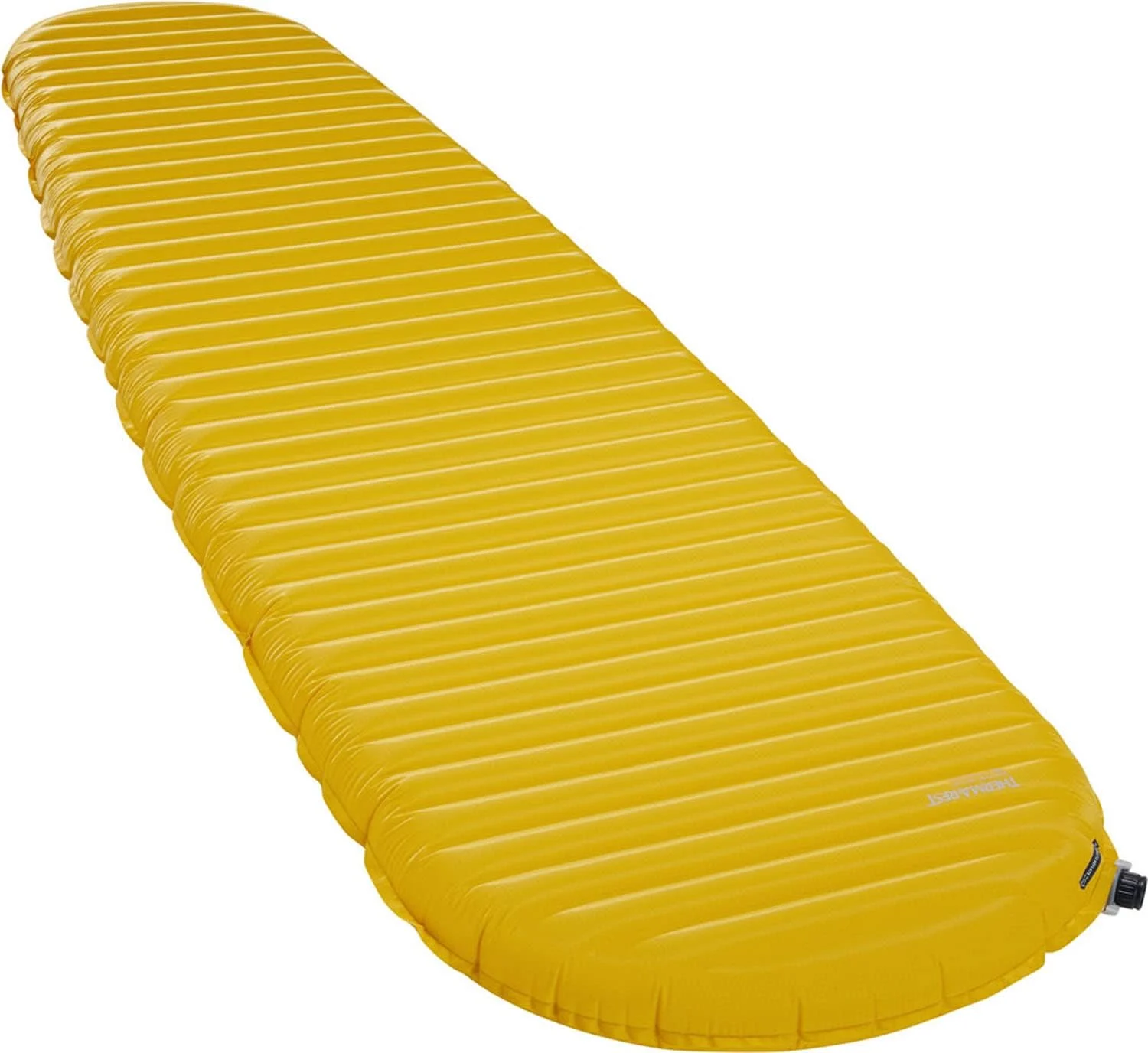
- Insulated upgrade: the Therm-a-Rest NeoAir XLite NXT — 354 g, R-4.5, packs to roughly the size of a 1L bottle. The warmth-to-weight benchmark for moto camping.
- Budget: the Klymit Static V2 — durable, cheap, fine for summer at R-1.3. Heavier and bulkier than the NeoAir but it’ll take real abuse.
Pillow: a packable inflatable like a Trekology Aluft or Sea to Summit Aeros beats a rolled-up jacket on night three. Around 80 g and packs to the size of a deck of cards.
Check Synthetic Sleeping Bags on Amazon →
Check Inflatable Camping Pillows on Amazon →
Go deeper: Best Compact Sleeping Pads for Motorcycle Camping
3. Camp kitchen
The whole kitchen should nest inside the pot and weigh under a kilo. On a motorcycle the choice is between an all-in-one boil system (fast, fuel-efficient, perfect for rehydrated meals and morning coffee) and a stove + pot setup (more flexible if you want to actually cook).
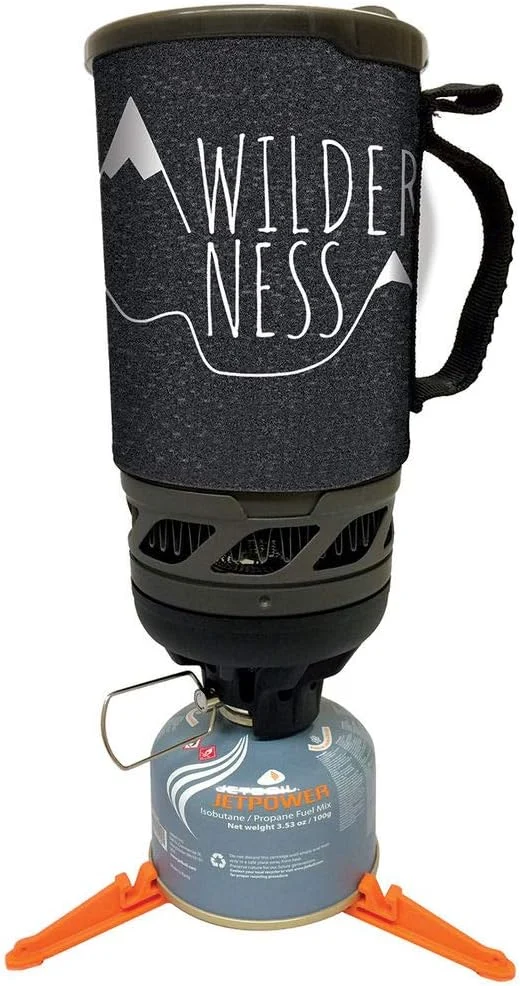
Boil systems win on speed and fuel efficiency — about 12 boils per 100g canister vs 8 on a separate-burner stove, and water boils in 100 seconds. The trade-off is bulk and inflexibility: you boil water in them well, you can’t really simmer rice or fry an egg.
Separate-burner stoves like the PocketRocket lose 30 seconds on boil time but you can cook real meals on them. For solo riders mostly drinking coffee and rehydrating freeze-dried food, the boil system wins. For two riders or anyone who likes to cook from raw, the separate burner is the right call.
- Boil-and-go: the Jetboil Flash — water boiling in roughly 100 seconds, integrated wind-resistant burner, the polished system. Ideal if you mostly rehydrate meals and need coffee in your hand fast.
- Budget / flexible: the MSR PocketRocket 2 — 73 g, pairs with any pot, real flame control so you can simmer. The stove I’d recommend to almost any new moto camper.
- Cookware: a single nesting set like a GSI Pinnacle or a Sea to Summit X-Pot covers everything. Don’t bring more than one pot.
- Utensil: one titanium long-handle spork is all you need. The long handle reaches the bottom of a freeze-dried bag without coating your knuckles in sauce.
- Water: the Sawyer Squeeze filter plus a collapsible 2L bottle (Cnoc or Platypus) means you can camp wherever there’s a stream — no need to hunt for a tap or carry days of water on the bike.
Check Camping Cook Sets on Amazon →
Check Titanium Sporks on Amazon →
Go deeper: Best Portable Camp Stoves for Riders · How to Cook on a Motorcycle Trip — gear, menu & camp kitchen
4. Camp comfort: light and a chair
These two items earn their space faster than anything else after a long day in the saddle. Skip them once and you’ll buy them before the next trip.
Lighting — bring two sources, never one. A headlamp for hands-free tasks (pitching, cooking, finding the toilet at 2 a.m.) and a small lantern for 360° camp light so you’re not constantly aiming a beam at your dinner. Two redundant sources also means a dead battery on one doesn’t end your evening.
- Headlamp: Black Diamond Spot or Petzl Actik Core — both around 90 g, 350+ lumens, USB-rechargeable. Get the rechargeable version, not the AAA — one cable charges everything.
- Lantern: the Black Diamond Moji R+ is tiny and magnetic (sticks to your bike). For brighter, all-night light go BioLite AlpenGlow 500 or Goal Zero Lighthouse.
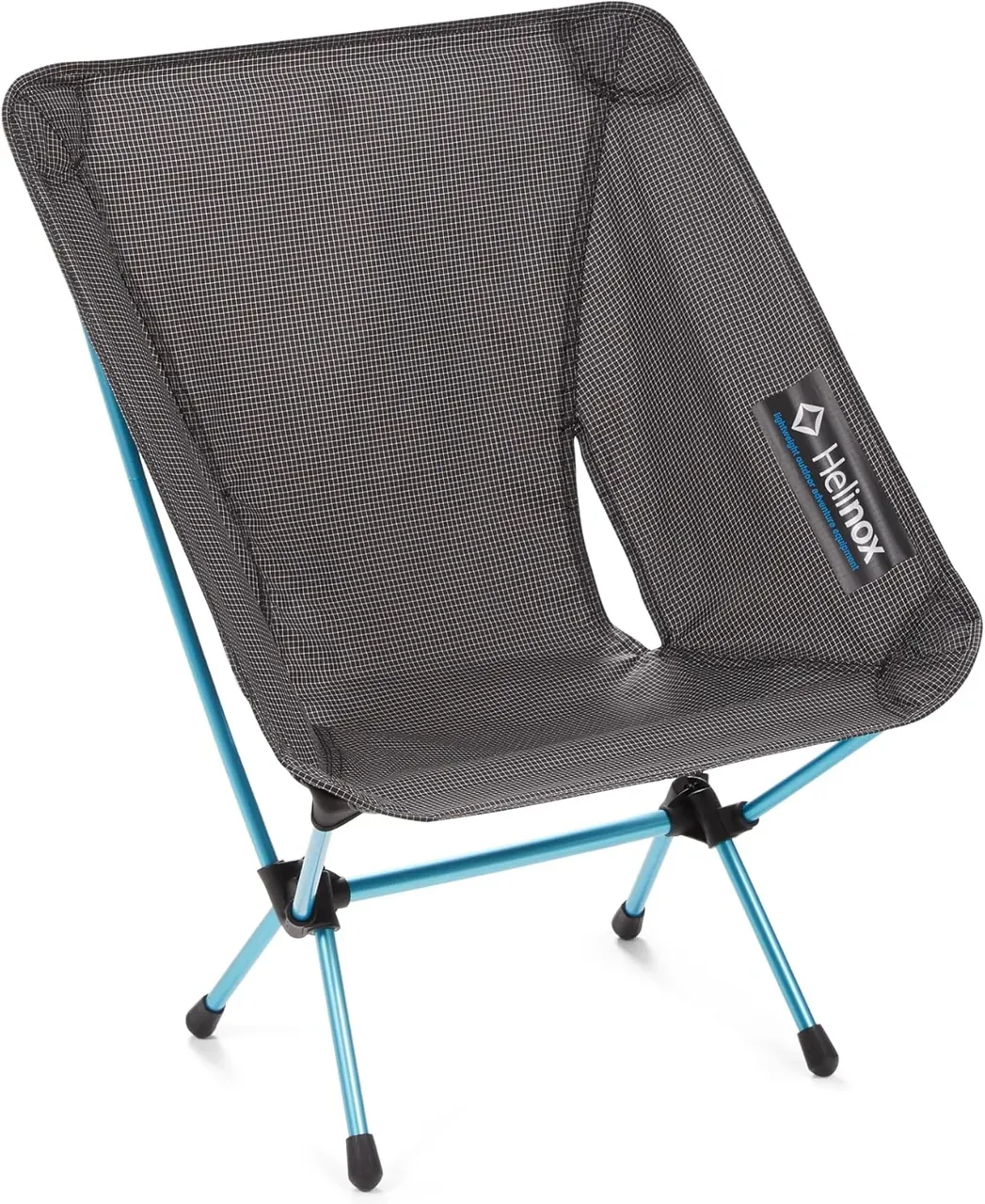
Camp chair — the upgrade riders regret skipping. A folding seat changes the evening. You sit, you cook, you read, you watch the sunset. A rock or a log lasts about twenty minutes before you want your chair back.
- Premium: the Helinox Chair Zero — ~1.1 kg, packs to the size of a 1L water bottle, genuinely comfortable for hours. The reference standard.
- Lighter alternative: the Helinox Chair Zero LT trims another ~150 g for short-trip riders.
- Budget: the Trekology Yizi Lite — about a third of the Helinox price, a touch heavier, still packs small. The right starter chair.
Check Black Diamond Spot on Amazon →
Check Black Diamond Moji on Amazon →
5. Luggage & packing
Your camping kit should live in one bag you can grab off the bike whole. Keep the dewy tent away from your clean clothes in the panniers, and keep the daily-access items (rain layer, water bottle, snacks) somewhere you don’t have to unstrap a duffel to reach.
The realistic setup is soft panniers + tail dry bag + tank bag. Panniers hold the bulk (sleeping bag, clothes, tools), the dry bag on the tail holds the tent and pad, the tank bag holds wallet, phone, snacks, gloves liner.
- Soft panniers: the Mosko Moto Backcountry 35L — aluminium wedge mount, one-latch on/off, fully waterproof. After 8,500 km it sits at the top of the soft-luggage market. Full breakdown in our Mosko Moto Backcountry 35L review.
- Tail dry bag: a 30–40L roll-top from SealLine or Sea to Summit. Welded seams, not stitched. Stitched seams leak in the first heavy rain.
- Tie-downs: Rok Straps are the rider-favourite. Bungee cords stretch, work loose, and snap into your face. Rok Straps don’t.
Strap discipline matters more than people admit: every external strap should be tightened until it’s quiet, then checked once more after the first 20 km. A loose strap turns into a flapping pannier turns into a destroyed roll bag in about 80 km of highway riding.
Check Motorcycle Dry Bags on Amazon →
Go deeper: Best Adventure Motorcycle Panniers 2026 · How to Pack a Motorcycle for a 2-Week Camping Trip
6. Tools, safety & navigation
The category that turns a remote breakdown from a three-day rescue into a one-hour delay. None of this is optional, none of it should be cheap, and almost all of it should live in the same place on the bike every trip so you can find it in the dark.
Tire repair is the single most likely thing to ruin a trip. A nail, a sharp stone, a thorn — any of them turns a great riding day into a recovery operation. A tubeless plug kit plus a way to re-inflate is the difference between a 30-minute roadside fix and a tow.
- Tool kit + tire repair: a function-organized roll, a tubeless plug kit (Dynaplug or Stop & Go) and a mini compressor or CO2 cartridges. Practice the plug procedure in your garage once before you actually need it.
- Multi-tool: a Leatherman lives in the tank bag. Pliers, knife, file, screwdriver bits — it covers 90% of camp tasks the bike’s tool roll doesn’t.
- First aid: an Adventure Medical Kits pouch sized to your trip. Don’t carry an oversized one and don’t carry a sub-50-piece “compact” one. Mid-size.
- Power: an Anker PowerCore 10,000–20,000 mAh bank keeps the phone, GPS, headlamp, and intercom alive for 3–4 days off-grid. Charge it from the bike’s USB port while you ride.
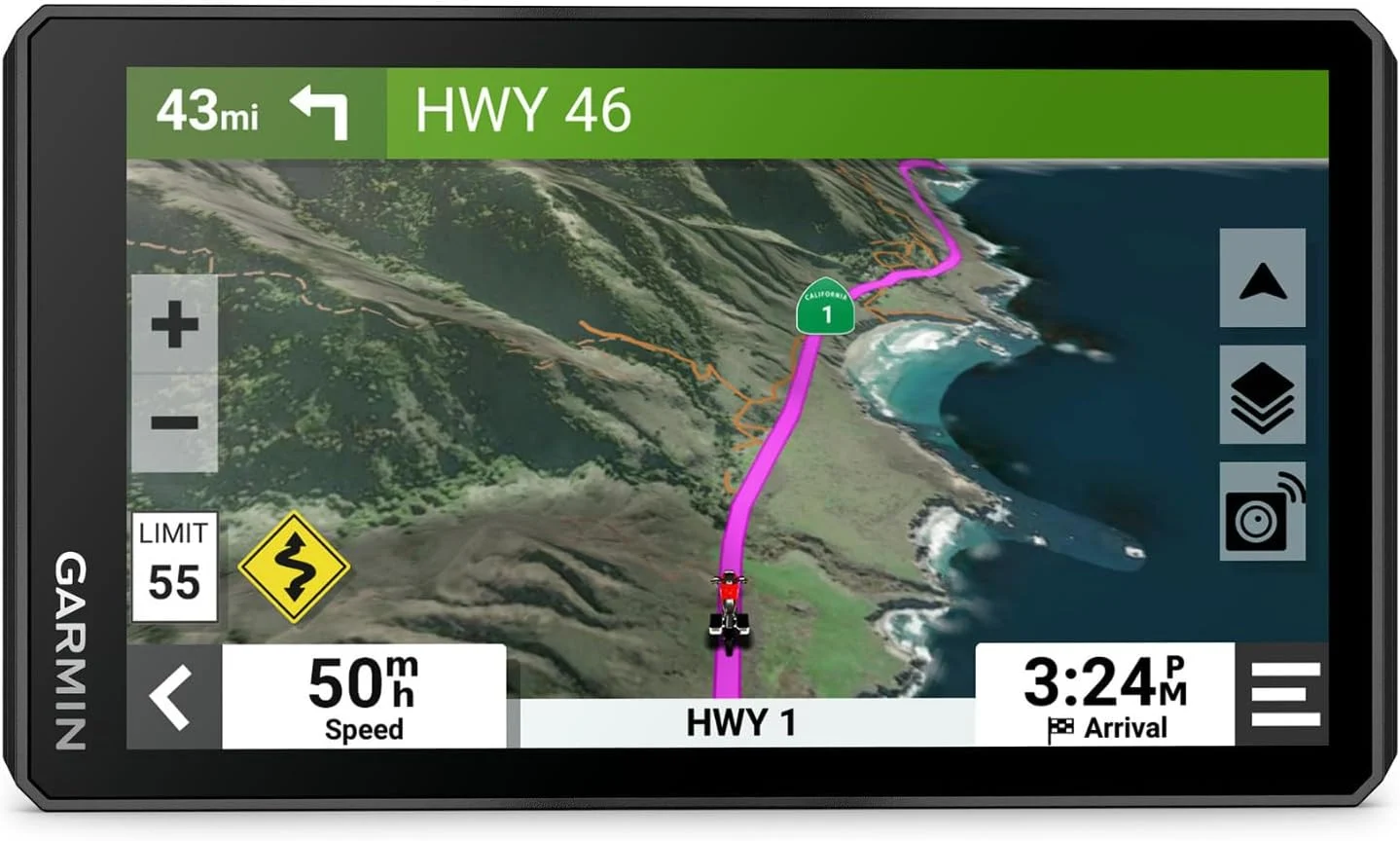
- Navigation: the Garmin Zumo XT2 if you want a dedicated, glove-friendly, sun-readable GPS. Our honest take on whether it beats a phone is in the Garmin Zumo XT2 review.
- Comms: an intercom like the Cardo Packtalk Edge or Sena 50S . For solo riders an intercom matters less, but turn-by-turn navigation in your ear keeps your eyes on the road. See Cardo vs Sena 50S.
- Solo safety: a Garmin inReach Mini 2 satellite messenger if you camp out of cell range. Two-way SMS over satellite, SOS button, position tracking. For solo riders in remote terrain it’s the single most important $400 you’ll spend.
Check Tubeless Plug Kits on Amazon →
Check Adventure Medical Kits on Amazon →
Check Anker PowerCore on Amazon →
Check Garmin inReach Mini 2 on Amazon →
Go deeper: The Ultimate Off-Road Motorcycle Tool Kit · Solo Motorcycle Camping Safety · How to Secure Your Motorcycle While Wild Camping
7. What you wear
Riding gear is its own checklist, so here’s the short version: protective ATGATT (all the gear, all the time) on the bike, plus one set of light off-bike clothes for camp. Two pairs of camp socks. One travel towel. That’s it.
The temptation is always to pack a second jacket, a second pair of pants, “just in case.” Don’t. Wash your camp shirt in a Sawyer-filtered stream and hang it from the tent guyline — it’ll dry overnight. Clothes are the easiest category to over-pack and the one that eats the most pannier space when you do.
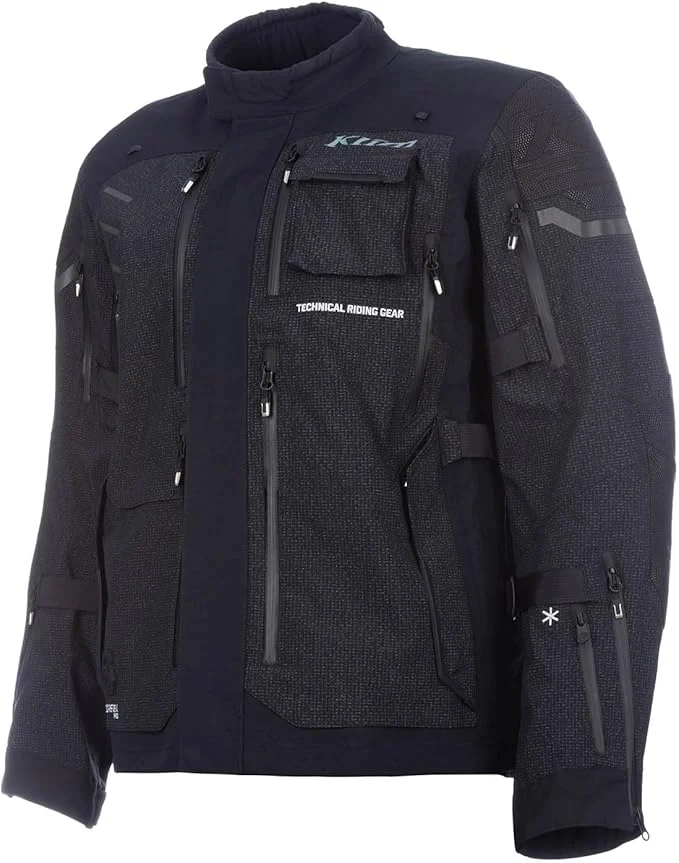
- Jacket: if you’re shopping at the top end, the Klim Badlands Pro earned its place over 12,000 km of testing — Gore-Tex Pro, D3O armour, the touring-and-adventure benchmark. Full review here.
- Camp layer: one packable down or synthetic insulated jacket. Doubles as a pillow stuff inside a stuff sack.
- Full head-to-toe kits with prices: Motorcycle Outfit for Men · Motorcycle Outfit for Women
The printable checklist
Copy this, trim it to your trip, and tape it inside a pannier lid. The bullets are the categories — fill in your specific gear next to each.
Toggle Interactive Packing Checklist
- Shelter: tent · footprint · pegs/guylines · repair tape
- Sleep: sleeping bag · pad · pillow · liner (optional)
- Kitchen: stove · fuel canister · pot · spork · lighter + backup · water filter · collapsible bottle · coffee
- Comfort: headlamp · lantern · chair · power bank · charging cables
- Luggage: dry bag · panniers · tie-down straps · compression sacks
- Tools/Safety: tool roll · tubeless plug kit · compressor or CO2 · multi-tool · first aid · zip ties · duct tape · chain lube
- Navigation/Comms: GPS or phone mount · intercom · paper map backup · satellite messenger (remote trips)
- Wear: helmet · jacket · pants · gloves · boots · rain layer · camp clothes · camp socks · travel towel
(Tip: turn this into a downloadable PDF with a tickbox column. The simplest version is to print this page and tick by hand the night before.)
Final word
Don’t buy the whole list. Start with a tent, a sleep system, and a stove, then add one comfort item per trip until the bike still handles the way you like and the panniers still close. The best motorcycle camping kit isn’t the lightest or the most expensive — it’s the one you can pack in ten minutes, ride all day without thinking about, and set up at camp before the sun is fully down.
The gear is just the entry fee. The trip is the point.
When the kit is sorted, point it somewhere worth it: Wild Camping in Turkey on a Motorcycle · Best Wild Camping Bays in the Mediterranean · How to Plan a Long-Distance Motorcycle Trip.
Frequently Asked Questions
How much does a full motorcycle camping setup cost?
A solid budget kit (Naturehike tent, value down bag, Klymit pad, PocketRocket stove, Trekology chair) lands around the entry tier — roughly $350–$450 all-in. A premium tested kit (Copper Spur, Spark bag, NeoAir XLite NXT, Jetboil Flash, Helinox Chair Zero) is several times that, closer to $1,400–$1,700. Both will get you the same night under the stars. The upgrade buys weight savings, pack size, and longevity — not a better view.
How do you pack camping gear on a motorcycle?
Heavy and dense low and central (tools, water, fuel) so they don't unsettle the bike in turns. Bulky-but-light up high or on the tail (tent, sleeping bag). Daily-access items on top. Balance weight left-to-right within 1–2 kg per side. Run the layout through our Pack My Bike simulator before you ride out to catch lateral imbalance before it bites you on gravel.
Do you need a special tent for motorcycle camping?
Not a dedicated one — a good lightweight backpacking tent works perfectly. What matters is packed pole length (must fit across a 30L pannier without sticking out), a vestibule big enough for a helmet and boots, and fast pitching in wind after a 10-hour ride. Dedicated 'bike garage' tents like the Lone Rider Mototent are a niche for big ADV riders who want to park the bike inside — overkill for everyone else.
What's the one thing beginners forget?
Two things, actually. First, a way to charge devices off-grid — a 10,000+ mAh power bank keeps your phone, headlamp, and GPS alive for 3–4 days. Second, a tubeless plug kit and a mini compressor. The first keeps your navigation alive when you're miles from a plug; the second keeps a single nail from ending the trip.
Is wild camping legal where I'm riding?
Depends on the country. Scandinavia (allemansrätten), Scotland, and most of Eastern Europe are tolerant or fully legal. France, Spain, Italy are technically restricted but pragmatic outside national parks. Turkey is permissive in remote areas. Always check local rules, leave no trace, and avoid pitching within sight of a road or a private boundary. Our wild camping guides cover specific regions in depth.