Insurance for adventure motorcycle touring is more complicated than it should be. You need bike insurance that covers your usage. You need travel insurance that doesn’t exclude your bike’s engine size. You may need a Green Card for certain border crossings. And the exclusions vary so much between providers that two policies marketed as “comprehensive motorcycle travel cover” can offer almost opposite levels of real protection.
This adventure motorcycle insurance guide lays out the categories of coverage that actually matter for touring riders in 2026, the common traps that catch people out, and the things to verify in writing before any serious trip. It’s written as a practical rider’s guide, not as financial or legal advice.
Disclaimer: This is a general guide based on rider experience and research. Insurance is jurisdiction-specific and policy details change frequently. Always verify coverage details directly with your insurer before riding.
Introduction: The Trap Most Riders Fall Into
The single most common insurance mistake among touring motorcyclists is assuming that the travel insurance bundled with their credit card, bank account, or general travel policy covers them while riding a motorcycle.
It almost certainly does not.
Standard travel insurance policies — the kind sold at airports, bundled with bank accounts, or attached to credit cards — typically include one of two exclusions: motorcycles over 125cc are entirely excluded, or motorcycle riding is excluded except as a paying passenger on licensed transport. Either way, the rider on a 700cc adventure bike in Morocco is not covered, regardless of how clearly the policy says “worldwide travel coverage.”
The fix is straightforward: buy a motorcycle-specific travel insurance policy that explicitly covers your engine size and your intended type of riding. The cost is typically $50-150 for a two-week trip, more for longer durations or off-road inclusion. The cost of not doing this can be $50,000+ in medical evacuation bills you weren’t expecting.
Bike Insurance: What ADV Riders Actually Pay in 2026
US figures, for context:
The average full-coverage policy for a mid-size cruiser runs around $40-50 per month for a 35-year-old rider with a clean record. Adventure bikes typically carry a 1.1-1.3x multiplier over the cruiser baseline, putting full coverage in the $50-80 per month range.
The factors that move the number:
Bike value (higher value, higher premium). Rider age and experience (under 25 is expensive, 50+ usually cheaper). Zip code (urban areas cost more). Garaging arrangements (a locked garage saves real money). Engine size (above 1,000cc carries a small premium). Riding history (claims and tickets matter for years).
The three dominant US providers for adventure bikes:
State Farm: traditional broad coverage, good claim service, average pricing.
Progressive: aggressive on price, useful add-ons including up to $3,000 of safety apparel damage coverage (the apparel coverage genuinely matters for touring riders).
GEICO: competitive pricing, 10% discount for riders 50+, solid for high-mileage commuters.
UK pricing runs somewhat lower in absolute terms (£35-60 per month for equivalent coverage) but the policy landscape is different — UK riders deal with more variation in voluntary excess and named-rider rules than US riders typically face.
Travel Insurance: Why Your Standard Policy Won’t Cover You
The exclusion mechanics:
Most mainstream travel policies — Allianz, World Nomads (standard tier), most credit card bundles — exclude “motorcycle riding” or limit coverage to “motorcycles 125cc and under” or “as a passenger only on licensed transport.”
These exclusions are often buried in the policy wording, not flagged at purchase. Riders assume coverage exists, ride for two weeks across Europe, return home, and only discover the gap when filing a claim or being denied at a hospital abroad.
The fix:
Buy a motorcycle-specific travel insurance policy. Verify in writing that the policy covers:
Your bike’s engine size explicitly stated. Off-road or unsealed-road riding if relevant to your route. All countries on your itinerary, including any non-EU destinations. Medical evacuation with a sufficient limit (at least $500,000 USD recommended). Trip duration for your full planned trip.
What to Look for in Adventure Motorcycle Travel Insurance
Five clauses to verify, in writing, before purchase.
Engine size limit: must explicitly cover your bike’s displacement. “Motorcycles” is not enough — the wording needs to state “no engine size limit” or specify a number above your bike’s displacement.
Off-road inclusion: only matters if your route includes unsealed roads. If it does, the policy must explicitly include “off-road” or “unsealed roads” — generic “motorcycle riding” cover usually excludes them.
Country list: some policies exclude specific countries by default (Ukraine, Russia, Iran, Libya). Verify your full route is covered.
Medical evacuation limit: $500,000 USD minimum. A surprising number of motorcycle travel policies cap evacuation at $100,000, which is inadequate for a serious incident in a remote area.
Trip duration cap: many annual policies limit individual trips to 30 or 60 days. For multi-month overlanding, you need a long-stay or expat policy, not a standard travel policy.
Insurance Checklist for ADV Touring
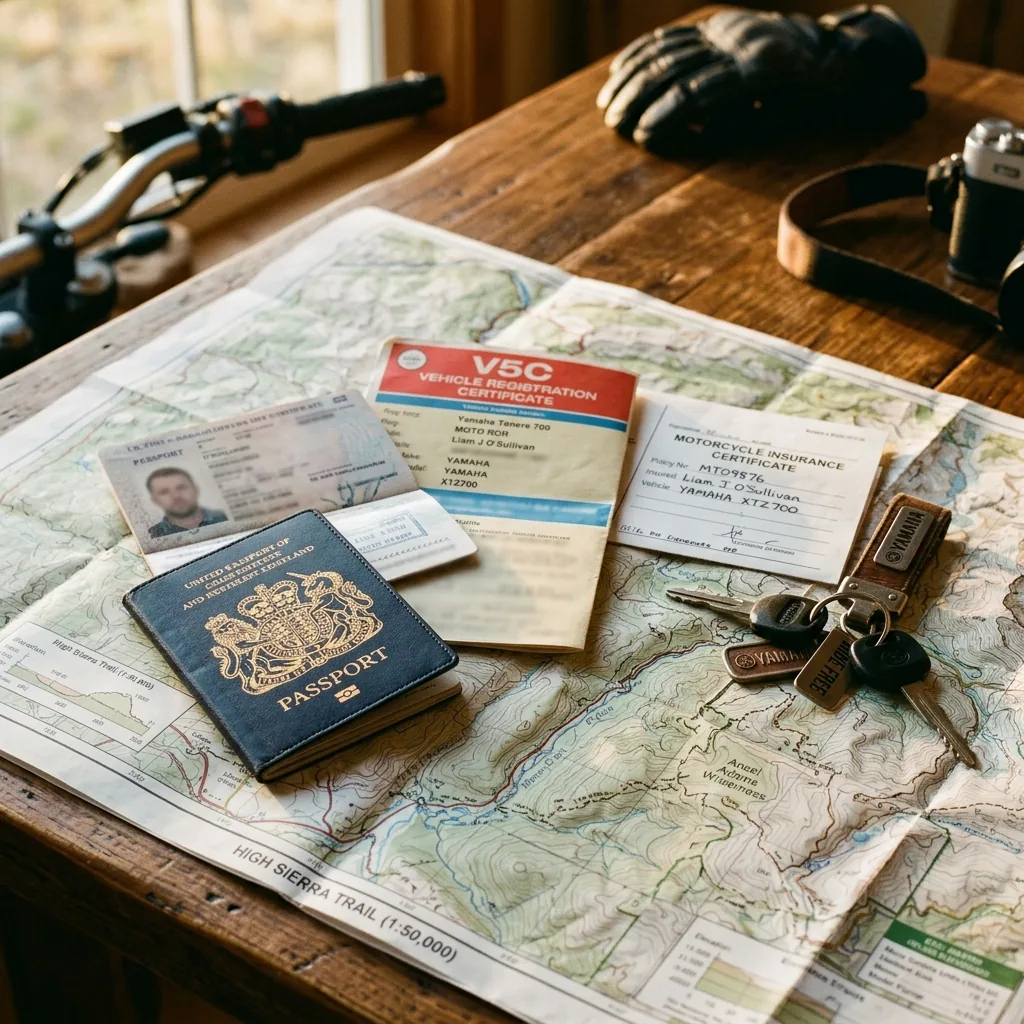
Verify each item before departure. Get coverage details in writing where possible.
- Bike insurance confirmed valid for all planned route countries (0 g)
- Green Card obtained if riding to non-EU countries that require it (minimal)
- Travel insurance confirmed: explicitly covers motorcycles (0 g)
- Engine size limit verified in policy — 125cc cap is a trap (0 g)
- Off-road coverage confirmed in writing if route includes piste (0 g)
- Medical evacuation limit: minimum $500,000 USD recommended (0 g)
- Trip duration cap verified against full trip length (0 g)
- Emergency contacts and policy numbers saved offline on phone (0 g)
- Printed copy of all policies in waterproof tank bag (60 g)
- Emergency assistance numbers stored in phone speed dial (0 g)
Green Card: When You Need It and When You Don’t
The Green Card is an international motor insurance certificate. The card itself proves your bike’s insurance is recognised for liability in the destination country.
Required for non-EU bikes entering: Albania, Bosnia and Herzegovina, Kosovo, Moldova, Montenegro, North Macedonia, Serbia, Ukraine, Morocco, Tunisia, Israel, Iran, Turkey (recently relaxed for some EU-issued plates, verify before travel).
Not required within the EU/EEA: standard insurance certificate is sufficient for cross-border riding between EU member states.
How to get one: contact your home bike insurer at least four weeks before departure. Most issue the Green Card free or for a small admin fee (£10-30). The card is physical paper — keep it with your registration document.
Some insurers will refuse to issue a Green Card for high-risk destinations like Ukraine or certain Western Balkans countries. If your insurer refuses, you’ll need to either change insurers or buy temporary border insurance on arrival. Border insurance is widely available at most non-EU border crossings but is more expensive and offers less coverage than a proper Green Card.
Recommended Providers (US and UK)
The major providers actively writing motorcycle-friendly travel insurance in 2026:
US providers: IMG Sport (motorcycle-aware travel cover), Tin Leg (multiple tiers including motorcycle inclusion), BHTP AdrenalineCare (extreme sports and motorcycle coverage), GeoBlue (long-term and multi-trip cover).
UK providers: Big Cat (specialist motorcycle travel insurance with off-road options), Bike Insurance Direct (touring extensions on bike policies), Carole Nash (touring add-ons), Bennetts (UK and EU bike cover with European extensions).
For the bike insurance itself, US riders should compare Progressive, GEICO, and State Farm. UK riders should compare Carole Nash, Bennetts, and Bikesure. None of these are recommendations — they’re starting points for verifying coverage that fits your specific bike, route, and rider profile.
Key Exclusions That Catch Riders Out
Five exclusions that appear in most policies and end most claims.
Engine size cap: discussed above. The single most common exclusion.
Off-road riding: rarely covered without explicit inclusion. Riding the Trans Euro Trail in a policy that doesn’t include off-road means no coverage if anything goes wrong on the trail.
Riding without a valid licence in the country: failing to carry an International Driving Permit where required can void coverage retroactively. Get the IDP where it’s needed.
Riding under the influence: blood alcohol limits vary by country. Some countries (Czechia, Hungary, Romania) enforce a zero-tolerance limit. Any positive reading typically voids the policy.
Riding gear inadequacy: some specialty policies require minimum gear standards (helmet, jacket, gloves, boots). Riding in shorts and trainers, even where legal, can void the policy in case of injury. Wear the gear.
Disclaimer and FAQ
This guide is a practical overview based on rider experience and 2026 research. Insurance products change frequently, and specific policy wording always overrides general guidance. Verify all coverage details directly with your insurer in writing before riding.
For related preparation topics, see our Europe motorcycle border crossing guide, riding the Balkans guide, solo motorcycle camping safety guide, and Morocco motorcycle adventure guide.
Disclosure: This article does not contain affiliate links and we are not paid by any insurance provider mentioned. Provider names are included as starting points for rider research, not as endorsements.
Frequently Asked Questions
Does my standard travel insurance cover me on a motorcycle abroad?
Almost certainly not, if your bike is over 125cc. Most mainstream travel insurance policies — including the ones bundled with credit cards and banking packages — explicitly exclude motorcycles above 125cc engine displacement, and many exclude any off-road riding regardless of engine size. This is the single most common insurance trap touring motorcyclists fall into. Before any international trip, verify in writing that your travel policy explicitly covers motorcycles at your bike's engine size, and that off-road or unsealed-road riding isn't excluded.
How much does adventure motorcycle insurance cost in the US in 2026?
Full-coverage insurance for a mid-size ADV bike runs roughly $50-80 per month in the US for a 35-year-old rider with a clean record. Factors that move the number: bike value, rider age and experience, zip code, garaging arrangements. Progressive, GEICO, and State Farm are the major providers covering adventure bikes. Progressive's safety apparel coverage (up to $3,000) is genuinely useful for touring riders. GEICO offers a 10% discount for riders 50+.
What is a Green Card and when do I need one?
A Green Card is an international certificate of motor insurance that proves your bike is covered for liability in countries outside your home country's standard insurance area. Required for non-EU bikes entering Albania, Bosnia and Herzegovina, Kosovo, Montenegro, Moldova, Serbia, Ukraine, Morocco, and Tunisia, among others. Not required within the EU/EEA — your standard insurance certificate is sufficient. Get the Green Card from your home insurer before departure; most issue it free or for a small admin fee.
What medical evacuation coverage do touring motorcyclists need?
A minimum of $500,000 USD coverage is the working recommendation. Medical evacuation from a remote area — a helicopter flight from a Moroccan piste track, an air ambulance from rural Albania, ground transport across borders — routinely costs $50,000-$200,000 without insurance, and the bills can run higher if multiple transfers are needed. Many bike-specific travel policies cap evac at $100,000, which is inadequate for serious incidents. Read the actual limit before you ride.
Can I get insurance that covers me for the Trans Euro Trail or piste riding?
Yes, but you have to ask for it explicitly. Most travel and bike insurance policies exclude 'off-road riding' as a standard exclusion. Specialist providers like IMG Sport, Big Cat (UK), Tin Leg, and BHTP AdrenalineCare offer motorcycle policies that include off-road or unsealed-road riding when declared at purchase. The policy wording needs to explicitly include 'off-road' or 'unsealed roads' for piste-track riding to be covered. Get this in writing before you ride.