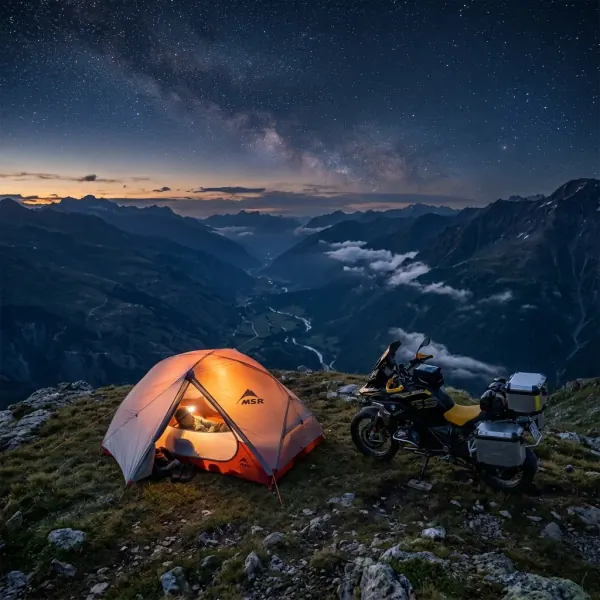
I’ve done seven solo motorcycle trips of a week or longer in the last three seasons. The longest was 14 days through remote stretches of the Black Sea coast and Eastern Anatolia. By day 9 I was talking to my bike at gas stops. By day 12 I was so tired of my own company I sat in a small town tea house for three hours not really drinking the tea, just being around other humans.
Solo moto camping is the most rewarding form of motorcycle travel I’ve found. It’s also the form with the smallest margin for error. There’s nobody to share the work with, nobody to call for help if your bike won’t start, nobody to notice if you fall ill in the night. The mistakes that other riders’ partners would catch are mistakes you make alone.
This guide is the working version of what I’ve learned about safety on solo remote trips. Solo motorcycle camping safety for remote tenting — not the catastrophizing internet version, not the reckless optimist version, but the practical preparation that lets you sleep well alone in places where help is far.
Realistic Risk vs Perceived Risk
Most pre-trip anxiety about solo motorcycle camping focuses on the wrong things. Internet forums talk about wildlife, robbery, and getting murdered in the woods. The actual statistics from rider deaths and serious injuries on solo trips show a different picture.
Real risks, ranked by probability:
- Single-vehicle crash on the road (fatigue, weather, mechanical)
- Drop the bike off-road, injure yourself in a fall
- Mechanical breakdown in a remote area with no help
- Hypothermia or heat exhaustion from weather you didn’t plan for
- Food poisoning or waterborne illness in foreign countries
- Acute illness (appendicitis, severe allergic reaction) far from medical care
- Storm or flash flood at a poorly chosen camp site
Risks people fear that almost never happen:
- Murder or violent attack by strangers
- Wildlife attack (bears, wolves, big cats in most riding regions)
- Kidnapping for ransom
- Being eaten alive by insects (you’ll just be very annoyed)
The preparation that matters is the preparation for the real risks. A satellite messenger covers mechanical and medical emergencies. Good camp site selection covers environmental risks. Travel insurance covers evacuation. A first aid kit covers minor injuries. None of these are about violent crime — because violent crime against solo campers in remote areas is exceedingly rare.
Before You Leave: Trip Planning Checklist
The 30-minute pre-trip routine that prevents most of what goes wrong:
- Route shared with trusted contact back home (0 g)
- Check-in schedule agreed (daily SMS or inReach ping) (0 g)
- Travel insurance confirmed covers motorcycle riding (0 g)
- inReach Mini 2 or PLB charged and packed (100 g)
- First aid kit with blister treatment (350 g)
- Emergency contacts saved offline not just in cloud (0 g)
- Weather forecast checked for full trip duration (0 g)
- Bike fully serviced — chain, tires, brakes, fluids (0 g)
- Spare key carried separately from primary (5 g)
Route sharing is the most important and most often skipped item. Send your daily plan to one person at home. Agree on a daily check-in — usually a 10-second SMS at the end of the ride day. If you miss the check-in by more than 12 hours, that person knows to call for help. This is the difference between “missing for 24 hours” and “missing for 5 days” in any emergency.
The check-in system requires discipline. Don’t skip a night because you’re tired. The whole system relies on you being consistent so the absence of a check-in is meaningful.
Choosing a Safe Camp Site
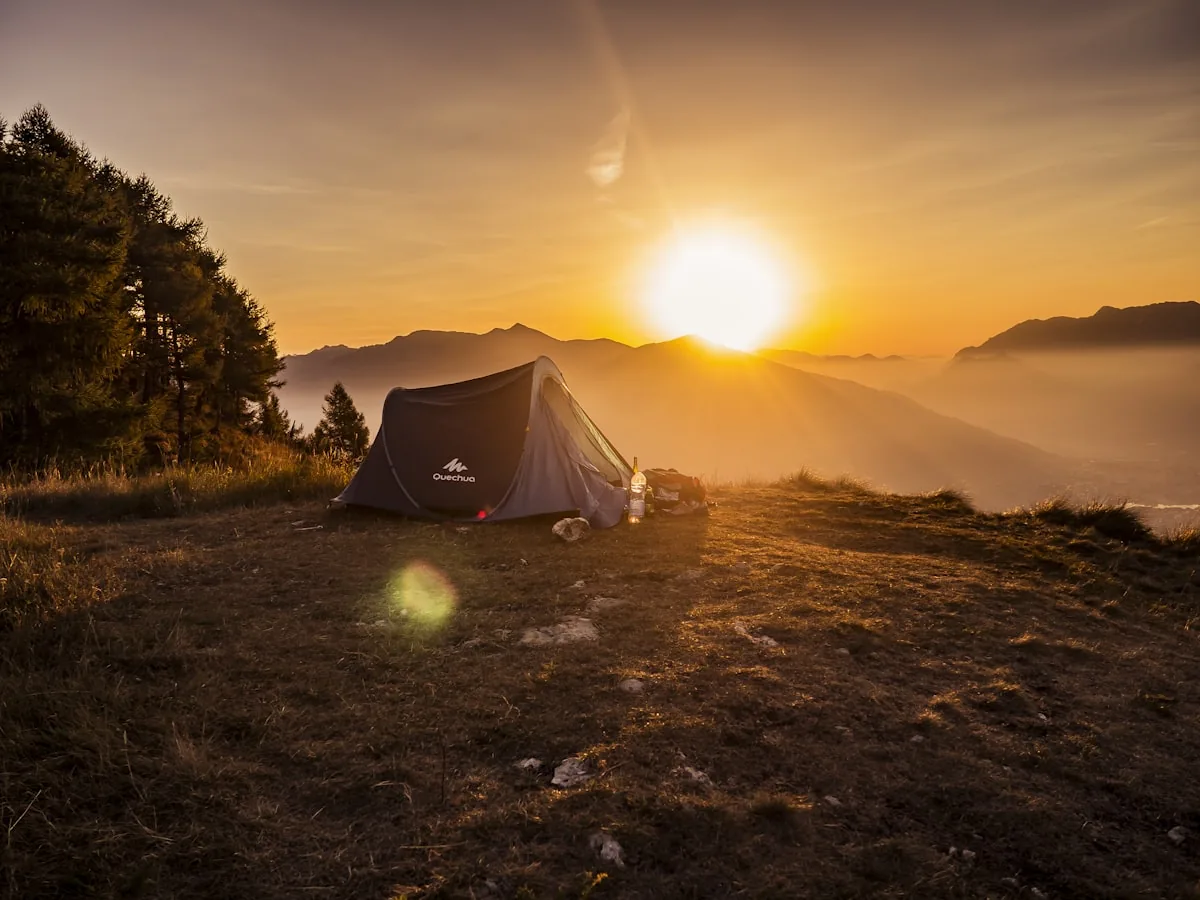
Five rules for camp site selection that prevent 90% of environmental problems.
Rule 1: Never camp in a dry riverbed or wash. Even in the dry season, even when it hasn’t rained in weeks. Flash floods kill more campers than any other environmental hazard. A storm 30 km upstream can send a wall of water through your camp with 10 minutes’ warning. If the ground shows water-rounded rocks and the soil is sandy and flat, you’re in a wash. Pitch higher.
Rule 2: Avoid the lowest point in a valley. Cold air sinks at night. The bottom of any valley can be 5-10°C colder than the slopes 50 meters above. Pitch on the side of the valley or on a rise, not in the bottom.
Rule 3: Look up for widow-makers. Dead branches in the trees above your tent can fall in wind. Look at every tree near your pitch site. If you see large dead branches still hanging, move 20 meters.
Rule 4: Visible from the road = vulnerable. If your camp is visible from the road, you’re inviting attention you don’t want. Pitch behind brush, behind a rise, around a corner from the road. Out of sight = out of mind.
Rule 5: Two exits. Always have a way out that isn’t the way in. If you camp at the end of a dirt track with a steep drop on three sides, you have one exit. If something goes wrong (medical, weather, unwanted visitor), you want options.
Spending 10 extra minutes choosing the right camp site is the single highest-return action in solo wilderness camping. Take the time.
Wildlife Awareness in Turkey and Mediterranean
The Mediterranean region has remarkably few dangerous animals. Turkey’s wildlife threats to solo campers are essentially:
Scorpions: Present in rocky and coastal areas. Most species are mildly venomous — a sting hurts like a wasp but rarely needs medical attention. Prevention: shake boots out in the morning, don’t leave gloves on the ground overnight, don’t put hands into crevices you can’t see.
Snakes: Present throughout Turkey. Mostly shy and harmless. The vipers (e.g., nose-horned viper) can deliver a serious bite but are rarely encountered if you watch where you step. Prevention: don’t reach into rock piles, watch where you sit, wear boots not sandals when walking around camp.
Dogs: Stray dogs in rural Turkey are the most realistic wildlife concern. Not aggressive in most cases, but a pack near your camp can be unnerving. Carry a small flashlight (bright light deters), don’t run, don’t make sudden movements, give them food only if you want them to stay all night.
Wild boars: Present in forested areas. Large and capable of damage if cornered. Almost never approach humans deliberately. Make noise when walking through dense brush at dawn and dusk.
Bears, wolves, big cats: Bears exist in Eastern Anatolia and the Kaçkar Mountains but encounters with campers are vanishingly rare. Wolves are present but shy. No big cats outside dedicated wildlife reserves.
The realistic wildlife preparation in Turkey: shake your boots in the morning, watch where you step, carry a flashlight, don’t camp on game trails. That’s all you really need.
Solo Rider Communication: inReach vs Phone vs Nothing
Three communication scenarios, three different setups.
Scenario 1: Route stays in cell coverage. A normal phone is enough. Pre-load offline maps (Google Maps offline, organic maps), share your live location with a contact at home, plan to make a daily check-in call. Carry a power bank.
Scenario 2: Route includes some remote sections. A phone plus a backup PLB (Personal Locator Beacon) like the ACR ResQLink is the minimum. PLBs are one-way distress only — push the button, emergency services find you. $300, lasts 10 years on factory battery, no subscription.
Scenario 3: Route includes serious remote sections. A Garmin inReach Mini 2 is the standard answer. $350 plus a $15/month basic subscription. Two-way satellite text, SOS button, location tracking. Send “ok” to home each evening even when you have no cell signal. If you get hurt or stuck, exchange messages with rescue coordinators in real time.
I carry the inReach Mini 2 on any trip that includes more than a half-day section without cell signal. The peace of mind is worth the $180/year subscription. The 100-gram weight cost is irrelevant.
Check Garmin inReach Mini 2 on Amazon →
First Aid for Solo Riders
A solo rider’s first aid kit needs to cover three categories of problem.
Minor injuries: Cuts, scrapes, blisters, burns. The everyday stuff that happens in camp and on the bike. Standard contents: adhesive bandages, gauze pads, antiseptic wipes, blister treatment (Compeed or similar), small antibiotic ointment, paracetamol and ibuprofen, antihistamine.
Major injuries: Severe wounds, broken bones, head injuries. The kit can stabilize, not treat — the goal is to get to professional care. Contents: large absorbent pad, elastic bandage, tourniquet (CAT or SOFTT-W), nitrile gloves, emergency blanket.
Medical conditions: Any chronic medication you take, plus broad-spectrum antibiotics if your doctor will prescribe them for emergency use abroad. For trips through regions with poor water quality, oral rehydration salts and loperamide for severe diarrhea.
A complete solo rider first aid kit weighs 300-400 grams. Pack it accessible — top of a tank bag or in a jacket pocket. A kit buried under three days of luggage is useless in an emergency.
Take a wilderness first aid course if you’re going to do this seriously. A two-day NOLS WFA course costs around $250 and teaches you the basics of injury triage, wound care, and emergency stabilization. Worth more than any single piece of gear.
Check Wilderness First Aid Kits on Amazon →
Mental Health on Long Solo Trips
The conversation nobody has. Solo trips longer than 5-6 days start to take a mental toll on most riders. The exact pattern varies — some hit a wall at day 4, some not until day 10 — but the trajectory is consistent. By the back half of a long solo trip, you’re more tired, more emotional, more likely to make small decisions badly.
The protections are obvious in retrospect:
Build social stops into the route. A guest house every 4-5 nights. A meal in a town with the locals. A phone call home in the evening from a spot with signal. Even brief conversations with strangers (at gas stations, in restaurants) reset something that solitude wears down.
Plan the town stop before you need it. When you’re already crashed out from too many days alone, you’ll make worse decisions about when to stop and where to stay. Pre-book a guest house for night 5 of a 10-day trip — even if you feel fine on day 4, the structure is protective.
Audiobooks and podcasts on the bike. Five hours of riding alone in silence amplifies internal noise. Five hours of riding with a long audiobook narrator in your ears feels like company. Most premium intercoms (Cardo Packtalk Edge, Sena 50S) handle Bluetooth podcasts cleanly — see the best motorcycle intercom systems guide.
Brief journal at night. Five minutes of writing — what you saw today, what you ate, where you slept. Externalizes the day, makes the trip feel less of a blur, and gives you something to read later when the long trip feels less hard than it did at the time.
The 7-10 day rule is real for most solo riders. Beyond that, plan a social reset — meet a friend at a midpoint, stay in a town for two days, do something that involves other humans. Solo riding is not the same as being alone. The trip is better when both are in balance.
Internal Connections
This guide pairs with other safety and route content:
- For securing the bike at remote camps, see how to secure your motorcycle while wild camping.
- For remote bay camping locations in Turkey, see remote Turkish bays only an adventure motorcycle can reach.
- For longer solo route planning, see Trans-Euro Trail for beginners.
FAQ
Five common questions are answered at the top of this page. The short version: real solo camping risk is mostly mechanical and medical, not criminal. A satellite messenger, a shared route, and good camp site judgment cover most of what goes wrong. The mental side is real on long trips — plan social stops in advance.
Whatever your version of solo motorcycle camping safety remote tenting looks like, the principle is preparation that’s proportionate to the real risks. Skip the catastrophizing and skip the recklessness. Bring an inReach, share your route, choose your camp sites carefully, and you’ll come home from solo trips with stories instead of scars.
Disclosure: Some links in this article are affiliate links. If you buy gear through them, we may earn a small commission at no extra cost to you.
Frequently Asked Questions
Is solo motorcycle camping really safe in remote areas?
For experienced riders with basic preparation, yes — the realistic risks are mechanical (bike breakdown), medical (injury without nearby help), and environmental (storms, exposure). Theft, violent crime, and wildlife are far lower-probability risks than most riders assume. The protection against the real risks is communication (satellite messenger or shared route), preparation (first aid kit, basic mechanical skills), and judgment (camp site selection, weather awareness). Get those right and remote solo camping is one of the safest forms of motorcycle travel.
Do I really need a Garmin inReach Mini 2 or is a phone enough?
If your route stays within cell coverage, a phone is enough. If your route includes mountain passes, remote dirt trails, or wilderness areas with no signal, a satellite messenger is non-negotiable. The inReach Mini 2 ($350 plus a $15/month basic subscription) sends two-way text messages from anywhere on Earth with sky view, includes an SOS button that connects to emergency services, and weighs 100 grams. For solo riders going seriously remote, it's the single most important safety device available.
What's the most common camp site mistake?
Pitching in a dry riverbed or wash. They look like ideal camp sites — flat, sandy, sheltered — and they kill people in flash floods. A storm 30 km upstream can send a wall of water through a wash with 10 minutes' warning. Other common mistakes: camping at the lowest point in a valley (cold air pools at night, you wake up freezing), camping under widow-makers (dead branches that fall in wind), and camping where the bike is visible from the road. Spend 5 extra minutes choosing a camp site and avoid 90% of bad outcomes.
Are scorpions a real risk in Turkey?
Yes, in rocky and coastal areas, but the practical risk is low. Turkish scorpions are mostly mildly venomous — a sting hurts like a wasp but rarely requires medical care. The actual precaution is simple: shake your boots out in the morning before putting them on, don't leave gloves on the ground overnight, and avoid putting your hands into rocky crevices you can't see into. The same advice applies to spiders. Snakes exist but are shy and almost never encountered by campers paying basic attention to where they step.
How do I deal with the loneliness of long solo trips?
It's real, especially after day 5-6 of solitude. Build social stops into your route — a guest house every 4-5 nights, a meal in a town with the locals, a phone call home in the evening from a spot with signal. Audiobooks and podcasts during the ride help. So does keeping a brief journal at night. The mental fatigue compounds; planning a town stop before you actually need it is wiser than pushing through until you crack. Many solo riders find 7-10 days is the sustainable maximum without a social reset.