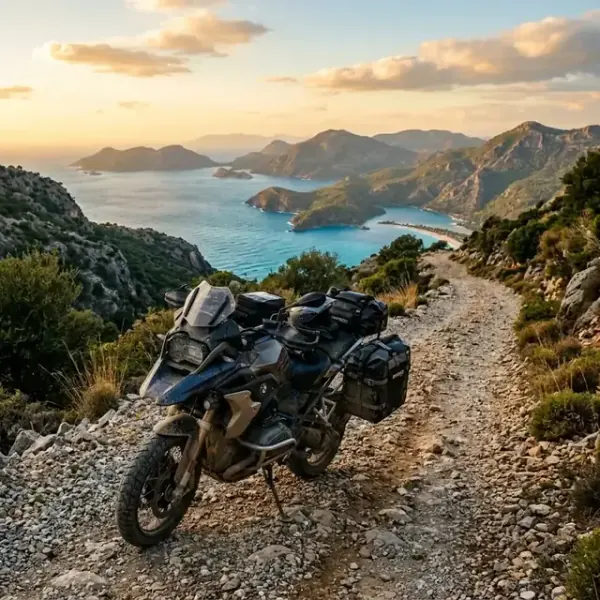
The Mosko Moto Backcountry 35L is one of the most-discussed soft pannier systems in adventure motorcycling, and the discussion usually comes down to a single number: $895 for the pair. That price puts it firmly in the premium tier, alongside hard aluminium luggage from Touratech and well above the strap-mounted soft bags from Wolfman, Giant Loop, and Nelson-Rigg.
This mosko moto backcountry 35l review is based on long-term testing of a Backcountry 35L pair on a mid-weight adventure bike. The Thrash-Meter on this site logs 8,500 km of mixed asphalt, gravel, and technical dirt across that period, with the bags returning a 92% life-remaining estimate at the time of writing. That track record informs what follows.
Introduction: A Different Kind of Soft Pannier
Most soft motorcycle panniers attach to the bike with cinch straps. The strap method is light, cheap, and rack-optional, but it has a real downside on technical terrain — the straps loosen under repeated impact, the bag shifts position, and the rider eventually has to stop and re-tension everything.
The Mosko Backcountry system replaces straps entirely with an aluminium wedge that locks the bag to a pannier rack. The wedge slides down onto a matching plate on the bike’s rack and a single latch at the top holds it in place. The result is a soft bag that behaves like a hard pannier in terms of stability, without the weight penalty or the leg-pinning risk of rigid aluminium in a fall.
What You’re Actually Buying: The Wedge System Explained
The wedge plate is the engineering decision that defines the Backcountry product. It is a precision-machined aluminium piece, roughly 6 mm thick, bolted permanently to the inner face of each pannier. The matching receiver bolts to the bike’s pannier rack and stays there.
To mount the bag, the rider lifts it onto the rack and slides the wedge straight down into the receiver. Gravity does most of the work. The locking latch at the top of the wedge clicks into place with a positive snap.
To remove the bag, the rider releases the latch with one hand, lifts the bag straight up, and walks away. The full removal sequence takes about five seconds per side. There are no straps to unbuckle, no quick-release clips to find, no canvas to wrestle.
The practical impact of this design becomes obvious over a long trip. A rider who removes the bags every night at a hotel or campsite — for security, to lighten the bike, or to access contents — saves roughly five to ten minutes per stop compared to a strap system. Over a two-week trip that adds up to hours of saved time.
Build Quality and Materials
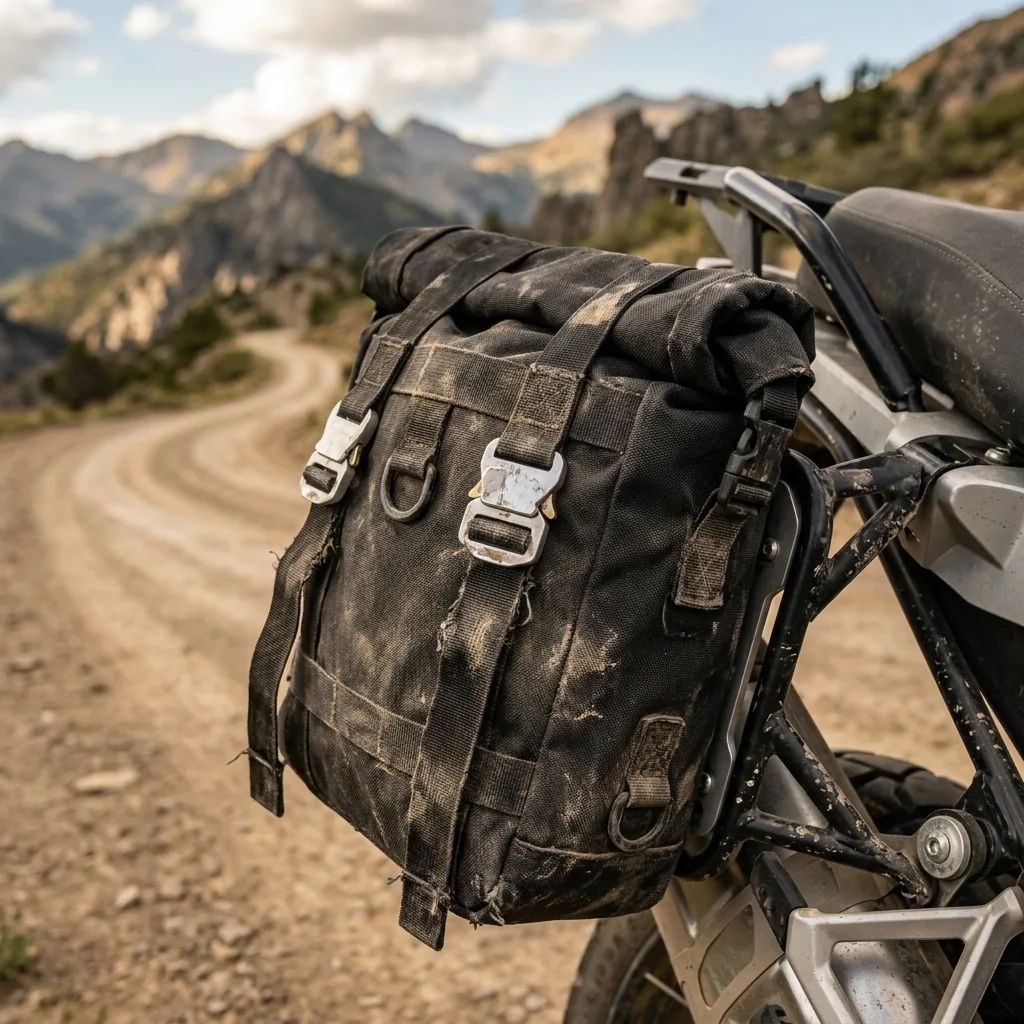
The outer shell of the Backcountry 35L is 1680D ballistic nylon, the same fabric class used in high-end military and tactical luggage. The high-wear panels — bottom corners, the area near the wedge plate, the leading edge facing the wind — are reinforced with Hypalon, a synthetic rubber sheet used in inflatable boat construction. Hypalon is resistant to abrasion, UV, and chemical exposure.
Stitching is doubled at every stress point. The main bag-to-wedge interface uses load-bearing webbing routed through the wedge plate and stitched in a box-and-X pattern. Zippers are YKK on the external pockets; the main closure is a roll-top with three buckle attachment points.
The hardware is not generic. The buckles are ITW Nexus, the same brand used on military rucksacks. The roll-top tensioner is a custom Mosko Moto piece. The molle webbing across the outer face accepts standard MOLLE-compatible accessories — additional pouches, tool rolls, water bottle holders.
The construction philosophy is clear: every component is rated above the loads the bag will see in normal use. The bag is overbuilt by design, which is what justifies the price.
On-Bike Performance
The Backcountry 35L was tested across three terrain types: paved highway, graded gravel, and technical single-track. The bag’s behaviour on each surface tells the story.
On paved highway at sustained speeds of 110-130 km/h, the bag is invisible. Zero perceptible flex, zero wind flutter at the seams, no sound. The wedge mount means there is no shifting on the rack regardless of crosswind or trailing-vehicle turbulence.
On graded gravel at 50-80 km/h, the bag transmits some vibration but does not move on the bike. Strap-mounted soft panniers tend to creep downward over hours of corrugated road. The wedge eliminates that creep.
On technical single-track with the bike fully loaded — drops, recoveries, hard braking on loose surface — the bag stays locked. The 8,500 km test period includes multiple low-side drops on loose terrain. The wedge survived every drop without damage, the locking latch never released unintentionally, and the bag never came off the bike.
A note on width: each Backcountry 35L bag, mounted, adds roughly 30 cm of width to the bike compared to bare panniers. Riders accustomed to tight forest single-track should factor this in — a bag that clears a tight gap with bare panniers may not clear the same gap with the Backcountry mounted.
Mosko Backcountry Pannier Kit Contents Checklist
The Backcountry 35L is sold as a complete system including the bags, frames, internal dry liners, and optional Aux Pox expansion pockets. Total kit weight as shipped is roughly 8.9 kg.
- Two 35L pannier bags (2.95 kg each)
- Two mounting frames and wedges (1.1 kg each)
- Two dry bag liners included (180 g each)
- Two Aux Pox expansion pockets optional (220 g each)
The included dry bag liners are the genuine waterproof layer of the system. Critical contents — sleeping bag, electronics, documents — pack inside the liner before the liner goes into the pannier. The outer ballistic shell handles abrasion and the bulk of weather, but for full waterproof confidence the liner is non-negotiable.
The Aux Pox are optional 5 L MOLLE-attached expansion pockets that add capacity for items the rider wants accessible without opening the main roll-top. Common contents: a rain shell, gloves, an action camera, a snack stash. With both Aux Pox attached, each pannier reaches roughly 35 L total volume.
Pros and Cons After 8,500 km
- Wedge mount system — five-second removal and zero shifting on the bike
- 1680D ballistic nylon and Hypalon construction is genuinely overbuilt for the application
- Included dry liner provides full waterproof protection for critical contents
- MOLLE-compatible exterior accepts standard tactical accessories
- Available fitment kits for most major adventure bikes
- Aux Pox expansion adds usable volume without bulk when empty
- $895 for the pair places it in the premium tier — not casual money
- Requires a compatible pannier rack — no rackless option available
- Wedge plate and frame add 1.1 kg per side beyond the bag weight
- Roll-top main closure is splash-proof, not submersible without the liner
- Adds roughly 30 cm of width — relevant for tight technical single-track
Who Should Buy It
The Backcountry 35L is the right pannier for a specific rider profile. Overlanders riding mid-to-large adventure bikes (Ténéré 700, Africa Twin, R 1250 GS, KTM 890 Adventure R) who run a pannier rack already, who remove luggage frequently at lodging stops, and who prioritise long-term durability over upfront cost will get full value from the system.
The Backcountry is the wrong choice for three rider profiles. Lightweight credit-card tourers who want minimal luggage benefit more from a single Kriega OS-22 or a Mosko Reckless harness. Strict-budget riders with under $400 to spend on luggage should look at the Nelson-Rigg SE-2050 or the Giant Loop Coyote. Riders who specifically want hard, lockable cases for security-sensitive cities should not be looking at any soft pannier system.
For the middle of the adventure-touring market, the question is whether the wedge system and the build quality justify the price difference over a strap-mounted Wolfman or Giant Loop pannier of similar capacity. The honest answer is: yes, if removal speed and rigidity matter; no, if those features are not a priority.
Verdict
The Mosko Moto Backcountry 35L is the best soft pannier system on the market for adventure motorcycles equipped with a pannier rack. The combination of ballistic construction, rigid wedge mounting, included dry liners, and modular MOLLE expansion solves problems that strap-mounted competitors do not solve.
The price is high. The bags are heavy compared to a minimalist Kriega rackless setup. The system requires a rack as a baseline. None of those caveats undermine the core argument — for a long-distance adventure motorcycle that lives on real terrain and gets unpacked every night, this is the system that earns its place.
Direct purchase is also available through moskomoto.com, which often carries bundle pricing on the bags-plus-fitment package and offers detailed fitment guides for specific bike models. Both purchase paths receive the same warranty coverage.
Disclosure: Some of the links in this article are affiliate links. If you buy gear through them, we may earn a small commission at no extra cost to you. It helps fund the road trips that make these independent reviews possible — every gear recommendation here is based on real-world long-term use.
Frequently Asked Questions
Is the Mosko Moto Backcountry 35L waterproof?
The outer shell of 1680D ballistic nylon with Hypalon panels resists rain and road spray well, but the main roll-top closure is splash-proof rather than fully submersible. Mosko Moto includes a dedicated internal dry bag liner with every Backcountry pannier — that inner liner is the true waterproof layer. Pack critical items inside the liner and the bag survives heavy rain or a brief stream crossing without water reaching the contents.
Do the Mosko Moto Backcountry panniers need a luggage rack?
Yes. The Backcountry system requires a compatible pannier rack to mount the aluminium wedge plates. Mosko Moto sells fitments for most major adventure bikes (Yamaha Ténéré 700, Honda Africa Twin, BMW R 1250 GS, KTM 890 Adventure), or the wedge plates can be adapted to aftermarket racks from SW-Motech, Outback Motortek, and similar brands. The rack stays on the bike permanently; the bags clip on and off in seconds.
What is the Mosko Moto wedge system and why does it matter?
The wedge is an aluminium plate bolted to the inner face of the pannier that slides downward onto a matching receiver on the bike's rack. A single locking latch at the top secures the bag in place. The advantage over strap-mounted soft panniers is twofold — removal takes five seconds with no straps to unclip, and the bag is anchored on a rigid plane rather than tensioned canvas, so it does not shift under load on technical sections.
How heavy is each Mosko Backcountry 35L pannier?
Each pannier weighs 2.95 kg (6.5 lbs) empty, excluding the mounting frame and wedge plate. The frame and wedge add another 1.1 kg per side, mounted to the bike's rack. Total dry weight per side is around 4 kg before any contents go in. For comparison, a pair of hard aluminium panniers like the Touratech Zega Pro weighs roughly 7-9 kg per side empty.
Mosko Moto Backcountry vs Kriega OS-32 — which is better for overlanding?
Different philosophies. The Mosko Backcountry uses a rigid wedge that locks onto a pannier rack — fast removal, anchored rigidity, but requires the rack. The Kriega OS series is rackless and uses a tensioned harness around the rear of the bike, lighter overall but slower to mount and dismount, with more shifting under hard off-road loads. For overlanders who frequently remove bags at hotels or campsites, the Mosko system wins on convenience. For lightweight tour-focused riders prioritising weight savings and rack-free simplicity, Kriega is the cleaner choice.