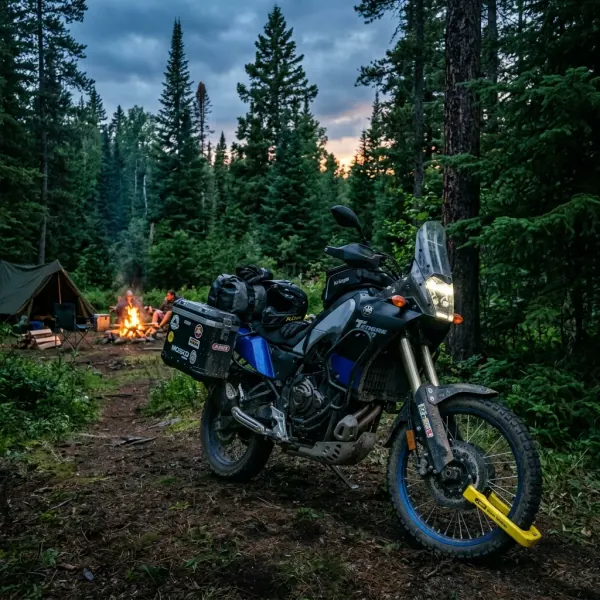
I’ve spent maybe 60 nights wild camping next to a motorcycle in the last three years. The bike has been stolen exactly zero times. It’s also been approached by exactly two strangers in the dark — both shepherds checking what I was doing on their grazing land, both polite, both unconcerned with the bike.
The internet would have you believe wild camping next to an expensive motorcycle is a constant exercise in paranoia. The reality is calmer. Remote-wilderness theft is rare. The real risk isn’t where most riders worry — it’s at the roadside pull-off where you stopped for lunch, the trailhead where you parked to walk to a beach, and the hostel parking lot in town.
This guide is the practical version. How to secure your motorcycle while wild camping with a layered setup that handles realistic threats without turning every campsite into a fortress. The gear matters less than the thinking. I’ll cover both.
Realistic Risk Assessment for Remote Camping
Most riders overestimate wilderness theft risk and underestimate roadside theft risk. The math is simple. Stealing a 200 kg motorcycle requires either riding it away (needs the key or hot-wiring skill) or transporting it in a van (needs road access for the van). Neither is easy 5 km down a dirt track in remote forest.
The places motorcycle theft actually happens are where any of these conditions are true:
- Bike parked overnight in an urban area
- Bike parked at a trailhead, beach, or viewpoint while you walk away
- Bike at a roadside pull-off near a town
- Bike at a hostel or hotel with parking visible from the street
- Bike at a campground frequented by non-campers
The places it almost never happens:
- Bike at a remote wild camp 1+ km off the road
- Bike in dense forest with no clear approach
- Bike on a beach accessible only by 4x4 trail
- Bike at altitude above the snowline
This isn’t theoretical. ADVrider and various motorcycle touring forums have decades of post-mortem analysis of bike thefts. The pattern is overwhelming: thieves go where bikes are easy to find and easy to remove. Wild camp spots are neither.
That said, “rare” is not “zero.” Layered security is cheap insurance against the unlikely-but-possible event.
The Threat Landscape: Where Bike Theft Actually Happens
Three categories of threat, each requiring different countermeasures.
Opportunistic petty interference. Someone walking by sees an unattended bike, tries the kickstand, tries the saddle, sees if the keys are in. Defeated by any visible lock — a $40 disc lock makes the bike not worth the 30 seconds of investigation. This is by far the most common threat at trailhead-and-roadside stops.
Targeted theft for transport. A van pulls up at night, two people lift the bike into the van, gone in 90 seconds. This is what real motorcycle theft looks like in cities. Defeated by chains to a fixed anchor (so the bike can’t be lifted), GPS tracking (so it’s traceable if it does move), and avoiding overnight street parking near major roads.
Vandalism and damage. Kids in a small town, drunks at a tourist beach, someone with a grudge. Defeated by parking out of sight, using a bike cover, and not leaving the bike visible at known party spots overnight.
Match your security setup to the actual threat you’ll face. A 1.4 kg chain is overkill for a wilderness camp where nobody will see your bike. A disc lock alone is underkill for a hostel parking lot in a known theft city.
Disc Locks: First Layer of Defense
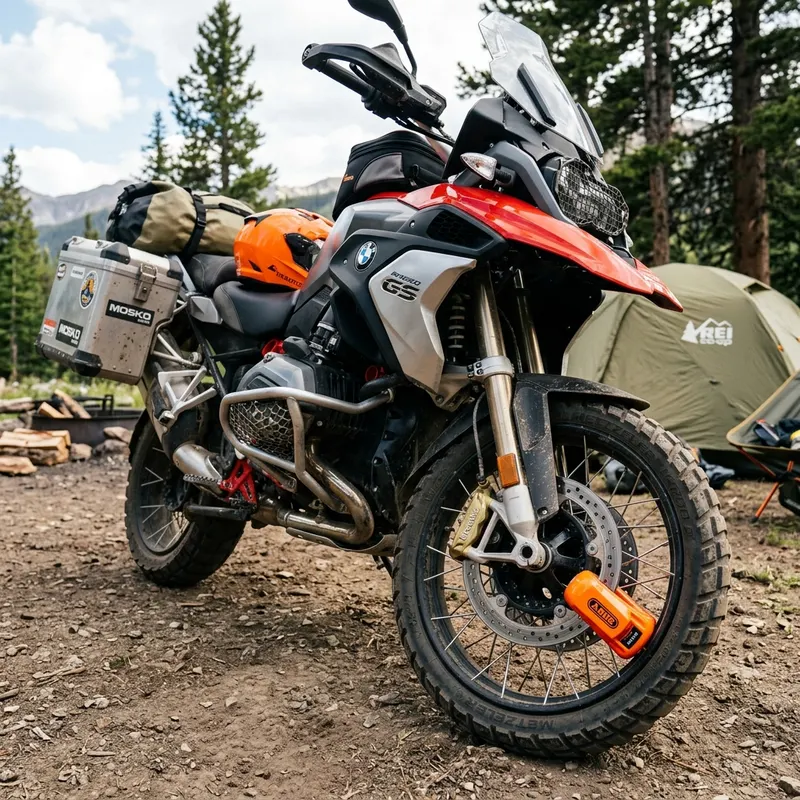
A disc lock clamps to one of your brake discs so the wheel can’t rotate. The bike can’t be ridden away and can only be wheeled with the wheel locked. Most disc locks weigh 250-400 g, fit in a tank bag pocket, and cost $30-80.
The best disc locks add an alarm — a small accelerometer that triggers a 110 dB siren if the bike is disturbed. Xena makes the most-recommended version (around $60, 310 g). The alarm is the real deterrent. A thief approaching a bike with a visible alarm-equipped disc lock sees both the lock and the alarm sticker and almost always moves on.
Practical rules:
- Always attach the disc lock to the front brake disc, not the rear. Rear discs are partially shielded by the swingarm and chain — harder to access, easier to forget to remove.
- Use a bright-color reminder cord between the disc lock and the handlebar. Riding off with the disc lock attached is a real way to break the disc, your wallet, and your dignity at the same time.
- Replace the battery in alarmed disc locks once a year. Dead alarm = no deterrent.
A disc lock is not a serious anti-theft device. A determined thief can defeat one with a hammer or a portable angle grinder. What it does is signal “this rider takes security seriously, find an easier target.” For 95% of camping situations, that signal is enough.
Check Disc Locks with Alarm on Amazon →
Chain Locks: When Security Matters More Than Weight
A chain lock is what you carry when you might leave the bike in a high-risk urban environment overnight. A serious chain — Kryptonite New York Chain, Abus Granit X-Plus — uses 14-16 mm hardened steel links that defeat bolt cutters and resist hand-held angle grinders for several minutes.
The trade-off is weight. A 1.2 m Kryptonite chain weighs about 1.4 kg. That’s significant on a motorcycle. The math is: you carry it during the day to lock the bike at city overnight stops. You don’t typically use it at wilderness camps.
The chain only works when looped through a fixed anchor. A tree, a guardrail post, a concrete bollard. Looping a chain through the bike’s own frame doesn’t prevent the bike being lifted — it just makes the bike heavier to lift. If there’s no anchor available at your stop, the chain provides little additional security beyond a disc lock.
Loop the chain through the frame, not the wheel. A wheel can be removed and the bike rolled away on the chain. The frame is the bike — chain through the frame means chain stays with the bike.
Check Heavy-Duty Chains on Amazon →
GPS Tracking: The Best Insurance Money Can Buy
For about $30 plus a $10/year iCloud account, an Apple AirTag is the most effective theft recovery insurance available. Hidden under the seat, inside the fairing, or in a small case strapped to the subframe, the AirTag pings nearby iPhones and reports its location back to you through the Find My network.
In any populated area, network density is high enough that a stolen bike reports a location within hours. I’ve watched a friend’s stolen scooter (with an AirTag hidden under the floorboards) get traced to a specific apartment building in Istanbul within 6 hours of theft. Police recovered it the same week.
Practical rules for hiding an AirTag on a motorcycle:
- Don’t put it in an obvious spot. Under the seat is the first place a sophisticated thief checks.
- Inside a fairing panel, sealed in a small waterproof bag, is harder to find.
- Power it cleanly — AirTag batteries last about a year, set a calendar reminder to replace.
- Don’t tell anyone the location, ever. The thief is not always a stranger.
For larger budget and serious tracking, dedicated motorcycle GPS trackers (Optimo, Monimoto, Pegase) cost $150-300, use cellular networks for live tracking, and have battery life of 6-12 months. They’re better than AirTags in remote areas with no iPhone density. For urban and semi-urban use, AirTag at $30 is the better cost-to-recovery ratio.
Using Natural Anchor Points in the Wild
At a wilderness camp, the chain you brought may have no obvious anchor. Trees, boulders, and natural features can substitute.
Trees. Loop the chain around the trunk, not a branch. Branches break or saw through. A tree trunk over 20 cm diameter is effectively an anchor — defeating it requires the thief to bring a chainsaw, which they won’t. Wrap the chain in an old sock or t-shirt to protect the tree bark.
Boulders. Large boulders work if the chain wraps fully around them. A boulder you can lift is not an anchor. A boulder that takes two people to lift is. Common in rocky coastal camps and mountain pull-offs.
Anchor points on your bike. Run the chain through the frame, not through the wheel or any bolt-on accessory (luggage rack, top box mount). Bolt-on parts can be removed in seconds.
If no anchor is available, the chain still adds friction — a thief has to defeat both the disc lock and the chain to roll the bike away. Combined with hiding the bike and using a cover, the layered approach is enough for almost any wilderness camp.
Motorcycle Security Camping Checklist
Total weight: about 2.5 kg for full security. The minimum (disc lock + AirTag) is 320 g.
- Disc lock with alarm Xena or Oxford (310 g)
- 1.2m security chain Kryptonite or equivalent (1.4 kg)
- Apple AirTag hidden in fairing (11 g)
- Bike cover neutral color (500 g)
- Copy of documents in separate bag from bike (minimal)
The disc lock and AirTag are the minimum I carry on every trip. The chain comes only for trips that include 2+ nights of urban overnight parking. The bike cover comes for any trip where I’ll be camping near roads or trailheads where the bike could be visible to passersby.
The “copy of documents” line is important. Keep your registration, insurance, and one passport photocopy in a small dry bag inside your tent — not in the bike. If the bike gets stolen, you still have proof of ownership for the insurance claim and the police report.
At-Camp Security Routine
The 5-minute routine I follow at every wild camp:
- Park the bike out of direct sight. Behind your tent, behind brush, or behind a rock. Anything that means the bike isn’t visible from the trail or road.
- Disc lock on the front brake disc, alarm activated.
- AirTag confirmed working — quick check via Find My on your phone before you go to sleep.
- Bike cover on, in neutral color (gray, dark green, black). A bright cover advertises the bike. A neutral one hides it.
- Documents and valuables out of the panniers and into your tent or sleeping bag.
In a higher-risk camp (visible from road, near a town), add:
- Chain loop through the frame and around a tree or rock.
- Pannier locks engaged even if panniers are mostly empty — slows down anyone investigating.
This routine takes 5 minutes once and protects against 95% of realistic camping threats.
When to Worry vs When to Sleep
A few situations genuinely warrant extra caution:
- Camping within sight of a major road or highway
- Camping at known trailheads or beach pull-offs frequented by day visitors
- Camping near villages or small towns where strangers will pass
- Camping where you’ve been seen arriving by multiple people
In these situations, full security routine: disc lock, chain, cover, hidden parking, valuables in tent.
A few situations where I’d skip the chain and sleep easy:
- Camping 1+ km off any road, accessed by hiking or 4x4 trail
- Camping in dense forest with no clear line of sight
- Camping at altitude above any practical thief approach
- Camping on a remote bay or beach with no road access
The peace of mind from a layered setup is worth the few hundred grams of extra gear. The peace of mind from realistic threat assessment is worth more.
FAQ
Five common questions are answered at the top of this page. The short version: real wilderness theft is rare, opportunistic roadside theft is common, layered security beats one big lock, and a $30 AirTag is the best recovery insurance available.
Whatever your version of how to secure your motorcycle while wild camping looks like, the principle is to make your bike less attractive than the next available target. Most thieves are opportunists. A disc lock, an alarm, and an out-of-sight parking spot are usually enough. Save the chain for the city.
Disclosure: Some links in this article are affiliate links. If you buy gear through them, we may earn a small commission at no extra cost to you.
Frequently Asked Questions
Is motorcycle theft really common in remote camping areas?
No. Opportunistic theft is overwhelmingly an urban and roadside phenomenon — bikes parked overnight in town, at trailheads, or at unattended scenic viewpoints. Genuine remote wilderness theft is rare because thieves need to transport a 200 kg bike out, which requires road access and a van. If you're 3 km off the road wild camping in forest or on a remote bay, the realistic risk is near zero. The risk rises sharply for any spot visible from a road or near a town.
Disc lock or chain — which one should I carry?
Both, if you can afford the weight. A small disc lock (310 g, $40) deters opportunistic theft and casual interference — someone trying to roll the bike away or hot-wire it sees the lock and moves on. A chain lock (1.2-1.4 kg, $100+) is a real anti-theft device that requires bolt cutters or an angle grinder to defeat. For weekend trips and low-risk camping, a disc lock alone is enough. For multi-week trips with city stops, carry both.
Does an Apple AirTag actually work for finding a stolen motorcycle?
Yes, in regions with iPhone density. AirTags ping nearby iPhones in the background and report location back to you through the Find My network. In any populated area in Europe, North America, or developed Asia, the network density is high enough that a stolen bike with an AirTag hidden under the seat or in the fairing will report a location within hours. It's not perfect — it doesn't work in truly remote areas (no nearby iPhones) and a sophisticated thief can find and destroy the AirTag. But for $30, it's the best theft recovery insurance available.
Should I hide my motorcycle or keep it visible?
Hide it when you can. A bike covered with a neutral-color cover, or parked behind your tent and brush, is less of a target than one visible from the trail or road. The exception: organized campsites where visibility plus a locked chain to a fixed anchor is more secure than hiding. The principle is to make your bike less attractive than the next available target — most theft is opportunistic, not premeditated.
What about leaving documents and valuables on the bike overnight?
Don't. Documents (passport, registration, insurance) go in your sleeping bag or tent — never in a pannier. Cash, cards, and phone stay with you. Even a locked pannier can be cut open in 60 seconds with a knife or a small pry bar. If thieves do get the bike open, you want them to find nothing of value beyond the motorcycle itself. Pannier loss is recoverable. Identity loss in a foreign country is not.