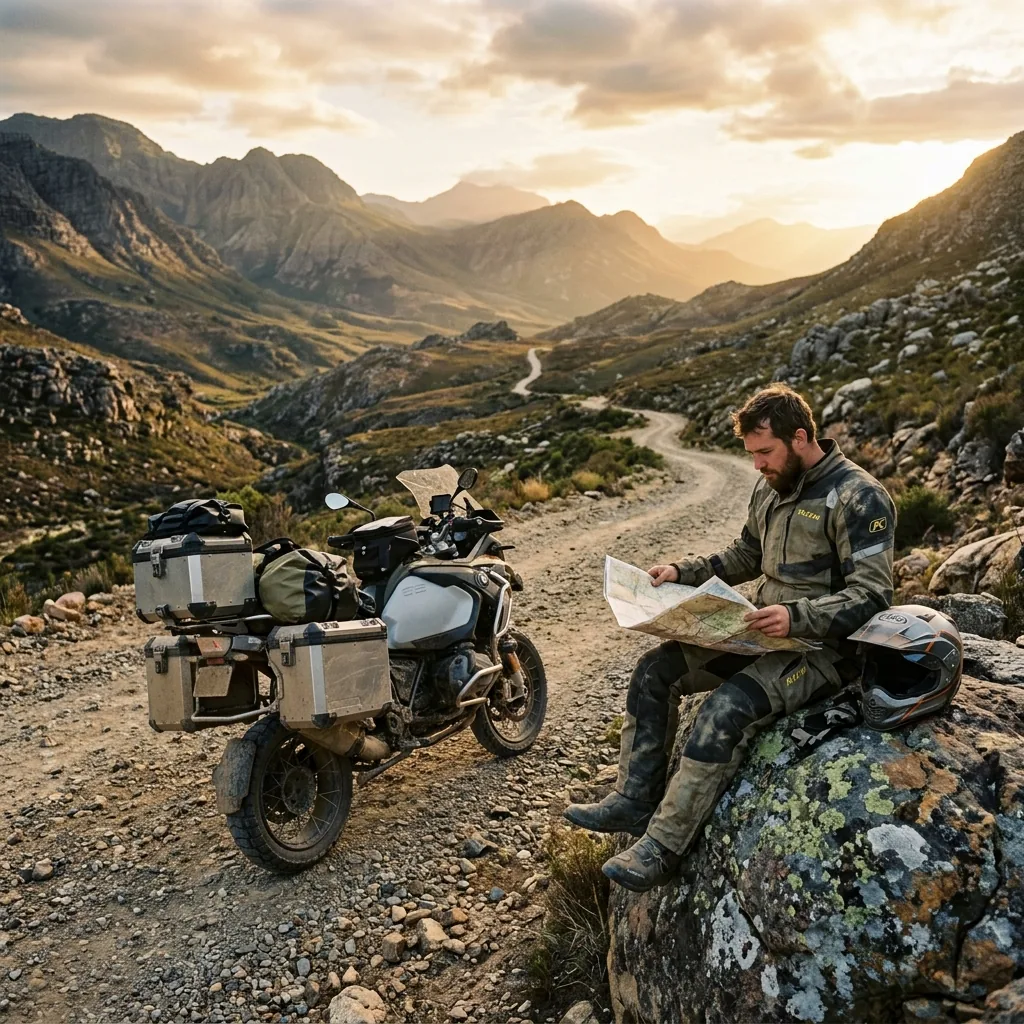
A long-distance motorcycle trip is mostly planning. The riding part is the smallest fraction of the total effort, even though it’s the part everyone remembers. The difference between a trip you complain about for six months and a trip you talk about for the rest of your life almost always comes down to what got prepared before the bike left the driveway.
This how to plan long distance motorcycle trip guide is the hub article — seven steps from blank map to ready to ride. Specific subtopics (gear, packing, border crossings, off-road technique) get covered in depth in linked guides. If you haven’t picked a bike yet, start with the best motorcycles for long distance touring shortlist — wrong-bike trips fail before the planning even begins. This piece is about sequencing — what to do, in what order, and why.
Introduction: The Difference Between a Good Trip and a Great One
A good trip happens when nothing goes wrong. A great trip happens when something does — and you’d already prepared for it.
Riders who’ve done this say the same thing: the planning is what stops the trip from devolving into a survival exercise. You can’t predict everything. You can predict the categories of things that go wrong, and you can prepare for those.
Seven categories cover roughly 95% of what derails a trip: route problems, timing problems, mechanical problems, gear problems, documentation problems, emergency problems, and the personal energy problems that come from poor sleep and over-ambitious daily distances.
Step 1: Route Planning — Tools and Approach

Three tools cover almost every routing need:
Google Maps: the default for road routing, point-to-point estimates, and finding restaurants and lodging. Limitation: it doesn’t know about scenic roads and tends to default to the fastest paved option.
Kurviger: the European rider favourite for scenic routing. The algorithm explicitly prioritises twisty roads, mountain passes, and motorcycle-friendly routing. Free tier is generous. The premium tier ($30/year) is worth it for serious tour planning.
Scenic (paid app, $20-30): the iOS standard for ADV tour planning, especially for routes that include gravel and unpaved sections. Highly configurable.
For specific routes — Trans Euro Trail sections, national park traverses, established overlanding routes — download GPX files from the relevant community sites. The TET has full country-by-country GPX files that update annually.
The right approach: rough out the trip in Google Maps for distance estimates, refine the day-by-day routing in Kurviger, and supplement with GPX files for any off-road segments.
Step 2: Timing — When to Go Where
Wrong-season trips fail in predictable ways: too hot, too cold, too wet, ferries closed, roads closed, accommodations booked solid.
The European default windows:
May to mid-June: ideal for most of Europe. Snow gone from passes, summer crowds not yet arrived, prices moderate.
Mid-September to October: also excellent. Stable weather in southern Europe, light is golden, prices drop.
July-August: avoid Mediterranean coastal areas unless booked months ahead. Heat in the Balkans, Spain, Italy is punishing. Northern Europe and Scandinavia are at their best.
For specific regional timing, see our Morocco motorcycle adventure guide and Trans Euro Trail starter guide.
Step 3: Bike Preparation Checklist
Two weeks before departure. Not the day before. This list catches roughly 80% of mechanical issues that would otherwise end the trip on day five.
- Chain wear checked and adjusted or replaced (0 g)
- Tyre condition and tread depth verified — adequate for the full trip distance (0 g)
- All fluids: oil, coolant, brake fluid checked and topped (0 g)
- Wheel, headstock, and swingarm bearings checked for play (0 g)
- Brake pads: minimum 3mm remaining for long trip (0 g)
- Luggage mounting checked and load-tested with planned weight (0 g)
- Battery condition checked, terminals clean (0 g)
- Throttle and clutch cables inspected, lubricated (0 g)
- All lights operational including indicators and brake (0 g)
- Spare clutch and brake levers packed (200 g)
If you’re not confident doing these checks, a major service two weeks before the trip is money well spent.
Step 4: Gear and Packing
A separate, deep topic. The short version:
Pack for the worst weather you’ll encounter, not the average. Pack one set of off-bike clothes. Pack the same tool kit you’d want if the bike failed in the middle of the trip.
For comprehensive coverage, see our guides on how to pack a motorcycle for a 2-week camping trip, the essential motorcycle tool kit for overlanding, and the best adventure motorcycle panniers.
The single most common packing mistake: bringing too much. The single most common item missing: a proper rain layer for under the jacket.
Step 5: Documents and Insurance
Documents stop trips faster than mechanical failures.
Required for any international motorcycle trip:
Passport valid for 6+ months beyond return date. Bike registration document — original, not photocopy. Insurance certificate covering all countries on the route. Green Card from your home insurer for non-EU countries that require it. International Driving Permit for countries where it’s required or recommended. Photocopies of all of the above, stored separately from the originals.
Travel insurance is the trap: most standard travel policies exclude motorcycles over 125cc. Buy a motorcycle-specific policy that explicitly covers your engine size and includes off-road riding coverage. For full coverage of this, see our adventure motorcycle insurance guide and Europe motorcycle border crossing guide.
Step 6: Emergency Planning
Three things to arrange before you leave.
Communication for remote areas: a Garmin inReach Mini 2 ($400 plus subscription) provides satellite messaging and emergency SOS even outside mobile coverage. For any trip involving the Atlas, the Carpathians, the Pyrenees, or Scandinavia, this is the line between “incident” and “emergency.”
Roadside breakdown coverage: AA, RAC, and continental equivalents offer motorcycle-specific recovery covering multiple countries. Roughly £80-150 for an annual policy. Worth it for any trip where DIY recovery isn’t realistic.
Emergency contacts and document copies: stored offline on your phone, plus printed copies in a waterproof document holder in the tank bag. Include passport, registration, insurance, EHIC/GHIC if EU, emergency contact, blood type, allergies.
For more on remote-area solo riding, see our solo motorcycle camping safety guide.
Trip Planning Gear List
The non-obvious essentials that the gear lists usually miss.
- Offline GPS device or phone mount, waterproof (400 g)
- First aid kit, compact, motorcycle-specific contents (350 g)
- Garmin inReach Mini 2 for remote areas (100 g)
- Document holder, waterproof, tank bag size (60 g)
- Tool kit, pannier roll style (1.35 kg)
- Tyre repair plug kit and 12V compressor (450 g)
- Spare clutch and brake levers (200 g)
- Multitool with chain breaker (180 g)
- Headlamp with red mode (90 g)
- Power bank 20,000 mAh for multi-day camping (380 g)
Shop Garmin Zumo XT2 GPS on Amazon →
Shop Garmin inReach Mini 2 on Amazon →
Shop Waterproof Document Holders on Amazon →
Step 7: The Day Before You Leave
A short checklist that catches the last 5% of problems.
Bike fully fuelled, tyres at the right pressure for the loaded weight (not unloaded), chain lubricated, all luggage strapped down with a final tug test. Documents in the tank bag, not the panniers. Phone charged and offline maps confirmed downloaded. Cash in the right currencies for the first two days. Emergency contacts told the route plan.
Sleep early. Don’t drink heavily. The trip starts with a 300 km day in 90% of cases — fresh is better than nursing.
FAQ
For deeper coverage of the specific topics referenced here, see the essential motorcycle tool kit for overlanding, how to pack a motorcycle for a 2-week camping trip, the Europe motorcycle border crossing guide, the Trans Euro Trail starter guide, solo motorcycle camping safety, off-road riding tips for loaded adventure bikes, and the best adventure motorcycle panniers.
Disclosure: Some of the links in this article are affiliate links. If you buy gear through them, we may earn a small commission at no extra cost to you. It helps fund the road trips that make these independent planning guides possible.
Frequently Asked Questions
How far in advance should I plan a long-distance motorcycle trip?
For a 2-4 week trip, start planning 3-4 months ahead. Ferries, lodging in popular routes, and bike service slots all fill faster than people expect. For a multi-month overlanding trip, 6-12 months is realistic — visas, vaccinations, vehicle import paperwork, and insurance for unusual countries can take that long to arrange properly. Last-minute trips work for weekend riding only.
What's the most common mistake riders make planning a long motorcycle trip?
Over-planning every day. The instinct is to lock in every accommodation, every route, every stop. The reality is that weather, mechanical issues, recommendations from other riders, and personal energy all change the trip as it unfolds. Plan the first few days tightly, lock in the must-see destinations, and leave roughly 20% of your time as flexibility. Riders who over-plan end up resenting their own itinerary by week two.
How much should a long-distance motorcycle trip cost per day?
Western Europe averages £80-120 per day all-in (fuel, food, lodging, occasional repairs) for a solo rider in 2026. Eastern Europe and the Balkans run £40-70 per day. Morocco and Turkey run £35-60 per day. Wild camping and cooking your own food can cut costs by 30-40%. Add a buffer of 15-20% for the things you can't predict — unexpected ferry costs, tyre replacement, the dinner you ended up paying for someone.
Do I need an international driving permit for a European motorcycle trip?
If you hold an EU, UK, or US licence and you're riding within the EU/EEA, no — your home licence is sufficient. For non-EU countries (UK, Switzerland, Norway), check each country's specific rules. For Morocco, Turkey, Ukraine, and the Western Balkans, an IDP is recommended even where not strictly required — it speeds up roadside checks and rental processes. The IDP costs about $20 and takes a week to issue.
What's the single most important thing to prepare before a long motorcycle trip?
The bike, in three parts: tyres with adequate tread for the full trip distance, chain and sprockets within service spec, and a recent oil change with the right grade. Skip these and the trip can end in the first week. The second most important thing is travel insurance that explicitly covers motorcycles over 125cc — the trap most riders fall into is assuming their standard travel policy covers them, when most don't.