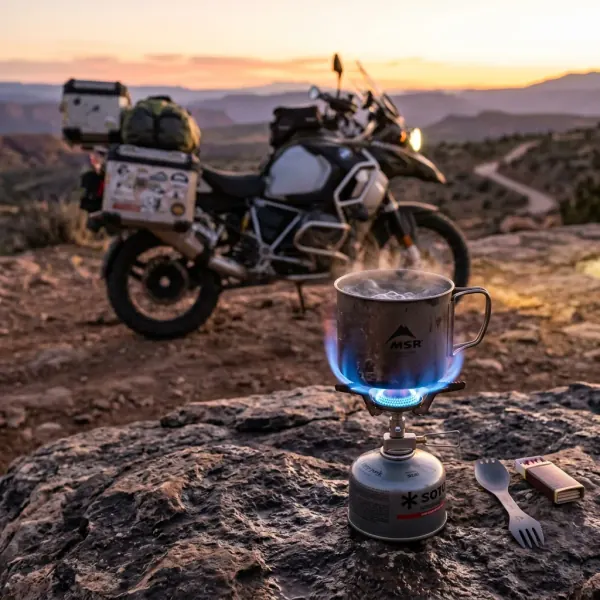
The first stove I owned for moto camping was a $40 propane single-burner from a hardware store. It weighed 800 grams, took up half my pannier, and the regulator clogged the third time I used it. I bought it because it was familiar — I’d used the same kind for backyard barbecues. I sold it after the trip and bought an MSR PocketRocket 2 for $50.
The PocketRocket is 73 grams. It fits inside a 550ml titanium mug with its canister. It boils a liter of water in 3.5 minutes. It has worked every single time I’ve lit it for two years.
That gap between “stove that works at home” and “stove that works on a motorcycle” is what this guide is about. The best portable camp stoves for motorcycle travel in 2026, ranked by what actually matters on the road: pack size, boil time, wind performance, and reliability when you’re cold and hungry at the end of a 400 km day.
What Makes a Stove Good for Motorcycle Travel
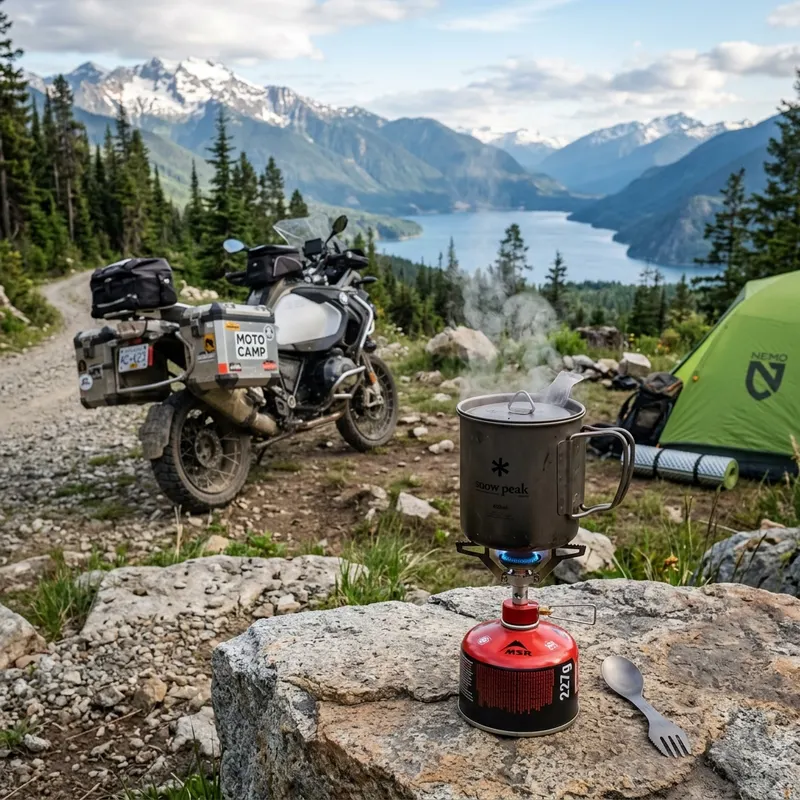
A motorcycle camp stove sits in the bottom of a pannier most of the time. The first thing that matters is pack size. A stove that nests inside a 550ml titanium mug with its fuel canister disappears in your luggage. A stove the size of a coffee mug eats space you needed for other gear.
Boil time is the next variable. After a 10-hour riding day, you want water boiling in 4 minutes, not 12. Premium stoves like the Jetboil Flash hit 90 seconds for 0.5L. Budget Chinese stoves like the BRS-3000T take closer to 4 minutes for the same volume. Either is fast enough for one rider; only the fast ones really work for two-up cooking.
Wind performance is the variable nobody talks about until they’ve cooked on a beach. A 15 km/h sea breeze can double boil time and triple fuel consumption on an unprotected stove. Coastal moto camping demands either an integrated wind-resistant system (Jetboil) or a separate burner plus a foil windscreen.
Reliability is the last and most important. The stove needs to ignite on the first or second strike, in rain, after being shaken inside a pannier for 400 km. Premium brands earn their price here. Cheap stoves usually work — until the trip you really need them to.
Best Motorcycle Camp Stove Options List 2026
5 Camp Stoves — Side by Side
Click any column to sort ↕| Stove | Weight | Boil Time (1L) | Wind Performance | Price | Rating |
|---|---|---|---|---|---|
| Editor's PickMSR PocketRocket 2 | 73 g | 3.5 min | Fair (add windscreen) | $50 | |
| MSR PocketRocket Deluxe | 96 g | 3.3 min | Good | $80 | |
| Snow Peak LiteMax | 56 g | 4.0 min | Fair | $75 | |
| Jetboil Flash (system) | 371 g | 1.7 min (0.5L) | Excellent | $110 | |
| Best ValueBRS-3000T | 25 g | 4.5 min | Poor | $15 |
1. MSR PocketRocket 2 — Best Overall (73 g)
The PocketRocket 2 is the stove I’d recommend to almost any rider as a first buy. Around $50 retail, 73 grams without the canister, and it boils a liter of water in 3.5 minutes on a fresh canister.
The build is exactly what you want — brass valve, stainless steel pot supports that fold flat, brass burner head. It nests inside a 550ml titanium mug with a 100g canister and a folding spork, which means your entire kitchen lives in the volume of a coffee mug at the bottom of a pannier.
Ignition is manual — strike a lighter to the burner head. There’s no piezo ignition button. This sounds annoying until you realize that piezo ignitions on cheap stoves are the first thing to fail. Manual ignition with a Bic lighter is more reliable. Carry the lighter in your tank bag with a backup ferro rod and you’ll never miss a meal.
Flame control is excellent. The valve is fine-threaded enough to simmer a real meal without scorching. Most ultralight stoves are full-on or full-off — the PocketRocket 2 actually simmers, which means you can cook rice and pasta from raw instead of just boiling water.
The honest weak point is wind. The narrow pot support and open burner do nothing to block sidewind. On a calm forest evening, fine. On the coast, add an aluminum windscreen — 28 grams, $10 — and you’ve fixed the problem completely. Just don’t use a full wrap-around screen with the canister directly under the stove; leave the bottom open for ventilation.
Check PocketRocket 2 on Amazon →
- 73 g — nests inside a 550ml mug
- 3.5 min boil time for 1L on a fresh canister
- Real flame control — can simmer, not just boil
- Brass valve and stainless supports built to last
- $50 — best value in premium stoves
- No piezo ignition — carry a lighter
- Open burner needs a windscreen on the coast
- No pressure regulator — slower in cold weather
2. MSR PocketRocket Deluxe — Best for Cold Conditions (96 g)
The Deluxe is the PocketRocket with three additions: a built-in piezo igniter, a pressure regulator, and a wider, more wind-resistant burner head. Around $80, 96 grams.
The pressure regulator is the upgrade that matters. Standard canister stoves lose performance as the canister empties (pressure drops) and as temperature drops (vapor pressure drops). The regulator compensates automatically, which means full flame from a 1/4-full canister and reliable performance down to about -15°C. For alpine trips, mountain passes, or autumn shoulder-season riding, this is genuinely useful.
The piezo igniter eliminates the lighter step. Click the button, flame appears. After three seasons, my Deluxe’s piezo still works — but piezos are mechanical and they do eventually fail. Carry a backup lighter even with this stove. Always.
The wider burner head spreads heat across a larger area of pot bottom, which improves efficiency and reduces hot spots. Boil time on a fresh canister is 3.3 minutes vs the regular PocketRocket’s 3.5 — small difference. The real benefit shows up in cold weather where the regulator and burner shape combine to keep performance consistent.
If you only ever camp in summer, save $30 and buy the PocketRocket 2. If you ride into cold weather or up in altitude, the Deluxe earns its premium.
Check PocketRocket Deluxe on Amazon →
3. Snow Peak LiteMax Titanium — Lightest Canister Stove (56 g)
The Snow Peak LiteMax is titanium where everything else is steel or brass, and at 56 grams it’s the lightest legitimate stove on this list. Around $75 retail.
Construction is beautiful — titanium burner head, titanium pot supports, titanium valve handle. Snow Peak’s Japanese build quality is what you’re paying for. The stove looks like a piece of design and works like the PocketRocket 2 with a slightly slower boil time (about 4 minutes for 1L).
The honest assessment: for moto camping specifically, the 17-gram weight savings vs the PocketRocket 2 doesn’t matter. Your bike doesn’t care. The boil time is marginally slower, the price is $25 more, and the flame control is roughly equivalent. The reason to buy this stove is build quality and aesthetics, not function.
If you appreciate Japanese craftsmanship and you’re going to look at this stove in your kitchen for the next 10 years, get the LiteMax. If you’re optimizing dollars for performance, the PocketRocket 2 is the better buy.
Check Snow Peak LiteMax on Amazon →
4. Jetboil Flash — Fastest Boil (371 g system)
The Jetboil Flash is a fundamentally different design — an integrated stove, pot, and heat exchanger that bolts together into a single unit. 371 grams complete, around $110, boils 0.5L of water in 100 seconds.
That 100-second number is real and it’s transformative. After a long day, you want coffee in your hand inside two minutes, not five. The Jetboil delivers it. The heat exchanger fins on the bottom of the pot capture about 80% more heat from the flame than an open pot does, which means dramatically less fuel burned per boil. A 100g canister gives you about 12 boils on a Jetboil vs about 8 on a PocketRocket.
The trade-offs are real. The Flash is 371 grams complete — 5x the weight of a PocketRocket. It only works with the integrated 1L cup; you can’t use a regular pot or a frying pan. It’s a boil-water-only system, not a cook-food-from-raw system. And the integrated canister-and-cup tower makes it tippy on uneven ground.
For motorcycle camping where you mostly boil water for instant meals, instant coffee, and freeze-dried dinners, the Jetboil is brilliant. For real cooking from raw ingredients, get the PocketRocket and a separate pot.
Check Jetboil Flash on Amazon →
5. BRS-3000T — Cheapest Ultralight ($15, 25 g)
The BRS-3000T is a Chinese-made titanium ultralight stove that costs $15 on Amazon and weighs 25 grams. It works. Tens of thousands of backpackers and motorcycle campers use one. I keep one as a backup in my emergency kit.
What you get for $15 is real titanium construction, a brass valve, three folding pot supports, and a working flame. Boil time is around 4.5 minutes for 1L — slower than the PocketRocket but not by much. Flame control is rougher; the valve is less precise so simmering is harder.
The honest concerns: the pot supports are thinner than the MSR’s and can bend under heavy pots (1L+ full). The build feels lighter and more fragile. The flame regulator can stick in cold weather. None of these are deal-breakers. They’re reasons it’s $15 instead of $50.
For a solo rider boiling 0.5L at a time for coffee and instant meals, the BRS is genuinely sufficient. As an emergency backup or a first stove for a tight-budget rider, it’s hard to argue with at $15.
Fuel Canisters: How Long Do They Last?
Isobutane-propane canisters come in three sizes:
| Canister | Full Weight | Burn Time (PocketRocket) | Boils Approx. |
|---|---|---|---|
| 100g | 211 g | ~45-60 min | 6-8 |
| 230g | 380 g | ~90-120 min | 12-16 |
| 450g | 730 g | ~3 hours | 24-30 |
For motorcycle camping, the 100g canister is usually the right choice — small enough to nest inside a 550ml mug, light enough not to matter, and one canister covers a 3-4 day solo trip. For longer trips, carry two 100g canisters rather than one 230g — easier to pack and gives you a backup if one is half-empty.
Stove efficiency varies. The Jetboil Flash with its heat exchanger gets roughly 50% more burn time per canister than the PocketRocket. The BRS-3000T is roughly equivalent to the PocketRocket.
In summer Mediterranean conditions, a 100g canister covers 6-8 meals of boil-water cooking. Bring one and a half cans for a 5-day trip and you’ll have margin.
Wind Performance: The Coastal Rider Problem
A 15 km/h breeze on the beach can double your boil time. A 25 km/h gust will blow out an open canister stove flame completely. Coastal moto camping requires a wind strategy.
Option 1: Foil windscreen. A simple aluminum foil wrap-around screen, 28 grams, $10. Works with any separate-burner canister stove (PocketRocket, BRS, Snow Peak). Crucial rule: never use a full wrap-around screen with the canister directly underneath. Heat builds up, canister pressure rises, and you can rupture the can. Leave the bottom 5-10 cm open for ventilation.
Option 2: Integrated system. The Jetboil Flash has built-in wind resistance — the heat exchanger and the high-walled cup combine to make wind almost irrelevant. If you camp on the coast frequently, this is a real reason to buy a Jetboil.
Option 3: Natural shelter. A rock, a log, your motorcycle pannier — any solid object on the windward side of your stove does the same job as a windscreen. Free, no weight, just situational awareness.
Motorcycle Camp Kitchen Packing Checklist
Everything you need to cook real meals on the road. Total weight: about 750 grams.
- Camp stove (56-371 g depending on model)
- 100g isobutane fuel canister (211 g full)
- Titanium 550ml mug with lid (88 g)
- Folding spork (14 g)
- Windscreen aluminum (28 g)
- Lighter and backup matches (30 g)
- Small dish towel for cleanup (15 g)
The whole kit nests together: stove + canister + lighter inside the 550ml mug, towel wraps around the outside, windscreen tucks flat against the pannier wall. Total volume: about the size of two stacked coffee mugs.
FAQ
Five common questions are answered at the top of this page. The short version: get a PocketRocket 2 if you want one stove that does everything well. Get a Jetboil Flash if you only boil water and you want it fast. Get a PocketRocket Deluxe if you ride into cold weather. Get a BRS-3000T if budget is tight or you want a backup.
Whatever you end up with from this list of best portable camp stoves motorcycle travel, the stove that earns its place is the one that lights on the first strike at the end of a long day. The right stove is the one you trust.
Disclosure: Some links in this article are affiliate links. If you buy gear through them, we may earn a small commission at no extra cost to you. Every stove on this list was cooked on for at least a full weekend before it made the cut.
Frequently Asked Questions
Canister or liquid fuel stove for motorcycle travel?
Canister stoves (MSR PocketRocket, Jetboil, BRS-3000T) are lighter, simpler, and faster to set up. Liquid fuel stoves (MSR WhisperLite, Optimus Polaris) work better in extreme cold and you can refuel from a gas station in a pinch. For 95% of motorcycle camping — anywhere with isobutane canisters available — canister stoves are the right answer. They're under 100 grams, ignite in 5 seconds, and require zero maintenance. Liquid fuel is for serious cold-weather expeditions and long-term overland trips through regions where canisters are hard to find.
How long does a 100g isobutane canister actually last?
Around 45-60 minutes of total burn time on a typical canister stove like the PocketRocket 2. That works out to roughly 6-8 meals if you're boiling water for instant coffee, oatmeal, and freeze-dried dinners. For a 5-day solo trip, one full 100g canister plus a half-used backup is usually enough. The Jetboil Flash is more fuel-efficient — closer to 12 boils per canister — but the stove itself is heavier.
Is the BRS-3000T really safe at 25 grams?
Yes, with caveats. The BRS is a real Chinese ultralight stove — titanium body, brass valve, pot supports that fold flat. It works exactly as advertised and tens of thousands of backpackers use it. The catch: the pot supports are thin and can bend under the weight of a heavy pot (1L+). The flame regulator is less precise than the MSR. For a solo rider boiling 0.5L at a time, it's fine. For two riders cooking real meals in a 1.5L pot, get the PocketRocket 2 instead.
Do I need a windscreen?
On the coast, yes. On the Aegean and Mediterranean, even a 15 km/h breeze drops your boil time by 50% and burns 2-3x the fuel. A 28-gram aluminum windscreen wrapping around your stove pays for itself in a single weekend of coastal camping. Never use a windscreen with an integrated canister stove like the Jetboil — heat builds up under the canister and can rupture it. Windscreens are for separate-burner stoves only.
What about cold weather performance?
Standard isobutane-propane canisters (the kind you buy at outdoor stores) work down to about -10°C. Below that, the propane vaporizes fine but the butane fraction stays liquid and pressure drops. Cold-weather options: warm the canister inside your jacket for 5 minutes before lighting, use a windscreen-with-heat-exchanger like the Jetboil, or upgrade to the MSR PocketRocket Deluxe with built-in pressure regulator that compensates automatically down to about -15°C.