Wild Camping in Turkey on a Motorcycle: Bays, Legality and Best Spots
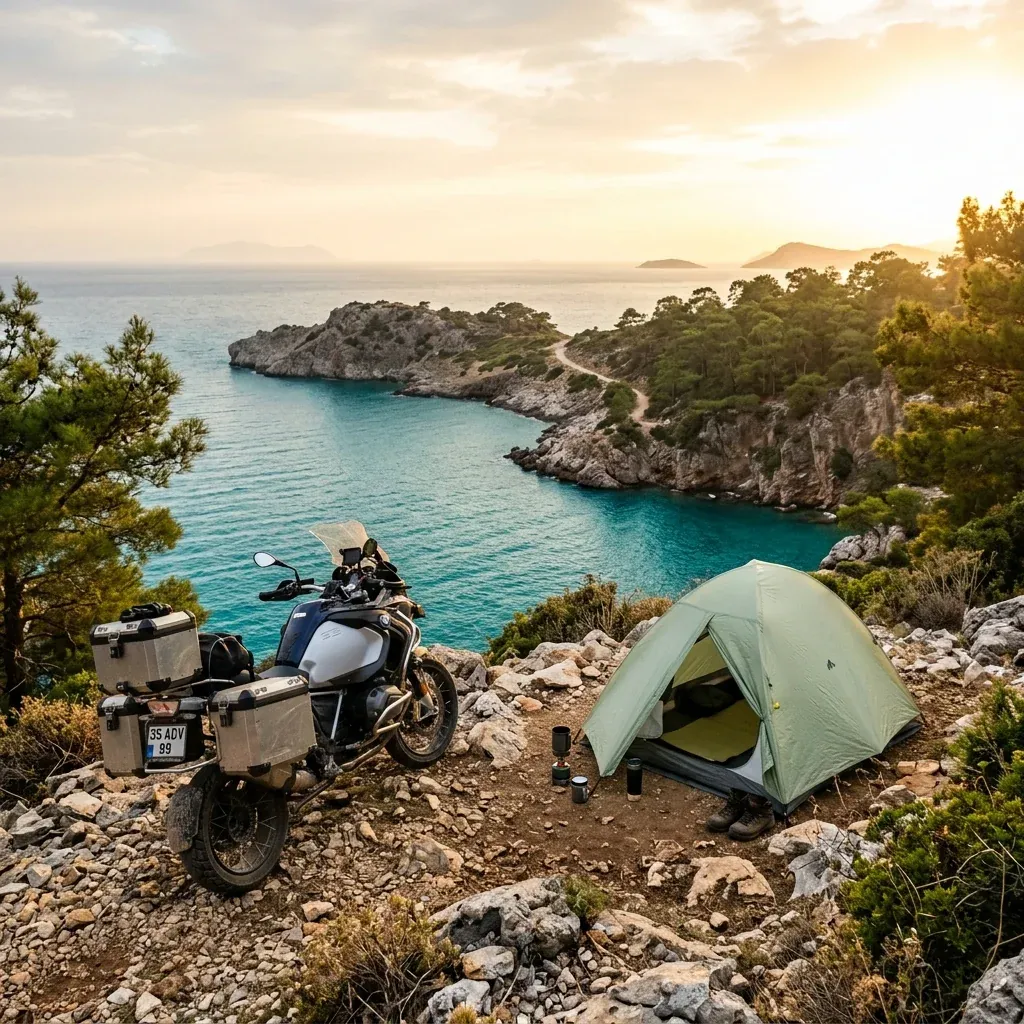
I woke up at 06:14 a few kilometres south of Datça, in a cove I’d found by riding down what the map had called a track and what the locals would have called a goat path. My tent was still wet from condensation. The CFMOTO 250NK was leaned against a pine. Twenty metres in front of me, the Aegean was that ridiculous green-blue colour that doesn’t render properly on a phone screen. There was nobody else on the beach. There had been nobody all night.
That’s the thing about wild camping in Turkey that nobody seems to write about properly: the bays are there, the laws are workable, the locals are friendly, and almost nobody outside Turkey is doing it. After 8,500 km across this country on a small bike, half of those nights spent in a tent, I keep meeting European overlanders who tell me they’d never considered Turkey for camping. They went to Albania instead. Albania is great. Turkey is on another scale.
This is the site’s namesake — bikes and bays. Below is how to actually do it: what the law says, where to go by season, what apps work, and what nobody tells you before your first Turkish bay night. Riders linking these bay nights into a continuous overland run will get more out of this once they’ve also read about riding the Trans Euro Trail through Turkey — most of the wild-camp coves below sit within a day of a published TET section.
Is it actually legal?
Turkish wild camping law is one of those classic grey areas where the written rule and the lived reality have almost nothing to do with each other.
The technical position: pitching a tent on unregistered land is not permitted. That’s the line you’ll find in the few English-language sources that bother to research it. In practice, the rule is enforced so rarely that I’ve met gendarmes who didn’t know it existed. The blog Hopeful Explorers, after three months of wild camping across Turkey, summed it up cleanly: legal in practice, provided there’s no sign saying otherwise. Lost With Purpose, a moto blogger who rode the whole country, went further — she called it “encouraged in most places.” Self Guided TR, who runs tours here, reports hundreds of nights without serious problems.
So here’s the honest version. There’s a small group of places where you absolutely shouldn’t camp:
- Private land. Obvious, but worth saying — fenced ground, anything with a “özel mülk” sign, cultivated fields.
- National park interiors. Designated campgrounds inside parks like Dilek Yarımadası and Olympos Beydağları are fine. Pitching outside them is not, and the rangers do check.
- Military zones. Parts of the coast east of Marmaris are still active. Signs are in Turkish and Russian. Take them seriously.
- Within sight of ancient ruins. This one bites people. Self Guided TR documented a group hauled to the gendarmerie at 2 a.m. on suspicion of treasure hunting. It’s a real charge here, and pitching within a kilometre of antik kent ruins is exactly how you trigger it.
Outside those zones, you’re in workable grey. Pick a spot that’s not visible from a road, set up after sunset, leave before the morning shift starts, and you will almost never have a problem. If a gendarme does find you — and on a popular bay in summer they sometimes do — the script is consistent. They’ll ask where you’re from. They’ll ask where you’re going. They’ll wish you a good trip. The Hopeful Explorers crew got the 2 a.m. visit; the soldiers were apologetic for waking them up.
The one rule that is genuinely enforced is the fire ban. On the Aegean and Mediterranean coasts in summer, open flame is illegal, and the fines are real. I’ll come back to this.
When to go: season by region
Turkey is six different countries climatically, and treating it like one is how riders end up sweating through 41°C in a black tent on the Aegean in August.
| Region | Ideal window | Avoid |
|---|---|---|
| Aegean coast | May–June, Sep–Oct | Jul–Aug (40°C+, crowded) |
| Mediterranean coast | Apr–Jun, Sep–Oct | Jul–Aug (38–42°C) |
| Black Sea | Jun–Aug | Nov–Mar (rain, fog) |
| Kaçkar high plateaus | Jul–Aug | After Sep (snow risk) |
| Central Anatolia | Apr–Jun, Sep–Oct | Winter (−15°C possible) |
The Aegean and Mediterranean coasts in July and August are not camping country. They’re tent-as-oven country. Daytime temperatures sit at 38 to 42°C, the bays you came for are full of Istanbul weekenders, and by mid-afternoon the only place to be is in the water. May, June, September, October — that’s when these coasts make sense.
The Black Sea inverts everything. It’s the right coast in summer precisely because the Aegean is too hot. June through August on the Bartın–Sinop stretch is mild, green, and largely empty of foreign tourists. Locals from Ankara go to Antalya; they don’t go north. The full bay-by-bay version of this coast — Amasra through to the Kaçkar Mountains — is broken out in the Black Sea & Kaçkar route guide.
The Kaçkar window is narrow. Yayla camping above 2,000 m is a July and August thing. By mid-September snow is possible on the passes, and the road over Ovit Dağı starts closing. Even in August, plan for 5°C nights. I made the mistake of bringing a +10°C bag up there once. I didn’t sleep.
Where to camp: five regions worth your time
1. Datça and Bozburun Peninsulas — The Hard Ones
If you only ride to one set of Turkish bays, this is where I’d send you. It’s also where I’d send the fewest beginners.
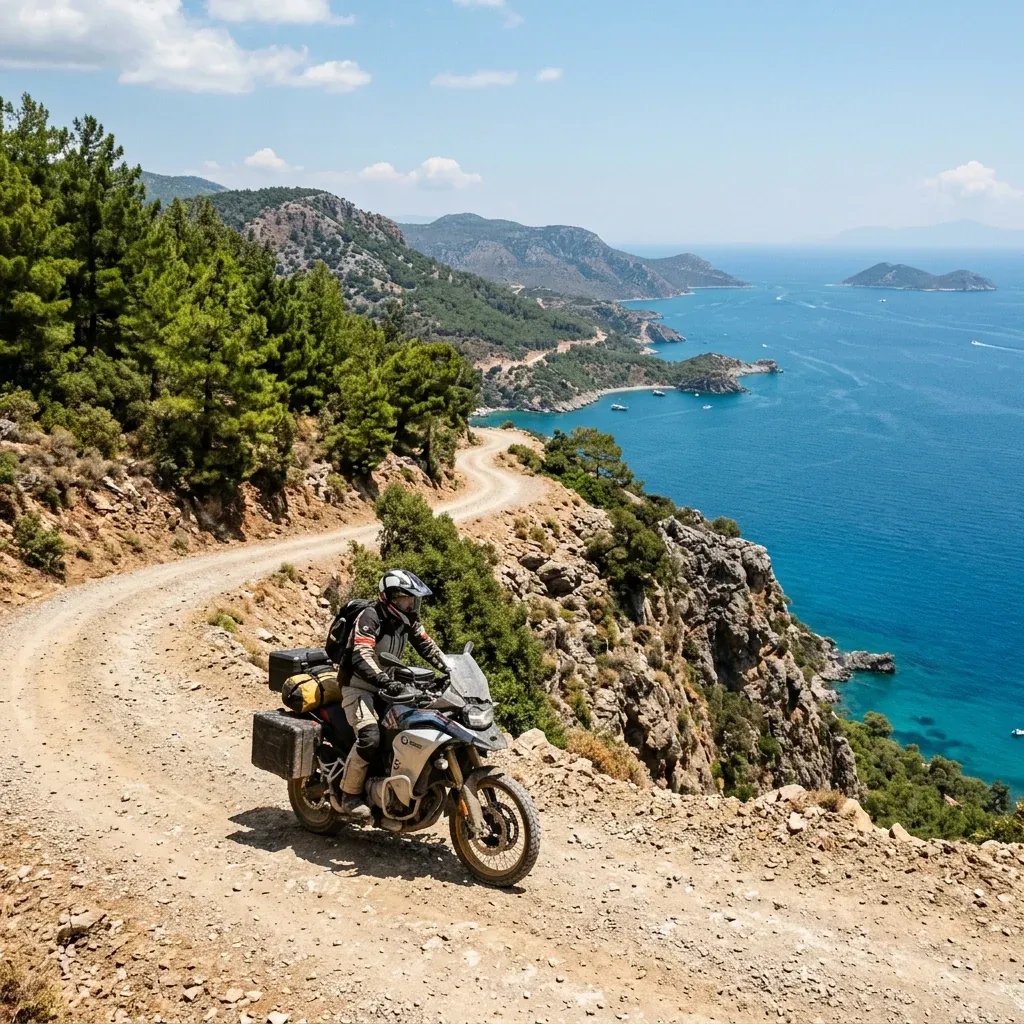
The two peninsulas hang off the southern edge of Muğla province, west of Marmaris. On the map they look like a half-hour detour from the main coast road. On the bike they’re four to six hours, depending on how often you stop to take photos and how often a herd of goats blocks the road. The Datça–Marmaris stretch alone is 68 km of switchbacks across genuinely steep terrain, with sections of broken tarmac and gravel mixed in.
What you get for the effort is the least developed coastline in the Turkish Aegean. Bozburun, in particular, feels like the Aegean before mass tourism arrived — fishing villages with one café, dirt tracks dropping to coves that don’t appear on Google Maps, and the kind of silence at 10 p.m. that makes you double-check the GPS to confirm you’re still in the same country as Bodrum.
A specific note on the Datça tip. Most riders stop at Datça town and turn around. Don’t. Keep going west another 35 km, past Knidos, on the increasingly broken road towards the cape. The last 10 km is rough and slow, and the bays you find at the end are the reason this peninsula exists. They were on the cover of the Lonely Planet for thirty years before anyone built a hotel out there. Most of them still don’t have hotels.
The catch is water. The villages on these peninsulas are far apart, and a couple of the loops I rode last June had stretches of 40 km without a reliable çeşme — the public spring-fed taps you’ll find in most Turkish villages. Carry more water than you think you need. Three litres minimum on the bike for a summer day, with another two for camp. The tap water in the villages is potable; the streams at this latitude in summer are mostly dry.
2. Karaburun Peninsula — İzmir’s Secret
An hour and a half north-west of İzmir city centre, on a peninsula most Turks couldn’t point to on a map.
Karaburun is what happens when a coastline this good is twenty minutes too far from anything. The interior is hard volcanic rock and pine, the coastline is jagged, and the water at the small coves on the western side is the kind of clear that ruins you for other seas. There are sea caves and ancient shipwrecks just offshore that the diving community knows about and almost nobody else does. The road that loops around the peninsula is paved, narrow, and almost empty even in July.
You can’t reach every cove on the bike — some are boat-only — but enough are accessible via short scrambles down from the road that you’ll be fine. Pitch above the beach, not on it. The wind here is real, and a tent on sand at midnight in 40 km/h gusts is one of the more humbling experiences you can have.
Go to Karaburun. Don’t tell people about it. That’s the deal.
3. The Lycian Coast Corridor (Fethiye to Antalya)
This is the most famous riding road in Turkey for a reason, and the trap most foreign riders fall into is assuming it’s the best place to camp. It’s a fantastic place to ride. It’s a mixed place to camp.
The road between Fethiye and Antalya — call it 220 km via the coastal route through Kalkan and Kaş — is one of the great Mediterranean rides. It does what the Amalfi Coast does without the buses, and what the Croatian coast does with better food. In May or October, it’s near-perfect. In July or August, it’s bumper-to-bumper rental cars and overpriced beach clubs, and the cove you remember from May has a 60-lira parking attendant.
The same road, two months apart, is two different countries. Plan accordingly.
For camping along this corridor, two specific notes. Kabak Koyu, south of Ölüdeniz, is genuinely worth the effort — turquoise water, a tall cliff behind the sand, very little development. The catch is that the road down is steep, partly unpaved, and the last 800 m on some approaches isn’t really a road. A loaded ADV can do it. A 250NK two-up cannot. Decide based on your bike and your skill. Gizli Vadi Kamping near Kaş is the structured alternative: small, owner-run, close to the Lycian Way trail, paid but cheap, and a useful base if you want a shower before pushing east.
Butterfly Valley is on every list of beautiful spots in Turkey. It’s also boat-only or reached by a notoriously sketchy hike. Don’t try to ride to it. People have died on that descent.
The bays that work for motorcycle wild camping along this corridor are the smaller, scruffier ones between the named beaches. Look at the map between Kaş and Demre and pick the gravel tracks heading south. Some end in nothing. Some end in cove you’ll remember for ten years.
4. The Black Sea: Bartın to Sinop
Most foreign coverage of Turkey ignores the Black Sea entirely, and most domestic coverage focuses on the eastern end — Rize, Trabzon, the Kaçkar. The stretch between Bartın and Sinop is the underrated middle, and for motorcycle camping in summer it’s the strongest argument I can make for skipping the Aegean.
The road is narrow, twisty, and runs almost continuously along the water with green hills on the inland side. The villages are old fishing towns with one or two restaurants and almost no English. Dozens of small rivers come out of the Pontic Alps and meet the sea here, and the river mouths are where the camping spots are. Flat ground, fresh water, shade from poplars, sometimes a teahouse fifty metres away.
What you don’t get is hot weather. Even in July, the Black Sea coast averages 26°C with regular afternoon cloud cover. That’s the entire point. While the Aegean cooks at 40°C, you’re riding in jeans with a fleece in the panniers.
Two things to know. The road is slow — Bartın to Sinop is around 380 km but takes the better part of two days if you stop properly. And the weather genuinely turns. A clear morning can be a wet afternoon. The Black Sea is called what it’s called because of the storms, not because of the colour.
5. Kaçkar Mountains: High Camp
This is the section of the article that breaks the title. There are no bays in the Kaçkar. There’s no sea. What there is, is the best high-altitude motorcycle camping in Turkey and probably the best on this side of the Caucasus.
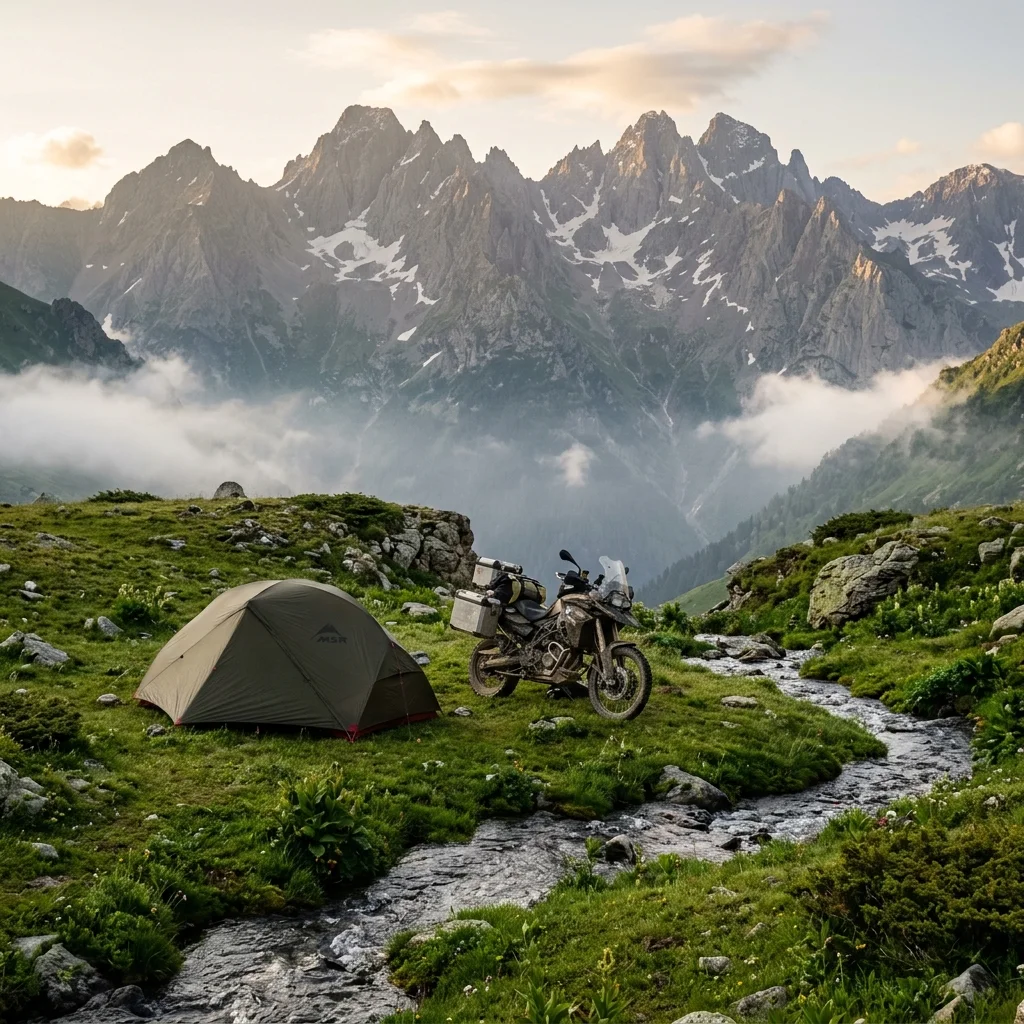
Start at Ayder Yaylası, two hours’ winding climb up from the Black Sea coast at Pazar. Ayder is the gateway — hot springs, a few hotels, last reliable fuel. From there the road narrows, turns to gravel above 1,800 m, and climbs through forest into the open yaylas — the high alpine plateaus where Turkish herders have summered with their animals for centuries.
A yayla is a flat, grass-covered shelf cut into the mountainside, usually with a spring running through it. Pitch a tent on one of these and you are doing what humans here have been doing for a thousand years.
 The herders are friendly. The dogs are not — more on that in a minute. The water from the springs is some of the cleanest I’ve drunk anywhere, though I still ran it through a filter.
The Trans Kaçkar route — Ayder to Yusufeli, roughly — is the best two days of motorcycle riding I’ve done in this country. Loose gravel hairpins, river crossings, 3,000 m passes. You don’t need a 1200 GS to do it. I did most of it on a 250 single. But you do need to be honest about your gravel skills before you commit, because there are no shortcuts off the mountain.
Two warnings. First, the Kangal dogs. These are not pet dogs. They’re working livestock guardians, 65 kg, and they are doing the job they were bred for, which is killing wolves. They do not bluff. If you camp anywhere near sheep, you will meet one, and you will need to manage the meeting carefully — slow movement, no eye contact, do not run. Cycloscope, who toured the eastern Pontic ranges, calls them “the real danger” of camping out here, and they’re right.
Second, the temperature. Even in August, nights at 2,400 m are around 5°C. Bring the bag you’d bring for an Alpine hike, not the one you used on the Aegean two weeks ago.
Wake up at 2,300 m with the valley below you full of cloud and one of the highest peaks in Turkey turning pink across the saddle, and you’ll understand why this is the section I had to include even though the website is called bays.
Tools of the night: apps and gear
Three apps do 90% of the work. Park4Night is the European camping app and has surprisingly thorough Turkey coverage — most useful for the western half of the country, less so east of Sinop. iOverlander is the overlander-specific one and is where you’ll find the motorcycle-specific notes: “track passable on a single, not a 1200 GS” type comments, plus water and fuel points. Maps.me runs offline. In rural Turkey, GPS coverage is fine but the data is not — download the country tiles before you go, and Maps.me will route you on tracks that Google Maps doesn’t acknowledge exist.
Use all three together. The places that show up on Park4Night and iOverlander are good. The places that show up on neither, and that you find by reading Maps.me’s track grid in a village teahouse, are sometimes better.
Gear-wise, the constraint is the bike. A solo motorcycle wild camping kit lives or dies on whether it actually fits in the panniers, so the list is short: a sub-1.5 kg single-person tent (the best motorcycle camping tents round-up covers the current options), an inflatable mat (best compact sleeping pads for motorcycle camping for what actually fits), a sleeping bag rated to whichever coast you’re hitting, and a portable stove (best portable camp stoves for riders — and on the Aegean and Mediterranean in summer, a stove isn’t optional, it’s the entire cooking solution).
Water filter or chlorine tablets — needed in the Kaçkar and parts of the Black Sea where you’ll fill bottles from streams. Pointless on the Aegean, where you fill from village taps.
Power: a 10,000 mAh bank handles a night of phone-GPS-headlamp without drama. Two nights between charging opportunities and you want 20,000.
Emergency: 112 is the all-services number. It works.
What nobody tells you
The five things I wish someone had told me before my first night out here.
The 2 a.m. gendarme visit isn’t a problem. They will check ID, ask where you came from, possibly take a photo of your plate, wish you a good night. They are not arresting anyone. The mistake is panicking and packing up. Sit up, smile, hand over the passport, drink the tea if it appears.
Don’t refuse the tea. Anywhere. Ever. When a shepherd or a fisherman or a village kid offers çay, that’s the social bridge for the next twenty kilometres of road. Sit down. Drink it. You’ll be told things about the route ahead that no app has.
The Kangal dogs in eastern Turkey are not a joke. I’ve already said it. I’m saying it again. People get badly hurt every year. If a Kangal is between you and where you want to go, you don’t go that way.
The ancient ruins rule is the one to memorise. “Beautiful cove next to a Lycian sarcophagus” sounds romantic. It’s also how you end up explaining yourself in a fluorescent-lit station at 3 a.m. while a sergeant types your details into a 2003 Dell. Pitch a kilometre away, minimum.
Searching “camping in Turkey” online turns up the Aegean. The real work is on the Black Sea and the high plateaus, and almost nobody outside Turkey has written it up. That gap is real. Use it.
Your first night
If you’ve never wild camped here and you want a soft introduction, here’s the recipe.
Pick a weekday in late May or early June. Ride to the western end of the Datça peninsula. Find a cove on the southern side, somewhere past Knidos. Set up after 7 p.m., when the day visitors have left. Don’t light a fire. Eat something simple off the camp stove. Sleep with the rainfly open if the forecast is dry — the stars over the Aegean in May are extravagant.
Be packed and on the bike by 7 a.m. The fishermen will already be out. The road back will be empty. You’ll be in a village having breakfast by 8.
That’s the whole loop. Do it once and the rest of this list will make sense.
FAQ
Is wild camping legal in Turkey? Technically, pitching a tent on unregistered land is not permitted, but enforcement is rare and most gendarmes don’t treat it as a problem. Stay away from private land, national park interiors, military zones, and ancient sites, and you’ll almost never have an issue. Keep a low profile and you’re in a workable grey area.
Can I make a campfire when wild camping in Turkey? Not on the Aegean or Mediterranean coast during summer. Wildfire risk is high, fines are real, and the ban is one of the few things actually enforced. Use a portable camp stove instead. The Black Sea and high plateaus are more flexible, but still use judgement.
What apps should I use to find camping spots in Turkey? Park4Night and iOverlander both have solid Turkey coverage with motorcycle-specific notes. Maps.me works offline and is more reliable than Google Maps in rural areas. Use all three together and you’ll rarely be stuck for a spot.
Is it safe to wild camp alone in Turkey? In rural areas, yes — safer than most riders expect. Theft is uncommon away from tourist hotspots, locals are curious rather than hostile, and the gendarmes are friendly when they do show up. The real risks are Kangal dogs in eastern Turkey, wildfire bans, and pitching too close to ancient ruins.
What’s the best time of year for motorcycle camping in Turkey? May–June and September–October on the Aegean and Mediterranean coasts. June–August on the Black Sea. July–August in the Kaçkar high plateaus. Avoid the southern coasts in July and August — temperatures hit 40°C and the bays are full.
If you’re putting a kit together for your first run, the relevant gear breakdowns are the best motorcycle camping tents, the best compact sleeping pads for motorcycle camping, and the best portable camp stoves for riders. For a structured road tour with camping baked in, the Lycian Way motorcycle route writeup covers the southern coast in more riding detail.
Disclosure: Some links in this article are affiliate links. If you buy through them, Bikes and Bays earns a small commission at no extra cost to you. We only link to gear I’ve used or would use on my own bike.
Frequently Asked Questions
Is wild camping legal in Turkey?
Technically, pitching a tent on unregistered land is not permitted, but enforcement is rare and most gendarmes don't treat it as a problem. Stay away from private land, national park interiors, military zones, and ancient sites, and you'll almost never have an issue. Keep a low profile and you're in a workable grey area.
Can I make a campfire when wild camping in Turkey?
Not on the Aegean or Mediterranean coast during summer. Wildfire risk is high, fines are real, and the ban is one of the few things actually enforced. Use a portable camp stove instead. The Black Sea and high plateaus are more flexible, but still use judgement.
What apps should I use to find camping spots in Turkey?
Park4Night and iOverlander both have solid Turkey coverage with motorcycle-specific notes. Maps.me works offline and is more reliable than Google Maps in rural areas. Use all three together and you'll rarely be stuck for a spot.
Is it safe to wild camp alone in Turkey?
In rural areas, yes — safer than most riders expect. Theft is uncommon away from tourist hotspots, locals are curious rather than hostile, and the gendarmes are friendly when they do show up. The real risks are Kangal dogs in eastern Turkey, wildfire bans, and pitching too close to ancient ruins.
What's the best time of year for motorcycle camping in Turkey?
May–June and September–October on the Aegean and Mediterranean coasts. June–August on the Black Sea. July–August in the Kaçkar high plateaus. Avoid the southern coasts in July and August — temperatures hit 40°C and the bays are full.