The first long moto trip I went on, I planned my meals like a backpacker — three freeze-dried dinners, 12 energy bars, a bag of jerky, and instant oats for breakfast. On day three I would have paid double for a real plate of pasta. On day five I went into a village restaurant in jeans-and-armor and ate a kilo of stew because my body had stopped pretending the freeze-dried meals were food.
The lesson stuck. Motorcycle camping food is not backpacking food. The constraints are different. You’re not carrying everything for 7 days on your back — you can resupply daily in villages and small towns. You can carry fresh ingredients for the first 2-3 days. You can buy bread, cheese, tomatoes, olives at any village shop in Turkey for the price of a coffee.
This guide is the working version of camp cooking I’ve evolved over three seasons. How to cook on a motorcycle trip with a 750-gram kitchen, a meal plan that adapts to where you are, and the small details (spice kit, coffee, water sourcing) that turn camp dinners from survival rations into actual food.
The Minimal Kitchen: What You Actually Need
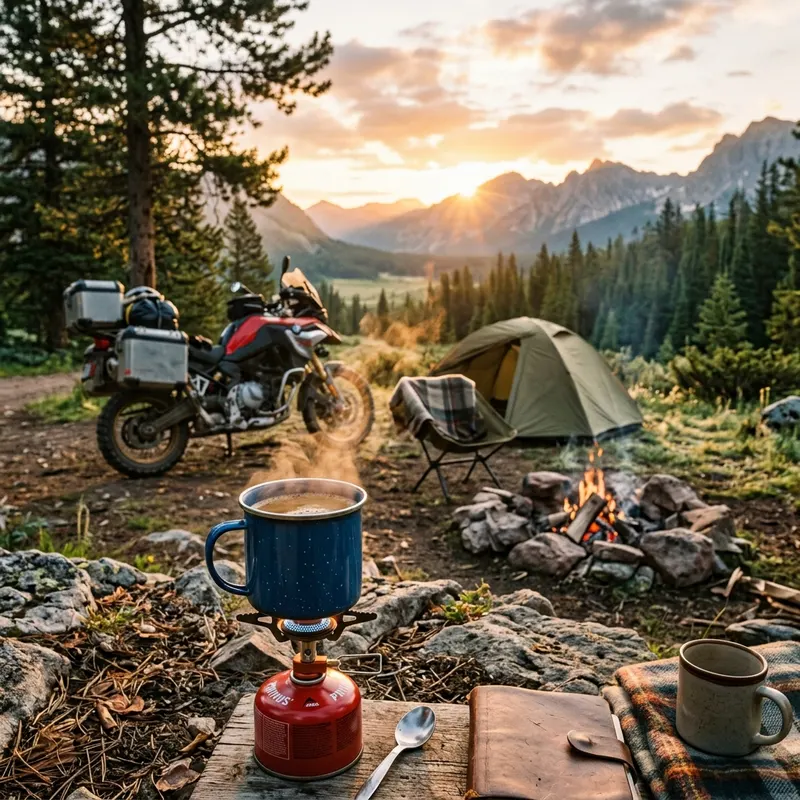
A camp kitchen for moto travel needs to cook one hot meal per day plus coffee. That’s it. You don’t need a frying pan, a cutting board, two pots, or a four-piece utensil set. The minimal kit fits inside a 550ml titanium mug with room to spare.
Stove: MSR PocketRocket 2 (73g) is the working answer. See the full camp stove guide for alternatives.
Pot/mug: A 550ml titanium mug with lid. Doubles as cooking pot, eating bowl, and coffee mug. Toaks and Snow Peak both make excellent versions for $30-50.
Utensil: One titanium folding spork. Eat soup, eat pasta, stir cooking food. 14 grams.
Fuel: One 100g isobutane canister covers 6-8 hot meals. Bring 1.5x what you think you need.
Windscreen: 28 grams of aluminum foil that doubles your stove’s efficiency in any wind. Don’t skip it.
Lighter and backup matches: 30 grams. A Bic lighter plus a small box of waterproof matches in a separate pocket. Lighters fail in cold and wet — having both is cheap insurance.
Spice kit: Five tiny containers — salt, pepper, paprika, chili flakes, dried oregano — total 100 grams. This is the single item that transforms dried camp meals from “edible” to “actually good.”
That’s the kitchen. Total weight: 750 grams. Total cost: $80-100 for the budget version, $200 for premium gear that lasts a decade.
Camp Kitchen Gear List
The complete kit you carry, with weights:
- MSR PocketRocket 2 stove (73 g)
- 100g isobutane canister (211 g full)
- Titanium 550ml pot with lid (88 g)
- Sawyer Squeeze water filter (85 g)
- Folding spork (14 g)
- Mini spice kit 5 containers (100 g)
- AeroPress Go coffee maker optional (280 g)
- Bic lighter + matches backup (30 g)
- Foil windscreen (28 g)
Without the AeroPress, you’re at 629 grams. Add the AeroPress and you’re at 909 grams — still less than a kilo for a complete cooking and coffee setup that handles a 2-week trip.
The whole kit nests together. Stove, canister, lighter, and spork inside the 550ml pot. Spice kit and windscreen flat against the pannier wall. AeroPress Go in its own dedicated case. The total volume is about the size of a thermos.
Check MSR PocketRocket 2 on Amazon →
Meal Planning: 7-Day Example Menu
The strategy: fresh food for the first 2 days, semi-fresh through day 4, fully dried by days 5-7. Resupply fresh items at any village shop along the route.
Day 1 — Fresh from town
- Breakfast: Skip, big breakfast in town before leaving
- Lunch: Bread, cheese, tomatoes, olives — picnic at a roadside spot
- Dinner: Fresh pasta with tomato sauce (canned), olive oil, garlic, parmesan
Day 2 — Still fresh
- Breakfast: Instant oats + fresh fruit (banana, apple)
- Lunch: Bread + cheese + sliced tomato + olives
- Dinner: Couscous + fresh vegetables sauteed in olive oil + canned tuna
Day 3 — Resupply day
- Stop at a village shop midday. Buy: bread, cheese (hard, lasts 3-4 days unrefrigerated), tomatoes, eggs (carry carefully in a pannier corner).
- Breakfast: Instant oats + nuts
- Lunch: New bread + cheese + tomato
- Dinner: Pasta + canned tomato + dried oregano + parmesan
Day 4 — Mixed
- Breakfast: Coffee + biscuits or crackers
- Lunch: Hard cheese (still good) + bread (buy fresh) + olives
- Dinner: Lentil soup (dried lentils + stock cube + dried vegetables + olive oil)
Day 5-7 — Dried/packaged
- Breakfast: Instant oats, instant coffee
- Lunch: Crackers + peanut butter sachets + dried fruit
- Dinner: Couscous + dried vegetables + olive oil + stock cube + spices
For a 7-day trip, total dry food weight from home: about 1.2 kg per person. Plus daily resupply (bread, fresh vegetables, occasional cheese) at €3-5/day from village shops.
Best Fast Camp Meals for Riders
Three meals that work every time, take under 15 minutes, and don’t require fancy ingredients.
1. Olive oil pasta with garlic and chili (8 minutes)
- 100g dried pasta (penne or fusilli — easier to eat from a mug than spaghetti)
- 2 tbsp olive oil
- 1 garlic clove (or 1 tsp dried garlic flakes)
- Pinch of chili flakes
- Salt, pepper
- Parmesan if available
Boil water, cook pasta 6 minutes, drain (carefully, save 2 tbsp pasta water), stir in olive oil, garlic, chili. Eat from the mug. 600-700 calories.
2. Couscous bowl (5 minutes)
- 90g instant couscous
- 200ml boiling water
- 2 tbsp olive oil
- 1 stock cube
- Dried herbs (oregano, basil)
- Optional: dried vegetables, hard cheese, canned tuna
Boil water with stock cube. Pour over couscous in mug. Cover with lid for 2 minutes. Stir in olive oil and herbs. 500-600 calories.
3. Lentil and vegetable soup (12 minutes)
- 80g red lentils (cook fastest, no soaking)
- 400ml water
- 1 stock cube
- Dried vegetables (carrot, onion flakes)
- 1 tbsp olive oil
- Salt, pepper, paprika
Boil everything together for 10-12 minutes. Lentils break down and thicken into soup. Add olive oil at the end. 450-550 calories.
All three meals: under 200g dry weight per portion, under €1 per meal in ingredients, 10-12 minutes total time including water boil. The spice kit is what separates these from being bland.
Water Sourcing in Turkey and Mediterranean
Water is the unsexy half of camp cooking. Done wrong, it ends a trip. Done right, it’s invisible.
Bottled water: Cheapest insurance. A 5L bottle costs around €0.70 in Turkey, fits behind your seat or strapped to a pannier. One 5L bottle is 1-2 days for a solo rider including cooking. Refill at any gas station, supermarket, or village shop.
Village fountains: Throughout Turkey, public drinking fountains (look for the “içme suyu” sign — “drinking water”) are common in town centers and along old roads. Free, generally safe, sometimes excellent quality (mountain village fountains can be cold spring water that tastes better than anything bottled).
Restaurant taps: In any town big enough to have a restaurant, you can ask politely and refill bottles at the kitchen tap. Costs nothing, takes 30 seconds.
Streams and springs: Filter before drinking. A Sawyer Squeeze ($40, 85g) is the standard choice. Reliable, simple, lasts thousands of liters. Cheap UV pen filters (SteriPen) work but require batteries. Iodine tablets work as a backup. Never drink unfiltered stream water in any populated area.
The realistic minimum: Carry 2-3L of bottled water on the bike at all times. Top up daily at the first village or gas station you pass. You will not run out of water in the Mediterranean if you pay basic attention.
Check Sawyer Squeeze on Amazon →
The Coffee Question
For many riders, coffee is non-negotiable. The options scale by quality and effort.
Instant coffee. 2-gram sachets, weightless, no gear. Nescafe Gold, Mount Hagen, or any decent local brand. Adequate for caffeine, mediocre for taste. The honest minimum.
AeroPress Go. 280 grams, $40, makes genuinely excellent espresso-style coffee in 90 seconds. Carry ground coffee (or a small hand grinder for the obsessive). The setup that turns morning camp coffee into something you look forward to.
Pour-over. Hario V60 ceramic dripper plus filters. Slower than AeroPress, makes a lighter brew. Lighter weight (about 100 grams plus filters).
I carry the AeroPress Go on any trip 4+ days. The morning ritual matters. Standing on a headland at sunrise with proper coffee in a titanium mug is a small thing that improves the entire day.
Check AeroPress Go on Amazon →
Resupply Strategy: The Real Skill
The single biggest mistake new moto-campers make is carrying too much food. A week of pre-packed meals weighs 2-3 kg, takes up volume you need for other gear, and means you eat the same dried meals while passing a dozen village shops with fresh bread, cheese, and produce.
Better strategy: carry 2-3 days of staples (couscous, lentils, pasta, olive oil, stock cubes, spice kit) and resupply fresh items daily. A village shop stop takes 10 minutes, costs €3-5, and gives you tomatoes, cheese, bread, fruit, and occasionally eggs or cured meat.
In Turkey, almost every village has a small grocery (bakkal) open from morning to evening. In the Mediterranean generally, bread is cheap and good everywhere. Plan resupply, not stockpile.
The exception is genuinely remote sections — TET stretches, Black Sea forest tracks, multi-day mountain passes — where 2-3 days between villages is realistic. Carry full dried staples for those sections, then resupply when you hit the next town.
Internal Connections
This guide pairs with related cooking and packing content:
- For stove options in detail, see best portable camp stoves for motorcycle travel.
- For packing your kitchen efficiently into the rest of your luggage, see how to pack a motorcycle for a 2-week camping trip.
- For tents that work alongside this kitchen setup, see best motorcycle camping tents.
FAQ
Five common questions are answered at the top of this page. The short version: 750g of gear is enough for a real camp kitchen, plan to resupply fresh food daily rather than carrying a week’s worth, filter any non-tap water, and don’t skip the spice kit.
Whatever your version of how to cook on a motorcycle trip looks like, the principle is: cook simple, resupply often, season everything well. Camp food doesn’t have to be survival food. Done right, dinner at a wild camp is a better meal than what you’d get at most roadside restaurants.
Disclosure: Some links in this article are affiliate links. If you buy gear through them, we may earn a small commission at no extra cost to you.
Frequently Asked Questions
Do I really need to cook on a motorcycle trip?
No, but you'll spend €15-25 a day on restaurant meals if you don't, and you'll be tied to whatever's open near your route. A 750g camp kitchen lets you eat a hot dinner anywhere you can sit down — at a wild camp, at a roadside layby, at a beach. For multi-day touring, the time and money savings add up. For 2-3 day weekend trips with cheap meals available, skipping the kitchen is reasonable.
How much water should I plan per day for cooking and drinking?
3-4 liters per person per day in normal conditions, 5-6 liters in hot weather or hard riding days. That breaks down to about 2L for drinking during the ride, 1L for cooking (one hot meal plus coffee/tea), and 0.5-1L margin. Plan to refill at any water source you pass — gas stations, village fountains, restaurants. In Turkey and the Mediterranean, mineral water is cheap and widely available. A Sawyer Squeeze filter (85g, $40) extends your options to streams, springs, and questionable village taps.
What's the lightest hot meal I can carry per day?
Around 150-180 grams dry weight per person per meal. A 90g pack of dried instant couscous plus 30g of dried vegetables plus 30g of olive oil plus a stock cube is a complete hot meal for one. Add some hard cheese (40g) and you're at 220g and 600-700 calories. For three full days of food, that's about 700g per person. Plenty light enough for any motorcycle luggage setup.
Can I drink water from streams in Turkey?
Not directly. Turkish streams in mountain areas are usually clean from the source but pass through grazing land and small villages before you reach them. Filter or treat all stream water — a Sawyer Squeeze removes bacteria and protozoa, which covers the realistic risks. Spring water from labeled fountains in villages (look for 'içme suyu' / 'drinking water' signs) is usually safe untreated, but filter as a backup if your stomach is sensitive to local microbes.
How do I keep coffee on long trips?
Three options. Instant coffee (Nescafe sachets, 2g, weightless) is the simplest — adequate quality, no gear required. Pour-over (AeroPress Go at 280g, or a small Hario V60) is best quality but requires bringing the filter or a permanent filter. Cold brew sachets work for some riders. I carry an AeroPress Go on any trip over 4 days because real coffee in the morning is non-negotiable. For shorter trips, instant is fine.