The first time I tried to pack a backpacking tent into a hard pannier on my CFMOTO 250NK, the pole bag was an inch too long. I pulled the case strap tight, heard the pannier rim creak, and decided that was probably bad. The tent rode 320 km on top of my tail bag instead — flapping in the wind, scraping the rack — and arrived with a small abrasion hole in the fly. The tent cost $450. The dry bag I should have packed it in costs $18.
That trip taught me something every motorcycle camper learns the expensive way: backpacking tent reviews are written for people who carry tents inside a backpack, cushioned by clothes, in 18-inch pole lengths optimized for trekking pack frames. Motorcycle camping changes every one of those assumptions.
This guide is written from the other side. After three seasons of moto camping across Turkey, Greece, and the Balkans — with 40+ nights in eight different ultralight tents — these are the best ultralight tents for motorcycle camping in 2026, ranked by what actually matters when you ride to your campsite: pole length for panniers, vestibule space for a helmet and boots, and whether the thing stays standing when you cannot drive a stake.
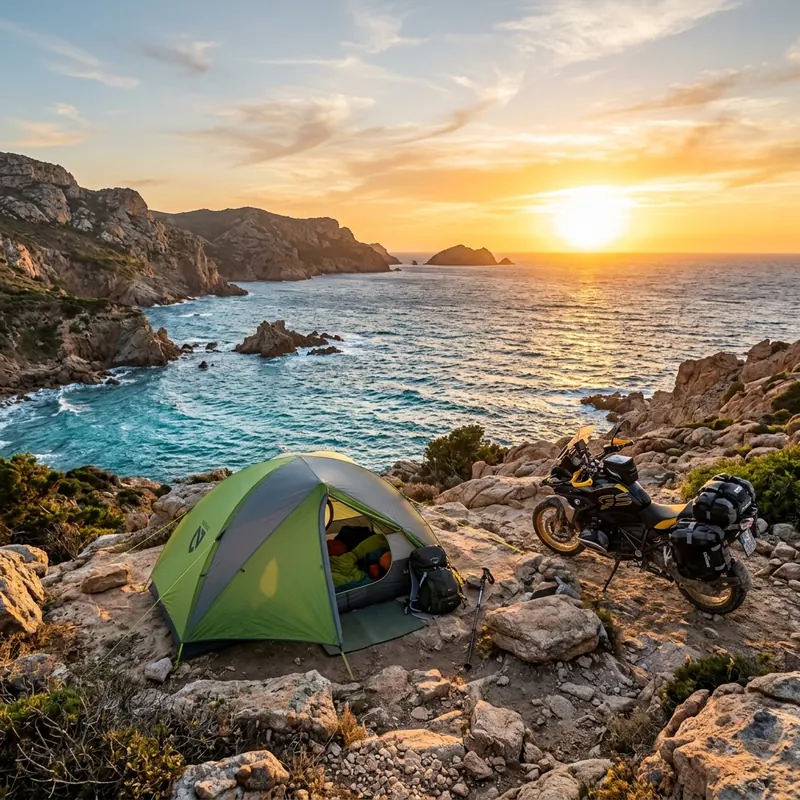
Best overall: Big Agnes Copper Spur HV UL2 — fully freestanding, two doors, 17-inch poles fit hard panniers, two huge vestibules per rider.
Best value: Naturehike Cloud Up 2 — 80% of the Copper Spur experience at one-fifth the price.
Lightest: Zpacks Duplex — 550 g of DCF perfection, if you can live with trekking-pole staking.
Best for two-up: MSR Hubba Hubba LT2 — only tent here with a true rectangular floor that fits two 25-inch pads.
Why Your Backpacking Tent Might Not Work on a Motorcycle
The Pole Length Problem Nobody Talks About
Hard panniers — Touratech Zega Pro, Givi Trekker Outback, Pelican 1550-style cases — typically have an internal usable depth between 18 and 22 inches. Anything longer than 21 inches is a hard no. Sport touring bikes with soft luggage are more forgiving, but tail bags and dry sacks still favor pole segments under 18 inches.
I have never seen a single backpacking tent review mention this. Every review I read before my first moto camping trip listed packed weight, packed dimensions, and trail weight. None told me that the MSR Hubba Hubba’s 18-inch pole segment is just long enough to cause a problem in a 19-inch Givi case.
If you ride with hard luggage, the pole segment length is the most important spec on the box. Everything else is secondary.
Freestanding vs Staked at Dispersed Sites
Backpackers mostly camp at established sites with soft ground. Motorcycle campers — especially the kind reading this — end up on BLM land, forest service roads, rocky bays, and pull-offs where the ground is hardpack or stone. A tent that needs stakes to stand up becomes useless when you cannot drive a stake.
Freestanding tents (Copper Spur, Hubba Hubba, Tiger Wall, Cloud Up 2) pitch on a flat rock with nothing but their own poles and your boots holding them down. Trekking-pole shelters and non-freestanding ultralights (Zpacks Duplex, Tarptent Notch Li) demand a real stake-out. On the wrong surface, they are a tarp draped over your sleeping bag.
This is not a small consideration. It is the difference between sleeping inside or outside.
Weight vs Packed Size: Different Priorities Than Backpacking
A backpacker obsesses over every gram because they carry the tent on their back for 20 km. A motorcycle camper carries the tent on the bike, where 200 grams of difference between two tents is invisible. What matters on a motorcycle is volume. Does the tent fit in a 30L pannier alongside a sleeping pad and bag, or does it need its own half-pannier?
This flips the equation. A 1.4 kg Copper Spur that packs to 6 x 17 inches is more practical for moto camping than an 800 g trekking-pole tent that packs to nothing but demands you also carry poles. Total system weight and total system volume are what count.
What to Look for in an Ultralight Motorcycle Camping Tent
| Spec | Why It Matters for Moto Camping |
|---|---|
| Pole segment length | Must fit hard pannier internal depth (target: under 18 inches) |
| Freestanding capability | Critical for hardpack, rock, and dispersed sites |
| Vestibule size | Stores helmet, boots, jacket, gloves — not just a small pack |
| Number of doors | Two doors stops the “climbing over a sleeping partner” problem |
| Fabric durability | 15D or thinner needs a dry-bag liner to survive luggage straps |
| Footprint included | Big Agnes/MSR sell separately ($40-60); Naturehike includes |
| Pack volume | More important than weight on a motorcycle |

The 8 Best Ultralight Tents for Motorcycle Camping in 2026
1. Big Agnes Copper Spur HV UL2 — Best Overall
| Spec | Value |
|---|---|
| Min weight | 1.22 kg / 2 lbs 11 oz |
| Packed size | 6 x 17 in (15 x 43 cm) |
| Price (2026) | ~$600 |
| Doors / vestibules | 2 / 2 (7 sq ft each) |
| Freestanding | Yes |
| Pole segments | ~17 in |
The Copper Spur is what every other freestanding ultralight tent gets compared to, and there is a reason. Two doors, two large vestibules, 17-inch poles that fit any pannier I have owned, and a fully freestanding pitch that works on slickrock or sand. The 15D Hyperbead fly is thin enough to need careful handling on the bike — pack it inside a dry bag — but the warranty is lifetime and Big Agnes actually honors it.
Best for: ADV riders who camp at varied sites, two-up couples who want their own door, anyone willing to spend once and stop researching tents.
Not great for: Riders who strap the tent directly to a rack without a protective bag — the 15D fly will abrade.
Check Copper Spur HV UL2 on Amazon →
2. Naturehike Cloud Up 2 — Best Value
| Spec | Value |
|---|---|
| Min weight | 1.38 kg / 3.04 lbs |
| Packed size | 12 x 45 cm |
| Price (2026) | ~$100-120 |
| Doors / vestibules | 1 / 1 (small) |
| Freestanding | Yes |
| Pole segments | ~17.7 in (borderline) |
I have spent more nights in a Cloud Up 2 than any other tent here. The honest summary: it is 80-90% of a Copper Spur at one-fifth the price. Same trail weight, same hubbed-pole freestanding design, includes a footprint Big Agnes charges $50 for. The single door is the real compromise — one rider has to crawl over the other. The 45 cm pole bag is tight in a 19-inch Givi case but does fit.
Read the full Naturehike Cloud Up 2 review for long-term details on the fabric, footprint, and what fails after a season.
Best for: First-time moto campers, budget-conscious riders, solo riders who want a roomy shelter, anyone testing whether moto camping is for them before spending $600.
Not great for: Two-up couples who want separate doors, riders camping in sustained 50+ km/h wind (the geometry is less stable than a Copper Spur).
3. MSR Hubba Hubba LT2 — Best for Two-Up Riders
| Spec | Value |
|---|---|
| Min weight | 1.47 kg / 3 lbs 4 oz |
| Packed size | 6 x 18 in (15 x 46 cm) |
| Price (2026) | ~$550 |
| Doors / vestibules | 2 / 2 (8 sq ft each) |
| Freestanding | Yes |
| Pole segments | ~18 in (tight in some hard cases) |
The Hubba Hubba is the only tent in this group with a true rectangular floor — two 25-inch sleeping pads actually fit side by side without one rider getting squeezed into the tapered foot. For couples or anyone over 6 feet tall, that geometry is decisive. The 20D fly is also tougher than the Copper Spur’s 15D — better for riders who strap tents to racks. MSR’s repair support is the best in the industry.
Best for: Two-up riding, tall riders, anyone prioritizing durability over absolute weight savings.
Not great for: Hard pannier owners with 19-inch internal depth — the 18-inch poles are a tight fit.
Check Hubba Hubba LT2 on Amazon →
4. Zpacks Duplex (Classic / Lite) — Lightest Option
| Spec | Value |
|---|---|
| Min weight | 550 g classic / 423 g Lite |
| Packed size | ~30 x 10 cm |
| Price (2026) | $649-669 |
| Doors / vestibules | 2 / 2 (7 sq ft each) |
| Freestanding | No (requires trekking poles) |
| Pole segments | N/A — bring your own |
If pack volume is your single most important metric, nothing else comes close. The Duplex compresses to a 4-liter brick and weighs less than a sandwich. Dyneema is inherently waterproof and stronger than nylon. The catch: it needs two trekking poles to pitch, and most motorcycle riders do not carry trekking poles. The workaround is buying Zpacks’ fixed carbon poles for ~$80 — a sensible investment if you commit to the Duplex. Single-wall construction also means more condensation in humid weather.
Best for: Solo ultralight minimalists, sport touring riders who want to fit a tent into a tail bag with room to spare, weight obsessives.
Not great for: Beginners (the pitch takes practice), riders camping on rocky bays where staking fails, anyone unwilling to buy or carry fixed poles.
5. Nemo Hornet Elite OSMO 2P — Best Semi-Freestanding UL
| Spec | Value |
|---|---|
| Min weight | 765 g |
| Packed size | 5 x 17 in (13 x 43 cm) |
| Price (2026) | ~$629 |
| Doors / vestibules | 2 / 2 (6.2 sq ft each) |
| Freestanding | Semi (foot must be staked) |
| Pole segments | ~17 in |
The Hornet Elite is the sweet spot between Copper Spur livability and Duplex weight. OSMO fabric is PFAS-free, recycled, and genuinely performs better wet than standard silnylon. Two doors, two vestibules, DAC Featherlite poles included. The catch is the geometry: it is truly snug for two adults, and the tapered foot means tall riders bump their head. As a roomy solo tent it is excellent.
Best for: Solo riders who want palatial space, weight-conscious gear-heads who do not want to deal with trekking poles, riders in humid conditions where OSMO fabric helps.
Not great for: Two adults plus gear, riders over 6’2”.
Check Hornet Elite OSMO 2P on Amazon →
6. Tarptent Notch Li — Best Solo Ultralight
| Spec | Value |
|---|---|
| Min weight | 607 g |
| Packed size | 4 x 14 in (10 x 36 cm) |
| Price (2026) | ~$629 |
| Doors / vestibules | 1 / 1 (10 sq ft — generous) |
| Freestanding | No (requires trekking poles) |
| Pole segments | N/A |
The Notch Li is the smallest packed shelter on this list — small enough to disappear inside a tank bag. The 10 sq ft vestibule is genuinely generous for a solo tent, large enough to store a helmet, boots, and jacket without crowding. Like the Duplex it needs trekking poles or fixed carbon poles, and single-wall construction means condensation in humid weather. It is a tent for riders who already know they want to live small.
Best for: Experienced minimalist solo riders, dual-sport and small-displacement bikes where every cubic inch matters.
Not great for: Beginners, two-up, anyone who prioritizes condensation-free mornings.
7. Big Agnes Tiger Wall UL2 — Best Budget-UL Freestanding
| Spec | Value |
|---|---|
| Min weight | 1.13 kg / 2.5 lbs |
| Packed size | 5 x 17 in (13 x 43 cm) |
| Price (2026) | ~$549 |
| Doors / vestibules | 2 / 2 (~6 sq ft each) |
| Freestanding | Semi (foot stakes required) |
| Pole segments | ~17 in |
The Tiger Wall is the lighter, cheaper, less luxurious cousin of the Copper Spur. Slightly smaller vestibules, semi-freestanding instead of fully freestanding, but 200 g lighter and $50 cheaper. For solo riders or couples who do not need the absolute roomiest tent, the Tiger Wall hits the price-to-weight sweet spot better than anything else from Big Agnes.
Best for: Solo riders who want a 2P shelter for gear, couples on a budget, riders who want a brand-name UL tent without paying flagship pricing.
Not great for: Hard-ground campers (semi-freestanding means stakes matter), riders who want the best of everything.
Check Tiger Wall UL2 on Amazon →
8. Durston X-Mid 1P — Wildcard Pick
| Spec | Value |
|---|---|
| Min weight | 680 g |
| Packed size | small |
| Price (2026) | ~$285 |
| Doors / vestibules | 2 / 2 (generous) |
| Freestanding | No (trekking-pole) |
| Pole segments | N/A |
The X-Mid is the most-recommended trekking-pole tent on r/Ultralight, and for good reason — 680 grams of double-wall construction at $285 is unprecedented value. Double-wall means less condensation than the Duplex or Notch Li. If you already carry trekking poles (or are willing to commit to fixed poles), this is the smartest dollar in ultralight tents. It loses to the Duplex on absolute weight and to the Copper Spur on freestanding convenience, but it beats both on value.
Best for: Value-focused solo riders, anyone burned by overspending on flagship gear before, riders who already own trekking poles.
Not great for: Riders who refuse to deal with non-freestanding pitches.
Head-to-Head Comparison
| Tent | Weight | Packed Size | Price | Freestanding | Doors | Pole Segments | Best For |
|---|---|---|---|---|---|---|---|
| Big Agnes Copper Spur HV UL2 | 1.22 kg | 6 x 17 in | $600 | Yes | 2 | 17 in | Best overall |
| Naturehike Cloud Up 2 | 1.38 kg | 12 x 45 cm | $100 | Yes | 1 | 17.7 in | Best value |
| MSR Hubba Hubba LT2 | 1.47 kg | 6 x 18 in | $550 | Yes | 2 | 18 in | Two-up / tall riders |
| Zpacks Duplex | 550 g | 30 x 10 cm | $649 | No | 2 | poles req. | Lightest |
| Nemo Hornet Elite OSMO 2P | 765 g | 5 x 17 in | $629 | Semi | 2 | 17 in | Roomy solo |
| Tarptent Notch Li | 607 g | 4 x 14 in | $629 | No | 1 | poles req. | UL solo |
| Big Agnes Tiger Wall UL2 | 1.13 kg | 5 x 17 in | $549 | Semi | 2 | 17 in | Value freestanding |
| Durston X-Mid 1P | 680 g | small | $285 | No | 2 | poles req. | Value trekking-pole |
Which Tent Is Right for Your Riding Style?
ADV / Off-Road Riders
You camp on hardpack, rocky soil, dirt pull-offs, and the occasional bay. Freestanding is non-negotiable. Pick the Copper Spur, Hubba Hubba, or Cloud Up 2. Skip anything that needs a real stake-out.
Sport Touring / Road Riders
You stay at campgrounds with soft ground and pre-stamped tent pads. Stakes drive easily. You can afford to optimize for pack volume. The Zpacks Duplex or Tarptent Notch Li becomes viable, and you save real space in your luggage.
Two-Up Couples
Get a 2P tent with two doors — climbing over your partner at 3 AM is a quiet relationship killer. Hubba Hubba LT2 (best floor geometry), Copper Spur (best overall), or Tiger Wall UL2 (best budget). Skip single-door tents like the Cloud Up 2 unless you are very tolerant.
Solo Ultralight Minimalists
Pick on weight and pack volume alone. Duplex if you want the best of everything regardless of cost, Tarptent Notch Li if you want the smallest pack volume, X-Mid 1P if you want value.
How to Pack an Ultralight Tent on Your Motorcycle
Hard luggage: Stand the pole bag vertically against the inside wall of the pannier, never across the floor where it can flex under compression. If your pannier internal depth is under 18 inches, you are limited to 17-inch poles or shorter.
Soft luggage / dry bags: The tent itself goes inside a compression dry bag — never directly into a soft pannier. Bungee straps and rack edges abrade thin fly fabric within a season.
Strapped to a rack: This is the worst option, but if you have to, wrap the tent in something sacrificial. A folded base layer or a $20 dry bag adds 100 grams and saves a $600 tent. Tape the contact points with electrical tape on the dry bag, not the tent.
Poles separate from fabric: Always. Compression on the fabric from sharp pole ends causes pinholes that you will find at 2 AM in a thunderstorm.
The Bottom Line
The right ultralight tent for motorcycle camping is the one whose poles fit your pannier, whose vestibule holds your helmet, and whose pitch survives wherever you actually camp. For most riders that is the Big Agnes Copper Spur HV UL2 — fully freestanding, two doors, 17-inch poles, lifetime warranty. For half the price with 80% of the experience, the Naturehike Cloud Up 2 is the smart starter tent. For solo ultralight obsessives, the Zpacks Duplex is in a class of one.
Buy once based on how you actually ride, not based on what backpackers recommend. The miles between gas stations are different from the miles between campsites, and the gear should be too.
Browse Ultralight Tents on Amazon →
Disclosure: Some of the links in this article are affiliate links. If you buy gear through them, we may earn a small commission at no extra cost to you. It helps fund the road trips that make these independent reviews possible — we test all gear ourselves before we recommend it.
Frequently Asked Questions
What tent pole length fits in motorcycle hard luggage?
Most hard panniers — Touratech Zega Pro, Givi Trekker Outback, Pelican-style cases — have an internal usable depth between 18 and 22 inches (45-55 cm). Any pole segment longer than 21 inches becomes a problem. The Big Agnes Copper Spur HV UL2 and Tiger Wall UL2 use 17-inch segments and fit comfortably. The Naturehike Cloud Up 2 standard pole bag is 45 cm and fits, but barely. Trekking-pole shelters like the Zpacks Duplex and Tarptent Notch Li sidestep the problem entirely — you carry the poles separately or buy short carbon fixed poles.
Can I use a backpacking tent for motorcycle camping?
Yes, with two caveats. First, ultralight fabrics in the 10D-15D range are designed to live inside a backpack cushioned by clothing. Strapped to a luggage rack with bungee cords, they abrade and develop pinholes. Use a stuff sack or pannier liner. Second, backpackers usually camp in established sites with soft ground. Motorcycle campers often end up on forest roads, gravel pull-offs, and hardpack where stakes won't drive — which makes freestanding tents dramatically more practical. A semi-freestanding or trekking-pole tent that backpackers love can become useless on the wrong surface.
Is the Zpacks Duplex good for motorcycle camping?
It is the lightest option in this guide at 550 grams, packs down to almost nothing, and is genuinely waterproof in any storm. But it requires two trekking poles, which most motorcycle riders do not carry. You either buy fixed carbon poles (add 200 grams and another small bag) or carry trekking poles you will only use to pitch the tent. It is also not freestanding — staking is mandatory, which fails on the rocky bays and hardpack many of us camp on. For solo riders willing to plan around it, the Duplex is unbeatable on weight and pack volume. For most others, a freestanding Big Agnes is the better tool.
How do I stop my ultralight tent from getting damaged on my bike?
Ultralight tents fail in two ways on a motorcycle: abrasion against the rack or luggage rim, and pole damage from compression. The fix is simple. Pack the tent inside a dry bag or compression sack instead of the manufacturer's thin stuff sack — this adds a sacrificial outer layer against straps and rough surfaces. Pack the poles separately along the inside wall of a pannier, not pressed against the floor. If you strap the tent to a rear rack, pad the contact points with a folded base layer. A $20 dry bag will keep a $600 Copper Spur alive for years.
What is the lightest tent I can fit in a 30L pannier?
The Zpacks Duplex Lite at 423 grams in DCF packs down to roughly 30 x 10 cm and consumes about 4 liters of pannier space. Of the freestanding options, the Big Agnes Tiger Wall UL2 (1.13 kg, packed to 5 x 17 inches) is the smallest fully self-supporting tent and leaves room in a 30L pannier for a sleeping pad and bag alongside. The Naturehike Cloud Up 2 packs to 12 x 45 cm in its compression sack — the pole tube is the dimension to watch, since 45 cm is tight against the inside wall of most 30L panniers.