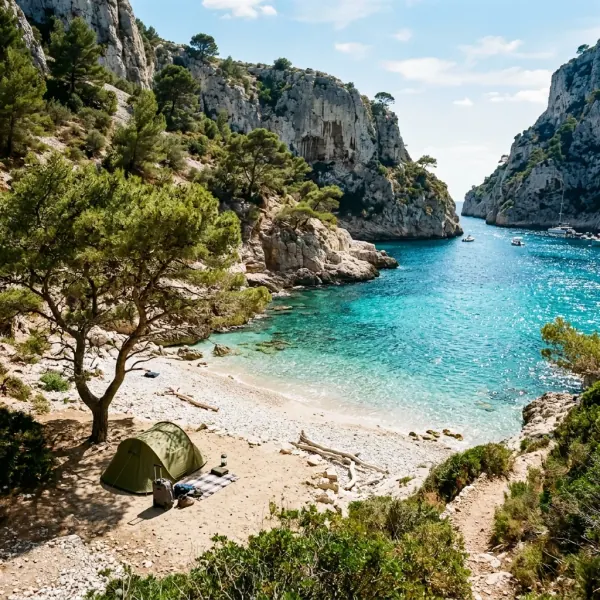
The best night I’ve ever spent outdoors was at a small bay on the Datça peninsula in southwest Turkey. A 4 km dirt track off the coast road, two switchbacks down to a cove of white pebbles and Aegean-blue water, no other campers, no road noise, just the wash of small waves and a half moon rising over the cliffs. I pitched the tent on a flat sandy patch above the tideline, swam at sunset, cooked a one-pot pasta dinner on the rocks, and slept eleven hours.
That bay is on this list. So are eleven others — places I’ve either camped at myself, ridden in to scout, or had recommended by riders I trust enough to take their word. This is the working best wild camping bays Mediterranean guide, organized by country and ranked by what each spot is actually like. Not the Instagram version. The version where I tell you the bay has perfect water but no flat ground for a tent, or excellent flat ground but a rough access track.
What Makes a Bay Good for Motorcycle Wild Camping
Not every beautiful bay is a good camping bay. The variables that matter:
Road access. Can you ride a loaded motorcycle to the bay, or do you have to park 1 km up the hill and carry gear down? Most of the bays on this list have at least dirt-track access for an adventure bike. A few require a short walk with luggage — noted where applicable.
Tent ground. Flat soil or sand is ideal. Pebbles and rounded stones are tolerable on a thick sleeping pad. Sharp rocks and bedrock are non-starters for inflatable pads. The best camping bays have at least a small patch of flat ground above the tideline.
Wind exposure. Coastal bays funnel wind. A bay open to prevailing winds (afternoon thermal sea breeze on the Aegean blows 15-25 km/h consistently) is uncomfortable for camping. Look for bays with natural windbreaks — headlands, trees, or rock formations.
Water source. Most coastal bays have no fresh water. Bring 4-5 liters per person for an overnight. A few exceptional bays have nearby streams or springs — noted where applicable.
Privacy. A bay accessible only by 4x4 or motorcycle stays empty. A bay with day-tripper boat access fills up during the day and empties at night. A bay you can walk to from a parking lot is unlikely to be empty even at midnight.
Legal tolerance. Varies by country and specific area. Generally, the more remote and undeveloped the bay, the higher the tolerance.
Turkey: The Best Mediterranean Country for Bay Camping
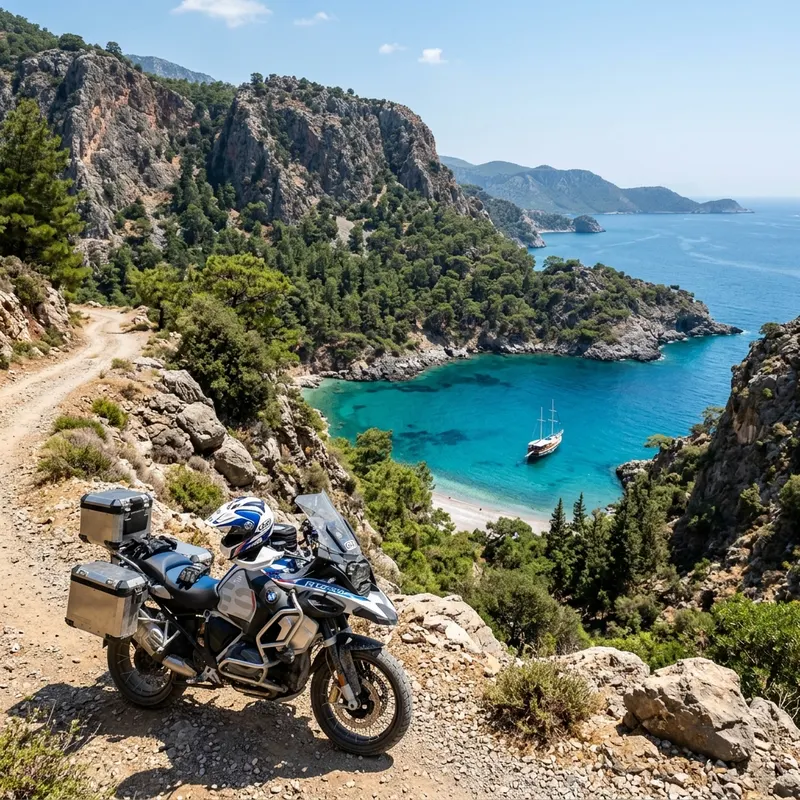
Turkey has the best combination of coastline length, road access, tolerance, and low population for wild-bay moto camping in the Mediterranean. Three regions stand out.
Region 1: Datça Peninsula
The Datça peninsula juts 80 km west from the southwestern Turkish coast. Most of it is sparsely populated pine forest with dirt tracks descending to small bays every few kilometers. The road from Marmaris west to Datça town is a beautiful coastal ride in itself.
Bay 1: Kargı Koyu. 12 km east of Datça town, 2 km off the main road on a dirt track. Small pebble cove with a flat sandy patch above the tideline big enough for two tents. Pine trees provide shade and windbreak. No other riders the night I camped. No water source — bring everything.
Bay 2: Hayıtbükü. Small fishing village with a beach and a couple of restaurants — not wild camping in the strict sense, but you can pitch 200 meters past the village on the headland for free, with restaurant access for dinner. Best for mid-trip resupply nights.
Bay 3: Mesudiye Bay (west end of Datça peninsula). The most remote area, accessed by 25 km of mixed paved and dirt road from Datça town. Multiple small coves between Mesudiye village and Knidos (the ruined ancient city at the peninsula’s western tip). The campable coves are the ones with no signs and small dirt tracks leading down.
Region 2: Kabak and Faralya (Near Fethiye)
South of Ölüdeniz on the Lycian coast, the Faralya/Kabak area is a small valley with a beach at the bottom and headlands extending north and south. Kabak Bay itself has small organized camps that allow motorcycle access — paid but cheap, with toilets and basic amenities.
Bay 1: Kabak Bay south end. Beyond the organized camps, the south end of the bay has a long rocky stretch with flat ground for one or two tents. Access via a 1 km hike from the road; you’ll need to carry luggage. Wild and quiet.
Bay 2: Sidyma Bay. 10 km south of Faralya, accessed by a steep 4 km dirt track. Small bay with mixed sand and pebbles. Remote enough that you’ll have it to yourself most nights outside July-August.
Region 3: Olympos and Çıralı Headlands
The stretch of coast north of Olympos toward Adrasan has several headlands accessible by paved and dirt roads. The official Olympos beach is a national park — no wild camping there. The headlands extending north into less-protected coastline are common wild-camp territory.
Bay 1: Sazak Bay. 8 km north of Çıralı, accessible by a small coast road and a final 500m dirt track. Small bay with a stream running into it from the back — rare for the Mediterranean coast, makes it the best-watered bay on this list. Pine forest behind for shelter.
Bay 2: Adrasan-area headlands. Multiple small coves between Çıralı and Adrasan, accessed by dirt branches off the coast road. The further north you go, the more privacy.
For a full route that connects these regions, see the Lycian Way motorcycle route guide.
Greece: Beautiful, Crowded, Officially Illegal
Greek wild camping is officially banned by law (Article 1, Decree 12/12/1969) but enforcement is selective. On the mainland — Peloponnese, mainland coast — tolerance is high in remote areas. On the popular islands (Mykonos, Santorini, Crete near tourist areas), enforcement is strict and ferry-bringing-a-motorcycle is expensive.
Peloponnese: The Mani peninsula in the south has rocky coves and small bays accessible by dirt roads. Camping is tolerated in remote spots away from villages. The terrain is harsh — rocky, exposed, with limited shade — but the privacy is excellent.
Pelion peninsula: Mainland coast east of Volos. Forested mountains drop to small pebble beaches. Coastal road plus side tracks give access to multiple bays. Northern Pelion bays (Damouhari, Mylopotamos area) are easier to camp at than the southern resort coast.
Crete south coast: The south coast of Crete (between Plakias and Sougia) has remote beaches accessible by hiking and 4x4. A few are reachable by motorcycle. Higher tolerance than the north coast tourist zone.
The Greek pattern: the further you are from a paved road and a named village, the more tolerated wild camping becomes. Stay one night, leave no trace, and you’ll rarely have a problem outside the most touristed islands.
Albania: Wild, Cheap, Underrated
Albania has 360 km of largely undeveloped coastline between Vlora and the Greek border. The road infrastructure is improving but most coastal bays are still accessed by rough dirt tracks. Wild camping is essentially uncontrolled — you camp where you like, with discretion.
Karaburun peninsula: West of Vlora, the Karaburun peninsula has multiple bays accessible only by boat or 4x4/motorcycle from the inland road. Stunning, remote, almost no infrastructure. Plan to be fully self-sufficient.
Llogara Pass to Himara: The 50 km of coast south of Llogara Pass has multiple small bays — Palase, Dhërmi, Drymades — with side tracks down to undeveloped sections. Tourism is growing fast here; pick the unpaved approaches for the wild camp experience.
Ksamil area: Beautiful but increasingly touristed. Wild camping is technically tolerated but you’ll have company in summer. Spring and fall are better.
The trade-off in Albania is comfort vs experience. The bays are some of the most beautiful in the Mediterranean. The infrastructure is poor — fuel is reliable in towns but spotty in between, water needs to be carried, and mechanical help is harder to find than in Turkey or Greece. Best for experienced solo riders comfortable with self-sufficiency.
Sardinia: Paradise with Rules
Sardinia has some of the clearest water and most striking coastlines in the Mediterranean. Wild camping is officially illegal under Italian law. Enforcement varies by region — strict on the famous Costa Smeralda and developed eastern coast, tolerant in remote interior and west-coast bays.
Sinis peninsula (west coast): The Sinis peninsula north of Oristano has multiple sandy bays accessible by dirt roads. Tolerance is higher here than on the east coast. One night, discreet, no fire — usually no problem.
Costa Verde (southwest): Long stretches of empty coast between Buggerru and Piscinas. Old mining roads provide access to multiple bays. Some of the best remote camping on the island, though water sources are scarce.
Asinara island: Mostly a national park with strict camping rules. Day visits only for most of it.
Sardinia is expensive to reach (ferry from mainland Italy) and tolerance is declining as overtourism grows. Excellent bays for moto camping if you can accept the more complex legal environment. Go in May or October to avoid both crowds and enforcement.
Corsica: Strict Rules, Stunning Bays
Corsica’s coastline is some of the most beautiful in the Mediterranean — granite cliffs, turquoise water, dense maquis vegetation. Wild camping is illegal and enforcement is active on the popular coast (Calvi, Porto-Vecchio).
The realistic options are:
Cap Corse (far north): The northern peninsula has small undeveloped bays accessible from coastal tracks. Tolerance higher here than the south coast resort zone. Still, plan for one-night discreet camping with no fire.
Désert des Agriates (north coast): A wild, arid zone with multiple beaches accessible only by hiking or 4x4. Some of the best remote camping on Corsica. Plage de Saleccia is the famous one — beautiful but increasingly known.
Western coast (Scandola area): Protected nature reserve with strict rules. Camping is essentially impossible inside the reserve boundaries.
For Corsica, plan to mix wild camping (1-2 nights at remote bays) with paid municipal campgrounds (€10-15/night) for most of the trip. Pure wild camping is harder to sustain here than in Turkey or Albania.
Cross-Mediterranean Comparison
| Country | Tolerance | Bay Access | Infrastructure | Cost | Overall |
|---|---|---|---|---|---|
| Turkey | High | Excellent | Good | Low | Best overall |
| Albania | Very high | Good | Poor | Very low | Best for self-sufficient riders |
| Greece (mainland) | Moderate | Good | Good | Moderate | Best for variety |
| Sardinia | Low (officially) | Moderate | Good | High | Best for stunning water |
| Corsica | Very low | Limited | Good | High | Best for short trips |
If I had one Mediterranean wild-camping bay trip to plan in 2026, it would be Turkey. The combination of coast length, tolerance, road quality, low cost, and infrastructure makes it the easiest place to actually enjoy this style of travel.
Universal Rules for Wild Bay Camping
Regardless of country, the principles that keep you safe and welcome:
- One night maximum at any single spot
- Arrive in late afternoon, leave by mid-morning
- No fires from June through October
- No music audible beyond your camp
- Pack out everything you bring in
- Toilet duties at least 50 meters from water sources, dig a hole, pack out paper
- If a local approaches and asks you to move, move politely
- Photographs for personal use only — never tag locations on Instagram
This is how the practice stays sustainable. Wild camping rights and tolerances erode every time a group leaves trash, lights a fire that gets out of control, or geotags a location that then gets overrun. The bays on this list are accessible because riders before you respected them.
Internal Connections
This guide pairs with related route and gear content:
- For securing the bike at remote bay camps, see how to secure your motorcycle while wild camping.
- For safety planning on solo trips to these areas, see solo motorcycle camping safety for remote tenting.
- For the Turkish-specific route that connects to several of these bays, see remote Turkish bays only an adventure motorcycle can reach.
- For the gear setup that handles bay camping, see best motorcycle camping tents and best compact sleeping pads for motorcycle camping.
FAQ
Five common questions are answered at the top of this page. The short version: Turkey is the best country for this style of travel, tolerance varies sharply elsewhere, satellite-view Google Maps is your best discovery tool, fire bans are strictly enforced in summer, and comfort varies bay by bay.
Whatever country you’re riding, the principle behind the best wild camping bays Mediterranean is the same — remote enough to be empty, accessible enough to reach with a loaded bike, beautiful enough to make the riding worth it. The bays that earn return visits are the ones you leave the way you found them.
Some links in this article are affiliate links. If you buy gear through them, we may earn a small commission at no extra cost to you.
Frequently Asked Questions
Is wild camping actually legal in Mediterranean countries?
Tolerance varies sharply by country. Turkey is the most tolerant — wild camping in undeveloped areas outside national parks is widely accepted as long as you leave no trace. Greece is officially illegal but tolerated in remote areas off the islands' tourist circuits. Albania is essentially uncontrolled. Italy bans wild camping by law but tolerates one-night discreet camping in remote regions like Sardinia and parts of the Apennines. France and Croatia have strict prohibitions actively enforced near beaches. The rule for the whole Mediterranean: remote, discreet, no fires, no trace, one night — and you'll almost never have a problem.
What's the best country for wild camping bays by motorcycle?
Turkey, by a wide margin. The combination of a 1,600 km coastline with hundreds of accessible coves, formal tolerance of low-impact wild camping, low population density along much of the coast, and excellent paved roads connecting bays makes it the best-value Mediterranean destination for moto-campers. Greece is second — beautiful but more crowded and officially illegal. Albania is wild and cheap but infrastructure is poor. Sardinia and Corsica are gorgeous but tolerance has been declining as overtourism increases.
How do I find good camping bays without a guide like this?
Satellite view on Google Maps. Zoom in on stretches of coast between named villages, look for small bays accessed by unpaved tracks that branch off the coast road. The bays without parking lots, restaurants, or named beaches are the ones worth checking. Cross-reference with Komoot or Wikiloc for hiker reports — anywhere a hiker has been is usually accessible to an adventure motorcycle. The actual discovery still requires riding the dirt track and confirming with your own eyes.
Are there fire restrictions I need to know about?
Yes — and they're strictly enforced in summer. From June through October, most Mediterranean countries ban all open fires outside developed areas. Penalties can be severe — Turkey introduced 10+ year prison sentences for wildfire starters after the 2021 fires. Use a contained canister stove (MSR PocketRocket, Jetboil) and never light a campfire on dry coastal grass or in pine forest during summer. If you absolutely need a fire, it has to be on bare rock or sand with no flammable material within 5 meters, and out completely before you sleep.
What's the realistic comfort level at these wild camping bays?
Variable. Some bays have shade trees, flat ground, fresh water from a nearby stream, and shelter from wind — luxurious. Others are rocky, exposed, with no water source and challenging tent pitching. The trade-off is usually privacy vs comfort: the most beautiful and remote bays are the hardest to camp at. Plan for the worst case — bring extra water, a self-supporting tent that doesn't need stakes, and a sleeping pad that handles rocky ground. The bays reward riders who can adapt.