Pannier choice is one of the most consequential gear decisions an adventure motorcyclist makes. The wrong panniers cost the rider on every kilometre of the trip — too heavy, too narrow, too wide, too fragile, too hard to remove, too easy to break a leg against in a fall.
The right panniers disappear into the background and let the rider focus on riding. This guide compares the five most-recommended pannier systems for adventure motorcycles in 2026, with construction details, weights, mount systems, and honest rider-fit recommendations.
This is the best adventure motorcycle panniers roundup organised around use case rather than brand preference. The right pannier for a Pan-American overlander is not the right pannier for a weekend dual-sport rider, and pretending otherwise produces bad recommendations.
Introduction: Why Pannier Choice Matters More Than You Think
A pannier is not just a bag. It is the single most loaded structural attachment to the motorcycle, the dominant factor in the bike’s center of gravity, the primary wear surface in any low-side fall, and the number-one cause of subframe damage on poorly chosen luggage setups.
Riders who underestimate pannier choice tend to discover the consequences slowly. Wheel bearings that should last 30,000 km start failing at 15,000 km. Subframe welds crack on big bikes that were never designed to carry 50 kg of luggage cantilevered off the rear. Soft bags wear through at strap points and start leaking. Hard cases bend in the first low-side and never close cleanly again.
Pannier choice gets evaluated across four dimensions: construction (fabric, hardware, stitching), weight (empty and loaded), mount system (rack-required, rackless, hybrid), and crash behaviour (deformation, abrasion resistance, leg-injury risk).
Hard vs Soft vs Hybrid: The Core Trade-Offs
Three pannier philosophies dominate the market.
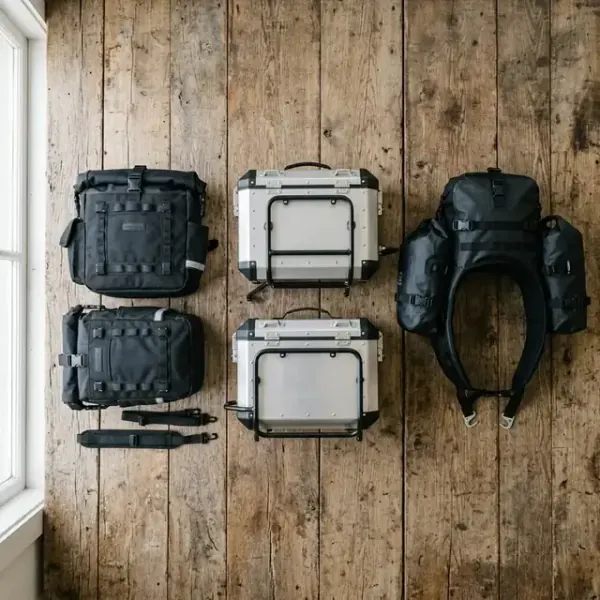
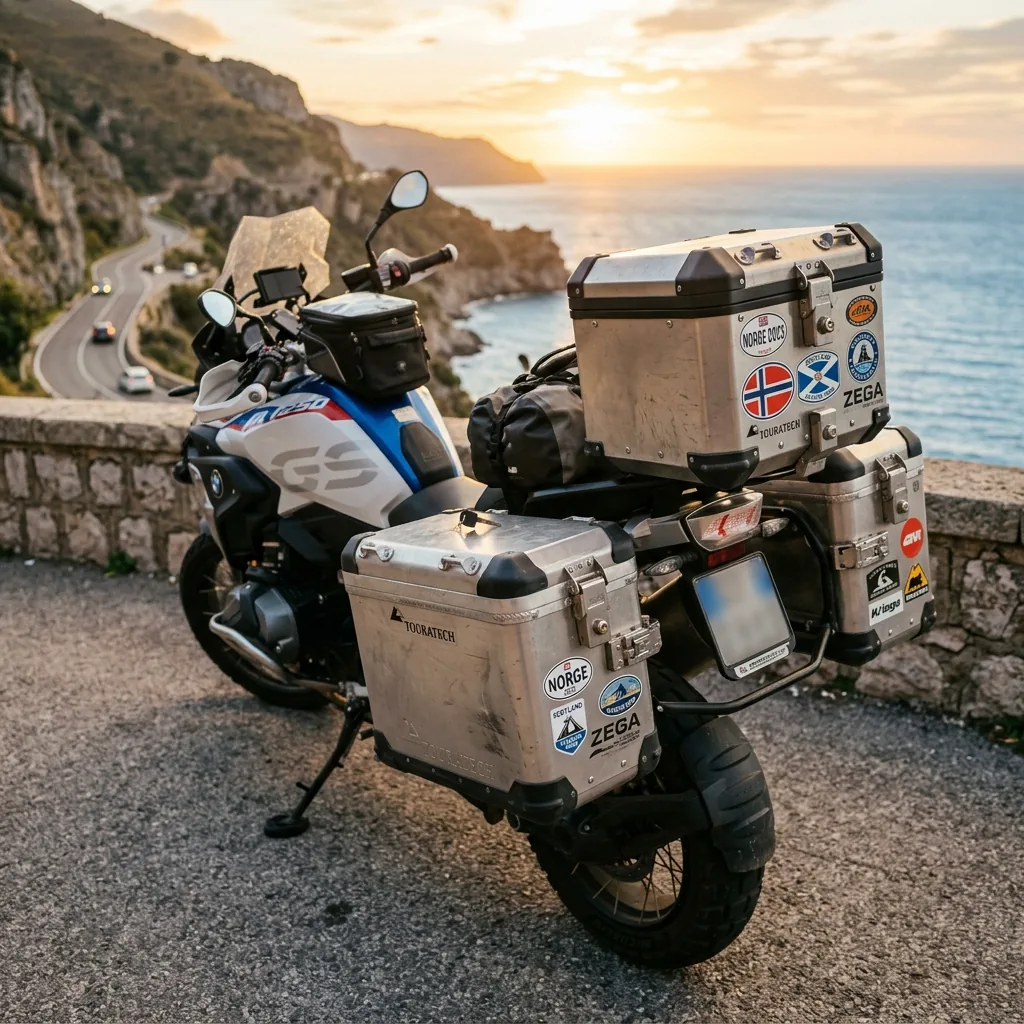
Hard panniers are aluminium or polycarbonate cases mounted on rigid frames. Touratech Zega, Givi Trekker, and Hepco & Becker Xplorer are the reference brands. They lock, they stack neatly at hotels, they survive being parked in dense traffic with luggage left inside. They also weigh 7-12 kg per side empty, they break in a hard crash, and an aluminium edge against a tibia in a low-side off-road fall is the textbook setup for a broken leg.
Soft panniers are fabric bags mounted on either dedicated racks or rackless harnesses. Mosko Moto, Kriega, Giant Loop, Wolfman, and Nelson-Rigg are the reference brands. They weigh 2-4 kg per side empty, they compress when empty, they slide across the bike rather than pinning the rider, and they accept impact deformation without permanent damage. They are not lockable in the meaningful sense, they soak slowly in extended rain without a liner, and they require more discipline at urban overnight stops.
Hybrid systems split the difference. Mosko Moto’s Backcountry line uses a rigid aluminium wedge mount with a fabric body. Giant Loop’s Round-the-World combines rackless saddlebag mounting with reinforced abrasion zones. The hybrid category exists because the strict hard-versus-soft binary leaves real overlanders unserved — they want soft-bag crash behaviour with hard-bag mount rigidity.
Best Adventure Motorcycle Pannier Options List
Five systems cover the most-recommended options across price, weight, and use-case categories. Total weights below are for the bags only, excluding mounting frames and racks unless noted.
- Mosko Moto Backcountry 35L pair — total bag weight 5.9 kg (5.9 kg)
- Kriega OS-32 plus OS-38 pair rackless system — total bag weight 2.8 kg (2.8 kg)
- Giant Loop RTW Roll-Top saddlebag single-piece — total weight 1.4 kg (1.4 kg)
- Touratech Zega Pro hard aluminium panniers pair — total weight 7.2 kg (7.2 kg)
- Nelson-Rigg SE-2050 budget soft panniers pair — total weight 2.1 kg (2.1 kg)
1. Mosko Moto Backcountry 35L
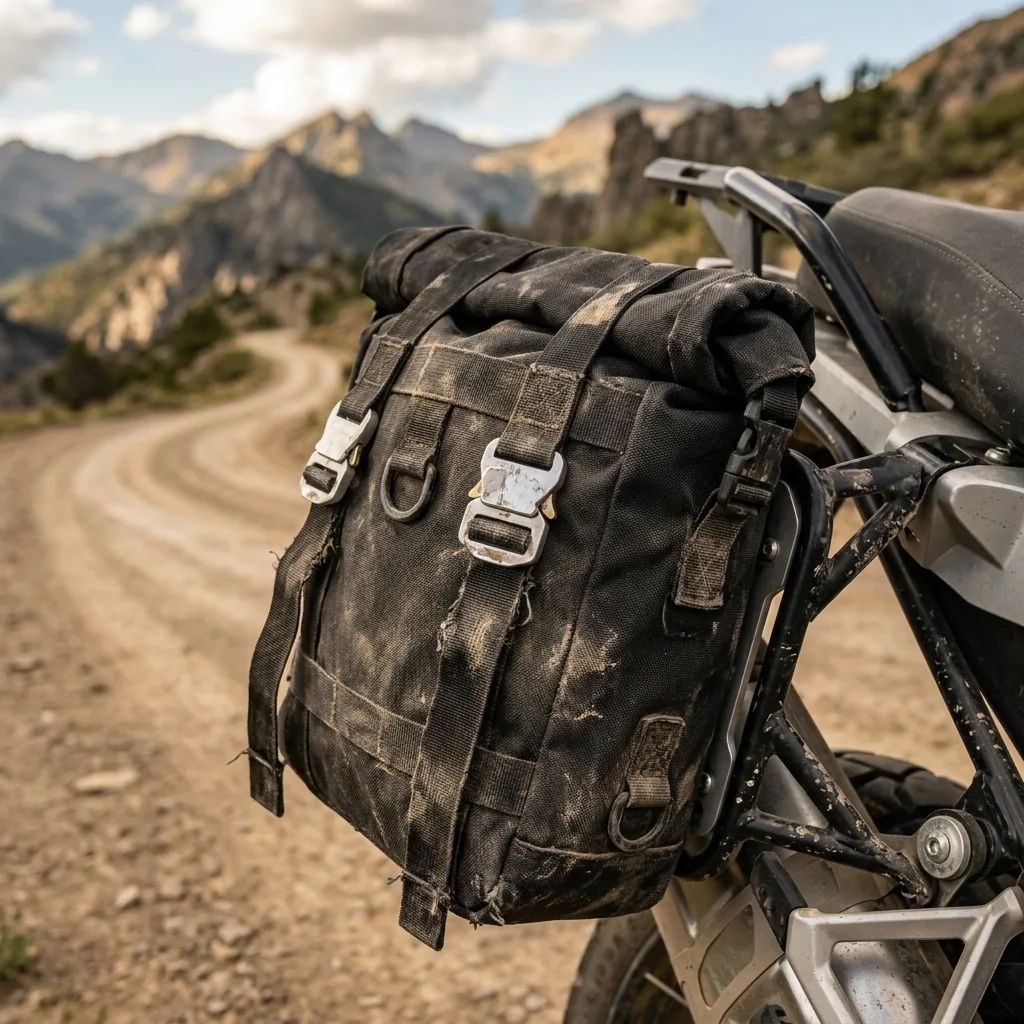
The Backcountry sits at the top of the soft-pannier market. The construction is 1680D ballistic nylon with Hypalon abrasion panels. The defining feature is the aluminium wedge mount that locks each bag to a pannier rack with a single latch.
Removal takes five seconds per side with no straps. The included internal dry bag liner provides the actual waterproof layer; the outer shell handles abrasion and weather but the roll-top closure is splash-proof rather than fully submersible.
Price runs about $895 for the pair excluding the bike-specific fitment kit. The Backcountry suits long-distance overlanders on mid-to-large adventure bikes who already run a pannier rack and remove bags frequently at lodging stops.
2. Kriega OS-32 + OS-38 Rackless System
Kriega’s OS series is the rackless answer to premium soft luggage. The system uses an OS-Base harness ($120) that wraps around the rear of the bike and tensions across the seat. Individual OS bags (OS-22 at 22 L, OS-32 at 32 L, OS-38 at 38 L) clip onto the harness with hooks and quick-release straps.
The fabric is 1000D Cordura with Hypalon high-wear panels and YKK Aquaguard zippers — fully waterproof zippered closures rated to immersion. No internal liner is needed for the OS series; the bag itself is waterproof.
Bag pricing runs $180-220 per individual bag plus the $120 harness. The Kriega system suits weight-conscious riders, lightweight middleweight bikes, and tour-focused riders who do not need quick removal at every stop. The harness tensioning takes 10-15 seconds per ride.
3. Giant Loop Round-the-World (RTW) Saddlebag
Giant Loop pioneered the rackless single-piece saddlebag concept. The RTW is a horseshoe-shaped bag that drapes over the passenger seat with a built-in saddle pad, secured by integrated straps that pass under the seat or around the subframe.
The fabric is heavy-duty TPU-coated polyester with welded seams. The single-piece design distributes load across the bike’s centerline rather than off the sides, which keeps the bike narrower than dual-pannier setups. Total capacity reaches 71 L across both sides plus the central pouch.
Price runs $300-400 depending on options. The RTW suits riders on dual-sport and smaller adventure bikes (DR-Z400, CRF300L, Himalayan), single-track focused trips where narrow profile matters, and riders without a pannier rack or budget for one.
4. Touratech Zega Pro Hard Aluminium Panniers
The Zega Pro is the reference hard pannier in the European adventure-touring market. Construction is 1.5 mm aluminium sheet TIG-welded into a rigid case, with stainless steel hardware throughout. Capacities range from 31 L to 45 L per side.
The cases lock with high-security barrel locks. The mounting system uses a Touratech-specific rack ($400-500 separately) with quick-release clamps that allow the cases to come off in roughly 30 seconds per side. The cases stack neatly for use as camp tables.
Price runs $1,200-1,600 for the pair plus the rack. Each case weighs 3.6 kg empty. The Zega Pro suits riders on big touring-focused adventure bikes (R 1250 GS, GS Adventure, Africa Twin), 80%-paved touring routes, and rider profiles that prioritise lockable security over off-road crash behaviour.
5. Nelson-Rigg SE-2050 Budget Soft Panniers
The SE-2050 covers the budget end of the adventure pannier market. Construction is 600D polyester with PVC-coated waterproof liner and reinforced base panels. Mount is strap-only — no wedge, no harness, no rack required.
Total per-side capacity is 21 L expandable to 31 L. The bags are universal-fit, attaching with adjustable straps that route over the seat and around any pannier rack or pillion grab handles. Waterproofing is via internal liner, similar to the Mosko approach but with thinner outer fabric.
Price runs $180-220 for the pair. The SE-2050 suits new riders running their first adventure bike, weekend trip riders not committed to long-term overlanding, and budget-constrained owners of bikes without bike-specific premium fitments available.
Mounting Systems Explained
Three mounting paradigms exist in the market, each with real consequences for daily use.
Rack-mounted with quick release is the Mosko Backcountry approach and the Touratech approach. A permanent rack stays on the bike. The bag locks onto the rack with a wedge, clamp, or pin system. Removal is 5-30 seconds per side. The downside is the rack itself adds 4-6 kg of permanent weight to the bike and costs $300-500 separately.
Rackless harness-mounted is the Kriega OS approach and the Mosko Reckless approach. A tensioned harness or strap network wraps around the bike’s rear, and individual bags clip to the harness. No rack required. Total system weight is lower. The downside is mounting and dismounting takes 10-15 seconds and requires more rider discipline to tension correctly.
Strap-only mount is the Giant Loop and Nelson-Rigg approach for entry-level riders. Bags attach directly to whatever the bike offers — pillion seat, grab rails, OEM rack. The simplest and cheapest method, with the downside that bags can shift under heavy load and need re-tensioning over multi-hour rides.
Which Panniers for Which Riding Style
Five rider profiles map cleanly to the five recommended systems.
Long-distance overlanding on mid-large adventure bikes — Mosko Moto Backcountry. The wedge mount and ballistic construction earn their price over hundreds of hotel-stop pannier removals across a multi-month trip.
Weight-conscious tour-focused riding on middleweight ADV bikes — Kriega OS-32 / OS-38. The rackless setup saves several kilograms of permanent rack weight while still providing fully waterproof construction.
Single-track focused dual-sport riding — Giant Loop RTW. The narrow centerline-mounted single-piece bag keeps the bike’s profile minimal for tight forest tracks where width matters more than capacity.
Paved touring with city overnight stops — Touratech Zega Pro. Lockable hard cases handle hotel parking situations that would leave soft luggage vulnerable, and the hard cases stack neatly as camp tables.
Budget-first first adventure bike — Nelson-Rigg SE-2050. Real waterproof construction at one-fifth the price of premium options. The Nelson-Rigg suits the rider testing whether adventure touring is the right hobby before committing to premium gear.
The honest summary: there is no single best pannier for adventure motorcycles. There is the right pannier for a specific bike, rider, and trip profile. Match the system to the use case and ignore the marketing.
Disclosure: Some of the links in this article are affiliate links. If you buy gear through them, we may earn a small commission at no extra cost to you. It helps fund the road trips that make these independent comparisons possible — every system in this guide has been evaluated against the published specs and against the real-world rider feedback that defines its reputation.
Frequently Asked Questions
Are soft or hard panniers better for adventure motorcycle riding?
Soft panniers win on technical off-road terrain. They weigh less, compress when empty, slide off rocks instead of bending the subframe, and do not pin the rider's leg in a low-side crash. Hard panniers win on paved touring, urban overnight stops, and rider profiles that prioritise lockable security. The most demanding answer: serious overlanders who switch between dirt and city often choose soft bags with discrete cable locks rather than fully lockable hard panniers.
How much weight should adventure motorcycle panniers carry?
Per-side weight should never exceed 10 kg loaded, and total luggage weight should stay under 20% of the bike's wet weight. A 220 kg adventure bike like a Ténéré 700 has a practical luggage ceiling around 35-40 kg total — that includes panniers, tail bag, tank bag, and any rack-mounted gear. Exceeding these limits compromises suspension behaviour, handling stability, and the long-term life of wheel bearings and subframe welds.
Do I need a luggage rack for soft adventure panniers?
Depends on the system. Mosko Moto Backcountry, Touratech ZEGA, and most hard panniers require a dedicated rack. Kriega OS-series, Giant Loop saddlebags, and Mosko Reckless are rackless — they attach with tensioned harnesses or saddle-style straps directly to the bike. Rackless systems weigh less and cost less but mount and unmount more slowly. Rack-mounted systems offer better load stability and faster removal.
How long do soft panniers last compared to hard panniers?
Premium soft panniers (Mosko Moto, Kriega, Giant Loop) last 80,000+ km of mixed adventure use before fabric or stitching shows real wear. Mid-tier soft panniers (Nelson-Rigg, Wolfman) typically last 30,000-50,000 km before the heavier-stressed fabric panels need replacement. Hard aluminium panniers (Touratech, Givi Trekker) effectively never wear out from use — they fail through impact damage, theft, or rust at the mount points. The longer-term cost question depends more on rider crash frequency than fabric durability.
Can I lock soft motorcycle panniers?
Soft panniers can be secured but not truly locked. Most premium soft panniers (Mosko Moto, Kriega, Giant Loop) include attachment points for small padlocks on the roll-top closures and main zippers. These padlocks slow casual theft but a determined thief can slice the fabric in under a minute. The realistic security strategy for soft panniers is to remove valuables at every stop, use a cable lock through the wedge or harness points to prevent the bag from walking away, and park the bike in monitored locations whenever possible.