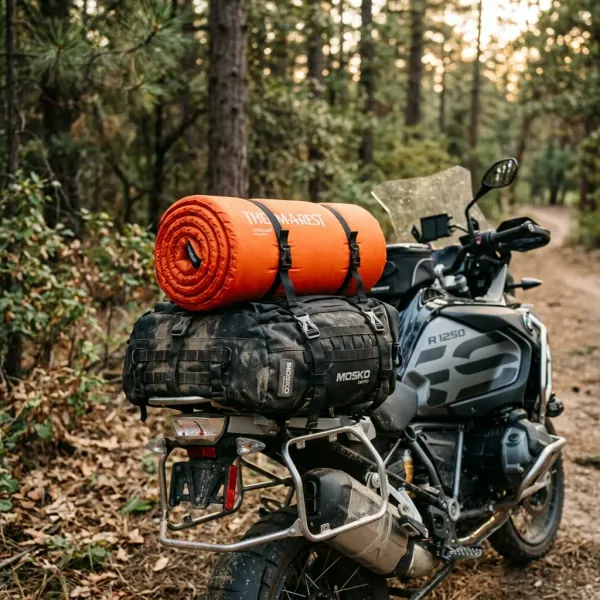
The first time I went motorcycle camping, I brought a $40 closed-cell foam pad I’d had since college. It was thick enough to be comfortable, light enough not to matter, and roughly the size and shape of a small surfboard. I strapped it to the back of my CFMOTO 250NK with two bungee cords and rode 200 km to a pine forest near Sapanca. By the time I got there, one corner of the pad had peeled off the bungee and was flapping in the wind like a flag. The other corner had a 10 cm gouge from rubbing against the exhaust shield.
I slept on it anyway because I had nothing else. But the lesson stuck: packed size on a motorcycle is everything. A pad that doesn’t fit inside your luggage is a pad you’ll lose, ruin, or hate carrying.
Three seasons later I’ve slept on a NeoAir XLite NXT on Aegean cliffs, a Klymit Static V2 in pine forests near Bursa, and a Nemo Tensor in a Kaçkar mountain camp during a 4°C night. This guide is the honest version of what to buy — the best compact sleeping pads for motorcycle camping in 2026, ranked by what actually matters when you’re loading the bike at 6 a.m.
What to Look for in a Motorcycle Camping Sleeping Pad
Sleeping pads sell on three numbers — weight, R-value, packed size — and motorcycle camping changes which one matters most.
Packed size is the first cut. If the pad doesn’t fit inside your tail bag, it gets strapped to the outside. Strapped to the outside means dirty, wet, exposed to sun, and one bungee away from being lost on the highway. Target a packed size of 13 cm diameter and 25-30 cm long, or smaller. That’s what fits a standard 30L tail bag with room left over for a sleeping bag and tent.
R-value is the second cut. R-value measures insulation from the ground. Summer Mediterranean trips need R-1 or higher. Three-season touring needs R-3 or higher. Cold-shoulder or alpine needs R-4.5 or higher. The difference between an R-1 and an R-4 pad isn’t optional — it’s the difference between sleeping warm and shivering at 3 a.m.
Weight is the third cut, and it matters less on a motorcycle than backpackers think. A 500g pad versus a 350g pad is 150g of difference. Your bike doesn’t care. What matters is the volume that weight comes in. A 350g pad in a 1L bottle-sized package beats a 350g pad in a foam roll twice that volume.
Best Compact Sleeping Pad Options List 2026
5 Sleeping Pads — Side by Side
Click any column to sort ↕| Pad | Weight | R-Value | Packed Size | Price | Rating |
|---|---|---|---|---|---|
| Editor's PickTherm-a-Rest NeoAir XLite NXT | 354 g | 4.5 | 23 × 10 cm | $220 | |
| Sea to Summit Ether Light XT | 340 g | 3.2 | 25 × 10 cm | $200 | |
| Nemo Tensor All-Season | 410 g | 3.5 | 20 × 8 cm | $200 | |
| Best ValueKlymit Static V2 | 490 g | 1.3 | 20 × 8 cm | $65 | |
| Therm-a-Rest Z Lite Sol | 410 g | 2.0 | 51 × 13 cm | $55 |
1. Therm-a-Rest NeoAir XLite NXT — Best Overall (354 g)
The NeoAir XLite NXT is the pad I’ve slept on for the last 30+ nights of motorcycle camping, and the pad I’d buy again without hesitation. Around $220 retail, 354 grams packed, R-value 4.5, and it compresses to roughly the size of a 1L Nalgene bottle.
The R-4.5 rating is what sells it. That’s three-season-plus warmth in a pad that weighs less than a hardcover novel. The internal Triangular Core Matrix structure — two layers of triangular baffles oriented at right angles — traps still air without using heavy down or synthetic fill. The result is a pad that punches above its weight for warmth.
The WingLock valve is small but matters. One position inflates fast, the other releases air fast. No more thumb cramp from a tiny one-way valve. With the included pump sack, full inflation takes 4-5 breaths’ worth of compressed air. Without it, about 15-20 lung-powered breaths.
The honest catch: the surface is crinkly. The reflective barrier inside makes a faint plastic-bag sound when you shift weight. After two nights you stop noticing. The first night, every roll-over wakes you. Lighter sleepers should test this in a store before committing.
Durability has been excellent. Three seasons, 30+ nights, zero punctures — I keep it on a footprint inside the tent, never inflate it to fully rigid, and roll it up dry. That’s the recipe.
Check NeoAir XLite NXT on Amazon →
- 354 g for an R-4.5 pad — best warmth-to-weight ratio available
- Packs to ~1L bottle size, fits any tail bag
- WingLock valve inflates and deflates fast
- Three-season rated, handles spring and fall nights
- Crinkly surface — light sleepers notice the first night
- Around $220 — premium pricing
- Thin floor (7 cm) — side sleepers may bottom out on rocky ground
2. Sea to Summit Ether Light XT — Lightest Inflatable (340 g)
The Sea to Summit Ether Light XT is the lightest inflatable on this list at 340 grams, with a 10 cm thickness that beats every other pad here for surface comfort. Around $200 retail. R-value 3.2 — three-season rated but not as warm as the NeoAir.
What sells the Ether Light is the Air Sprung Cell construction — interconnected cells like a mattress instead of long baffles. The result is a surface that supports your weight like a real mattress and contours to your body. For side sleepers and people with bad shoulders or hips, this is the most comfortable night’s sleep you can get on a motorcycle.
The trade-off is the R-3.2 rating — fine for summer and warm shoulder seasons, marginal in genuinely cold conditions. If your trips are summer Mediterranean and you sleep cold, this is the pad. If your trips include alpine passes or October mountain camps, the NeoAir’s R-4.5 is the safer call.
Packed size is essentially identical to the NeoAir — 25 cm long, 10 cm diameter. Fits any tail bag.
Check Ether Light XT on Amazon →
3. Nemo Tensor All-Season — Most Comfortable (410 g)
The Nemo Tensor All-Season is what I’d recommend to someone who values sleep comfort above all else. 410 grams, R-3.5, packs slightly larger than the NeoAir but still fits any tail bag. Around $200 retail.
The construction uses horizontal baffles instead of the NeoAir’s matrix or the Ether Light’s air sprung cells. The result is a flatter, more stable sleeping surface — you don’t roll into a sag in the middle the way some inflatables do. The 8 cm thickness is enough that side sleepers don’t bottom out on rocky ground.
The surface fabric is brushed and quieter than the NeoAir. No crinkle. For sound-sensitive sleepers, this alone justifies the choice. The R-3.5 rating is a touch lower than the NeoAir’s R-4.5 but adequate for any three-season trip in the Mediterranean and most of Europe.
The catch is weight — 410 g vs 354 g for the NeoAir. That’s 56 grams of difference. On a motorcycle, it doesn’t matter. If you backpack regularly with the same pad, it might.
4. Klymit Static V2 — Best Budget ($65, 490 g)
The Klymit Static V2 is where I’d start if you’ve never owned a real sleeping pad and you want something good without spending $200. 490 grams, R-1.3, packs to roughly the size of a 1L Nalgene, and it sells for $65 on Amazon.
The R-1.3 rating is the honest constraint. This is a summer pad. In warm Mediterranean nights above 15°C, it sleeps fine. Below 10°C ground temperature, you’ll feel the cold seep through the bottom. For pure summer moto camping, that’s not a problem. For shoulder-season or alpine trips, look elsewhere.
The Klymit V-Chamber design is genuinely clever — the V-shaped baffles limit air movement, which limits heat loss to ambient air. It’s not as warm as a high-R pad but it punches above the spec sheet.
Build quality at $65 is what you’d expect — adequate. The valves are simple rubber stoppers, slower to inflate and deflate than the WingLock or Sea to Summit valves. The fabric is a heavier polyester that feels durable but adds weight.
For the price, this is the easiest first sleeping pad to recommend. Use it for a summer or two, learn what you actually need, then upgrade.
Check Klymit Static V2 on Amazon →
5. Therm-a-Rest Z Lite Sol — Most Durable Foam (410 g)
If puncture-proof matters more than packed size, the Therm-a-Rest Z Lite Sol is the answer that has been right for 30 years. Closed-cell foam, accordion-folding, 410 grams, R-2.0, around $55.
This is not a pad you carry in a tail bag — at 51 × 13 cm folded, it’s too bulky. This is a pad you strap to the top of your panniers or behind your seat. The trade-off is real: it adds visible bulk to your bike. The upside is also real: nothing can puncture it. Pine cones, gravel, sharp grass, broken glass at a beach camp — all irrelevant. The pad has no failure mode.
For riders who do a lot of harsh-ground camping (rocky bays, gravel pull-offs, packed-dirt forest tracks), the Z Lite is the pad that survives where inflatables die. R-2.0 is summer-and-spring rated, not winter. The 2 cm of foam compresses under your hips and shoulders, so side sleepers feel hard ground through it.
Honest assessment: most riders should buy an inflatable. The Z Lite is for the rider who has had an inflatable fail at the worst possible moment and decided never again.
Inflatable vs Foam: Which for Motorcycle Camping?
Foam pads are bulletproof. They never puncture, they last decades, they sell for $55. The Therm-a-Rest Z Lite Sol is the canonical example.
Inflatable pads are comfortable and compact. They pack to a fraction of foam’s volume, they support side sleepers better, and the high-R-value models keep you warmer in cold weather. They also puncture, leak, and fail at 3 a.m. when you’d most like them not to.
For motorcycle camping, inflatable is the right answer for almost every rider. Packed size dominates the decision. A foam pad strapped to the outside of your luggage is a foam pad collecting road grime and exhaust soot. An inflatable in your tail bag is invisible until you need it.
The exception: if you ride a small bike with no external strap points and you camp on harsh rocky ground constantly, a foam pad on top of your tail bag (strapped clean and high) saves you from the inflatable failure mode.
R-Value Explained: How Cold Does It Get?
R-value is a measure of resistance to heat flow through the pad. The higher the number, the more it insulates you from the ground.
| R-Value | Use Case |
|---|---|
| 1.0-2.0 | Summer only, above 15°C ground temp |
| 2.0-3.0 | Late spring through early fall, above 10°C |
| 3.0-4.5 | Three-season, above 0°C |
| 4.5+ | Cold weather, below freezing |
Most riders sleep at least one night colder than they expected. A pad rated 0.5-1.0 above your worst expected condition is the right buy. The NeoAir XLite NXT at R-4.5 handles everything short of winter. The Klymit V2 at R-1.3 is summer only. Plan honestly.
Packed Size: What Actually Fits in a Tail Bag
The standard motorcycle tail bag is 25-35 liters. A typical packed sleeping pad needs to fit alongside a tent, a sleeping bag, and a few small items. Target packed dimensions: under 25 cm long, under 13 cm diameter.
All four inflatable pads on this list hit that size or better. The Z Lite Sol does not — it’s foam, it doesn’t compress, and at 51 × 13 cm it lives outside the tail bag.
If your tail bag is full and you’re trying to choose between two inflatables, pick the smaller one. Volume on a motorcycle is more precious than the spec sheet suggests.
FAQ
Five common questions are answered at the top of this page. The short version: get a NeoAir XLite NXT if budget allows. Get a Klymit V2 if it doesn’t and you camp in summer only. Get a Nemo Tensor if comfort matters more than weight. Get a Z Lite Sol if puncture-proof matters more than pack size.
Whatever you end up with from this list of best compact sleeping pads motorcycle camping, the pad that earns its place is the one you forget about until morning. The right pad is the one you wake up rested on, with no memory of the ground underneath.
Disclosure: Some links in this article are affiliate links. If you buy gear through them, we may earn a small commission at no extra cost to you. Every pad on this list was slept on for at least three nights before it made the cut.
Frequently Asked Questions
Inflatable or foam — which is right for motorcycle camping?
Inflatable wins on packed size — a 354g NeoAir packs to roughly the size of a 1L bottle. Foam wins on durability — a Z Lite Sol will never puncture and will last a decade. For most riders, inflatable is the right answer because packed size on a bike is everything. Carry a foam pad only if your bike has dedicated strap points (top of panniers, behind the seat) where the bulk doesn't matter. On a tail-bag-only setup, inflatable is the only sensible choice.
What R-value do I need for moto camping?
Depends on season. Summer Mediterranean trips — anything above R-1.0 is fine. Spring and fall shoulder seasons — aim for R-3 or higher. Winter or alpine — R-4.5 or above. The R-value is how well the pad insulates you from the ground, which steals more body heat at night than the air does. A summer-rated pad in October will leave you cold even in a good sleeping bag.
How small does a sleeping pad really need to pack?
Target: 13 cm diameter, 30 cm long, or smaller. That's the threshold where the pad fits inside a standard 30L tail bag with room left over for other gear. Anything bigger and you're either strapping it to the outside (where it gets dirty and wet) or buying a larger luggage system. The premium inflatable pads (NeoAir XLite NXT, Sea to Summit Ether Light) all hit this size easily. Budget pads like the Klymit Static V2 are double the volume.
Will an inflatable pad really survive a season of moto camping?
Yes, with care. Three things kill inflatable pads: sharp ground (pine cones, sharp grass, tent pegs), overinflation (stretches seams), and rolling them up wet (mold inside). Use a footprint or groundsheet under your tent. Inflate to firm-but-not-rigid — you should be able to push your finger down 1 cm with moderate pressure. Air the pad out fully before packing. Do all three and a $200 inflatable lasts 5+ seasons. Skip them and you'll be patching it before next summer.
What's the warmest pad that still fits a motorcycle?
The Nemo Tensor All-Season at 410g and R-3.5 is the best balance — warm enough for spring and fall, packs to about the size of a 1L bottle, and the surface is properly cushioned for side sleepers. For real winter use, the Therm-a-Rest NeoAir XTherm NXT at R-7.3 is the answer, but the trade is 450g packed weight and a slightly larger pack size. Both fit a tail bag.