Europe is the only continent where you can ride a world-class alpine pass, a legal wild-camping fjord coast, a Mediterranean corniche and a 100,000-kilometre off-road GPX route — all on one trip, without a carnet, and mostly without showing a passport between countries. No other region on earth packs this much varied, high-quality riding into distances a normal vacation can cover.
That density is also the planning problem. The great European routes are scattered across a dozen countries, their seasons don’t line up, and most riders discover too late that the pass they built the trip around opens three weeks after their ferry lands. This guide is the map: the routes that genuinely earn a dedicated trip, what each one rewards, when each window opens, and how to connect them into something bigger than a single loop.
It pulls together the detailed route guides for each region into one planning hub, and points to the gear, camping and logistics resources where those decisions start to matter.
The Routes at a Glance
| Route | Country | Length | Character | Window |
|---|---|---|---|---|
| Alps: Stelvio & Dolomites | Italy / Switzerland / Austria | Loops, 1,000–2,000 km | The world’s densest concentration of great passes | Mid-Jun–Sep |
| Pyrenees coast-to-coast | Spain / France | ~1,450 km | Quieter, wilder alternative to the Alps | May–Oct |
| Norway: fjords & Lofoten | Norway | 2,000+ km | The most dramatic scenery in Europe, legal wild camping | Jun–early Sep |
| North Coast 500 | Scotland | 830 km loop | Highland single-track, Bealach na Bà, right-to-roam | May–Sep |
| Wild Atlantic Way | Ireland | ~2,500 km | Peninsula-after-peninsula Atlantic coast | Apr–Oct |
| Transfăgărășan & Transalpina | Romania | 2 roads + approach | Europe’s two most spectacular mountain roads | Jul–Sep |
| The Balkans | 6+ countries | Open-ended | Cheap, empty, underrated — Europe’s adventure corner | Apr–Oct |
| Trans Euro Trail | Continent-wide | ~100,000 km route | The off-road way across Europe | Varies by section |
Each of these is covered in a dedicated deep-dive guide linked in its section below. They ride very differently, and — more importantly for planning — their seasons and geography determine which ones combine into a single trip.
The Alps: Stelvio, the Dolomites and the Great Passes
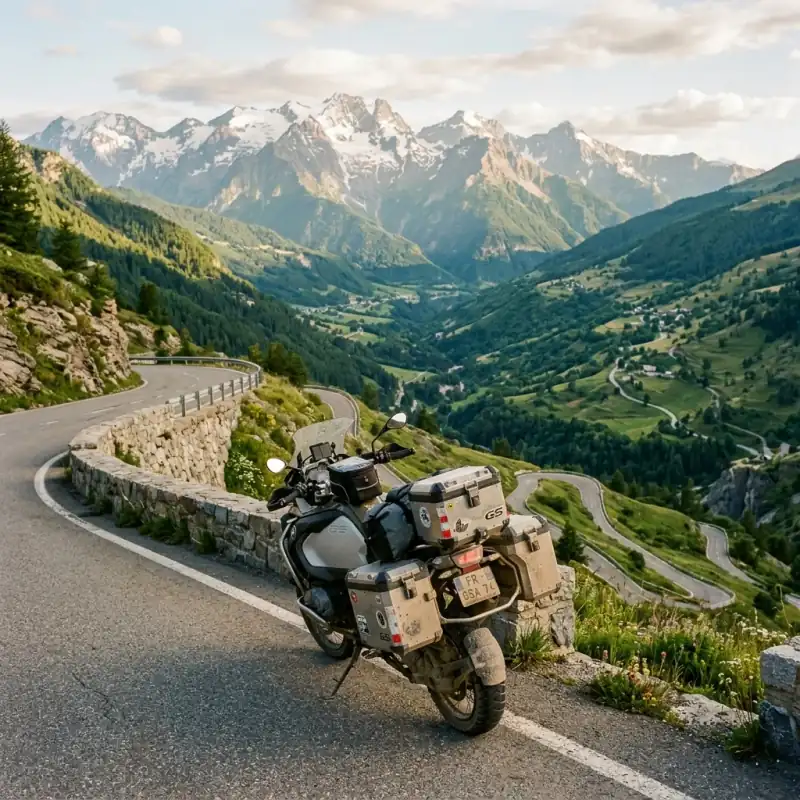
If European motorcycling has a center of gravity, it’s here. The Alps hold more legendary passes within a day’s ride of each other than anywhere else on the planet — the Stelvio’s 48 numbered hairpins, the Sella Ronda circuit in the Dolomites, the Grossglockner, the Furka-Grimsel-Susten triangle. This is the region riders cross continents to reach, and it earns the reputation.
The riding is engineered mountain road at its best: consistent surfaces, proper switchback geometry, and villages with fuel and coffee spaced exactly where you want them. The trade-off is popularity. The Stelvio in August is a procession of cars, cyclists and buses, and the famous passes reward an early start more than any other roads in Europe.
Two planning facts matter more than any pass list. First, the season is short: the high passes reliably open from mid-June and can see snow again by late September. Second, altitude compresses the day — 300 km in the high Alps is a full riding day, not a half.
The Pyrenees: Cap de Creus to the Picos de Europa
The Pyrenees are what the Alps were reportedly like thirty years ago: the same quality of mountain road with a fraction of the traffic. The range runs coast-to-coast — Mediterranean to Atlantic — along the French-Spanish border, and a full traverse from Cap de Creus to the Picos de Europa strings together Tourmalet-class passes, empty valley roads and the green mountain country of northern Spain that almost no touring rider ever sees.
The case for the Pyrenees over the Alps is simple: emptier roads, longer season, cheaper everything, and a wilder feel — with the Picos de Europa extension adding a second mountain range most riders have never heard of. The case against is equally simple: fewer iconic names, and services thin out in the middle sections in a way the Alps never allow.
Riders shipping in from the UK can shortcut the approach with the UK to Spain motorcycle ferry.
Norway: Fjords, the Atlantic Road and Lofoten
Norway is the scenery superlative of European motorcycling, and it isn’t close. Trollstigen’s cliff-face hairpins, the Atlantic Road’s wave-swept bridges, the Geiranger fjord descent and the improbable alpine islands of Lofoten — the country delivers a visual intensity per kilometer that the Alps and the coasts simply don’t match.
It also has one of the most generous wild-camping laws anywhere. The allemannsretten right-to-roam makes free camping on open land a protected legal right, which transforms the economics of touring the most expensive country in Europe. A Norway trip on a loaded bike with a tent costs a fraction of the hotel version and is the better trip anyway.
The riding window is the shortest of any route here: June to early September, with Lofoten weather chaotic even in high summer.
Scotland: The North Coast 500
Scotland’s NC500 is the most famous road trip in Britain — an 830 km loop around the northwest Highlands from Inverness, anchored by the Bealach na Bà, the closest thing the British Isles have to an alpine pass. The northwest section between Applecross, Torridon and Durness is the heart of it: single-track roads through mountain-and-sea-loch country that feels far bigger than the map suggests.
Scotland shares Norway’s key advantage — a legal right to wild camp under the Scottish Outdoor Access Code — and shares its key warning: the weather is a coin flip in any month, and the midges from June to August are a genuine factor in camp-spot choice.
Traffic is the thing to plan around — the NC500’s popularity is its biggest problem — and the North Coast 500 motorcycle guide covers that alongside the full loop plan, the accommodation and camping strategy, and the quieter alternative sections.
Ireland: The Wild Atlantic Way
Ireland’s answer to the NC500 is three times longer and arguably better value: roughly 2,500 km of waymarked Atlantic coast from Kinsale in Cork to Malin Head in Donegal, built around a rhythm of peninsulas — Beara, the Ring of Kerry, Dingle, Connemara, Achill, Donegal — rather than one dramatic loop. Healy Pass, Slea Head Drive and Conor Pass are the signature roads; the dead-end peninsula detours are the secret ones.
Compared with Scotland: cheaper, quieter, warmer in welcome, with less motorhome congestion — but no legal right to wild camp, so the touring pattern runs on Ireland’s dense network of cheap beachside campsites instead, with discreet wild stops where tolerated.
Plan it south to north; the Wild Atlantic Way motorcycle route guide has the rest — the beachside campsites worth building the trip around, the ferry logistics and the weather strategy.
Romania: Europe’s Two Greatest Mountain Roads
The Transfăgărășan and the Transalpina are two of the most spectacular individual roads in Europe, and they cross neighbouring ranges of the Southern Carpathians, the Făgăraș and the Parâng, a short ride apart. The Transfăgărășan is the famous one — the serpentine north-face climb to Bâlea Lake that television made a global icon. The Transalpina is the higher, longer, emptier one that many riders quietly prefer.
What makes Romania more than a two-road stop is everything around them: the Carpathian backroads, the fortified churches of Transylvania, prices roughly half of western Europe, and a genuine sense of edge-of-Europe adventure without leaving the EU. The catch is the calendar — both roads sit above 2,000 meters and reliably open only July through September, the shortest window of any paved route in this guide except Norway.
The Balkans: Europe’s Underrated Adventure Corner
The Balkans are where European touring turns into European adventure. Montenegro’s Kotor serpentine and Durmitor ring road, the Albanian Riviera’s coastal descents, Bosnia’s mountain interiors, North Macedonia’s lake country — all of it cheaper, emptier and rawer than anything west of it, with wild camping broadly tolerated and hospitality often compared to Turkey’s.
The region asks slightly more of the rider: non-Schengen border crossings (passport at each one, plus a Green Card for Albania and North Macedonia), fuel and mechanical infrastructure a notch below the EU norm, and road surfaces that vary from new EU-funded asphalt to broken mountain tarmac within a single afternoon. None of it requires an off-road bike; all of it rewards a light one.
Start with the Balkans motorcycle guide for the border-by-border practicalities, the route backbone and the country-by-country highlights, then the Balkan wild camping rules for the legal camping picture. Most riders enter the region down Croatia’s Adriatic coast — the D8 Dalmatian Coast route guide covers that approach and Croatia’s strict camping rules. Riders continuing southeast connect directly into the Turkey network via the ultimate Turkey motorcycle tour guide.
The Trans Euro Trail: Crossing Europe Off-Road
Everything above is paved. The Trans Euro Trail is the other way across the continent: a community-mapped route of roughly 100,000 km (the TET’s own figure) of legal dirt roads, forest tracks and byways that threads through most of the countries in this guide. It’s free, GPS-file based, and maintained by volunteer “linesmen” in each country — the closest thing Europe has to a continental off-road backbone.
The TET is not a single trip; it’s an ingredient. Most riders fold TET sections into a paved tour — a few days of Portuguese or Spanish trail, the Carpathian sections alongside the Romanian roads, the Scandinavian forest tracks — rather than riding it end to end. It demands a genuine adventure bike, off-road tyres and self-recovery skills, and it rewards them with a Europe the road network never shows.
The Trans Euro Trail beginners guide explains what the trail actually is, how the GPX files and country sections work, and the beginner mistakes to avoid; the riding-technique side is in off-road riding tips for loaded adventure bikes, and the Turkish continuation has its own Turkey TET section of the Turkey guide.
When to Ride: A Seasonal Strategy
The single most common planning mistake on a European route trip is ignoring the altitude calendar. The continent’s riding season is really three overlapping windows:
April–June and September–October: the coasts. The Wild Atlantic Way, the NC500 approach months, the Mediterranean coastal routes, Iberia and the Balkans are all at their best in the shoulder seasons — mild weather, empty roads, low prices. July-August on the famous coasts means traffic and peak pricing.
Mid-June–September: the mountains. The high Alps, the Transalpina, the Norwegian mountain roads and the top TET sections are snow-gated outside this window. Building a trip around a great pass in early June is the classic error — check opening dates, not just weather forecasts.
July–August: the far north. Norway above the Arctic Circle and the Scottish Highlands are genuinely at their best in high summer, which conveniently is exactly when the Mediterranean is too hot and too crowded.
The strategy writes itself: coasts in the shoulders, mountains in the middle, and multi-region trips sequenced south-to-north as summer builds.
Borders, Documents and Insurance
Europe’s paperwork is light by world standards, but the details bite at the edges.
Inside Schengen (the Alps, Pyrenees, Norway, most of the routes here), there are no routine passport checks, though Switzerland and Norway are outside the EU customs union and can stop you for a customs check. The UK and Ireland check passports but need no Green Card. The western Balkans need passport and insurance at every crossing, and vehicle insurance for Kosovo is typically bought at the border. Non-EU visitors must track the Schengen 90/180-day rule across the whole trip — it’s the constraint that shapes most long overland itineraries.
The document set is the same everywhere: passport, registration, proof of insurance, with a Green Card for the countries outside the Multilateral Agreement, and an International Driving Permit where required. The full country-by-country breakdown — including the Balkan crossings and the ferry document checks — is in the European border crossing documentation guide, and the insurance products that actually cover a multi-country trip are in the insurance section of the border-documents guide.
For the trip-planning framework itself — routing, pacing, accommodation mix, fuel strategy — start with long-distance trip planning checklist.
Camping Your Way Across Europe
Camping is what turns Europe’s most expensive routes into affordable ones, and the legal picture varies more than most riders expect: a protected legal right in Norway, Sweden and Scotland; tolerated in Ireland and most of the Balkans; formally restricted but quietly practiced in France, Spain and Italy. The country-by-country rules are mapped in the European wild camping legal guide.
The gear side is its own planning problem — a Europe route trip means packing for Norwegian rain and Mediterranean heat on the same bike. The motorcycle camping gear checklist covers the full system, the complete camping and touring guide covers the method, and how to pack a motorcycle for a two-week trip covers the loadout that has to survive both.
Building a Multi-Route Trip
The routes in this guide combine naturally along a few well-worn axes:
Two weeks — the Alpine core. Alps and Dolomites, optionally extended into Slovenia. The densest great-riding-per-day option in Europe. Fly-and-rent or ride down from the Channel in two days each way.
Two weeks — the Celtic coasts. NC500 plus the Wild Atlantic Way, linked by the Cairnryan–Belfast ferry. The best coastal riding in Europe in a single trip, best in May-June or September.
Three weeks — west to east. Pyrenees, then the Alps, then down through the Balkans — the classic diagonal that samples three mountain ranges and ends in cheap, warm country. Sequence it eastward so the Balkans arrive as the Alps’ season fades.
Three to four weeks — the northern epic. Germany or the ferry ports north through Sweden or coastal Norway to Lofoten and back. High summer only. The wild-camping trip of a lifetime, and cheaper than it looks thanks to the tent.
Open-ended — the TET diagonal. For the off-road committed: TET sections stitched from Portugal or the Alps toward Romania and onward into Turkey. The bike and skills threshold is real; the reward is a continent most riders never see.
For bike choice across any of these, the principle from the long-distance touring bikes guide holds: weight beats power everywhere in this guide — on the hairpins, on the single-track, at the wild camp, and doubly so on the TET.
Where to Start
For a first dedicated route trip, the answer for most riders is the Alps — the infrastructure is flawless, the riding is the continent’s benchmark, and a one-week loop from Munich, Milan or Innsbruck delivers more legendary roads than any other single week in motorcycling.
For the second trip, go where the Alps aren’t: Norway if scenery and wild camping pull hardest, the Celtic coasts if the draw is ocean and atmosphere, Romania and the Balkans if it’s value and adventure. And when the paved classics start feeling solved, the Trans Euro Trail reopens the whole continent from the beginning.
Europe’s advantage over every other touring destination is that these choices aren’t exclusive. The distances are short, the borders are open, and the next great route is never more than two days’ ride from the last one. The riders who get the most out of the continent stop treating it as a list of separate trips — and start treating it as one big one, taken in pieces.
Frequently Asked Questions
What is the best motorcycle route in Europe?
There's no single answer, but by broad rider consensus the shortlist is stable: the Stelvio-Dolomites region of the Alps for the greatest concentration of legendary passes, Norway's fjord country for the most dramatic scenery per kilometer, Romania's Transfăgărășan for the single most spectacular road, and Scotland's North Coast 500 or Ireland's Wild Atlantic Way for the best coastal riding. Which one is 'best' depends on whether you ride for corners, views, remoteness or coastline — this guide breaks down what each region actually rewards.
How long do you need for a Europe motorcycle trip?
One week covers a single region ridden properly — an Alps loop, the NC500 plus the Scottish approach, or the southern half of the Wild Atlantic Way. Two weeks lets you connect two neighboring regions, like the Alps plus the Dolomites and Slovenia, or the Pyrenees plus Picos de Europa. A month is the realistic minimum for a genuine multi-region trip such as the Alps to the Balkans, and riders doing the full north-to-south or west-to-east continent crossing typically plan six weeks or more.
When is the best time to ride the great European routes?
June to September for everything alpine and Nordic — the high passes of the Alps, the Transalpina and the Norwegian mountain roads only reliably open from mid-June. May-June and September are the sweet spots for the coastal routes (Wild Atlantic Way, NC500, the Mediterranean coasts), which get crowded and expensive in July-August. The Balkans and the Iberian routes stretch the season from April to October. A multi-region trip works best planned around this: coasts in the shoulder months, mountains in high summer.
Do you need an adventure bike for Europe's best routes?
For the paved classics — the Alps, Transfăgărășan, NC500, Wild Atlantic Way, the coastal routes — no. Any reliable motorcycle that's comfortable for consecutive long days works, and lighter bikes are actually an advantage on single-track and hairpin sections. A true adventure bike with off-road tyres becomes necessary only for the Trans Euro Trail and the unpaved detours in the Balkans and Scandinavia. Weight matters more than power on every route in this guide.
Can you wild camp along Europe's motorcycle routes?
It depends heavily on the country. Norway, Sweden and Scotland have legal right-to-roam camping, and they're the best wild-camping motorcycle destinations in the world. Ireland tolerates discreet one-night stops. France, Spain and Italy formally restrict it but tolerate stealth camping away from tourist zones. The Balkans are permissive in practice. The country-by-country legal picture is covered in the European wild camping legal guide, linked in the camping section of this post.
How do border crossings work on a multi-country European motorcycle trip?
Inside the Schengen area there are no border checks at all — you ride from Spain to Norway without showing a document. The paperwork matters at the edges: the UK and Ireland (passport checks, no Green Card needed), the western Balkans (passport checks at every crossing; a Green Card for Albania and North Macedonia, none needed for Bosnia, Montenegro or Serbia, and insurance bought at the border for Kosovo), and Turkey (temporary vehicle import). Non-EU visitors also need to track the Schengen 90/180-day rule. The full documentation breakdown is in the border crossing guide linked below.