Turkey is the most geographically varied country in Europe for a motorcycle trip. Three coasts, two mountain ranges, five climate zones, and a road network built around an empire’s worth of regional capitals. A rider can wake up in a pine-forested Aegean bay, ride inland to a Cappadocian cave hotel, and on a longer trip end up looking at Mount Ararat above the Iranian border — all without leaving one country.
That scale is also the problem. Most riders treat Turkey as a one-week coastal add-on to a wider European trip and end up seeing one strip of one coast. The country deserves better planning than that. This guide is the regional map: where the great roads are, which bays earn the detour, what each region demands of bike and rider, when to ride, and how to handle the documentation, fuel, food, and accommodation logistics that make or break the trip.
It pulls together the deep-dive route guides on each region into a single planning hub, and points outward to the relevant gear and camping resources when those decisions matter for what you’ll be riding through.
Why Turkey for a Motorcycle Trip
Three things make Turkey the destination it is for adventure riders, and all three are easy to overlook from a glance at a map.
The road network. Turkey has rebuilt much of its highway system over the last twenty years. The D-roads are wide, well-paved, and engineered for the terrain — coastal highways that hug the sea for hundreds of kilometers, mountain passes with proper switchback geometry, and a national density of fuel stations that means range anxiety is rarely the constraint it is in, say, Morocco or rural Greece. The pavement quality outside the major cities is consistently good, the traffic outside July-August is light, and the police presence is moderate and predictable.
The geographic compression. The country contains a Mediterranean coast that rivals Croatia and Greece, an Aegean coast as dense with ancient cities as anywhere in the Mediterranean, a Black Sea coast that looks like the Pacific Northwest, the high-altitude lake-and-volcano country of central Anatolia, and the genuine high mountains of the Kaçkar range and the east — all reachable from a single international entry point. A two-week trip that covers two of those regions sees more landscape variety than a month-long European loop.
The hospitality. Turkish rural hospitality toward travelers — and especially toward motorcyclists — is genuine in a way that survives every cynical pass at it. Villages off the main routes commonly invite riders for çay, for a meal, for a night’s stay. The cultural baseline matters because it makes the country far more forgiving of a breakdown, a wrong turn, or a wild-camp spot picked badly than the map alone would suggest.
What it adds up to is the best combination of road quality, landscape variety, and on-the-ground welcome anywhere in the broader region. The trade-off is the planning load — a country this big and this varied does not reward improvising a route on the way in.
The Regions at a Glance
| Region | Signature | Riding | Climate Window |
|---|---|---|---|
| Aegean Coast | Ancient cities, peninsula coves, olive country | Easy coastal D-roads + winding peninsula loops | Apr–Jun, Sep–Oct |
| Mediterranean / Lycian Coast | Kalkan–Kaş coast road, bays, ruins | D-400 coastal highway, well-paved | Apr–Jun, Sep–Oct |
| Cappadocia / Central Anatolia | Volcanic landscape, cave hotels, high plateaus | Open D-roads, mid-altitude plateaus | May–Oct |
| Eastern Anatolia | Mount Ararat, Lake Van, Nemrut, real wilderness | Long, remote D-roads + some gravel | Jun–early Oct only |
| Black Sea & Kaçkar | Green coast, alpine yaylas, switchbacks | Coastal D010 + serious mountain switchbacks | Jun–Sep (mountains) |
| Turkey TET | Country-spanning off-road overland route | Hard-packed gravel + technical sections | May–Oct |
These regions aren’t separate trips — they connect — but they ride very differently and reward different bikes, gear, and pacing. The deep-dive guide for each is linked in the relevant section below.
The Aegean Coast
The Aegean is the gentler half of Turkey’s two great southern coastlines. Where the Mediterranean is dramatic and cliffside, the Aegean is layered — olive groves running down to fishing harbors, ancient Greek and Roman ruins every twenty kilometers, and a string of peninsulas (Çeşme, Datça, Bodrum) that hide most of the country’s best small-boat bays.
The signature ride is the coastal traverse from Izmir south to Bodrum or Marmaris, with optional peninsula detours that double the distance and triple the experience. The pavement is excellent throughout. Traffic is light outside July-August. The defining stops are Selçuk and Ephesus (one of the best-preserved Roman cities in the Mediterranean), the Çeşme peninsula coves, and the slow, two-day Datça peninsula road that ends at one of the most spectacular dead-end ports on the coast.
This region is covered stage-by-stage in the Turkish Aegean coast motorcycle route guide, with the road notes, daily distances, and the small detours that turn it from a coastal sprint into a proper week.
It is also the region where a light bike pays off most. The Aegean’s hidden coves are often reached by a paved peninsula road followed by a final kilometer or two of sand-and-gravel. A 250-400cc dual-sport handles the descents the touring crowd skips. The same bike does the entire D-road backbone comfortably.
The Mediterranean / Lycian Coast
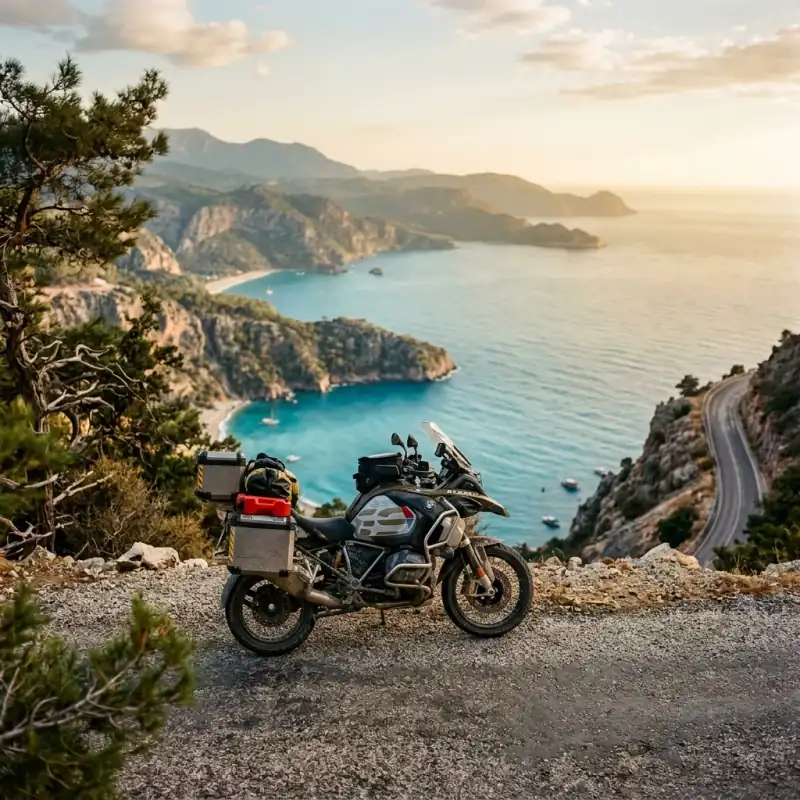
If a Turkey trip can only do one stretch of road, this is the one. The D-400 from Fethiye east to Antalya runs about 300 km along the cliffs and bays of the ancient Lycian region, and the 27 km between Kalkan and Kaş is widely rated the best stretch of coastal motorcycle road in the country.
The coast does almost everything well. The pavement is consistently good. The corners are a mix of medium-speed sweepers and tight headland switchbacks, with turquoise bays below the road and Lycian rock tombs and ruins along the way. The villages — Kalkan, Kaş, Üçağız, Çıralı — are working fishing ports that turn into modest evening crowds rather than resort strips.
The detailed seven-day stage plan is in the Lycian Way motorcycle route guide, which walks Fethiye to Antalya day by day with the road notes, the boat trip to Kekova, the Elmalı plateau detour and the campgrounds at Çıralı and Olympos.
The other thing the Mediterranean does better than anywhere else in Turkey is the bays themselves. The most-photographed coves on the Turkish coast are concentrated between Fethiye and Antalya — Kabak, Butterfly Valley, Patara, Kaputaş, Çıralı/Olympos. The ranked, ride-to-them list is in the most beautiful bays in Turkey you can reach by motorcycle, including the rougher approaches and the summer fire-season rules.
This is the region most casual visitors do, and it earns the attention.
Cappadocia and Central Anatolia
Inland from the southern coasts, the country opens out into the high plateau of central Anatolia — and at its heart, the volcanic moonscape of Cappadocia. This is the regional contrast that most distinguishes a Turkey trip from a Greek or Croatian one: a one-day ride from beach country takes the rider up to a plateau around 1,000 metres high, cave-cut churches, and the surreal eroded valleys around Göreme and Ürgüp.
The motorcycle case for Cappadocia is two-part. First, the riding itself in the volcanic valleys — a network of secondary roads connecting the rock-cut villages, with viewpoints over the Love Valley and Pigeon Valley that earn the detour. Second, Cappadocia works as the natural inland turn of a longer Turkey trip: an Aegean or Mediterranean coast ride that then climbs inland to Cappadocia for two or three days before returning by a different route gives the trip its regional contrast.
The route notes, the road loop between the main villages, why off-road riding in the protected valleys is illegal (and the licensed ATV alternative), and the practicalities of staying in a cave hotel with a bike are in the Cappadocia motorcycle route guide for 2026.
Beyond Cappadocia, central Anatolia thins out fast. Long, straight D-roads through agricultural plateaus connect Konya, Kayseri, and the routes east. The riding is functional rather than thrilling — most riders treat central Anatolia as a transit zone between the coastal west and the genuinely wild east.
Eastern Anatolia
This is the part of Turkey that most riders never reach, and the one that rewards the effort most heavily.
Eastern Anatolia begins around Erzurum and extends to the Iranian, Armenian, and Iraqi borders. The landscape is high steppe, lake-dotted volcanic plateaus, and the snowcapped massifs of Ararat and Süphan. The road density drops sharply. Distances between fuel stations stretch to 80-150 kilometers. The riding is on long, well-paved D-roads — the basic infrastructure is good — but the absolute remoteness is the defining feature. Recovery distances if something goes wrong are real.
The classic eastern triangle connects three sites: Mount Nemrut (the 2,150-meter summit with the famous toppled stone heads), Lake Van (the country’s largest lake, with an island monastery and a ride around the southern shore), and Doğubayazıt (the town at the foot of Mount Ararat and the staging point for the Iranian border). The full stage-by-stage routing, the fuel logistics, the accommodation thinness, and the side trips that justify the long approach are covered in the eastern Anatolia motorcycle route through Nemrut, Van and Doğubayazıt guide.
The region is summer-only. Snow closes the higher passes from late October through May. The riding window is realistically June through early October, with the safest weather in July-August despite the western heat — at 1,800-2,000 meters of base altitude, the eastern summer is hot but dry and the storms are afternoon-only.
Two practical notes the casual planner often misses. First, the southeast (Şanlıurfa, Diyarbakır, the area approaching the Syrian border) carries its own travel-advisory considerations and is worth checking national-government guidance on before routing through it. Second, the East is where solo travel logistics — fuel, accommodation, language, mechanical help — become genuinely demanding. It pays to read the solo motorcycle camping safety in remote areas guide before committing to a multi-day eastern stage.
The Black Sea Coast and the Kaçkar Mountains
The northern half of Turkey is the country’s hidden surprise. The Black Sea coast looks nothing like the south — green, wet, forested, with steep hills running down to a dark sea — and behind it rise the Kaçkar Mountains, a 3,900-meter range of glacier-carved valleys and high alpine pastures (yaylas) that ride more like the Alps than anything Mediterranean.
There are two distinct routes here, and they connect naturally into a single loop.
The coastal route runs east along the D010 through Amasra, Sinop, Trabzon and Rize to the Georgian border. The Amasra–Sinop section in particular is a slow, winding coastal road through villages that don’t see many international riders. The road climbs and descends repeatedly between cove towns. The deep-dive on this stretch is in the Black Sea Kaçkar motorcycle route from Amasra to Yusufeli guide.
The mountain loop turns south from the coast (typically from Rize, Hopa, or Trabzon) and climbs into the Kaçkar interior. This is the most spectacular sustained riding in Turkey — high passes like Ovit (2,640 m, now tunnelled underneath), ribbon-narrow asphalt switchbacks, mountain villages perched at the head of glacial valleys, and the famous yayla high pastures used for summer grazing. The mountain riding window is shorter (mid-June to mid-September) but the reward is the most alpine-feeling stretch of road in the country.
Riders continuing east overland into the Caucasus pick up the Black Sea to Georgia motorcycle route guide for the final stretch to the Sarp border crossing and the Batumi onward connection.
The Black Sea coast is wet year-round — the wettest region of Turkey by a wide margin. Pack for it. The best adventure motorcycle jackets guide covers the laminated-vs-liner waterproofing decision that matters most here.
The Turkey TET — The Off-Road Route Across the Country
The Trans Euro Trail’s Türkiye route is a free, volunteer-mapped GPX track of mostly unpaved roads, maintained by linesman Fatih Kara with a team of lengthsmen. It does not follow the Aegean or Lycian coasts. According to the route overview on transeurotrail.org, it runs in five sections:
- Greek and Bulgarian borders to Istanbul. Two entries that merge before the city: flat farm tracks and beaches from the Greek border, fast forest trails and the İğneada longoz forest from the Bulgarian one. The last stretch into Istanbul is deliberately on asphalt.
- Istanbul to Kastamonu. Out of the city by a short ferry, then hills between roughly 500 and 1,500 m, lakes and forest past Abant, Mudurnu and Safranbolu, to the old forests of Kastamonu.
- Kastamonu to Georgia. From around Ordu the route climbs above 1,500 m for long stretches and at times over 3,000 m, above the tree line, through the Black Sea mountains’ heavy rain, and includes the D915. The linesman advises against many of these roads before the end of June because of snow, and warm clothes even in August.
- Istanbul to Salda Lake (Denizli), added in 2022: north to south over green ranges and through villages, past the ancient Cilandıras bridge and Ulubey Canyon to Pamukkale and Salda.
- Salda Lake to Cappadocia, also added in 2022: into the Taurus, at times above 2,500 m, on dusty, rocky roads past the Aladağlar, including a tough cliff-edge descent the linesman calls the “Rolling Stone” road and says not to attempt alone or without confidence.
Two practical points carry across the whole route. Mobile coverage is intermittent in the mountains, so fuel, food and camping need planning; and village tea houses, usually beside the mosque, are where to ask for help. TET routes change: download the GPX from transeurotrail.org just before you travel, and check it as you go.
This is not a first off-road trip. It wants an adventure bike on proper off-road tyres, the skill to pick a loaded bike up alone, and the self-sufficiency for remote multi-day stages. Riders new to the trail should start with the Trans Euro Trail beginners guide, which also covers loaded-bike technique, and the Black Sea & Kaçkar route shows the same northern mountains on paved roads.
Wild Camping in Turkey
One of Turkey’s underrated draws is how tolerant it is of motorcycle wild camping. Outside national parks and active archaeological sites, pitching a tent on undeveloped coast, forest tracks, or upland yayla is widely accepted as long as the standard leave-no-trace rules are followed and summer fire bans are respected.
The full picture — which regions tolerate it, where the fire bans bite hardest, which national parks have campgrounds you should use instead, and the practical etiquette around camping near villages or pastures — is in the wild camping in Turkey on a motorcycle guide.
For the broader European context and how Turkey’s permissive approach compares with the legal regimes of the EU, the European wild camping legal guide for 2026 is the reference. The shelter-and-sleep system that makes any of this comfortable is covered in the motorcycle camping gear checklist and the adventure motorcycle camping and touring complete guide.
When to Ride
The riding window varies by region, and getting it right is the single most underrated decision in planning a Turkey trip.
Late April to mid-June and mid-September to October are the universal best windows. The southern coasts are warm but not brutal, the eastern passes are open, the water is swimmable, and the high-season coastal traffic and prices haven’t arrived (or have already left).
July and August are too hot for the southern coasts (35-40°C inland is normal) and turn the Mediterranean tourist towns into traffic-choked car parks. They are, paradoxically, the most reliable window for the eastern mountains — the Kaçkar and Ararat region — where the elevation cools the summer and the snow has fully cleared the passes.
Winter restricts the country sharply. The Mediterranean coastal D-400 stays open and rideable year-round in mild years, but everything inland, every mountain pass, and the entire eastern half is effectively closed November through April.
A two-region trip is usually best planned around the shoulder seasons: ride the coasts in late April-May or October, the mountains in June-July or September, and let the season pick the routing rather than the other way around.
Documentation, Insurance, and the Border
Entering Turkey on a motorcycle requires a small but inflexible set of documents. Get this right before leaving home — the bike must leave with the rider, and overstaying the temporary vehicle import results in significant fines on exit.
The required documents are:
- Passport valid at least six months from entry
- Motorcycle registration in the rider’s name (or a notarized authorization letter if the bike is registered to someone else, ideally translated)
- Green Card insurance explicitly listing Turkey as covered (standard European Green Cards often exclude Turkey — confirm with the insurer)
- International Driving Permit where your licence needs one (UK licence holders, for example, need a 1968 IDP for Türkiye)
The bike is logged against the rider’s passport on entry under a temporary import scheme. Stay within the permitted period (typically six months in a calendar year for the bike) and exit with it — the customs system tracks both.
The full breakdown of crossing into Turkey from each neighboring country, the standard fees, the typical waiting times, and the documentation traps to avoid is covered in the Europe motorcycle border crossing documentation guide. Türkiye is outside the EU’s Multilateral Agreement, so a European-registered bike needs a Green Card that lists it; what else to check in your bike and travel policies is in the insurance section of the border-documents guide.
Riders connecting Turkey to a wider European trip should also read the long-distance trip planning checklist guide for the routing, accommodation, and pacing decisions that matter most over multi-week trips.
Fuel, Roads, and Practicalities
Fuel. Stations are dense on every D-road and most secondary roads. Brands include OPET, BP, Shell, Total, and the national Petrol Ofisi. Prices are below most of western Europe and move with the lira and the oil market, so check a current per-litre price before the trip. Range anxiety is rarely an issue outside Eastern Anatolia.
Road quality. D-roads are consistently well-paved. Secondary roads vary from good to broken depending on region — the southern coasts are well-maintained, eastern secondary roads are rougher, and Black Sea minor roads can be wet and mossy. Mountain passes are generally well-graded but can have unmarked surface hazards (loose gravel, fallen rocks) after rain.
Driving culture. Urban driving is fast and loose. Highway lane discipline is approximate. Truck behavior on mountain roads requires defensive overtaking — make passes on straights, not in switchbacks. Police presence is moderate and predictable; the speed cameras on major D-roads are well-marked and respected.
Food. Eating well in Turkey is so easy it borders on automatic. Roadside lokantas (worker’s restaurants) serve a hot daily-changing menu for the price of a fuel stop. Village bakeries supply fresh bread morning and afternoon. The cooking on a motorcycle trip guide covers the camp-cooking side for wild-camp evenings.
Accommodation. Range is enormous and prices vary by region and season. Hotels and pensions in the under-€40 range are widely available outside high summer. Cappadocia cave hotels and Lycian coast resort towns push prices significantly higher in season. Budget riders combining hotels with two or three wild-camp nights per week can keep daily accommodation costs to a fraction of the European norm.
Sample Itineraries
One week — the Mediterranean coast (Fethiye to Antalya). The signature short trip. Land in Antalya, fly the bike or rent locally, ride west to Fethiye, then back east along the Lycian Way over six riding days plus an Antalya rest day. Covered in detail in the Lycian Way motorcycle route guide.
Two weeks — coast plus Cappadocia. Add a five-day inland loop from Antalya north to Cappadocia via Konya, three nights in Göreme, and a return via a different route. Combines the country’s signature coastal road with its signature inland landscape.
Two weeks — both coasts. Aegean (Izmir to Marmaris) over six days, then about 130 km by road from Marmaris to Fethiye, then the Lycian coast over six days. Sleeper option that gives a fuller picture of the south without inland time.
Three weeks — coast to east. Lycian coast week, Cappadocia mid-trip, then push east via Malatya to Mount Nemrut, Lake Van, and Doğubayazıt before returning by a northern route through Erzurum. Aggressive but doable in 21 days.
Three weeks — full national loop. Aegean coast, Mediterranean coast, Cappadocia, eastern triangle, Black Sea and Kaçkar return. Five-to-six-week version of this is more realistic if the goal is to ride rather than transit; three weeks is a sprint through the highlights only.
Choosing the Bike for Turkey
A Turkey trip is more bike-flexible than the photos suggest. The coastal D-roads and inland D-routes are paved highway. The vast majority of the country is reachable on any roadworthy motorcycle — a 250cc dual-sport, a sport-tourer, a 1300cc adventure machine all do the basic backbone fine.
What changes with bike choice is access to the marginal: the offroad descents to the remote Aegean bays, the Kaçkar mountain tracks, the Turkey TET, and the rough secondary roads in the east. A capable adventure bike with proper off-road tyres opens those up. A heavier touring machine doesn’t.
The general principle from the adventure motorcycle camping and touring complete guide applies cleanly to Turkey: weight matters more than power. A lighter bike the rider can pick up alone after a low-speed drop is worth more on Turkish offroad than thirty extra horsepower that rarely get used. The best motorcycles for long-distance touring in 2026, best adventure bikes for short riders, and best motorcycles for beginners guides each cover the trade-offs that matter for matching a bike to the kind of Turkey trip planned.
The mid-weight comparisons — Ténéré 700 vs Africa Twin, KTM 890 Adventure R vs Ténéré 700, and the three-way Transalp vs V-Strom 800DE vs Ténéré 700 — frame the realistic shortlist for a serious Turkey-and-beyond trip.
What This Guide Doesn’t Cover (Yet)
A few obvious omissions worth flagging for anyone using this as a planning anchor. Western Anatolia between the coasts (Bursa, Eskişehir, the inland routes connecting Istanbul to Izmir or Antalya) gets short attention here because it’s primarily a transit region — pleasant but unremarkable D-roads connecting more interesting destinations. The southeast beyond the Nemrut-Van-Doğubayazıt triangle is covered cautiously for travel-advisory reasons; routes through Diyarbakır, Mardin, and the border country with Syria carry their own considerations that go beyond a general motorcycle guide. And Istanbul itself isn’t a motorcycle destination so much as the cultural arrival and departure point — most riders treat it as the bookend of a Turkey trip rather than a riding stage.
The country still has more riding worth writing about than fits in any single guide. This pillar is the regional map; the route-specific deep dives linked throughout cover the actual stages, road notes, and on-the-ground specifics.
Where to Start
For a first Turkey trip, the answer is almost always the same: fly to Antalya, ride west to Fethiye, then back east along the Lycian Way over seven days. It’s the country’s signature stretch, the logistics are simple, the riding is excellent, the accommodation range covers any budget, and the trip can be extended in three different directions (north to Cappadocia, west along the Aegean, or east toward the eastern triangle) without restarting the planning from scratch.
For a returning rider, the answer is almost always the same too: go east, or go north to the Kaçkar. The Mediterranean coast is the door; the Black Sea, the Kaçkar Mountains, and the eastern Anatolian plateaus are the country’s serious adventure-motorcycle terrain, and they reward the second trip far more than they reward the first.
Either way, the country gives back what the rider puts into the planning. Turkey is not a place to wing a route on the way in. It is, by a clear margin, the most rewarding country in Europe for the rider who does the homework first.
Frequently Asked Questions
Where should I start a Turkey motorcycle trip?
Most riders coming overland enter from Bulgaria or Greece and start at Istanbul or Çanakkale. Flying in and renting locally, the natural anchors are Istanbul (the cultural arrival and best rental selection), Izmir (for the Aegean coast), Antalya (for the Mediterranean and Lycian Way), or Trabzon (for the Black Sea and the Kaçkar Mountains). The country is genuinely too large for one trip from a single base — pick a coast or a region and go deep rather than trying to ride a national loop in two weeks.
How many days do I need to see Turkey by motorcycle?
One week covers a single coastal stretch — for example Fethiye to Antalya on the Lycian Way, or Izmir down the Aegean. Two weeks lets you connect two coasts (Aegean and Mediterranean) or one coast plus Cappadocia. Three weeks is the realistic minimum for a coast-to-coast or coast-to-east trip taking in the Black Sea, the Kaçkar Mountains, and Eastern Anatolia. A full national tour with the deep east, the Black Sea, and both southern coasts is a five-to-six-week commitment.
Is Turkey safe to ride alone on a motorcycle?
Yes, with normal travel sense. The road infrastructure is good across the west and south, fuel is widely available, and rural Turkish hospitality toward travelers is genuinely warm. The realistic safety concerns are road behavior (urban driving is aggressive, lane discipline is loose) and route-specific issues — the southeast near the Syrian border has restricted areas best avoided, and remote eastern mountain roads carry real recovery distances if something goes wrong. Wild camping is widely tolerated outside national parks, archaeological sites and military zones, with one big exception: in summer, provincial fire-season orders ban entry to listed forests (in Muğla, 1 June to 31 October in 2026). The usual solo precautions, a shared route and a daily check-in, are in our camping and touring guide.
What documentation do I need to enter Turkey on a motorcycle?
A valid passport (six months remaining), motorcycle registration in the rider's name (or a notarized authorization letter if not), a Green Card insurance certificate valid for Turkey, and an International Driving Permit alongside the home license. The motorcycle is entered against the rider's passport on a temporary import basis — overstay the bike and you face significant fines on exit. Schengen and EU rules don't apply on the Turkish side, but the bike must leave with the rider. The full breakdown is in the Europe motorcycle border crossing documentation guide.
What's the best time of year to ride in Turkey?
Late April to mid-June, and mid-September through October. The coasts are warm but not brutal, mountain passes are open, the water is swimmable, and the high-season crowds are absent. July and August are too hot on both southern coasts (35-40°C inland, packed coastal traffic). The eastern mountains and the Kaçkar are only reliably open June through early October. The Black Sea coast is rideable from May to November but is wet year-round. Winter riding works on the Mediterranean coastal D-400 but eliminates everything inland.
Can I ride Turkey on a small bike or do I need an adventure bike?
Most of the country is reachable on any roadworthy motorcycle. The coastal D-roads and the inland D-routes are paved, well-maintained, and handle anything from a 250cc dual-sport to a heavy tourer. A genuine adventure bike with off-road tyres becomes useful for the Turkey TET, the offroad descents to the remote Aegean bays, and the rough mountain tracks in the east — but a small, light bike that fits the rider is more practical for most of the routes covered here than a heavy GS-class machine.