
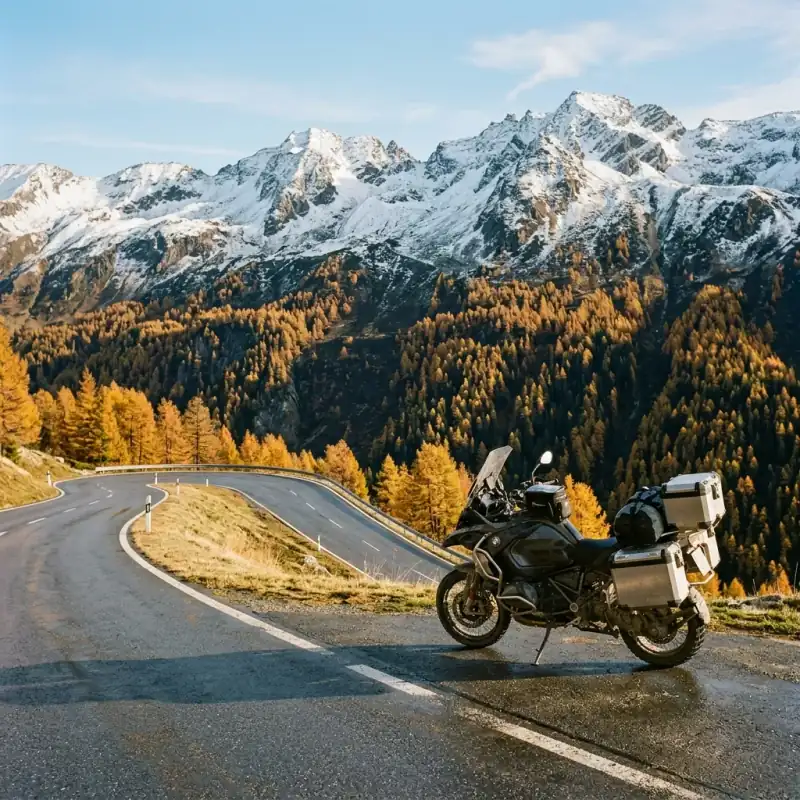
Ask anyone who rides Europe seriously which month they’d keep if they could only have one, and a surprising number say September. The tour buses have gone home, the passes are empty, the light goes long and golden in the afternoons, and the campsites have space. Autumn is the best riding of the European year.
It is also the season that most reliably ruins a trip, because it ends without warning. Not on a date you can look up a year ahead — on a morning when a roads department looks at the forecast and closes a pass with a few hours’ notice.
This guide is the closing calendar. Where the seasons actually end, with the road authorities’ own announcements rather than folklore; where the riding is still good after they do; and the one variable that decides more than temperature and gets ignored anyway.
The Part Nobody Tells You: Passes Don’t Close on a Schedule
There’s a widespread assumption that Alpine passes have closing dates the way ski lifts have opening dates. Most don’t. A public mountain road closes when the responsible authority decides conditions warrant it, and that decision can arrive with less than a day of notice.
Here’s what that looks like in practice, from the canton’s own announcement:
On Monday 27 October 2025 at 08:00, the Uri roads department closed the Furka and Susten passes for the winter — a decision taken in consultation with the cantons of Valais and Bern. The Oberalp and Klausen passes were shut the same day after snowfall.
Four passes, one morning, on a decision made in the preceding days. If your route sheet had you crossing the Furka on the 28th, your route sheet was wrong by then, and nothing you could have booked in advance would have told you.
The practical rule that falls out of this: from the second week of October, check the road authority’s own status page the morning you intend to ride a high pass. For the Swiss central Alps that’s the cantonal roads info service; for Austria and Italy it’s the operator or the provincial roads administration. Not a route-planning app, which will happily plot you over a closed pass, and not a forum post from last year.
The exception: toll roads publish a season
Roads run by a commercial operator behave differently, because they’re selling tickets and need a calendar. Two that matter to anyone riding the Eastern Alps:
Grossglockner High Alpine Road (Austria) — the operator announces a season and publishes hours for it. The most recent full season we can quote precisely is 2025, and it’s a good model for what to expect: the road stayed open until Sunday 2 November, running 06:00–19:30 with last entry at 18:45 until 26 October, then dropping to 08:00–17:00 with last entry at 16:15 from 27 October to the close. There’s an official night-driving ban outside operating hours. Currently published tolls: a motorcycle day ticket at €36.50 (€30 after 18:00) against €46.50 for a car, a three-week motorcycle ticket at €73 and a season ticket at €130.
Note what that final week actually means for a rider: a nine-hour window, last entry at quarter past four, on a road at over 2,000 m in the first days of November. Check the operator’s page for the current year’s closing date before you plan around it — that date moves, and it’s the operator’s to announce.
Timmelsjoch / Passo del Rombo (Austria–Italy) — open 07:00 to 20:00, motorcycle €18 one way, €25 return, €85 for the season. The operator doesn’t publish season dates on its rates or main pages, so treat the opening window as weather-dependent like any other high pass.
Both operators revise prices annually, so treat these as the shape of the thing rather than a quote.
And one autumn hazard that closes a road only to us
Of everything we read for this piece, this is the line that stopped us. The Grossglockner operator warns that in the early hours of the morning there may be short-term closures specifically for motorcyclists, because meltwater freezes on the road surface.
Think about what that describes. Not a snowstorm — a clear, calm October morning, a road that was merely wet yesterday afternoon, and a film of ice sitting in the shadowed hairpins at 2,000 m until the sun gets round to them. A car crosses it and feels a twitch. We don’t get a twitch.
That’s the real character of autumn in the mountains, and it’s why the sensible high-Alpine plan in October is a late start and an early finish, not a dawn raid.
The Variable That Actually Ends Your Season
Riders plan autumn trips around temperature. Temperature is the wrong number. Daylight is what shortens your days, compresses your route and pushes you into riding cold, wet roads in the dark.
We calculated the daylight hours for four points on the European riding map, using the standard solar-declination method — the same approach we used for the wind-chill table in our cold-weather riding guide. These are our figures, not a quoted source:
| Location | 1 Sep | 15 Sep | 1 Oct | 15 Oct | 1 Nov | 15 Nov |
|---|---|---|---|---|---|---|
| Alps (Innsbruck, 47.3°N) | 13h 08m | 12h 19m | 11h 23m | 10h 36m | 9h 42m | 9h 03m |
| Turkish Med (Antalya, 36.9°N) | 12h 47m | 12h 13m | 11h 35m | 11h 02m | 10h 25m | 9h 59m |
| Norway (Bergen, 60.4°N) | 13h 50m | 12h 31m | 11h 00m | 9h 42m | 8h 09m | 6h 59m |
| Iceland (Reykjavík, 64.1°N) | 14h 10m | 12h 37m | 10h 50m | 9h 17m | 7h 24m | 5h 54m |
Look again at the Norway row. Between 1 September and 1 November it loses more than five and a half hours of daylight. Most of a working day’s worth of riding light, gone, on a route where the distances are long and the ferries are timed. That is what ends the northern season, well before the temperature does.
The southern row is the mirror image: Antalya gives up barely two and a half hours over the same period and still has ten and a half hours of light on 1 November. Riding south in autumn isn’t only about chasing warmth. It’s about buying back the hours you need to actually cover ground.
What the Mediterranean Really Does in October
The southern coasts have a reputation as a reliable autumn bolt-hole, and the temperature data supports it. The rain data adds a condition that most “where to ride in autumn” lists leave out.
These are the official climate normals for Antalya from the Turkish State Meteorological Service:
| Mean temp | Mean daily max | Rainy days | Monthly rainfall | |
|---|---|---|---|---|
| September | 25.3°C | 31.2°C | 1.71 | 16.7 mm |
| October | 20.6°C | 26.6°C | 5.38 | 70.6 mm |
| November | 15.6°C | 21.4°C | 7.48 | 127.7 mm |
October on the Turkish Mediterranean averages a 26.6°C daily high. That is excellent riding weather by any standard, and it’s why the coast fills with European riders in the second half of the month.
But look at what happens underneath the temperature. Rainy days go from under two a month to more than five. Rainfall goes from 16.7 mm to 70.6 mm — more than four times as much water — and by November it’s nearly eight times September’s figure while the daily high has dropped ten degrees.
So the honest summary of the Mediterranean autumn is: the temperature holds long after the weather stops being dry. A September trip down the Turkish Aegean coast is a summer trip without the crowds. The same route in late October is a warm trip that will rain on you, on roads that get slippery in the first rain after a dry summer — the mechanism we cover in the wet-riding guide. Bring the rain gear, plan an indoor night or two, and it’s still one of the best months of the year to be there.
The same logic applies across the Med. Greece’s Peloponnese, the Albanian Riviera and Croatia’s Dalmatian coast all run the same pattern: still warm, increasingly wet, and increasingly empty in the good way.
An Autumn Calendar That Actually Works
Early-to-mid September: take the mountains while you can
The sweet spot, and it’s short. The passes are open, the summer traffic has collapsed, campsites are quiet, and you still have twelve-plus hours of daylight in the Alps.
Where to spend it, and why this month specifically:
- Stelvio and the Dolomites — the pass summits in August are a car park; in September you get the hairpins with room to use them. Base in Bormio, ride early, and accept that the first snow can arrive any week from here.
- Romania’s Transfăgărășan and Transalpina — the Transfăgărășan has a formal seasonal opening and the summer coach traffic is heavy, so early September is the widest gap between “open” and “busy” you’ll get all year.
- The Pyrenees — lower and further south than the Alps, so it holds its season a couple of weeks longer, and the Spanish side stays warm into October. If you only get one late trip, this is the mountain range that gives you the most margin.
- Norway’s fjord routes — September is already the back end of it. The riding is spectacular and the colour is extraordinary, but you’re losing around eighty minutes of daylight a fortnight up there, and the high passes start closing behind you.
One booking-day warning for the Stelvio specifically: it closes to motor traffic for cycling events, and the 2026 dates already published include 29 August (from the Bormio, Trafoi and Santa Maria Val Müstair approaches) and 19 September from the Bormio Bagni Vecchi side, 09:00 to 13:00. Riding four hours to a road that’s shut for a bike race is a memorable way to lose a morning.
Late September to mid-October: the coasts take over
The mountains become a gamble and the Adriatic becomes the answer. This is peak season for the Mediterranean coastal routes, for Sardinia and Corsica, and for the Balkan run down through Croatia and Albania.
Sea-level Turkey and Greece are at their best here: warm, quiet, and with the water still swimmable. If wild camping by the sea is the point of the trip, this is the window — our bays guides exist for exactly these weeks.
The specific case for the Adriatic in these three weeks: the coast road traffic drops off a cliff after the Italian and German holidays end, the ferries are still running something close to a summer timetable, and the sea is warmer in late September than it was in June. It’s the same route you’d have ridden in August with a third of the traffic and none of the queue for a campsite pitch.
Late October: the mountains shut behind you
This is when the Furka closes. Assume the high Alpine passes are gone or going, and that anything above about 2,000 m is weather-dependent day by day. The Grossglockner usually runs into the first days of November — it did in 2025 — but on short hours and with the morning-ice caveat.
Meanwhile the far south is still fully open. The Lycian coast in late October is one of the great underrated rides in Europe, and Cappadocia is in its best light of the year, though the nights on the plateau get properly cold.
November: south or stop
The realistic November list is short — Turkey’s Mediterranean coast, southern Spain and Portugal, Sicily, and the lower Aegean. Even there, you’re riding a warm-but-wet month with ten hours of daylight, and the campsite network is thinning out.
Everywhere else, this is when the trip becomes a winter storage job instead.
The Infrastructure Thins Out Before the Weather Does
The other thing that changes in autumn, and that route planners never model: services reduce on a timetable of their own.
The clearest documented example we found is the Norröna ferry to Iceland. Through the summer, Smyril Line sails from Hirtshals in Denmark on Saturdays and Tuesdays. From 13 September the autumn schedule cuts that to Sundays only, and the Iceland-side departures from Seyðisfjörður shift from Thursday daytime to Thursday evening. Same route, roughly half the departures, and the return leg of a two-week trip suddenly has one viable sailing a week.
Expect the same pattern in miniature everywhere: Greek island ferries drop to reduced winter timetables through late autumn, mountain campsites and refuges close for the season, and small-town fuel stations in the eastern parts of the map go back to shorter hours.
Campsites are the one that bites hardest, and it’s the opposite problem to summer. In August the site is open and full; in late October it’s empty and shut, with a chain across the entrance and a sign giving a reopening date in April. The workable habit for autumn is to check that your intended stop is still trading — a phone call or the site’s own page, not a listing aggregator, which will happily show you a campsite that closed three weeks ago — and to carry the flexibility to ride on for another hour if it hasn’t. None of it is a crisis. All of it turns “we’ll sort it out when we get there” into a bad plan, which is why our long-distance planning guide matters more in October than in July.
What Changes on the Bike
Autumn riding is not winter riding, but it borrows from it. Four things are worth doing before an October departure:
- Set tyre pressures cold, and re-check them as it gets colder. Pressure falls with ambient temperature — by our calculation, a tyre set to 2.5 bar at 20°C reads about 2.26 bar at 0°C without leaking at all. Our tyre pressure guide has the full table and the manufacturer figures.
- Assume the first rain after a dry summer is the worst rain. Months of rubber, oil and dust lift off the surface. Southern coastal roads in October are the classic case.
- Layer for a 15-degree swing in one day. An Alpine morning at 3°C and an Italian valley afternoon at 18°C is a normal October, and it’s what heated gear is genuinely for.
- Plan to be off the bike before dark. Look again at that daylight table and build the day around it rather than discovering it at 17:30 on a wet pass.
The Bottom Line
Autumn in Europe is not a shorter version of summer. It’s a season with a moving edge, and the edge moves from north to south over about eight weeks.
Take the mountains in early September while they’re still yours. Move to the Adriatic and Aegean as the passes get unreliable. By late October be somewhere south, with rain gear and a realistic idea of how few hours of light you have. And before you ride any high pass after the first week of October, spend two minutes on the road authority’s own page — because the people who close the Furka don’t announce it a season ahead. They announced the 2025 closure on the morning it happened.
A note on the costs: these are ballpark planning figures as of August 2026, not quotes. Ferry fares, campsite rates, fuel and tolls all move with the season and the operator — check current prices before you build a budget on them.
Frequently Asked Questions
When do Alpine passes close for winter?
Late October is the honest answer for the high passes, but there is no fixed date and that's the part riders get wrong. The closures are decided by road authorities when the weather makes the call, sometimes with a day's notice. A concrete example: on 27 October 2025 at 08:00, the Uri cantonal roads department in Switzerland closed both the Furka and Susten passes for winter, a decision taken jointly with the cantons of Valais and Bern, with the Oberalp and Klausen passes shutting the same day after snowfall. Toll roads with a commercial operator are more predictable, because they publish a season and sell tickets against it — Austria's Grossglockner High Alpine Road stayed open until Sunday 2 November in 2025, and announces its closing date each year. Everything else: check the road authority's own page the morning you plan to ride it.
Is October too late for a motorcycle trip in Europe?
It's too late for the high Alps in most years and close to perfect for the southern coasts. Turkey's Mediterranean coast in October, using the Turkish State Meteorological Service's official climate normals for Antalya, averages a daily maximum of 26.6°C — genuinely good riding weather. The catch isn't temperature, it's rain: the same records show the average number of rainy days rising from 1.71 in September to 5.38 in October, and monthly rainfall going from 16.7 mm to 70.6 mm. So October in the south is warm and roughly four times wetter than September. Pack for that and the month is excellent. Pretend it's still summer and you'll have a bad week.
What's the best European route for a late-season motorcycle trip?
Work south as the season goes. Through September the Alps and the Dolomites are still open and the summer traffic has gone. From late September into October the Adriatic and the Aegean take over — Croatia's Dalmatian coast, the Albanian Riviera, the Peloponnese, Turkey's Aegean and Lycian coasts. Into November the reliable options narrow to the far south: the Turkish Mediterranean, Sicily and southern Spain and Portugal. The pattern to plan around isn't only temperature but daylight, which collapses much faster in the north — by 1 November, our calculation puts Bergen in Norway on about 8 hours 9 minutes of daylight against Antalya's 10 hours 25 minutes.
Do mountain roads close overnight even before winter?
Some do, and it catches people out. Austria's Grossglockner High Alpine Road is a toll road with published operating hours and an official night-driving ban outside them — in 2025 the road ran 06:00 to 19:30 with last entry at 18:45 until 26 October, then 08:00 to 17:00 with last entry at 16:15 for the final week to its 2 November close. The Timmelsjoch High Alpine Road between Austria and Italy is open 07:00 to 20:00. If you're planning to be over a high pass at dusk in October, check that the road you've picked is actually open at that hour before you commit to it.
Can a pass be open but still closed to motorcycles?
Temporarily, yes, and autumn is when it happens. The Grossglockner operator warns that in the early hours of the morning there may be short-term closures for motorcyclists specifically, because meltwater freezes on the road surface. It is a sensible restriction and a good illustration of the wider autumn problem in the mountains: the hazard isn't snow, it's the ice that forms overnight on a wet road at altitude and sits in the shade until mid-morning. Separately, roads can close to all motor traffic for events — the Stelvio has scheduled cycling-event closures in 2026 on 29 August and again on 19 September from the Bormio side between 09:00 and 13:00.