
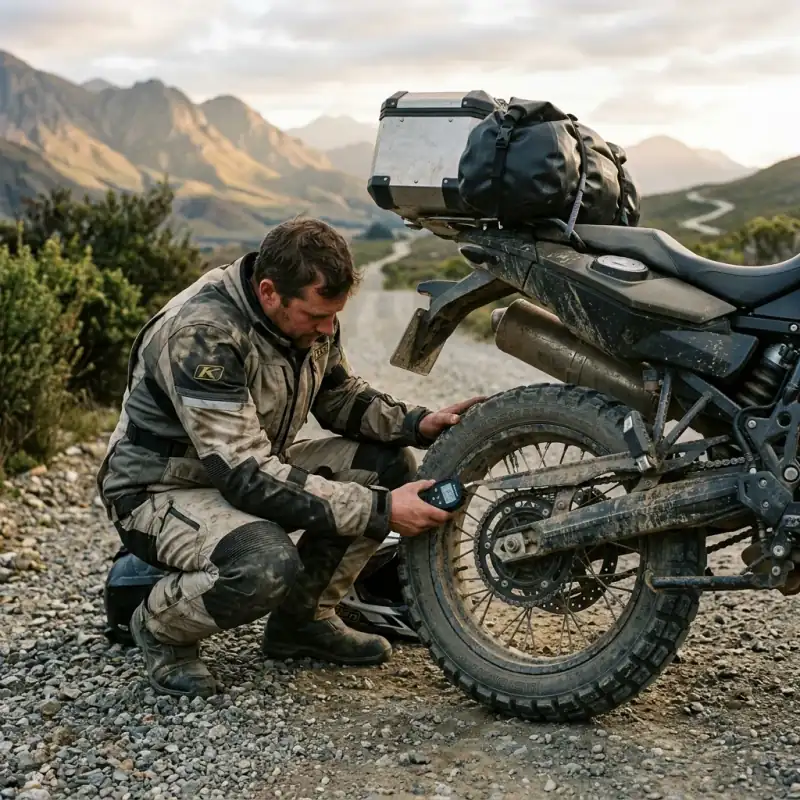
There’s a sentence that appears in almost every article about adventure bike tyre pressure: run about 32 front and 36 rear on the road, and drop two to four psi for dirt.
We went and read nine owner’s manuals to check it. It isn’t wrong exactly, but it turns out to be an average of manufacturers who don’t agree with each other — and on the off-road half, most of them decline to give a number at all.
What follows is every published cold tyre pressure we could pull from a manufacturer document for the adventure bikes people actually ride, plus three things the manuals say that almost nobody repeats: what a passenger really changes, why the pressure on your dashboard doesn’t match the pressure at the petrol station, and what a knobbly tyre does to your legal top speed.
The Chart: Published Cold Tyre Pressures, Nine Adventure Bikes
Every figure below came from a manufacturer’s own owner’s manual, handbook or official specification sheet. Where a maker doesn’t publish a value, the cell says so rather than being filled from somewhere else.
Manufacturer Cold Tyre Pressures — Side by Side
| Motorcycle | Solo, front / rear | With passenger | Off-road (published) | Source |
|---|---|---|---|---|
| Most detailKTM 890 Adventure R | 2.4 / 2.4 bar (35 / 35 psi) | Same — plus a separate full payload figure of 2.6 / 2.9 bar (38 / 42 psi) | 1.8 / 1.8 bar (26 / 26 psi) | KTM owner's manual, 2024 |
| Yamaha Ténéré 700 | 220 / 250 kPa (32 / 36 psi) | Same figures | 200 / 200 kPa (29 / 29 psi) | Yamaha manual |
| Honda CRF1100L Africa Twin | 225 / 250 kPa (33 / 36 psi) | 225 / 280 kPa (33 / 41 psi) | No figure — "change a little at a time" | Honda owner's manual (UK) |
| Honda XL750 Transalp | 225 / 250 kPa (33 / 36 psi) | 225 / 280 kPa (33 / 41 psi) | Not published | Honda owner's manual |
| Suzuki V-Strom 800DE | 225 / 250 kPa (33 / 36 psi) | 225 / 280 kPa (33 / 41 psi) | Not published | Suzuki owner's manual |
| Suzuki V-Strom 800 | 225 / 250 kPa (33 / 36 psi) | 250 / 290 kPa (36 / 42 psi) | Not published | Suzuki owner's manual |
| Highest rearBMW R 1300 GS | 2.5 / 2.9 bar (36 / 42 psi) | Same — one figure for all loads | No figure, warning only | BMW rider's manual |
| Triumph Tiger 900 GT / GT Pro | 2.5 / 2.9 bar (36 / 42 psi) | Same — one figure for all loads | No figure, warning only | Triumph owner's handbook, 2024 |
| Triumph Tiger 900 Rally Pro | 2.3 / 2.9 bar (34 / 42 psi) | Same | No figure, warning only | Triumph owner's handbook, 2024 |
| SimplestRoyal Enfield Himalayan 450 | 32 / 32 psi | Listed as "solo & with pillion" — same | Not published | Royal Enfield specification sheet |
A few things jump out of that table once you sit with it.
The front tyre barely moves across the whole industry — everything lands between 220 kPa and 2.5 bar, which is 32 to 36 psi. The rear is where manufacturers disagree, spanning 32 psi on the Himalayan to 42 psi on the BMW and the Tiger.
The two Tiger 900 variants differ from each other. The GT and GT Pro get 2.5 bar front; the Rally Pro, on its 21-inch front wheel, gets 2.3. Same model name, different number, same handbook.
Suzuki publishes different pressures for the 800 and the 800DE, and the difference only shows up two-up: the DE goes to 225/280, the road-biased 800 to 250/290.
What a Passenger Actually Changes
This is the split we didn’t see coming, because riders talk about “two-up pressures” as though it’s a universal concept.
Honda and Suzuki raise the rear and only the rear. From 250 kPa to 280 kPa — 30 kPa, a bit over 4 psi. The front stays exactly where it was. That makes physical sense: a passenger sits behind the rider, over or behind the rear axle, and the extra mass lands almost entirely on the rear tyre.
Yamaha and Royal Enfield don’t change anything. The Ténéré 700 manual gives 220/250 kPa for road riding whether you’re alone or two-up. Royal Enfield’s spec sheet is even more explicit — its table has a single row headed “Solo & With pillion”, 32 psi front and rear.
BMW and Triumph publish one number, full stop. BMW’s R 1300 GS rider’s manual gives 2.5 bar front and 2.9 rear “tyre cold” and doesn’t offer a load variant.
KTM does something different again and, we’d argue, more useful. Its manual lists “tyre pressure solo / with passenger” at 2.4 bar front and rear — passenger included, no change — and then a completely separate “tyre pressure full payload” entry at 2.6 bar front and 2.9 bar rear. That’s KTM saying the thing that actually matters isn’t whether a second person is aboard, it’s whether the bike is loaded to its limit. Which lines up neatly with what we found writing the payload chart: the passenger is rarely the problem on their own, it’s the passenger plus the luggage.
If you’re riding two-up regularly, the practical implications go well beyond pressure — that’s what our two-up guide is for.
Cold Means Cold, and Autumn Will Move Your Numbers
Every one of these manuals specifies cold pressures, and several go out of their way to define it. Suzuki’s is the clearest: use the gauge when the tyres are cool, before riding, because tyres heat up while travelling and the air pressure rises with them. The US Tire Manufacturers Association puts a number on “cool” — after driving, tyres need at least three hours to cool — and adds an instruction that matters at the end of a hot day: “Never ‘bleed’ or reduce inflation pressure when tires are hot from driving.” The high reading you’re looking at isn’t over-inflation. Let air out to chase it and you’ll be under-inflated tomorrow morning.
That’s the easy half. The half riders underestimate is what ambient temperature does over a season.
The US Tire Manufacturers Association’s own consumer guidance states it like this: “Tire inflation pressure increases (in warm weather) or decreases (in cold weather) 1-2 pounds for every 10 degrees of temperature change.” Note that it says degrees, not degrees Fahrenheit — it’s a US document, so Fahrenheit is implied, and that unstated unit turns out to matter. Rather than repeat the rule, we calculated it from the gas law — absolute pressure varies with absolute temperature — for the pressures on the chart above.
Our calculation, from a 20°C baseline:
| Ambient temp | Set to 2.5 bar (36.3 psi) | Set to 2.9 bar (42.1 psi) | Set to 220 kPa | Set to 250 kPa |
|---|---|---|---|---|
| 35°C | 2.68 bar (38.9 psi) | 3.10 bar (45.0 psi) | 236 kPa | 268 kPa |
| 25°C | 2.56 bar (37.1 psi) | 2.97 bar (43.0 psi) | 225 kPa | 256 kPa |
| 20°C (baseline) | 2.50 bar (36.3 psi) | 2.90 bar (42.1 psi) | 220 kPa | 250 kPa |
| 15°C | 2.44 bar (35.4 psi) | 2.83 bar (41.1 psi) | 215 kPa | 244 kPa |
| 10°C | 2.38 bar (34.5 psi) | 2.77 bar (40.1 psi) | 209 kPa | 238 kPa |
| 5°C | 2.32 bar (33.7 psi) | 2.70 bar (39.2 psi) | 204 kPa | 232 kPa |
| 0°C | 2.26 bar (32.8 psi) | 2.63 bar (38.2 psi) | 198 kPa | 226 kPa |
| −5°C | 2.20 bar (31.9 psi) | 2.57 bar (37.2 psi) | 193 kPa | 220 kPa |
Two things worth taking from that.
First, it confirms the USTMA rule at its lower end: our figure is 0.97 psi per 10°F for a tyre at 2.5 bar. Close enough to “1 psi per 10°F” to use as a mental shortcut.
Second — and this is the useful bit — the widely repeated “1 psi per 10°C” version of that rule doesn’t survive the arithmetic. You can see how it happened: a rule written as “10 degrees” in a US document gets read in Celsius everywhere else. But ten Celsius degrees is eighteen Fahrenheit degrees, and our calculation gives about 1.74 psi per 10°C at 2.5 bar. If you’ve been using the Celsius version to decide whether your pressures are still fine after a cold snap, you’ve been under-correcting by roughly half.
The seasonal version: set your pressures correctly on a 20°C afternoon in September, do nothing, and by a 0°C morning in November the same tyre reads about 3.5 psi low. It hasn’t leaked. It’s just cold. This is one of the reasons we bang on about pressure in the autumn riding guide and the cold-weather guide.
Disclosure: some links below are affiliate links. If you buy through them we may earn a small commission at no extra cost to you.
Check the AstroAI digital gauge on Amazon →
A note on why we’d pick a gauge with unit switching: look back at the chart. Yamaha publishes kPa, Honda and Suzuki publish kPa with kgf/cm² alongside, KTM and BMW publish bar, Triumph publishes bar and lb/in², and Royal Enfield publishes psi. If you ride more than one bike or read manuals from more than one maker, a gauge that shows all four saves a conversion error at exactly the wrong moment.
Why Your Dashboard and the Petrol Station Disagree
If your bike has tyre pressure monitoring, you’ve probably noticed the dash and the forecourt gauge never quite match, and assumed one of them is broken.
Neither is. BMW explains it in the R 1300 GS manual: the tyre-pressure readings shown in the instrument cluster are temperature-compensated and always referenced to a tyre air temperature of 20°C, while the gauges on forecourt air lines don’t compensate for temperature at all. So the values they show usually won’t tally. BMW is telling you the two instruments are measuring different things — one is showing you what the pressure would be at 20°C, the other is showing you what it is right now at whatever temperature the tyre happens to be.
Triumph goes further and makes it an instruction, in a warning box:
Triumph, Tiger 900 owner’s handbook: the TPMS “is not to be used as a tyre pressure gauge when adjusting the tyre pressures” — and using it to set pressures “may lead to incorrect tyre pressures leading to loss of motorcycle control.”
Triumph also notes that its TPMS light illuminates when a pressure is below the recommended figure, and will not illuminate if a tyre is over-inflated. And there’s a maintenance trap in the same section: don’t use tyre sealant on a wheel with TPMS sensors, because blocking the sensor’s pressure orifice causes irreparable damage to it and isn’t covered by warranty. That’s worth knowing before you pack a bottle of gunk as your puncture plan — see our roadside puncture guide for what we’d carry instead.
So: TPMS is genuinely valuable for the thing it’s for, which is warning you about a slow puncture at 120 km/h. It is not the tool for setting pressures on a cold morning.
Which is exactly the case for adding one if your bike didn’t come with it. A retrofit system doesn’t replace the gauge in your tank bag — it does the job the gauge can’t, which is watching the tyres while you’re moving. On a loaded bike a long way from a town, knowing about a slow leak twenty minutes before it becomes a flat is the whole value proposition.
Check FOBO Bike 2 TPMS on Amazon →
Off-Road: Most Manufacturers Won’t Give You a Number
Now the gap. Of the nine bikes on the chart, two publish an off-road pressure.
- Yamaha Ténéré 700: 200 kPa (29 psi) front and rear for off-road riding, against 220/250 on the road.
- KTM 890 Adventure R: 1.8 bar (26 psi) front and rear, against 2.4/2.4 on the road.
Do the arithmetic on the KTM and it’s a 0.6 bar drop, about 9 psi. That is roughly double the “drop 2 to 4 psi for dirt” advice you’ll find everywhere, including, until now, in our own off-road riding guide. KTM’s own number is far more aggressive than the internet consensus.
The rest decline, in different ways.
Honda tells you to check pressures before every off-road ride and again when you return to pavement, and says that if you decide to adjust pressure for a particular off-road condition, make changes a little at a time. No number.
BMW and Triumph publish nothing and instead warn about the consequences. BMW’s manual has a warning specifically about running lowered off-road pressures on smooth roads — risk of accident through impaired handling. Triumph’s is nearly identical: reduced off-road pressures will impair on-road stability, so always set them back for road use.
The reasonable conclusion isn’t that BMW and Triumph think you shouldn’t go off-road. It’s that lowering pressure is a rider decision with a rider’s risk attached, and manufacturers who haven’t validated a figure won’t publish one. When someone on a forum tells you the correct sand pressure for your bike to the psi, remember that in most cases the people who built the bike wouldn’t say.
If your manual gives you nothing
Leaving it there isn’t much help to someone with a GS or a Tiger who wants to ride a gravel section, so here’s what the data we do have suggests — clearly labelled as our reading of two data points, not a manufacturer figure and not a recommendation for your bike.
The only two published off-road pressures on the chart, from two makers with different chassis and different wheel sizes, land close together: 26 psi (KTM) and 29 psi (Yamaha), front and rear equal in both cases. That’s the whole evidence base. Two observations we’d draw from it:
- Both makers equalise front and rear off-road, rather than keeping the rear higher as they do on tarmac.
- Both drops are larger than the folk rule — 9 psi and 3–7 psi respectively, against the “2 to 4 psi” everyone repeats.
Guardrails that matter more than the number itself: drop pressure in small steps and feel the difference rather than jumping to a target; be much more conservative on tubeless wheels, where too little pressure can unseat the bead; understand that low pressure plus a hard-edged rock is how you pinch a tube; and put it back up before you rejoin the tarmac, which is the one thing both BMW and Triumph bothered to warn about in print. If your bike is heavily loaded, be more conservative again — the tyre is carrying more and running hotter, which is the reason KTM’s full-payload road pressure is higher, not lower.
And whatever you drop to, the pump matters as much as the gauge — going back up to road pressure at the end of a trail section is not optional, and doing it by hand with a bicycle pump on a hot afternoon is a special kind of misery.
Check the AstroAI 12V inflator on Amazon →
Pressure Is Part of Your Weight Limit
One line in the Suzuki manual reframes this whole topic, and we’ve quoted it before in a different context:
Suzuki, V-Strom 800DE owner’s manual: G.V.W.R. 430 kg (948 lbs) — “at the tire pressure (cold)” front 225 kPa, rear 280 kPa.
The load rating is stated at a pressure. Suzuki isn’t publishing two independent facts; it’s publishing one fact with a condition attached. Ride the bike loaded to near its gross weight on soft tyres and you are outside the terms of the rating, whatever the scales say.
That’s the link between this guide and the payload chart, and it’s the reason the two numbers belong in the same pre-trip check. It also explains why KTM bothers with a separate full-payload pressure: at 2.6/2.9 bar, the loaded 890 is running noticeably harder than the solo one, because the tyre needs the pressure to carry the weight without overheating.
The third leg of that stool is the suspension, which has its own load settings in the same manuals — covered in our suspension setup guide for a loaded bike.
Two Limits Hiding in the Tyre Section
While reading the manuals we found two things worth surfacing that have nothing to do with pressure.
Suzuki publishes a minimum tread depth of 1.6 mm front and 2.0 mm rear. That’s the manufacturer’s own wear limit, not a legal one. Legal minimums vary by country — in the UK the limit for motorcycles over 50cc is 1 mm across three-quarters of the tread width, while several European countries use 1.6 mm — so check your own jurisdiction rather than assuming. The manufacturer’s figure and the legal figure are not the same thing and the stricter one is the one to use.
Triumph attaches a speed limit to knobbly tyres. From the Tiger 900 Rally Pro handbook: with mud and snow / dual-purpose tyres fitted, the permissible maximum speed is 100 km/h (60 mph), and a warning sticker goes on the motorcycle where the rider can see it. If you’ve fitted aggressive rubber for a Trans Euro Trail trip, the motorway transit to get there has a manufacturer-imposed ceiling you probably didn’t know about.
How to Get This Right on Your Own Bike
- Find your figures in two places. The manual’s tyre section, and the label on the bike — usually on the swingarm, under the seat or on the headstock. They should agree. If your bike has been imported or re-registered, trust the manual for your market.
- Check cold. Before riding, or at least three hours after. Not after a fuel stop at the end of a 200 km day.
- Check with a gauge you trust, not the dash. And ideally the same gauge every time — two gauges disagreeing by 2 psi is completely normal, and consistency matters more than absolute perfection.
- Re-check when the season turns. Our table above is the reason: a 20-degree drop in ambient temperature is worth about 3.5 psi.
- Look up whether your maker publishes a loaded or off-road figure. If it does, use it. If it doesn’t, that absence is information too.
- Reset after the dirt. Both BMW and Triumph warn about this in print, and it’s the single most likely way for a good day off-road to end badly on the ride home.
The Bottom Line
The rule of thumb isn’t a lie, it’s an average — and averaging nine manufacturers who disagree produces a number that belongs to none of them.
What the manuals actually say is more interesting: that a passenger matters to Honda and Suzuki but not to Yamaha or BMW; that KTM thinks total payload matters more than passenger count and prices it at 0.6 bar; that only two of nine makers will commit to an off-road figure; and that the TPMS you paid for is explicitly not the instrument for setting pressures.
Go and read your own tyre section. It’s two pages, it’s more specific than anything a stranger can tell you, and on at least one of these bikes it contains a speed limit you didn’t know you had.
Disclosure: Some links in this article are affiliate links. If you buy gear through them, Bikes & Bays earns a small commission at no extra cost to you. We only link to gear that earns its place, and skip the button when nothing’s worth recommending.
Frequently Asked Questions
What tyre pressure should I run on an adventure motorcycle?
Whatever your own manual says, and the honest finding of this guide is that there is no single answer to copy. Across nine bikes taken straight from the manufacturers' own manuals, on-road solo figures run from 220 kPa (32 psi) front on a Ténéré 700 to 2.5 bar (36 psi) front on a BMW R 1300 GS, and rear figures from 32 psi on a Himalayan 450 to 2.9 bar (42 psi) on the BMW and the Tiger 900. That spread isn't noise — it reflects different tyre sizes, load ratings and chassis. The figure is printed in your manual and usually on a label on the swingarm or under the seat, and it is the only number with a manufacturer behind it.
Do I need to change tyre pressure when carrying a passenger?
It depends entirely on who made your motorcycle. Honda and Suzuki raise only the rear — the Africa Twin, Transalp and V-Strom 800DE manuals all go from 250 kPa (36 psi) rear solo to 280 kPa (41 psi) with a passenger, leaving the front unchanged at 225 kPa. Yamaha's Ténéré 700 manual prints the same 220/250 kPa for solo and two-up. KTM's 890 Adventure R manual lists 2.4 bar front and rear for 'solo / with passenger' together, then a separate, much higher 2.6/2.9 bar for full payload. BMW, Triumph and Royal Enfield publish a single set of pressures regardless of load. So check yours: roughly half the industry expects you to change something and half doesn't.
How much does tyre pressure drop in cold weather?
About 1 psi for every 10°F (5.6°C) drop. The US Tire Manufacturers Association's own guidance says pressure changes '1-2 pounds for every 10 degrees of temperature change' — degrees unnamed, but Fahrenheit in a US document. We ran the numbers ourselves from the gas law and got 0.97 psi per 10°F for a tyre set to 2.5 bar at 20°C, so the rule holds. What doesn't hold is the version you'll see repeated online as '1 psi per 10°C' — that's the same rule with the units swapped, and it understates the real effect by nearly half. Our calculation puts the change at about 1.74 psi per 10°C at that pressure. In practice: a tyre set correctly on a warm September afternoon is meaningfully soft on a frosty November morning, with no leak involved.
Can I use my bike's TPMS to set tyre pressures?
No, and two manufacturers say so in print. Triumph's handbook states plainly that the TPMS is not to be used as a tyre pressure gauge when adjusting pressures, and warns that doing so may lead to incorrect pressures. BMW explains why the readings differ: the pressures shown in the R 1300 GS instrument cluster are temperature-compensated and always referenced to a tyre air temperature of 20°C, while forecourt air lines don't compensate at all — so the two will usually disagree, and neither is lying. Use TPMS for what it's good at, which is telling you something is going wrong while you ride. Set pressures cold with a gauge.
How much should I drop tyre pressure for off-road riding?
Most manufacturers won't tell you, which is the single biggest gap between the manuals and the internet. Only two of the nine bikes here publish an off-road pressure at all: Yamaha's Ténéré 700 manual gives 200 kPa (29 psi) front and rear, and KTM's 890 Adventure R gives 1.8 bar (26 psi) front and rear — a drop of 0.6 bar, roughly nine psi, which is about double the '2 to 4 psi' rule of thumb the internet repeats. Honda tells you to change pressures 'a little at a time' and prints no number. BMW and Triumph publish no off-road figure at all and instead warn that riding on tarmac with reduced pressures impairs stability. If your manual has no number, you're improvising, and it's better to know that than not.