
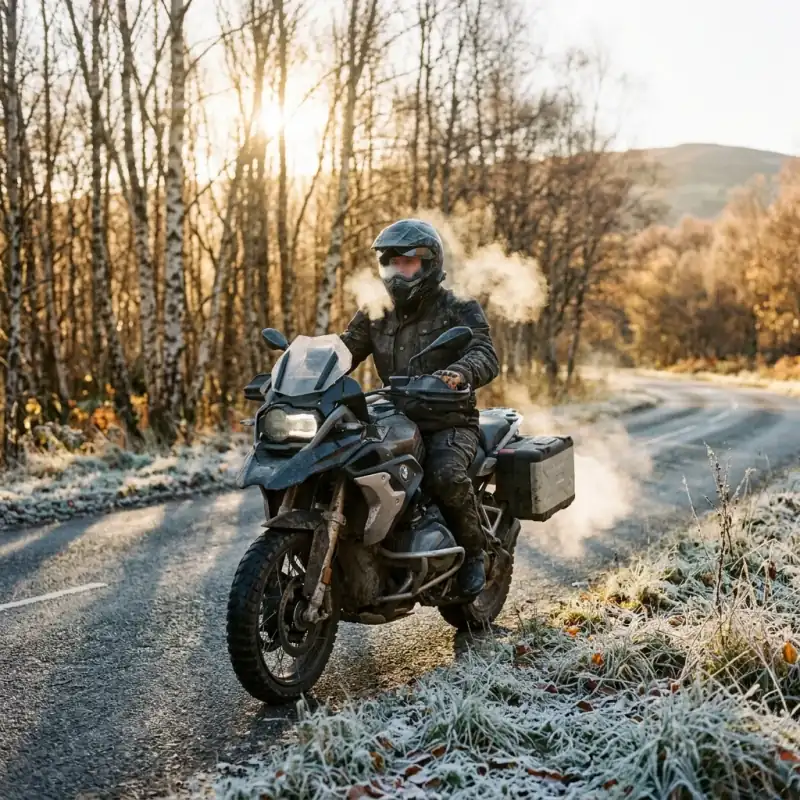
Cold is the honest opposite of heat. Where heat sneaks up on you invisibly, cold announces itself immediately — and then, having announced itself, it does something far more insidious. It takes your hands. Then it takes your judgement. And it does both while you’re still telling yourself you’re fine and there’s only another forty minutes to go.
That’s the thing worth understanding before a cold ride. The discomfort isn’t the danger. The danger is that the two things riding a motorcycle actually requires — working fingers and a clear head — are the first two things cold takes away, and the second one goes before you’re able to notice it going.
This guide covers riding well in the cold rather than surviving it: what the wind at road speed actually does to the temperature you’re experiencing, how to layer so it works, where to spend money for the biggest return, how the road itself changes, and the specific line between “cold” and “in trouble” that’s worth memorising. It’s the winter twin of our guide to riding in serious heat — and it’s about riding in the cold. If you’re planning to put the bike away instead, that’s a different job, covered in our winter storage guide and in what to look for in a winter cover.
What the Wind Actually Does
Riders talk about air temperature. Your body deals with air temperature plus the wind you’re generating, and at road speed that’s a substantial difference.
The US National Weather Service publishes the formula it uses for wind chill:
Wind chill (°F) = 35.74 + 0.6215T − 35.75(V^0.16) + 0.4275T(V^0.16)where T is air temperature in °F and V is wind speed in mph.
Applied at riding speeds, it produces numbers most riders have never actually looked at:
| Air temperature | 50 km/h | 80 km/h | 100 km/h | 120 km/h |
|---|---|---|---|---|
| +10 °C | +5.5 °C | +4.4 °C | +3.9 °C | +3.4 °C |
| +5 °C | −1.3 °C | −2.7 °C | −3.4 °C | −3.9 °C |
| 0 °C | −8.1 °C | −9.8 °C | −10.6 °C | −11.3 °C |
| −5 °C | −14.9 °C | −16.9 °C | −17.9 °C | −18.7 °C |
Calculated with the NWS formula above. Two honest limits on this table: the NWS defines wind chill only for air temperatures at or below 50°F (10°C) and wind speeds above 3 mph, which road speeds comfortably satisfy; and the formula models heat loss from exposed skin, so it describes what your face and any gap at your neck or wrists are experiencing, not your torso behind a screen and three layers.
The row that changes minds is the +5°C one. That’s an ordinary autumn morning — the kind of day you’d ride in a normal jacket without much thought — and at motorway speed your exposed skin is dealing with conditions below freezing.
The NWS makes one more point that riders routinely get backwards: wind chill applies only to people and animals. Inanimate objects don’t cool below the actual air temperature no matter how hard the wind blows. Your engine, your tyres and your fuel don’t experience the wind chill number. You do.
The Line Between Cold and In Trouble
This is the part to actually memorise, because it’s short and it matters.
The CDC lists the signs of hypothermia in adults as shivering, exhaustion or feeling very tired, confusion, fumbling hands, memory loss, slurred speech and drowsiness, and states that a body temperature below 95°F (35°C) requires immediate medical attention.
Read that list as a motorcyclist. Fumbling hands. Confusion. Those aren’t side effects of being cold; on a motorcycle they’re the failure of the two systems you’re steering with. And unlike a numb face, which announces itself, mild confusion doesn’t feel like confusion from the inside. It feels like the ride is going fine.
So the practical rules for cold riding are behavioural, not gear-based:
- Stop on a schedule, not on feel. Decide before you set off that you’ll stop every 45 minutes to an hour when it’s genuinely cold, and do it whether or not you think you need to.
- Use fine motor skill as your test. Struggling with a zip, a glove, a fuel cap or a phone screen is a real signal, not a joke. If your hands have stopped doing small things, stop and warm up properly — inside, with a hot drink, for long enough to actually work.
- Warm up properly, not briefly. Ten minutes standing next to the bike doesn’t reverse anything. Get indoors.
- Riding in company, watch each other. The person tipping from cold into hypothermic is the one least equipped to notice. If a riding partner goes quiet, gets clumsy, or starts making decisions that don’t make sense, that’s the moment to stop the ride — not to press on to the next town.
Shivering, incidentally, is your body working — it’s when someone stops shivering while still being obviously cold and unwell that things have moved on. Anyone showing the confusion, slurred-speech end of that list needs warming and medical help, not another 50 km.
Layering That Works at Road Speed
Three layers, three distinct jobs. Most cold-riding misery comes from a layer doing the wrong job.
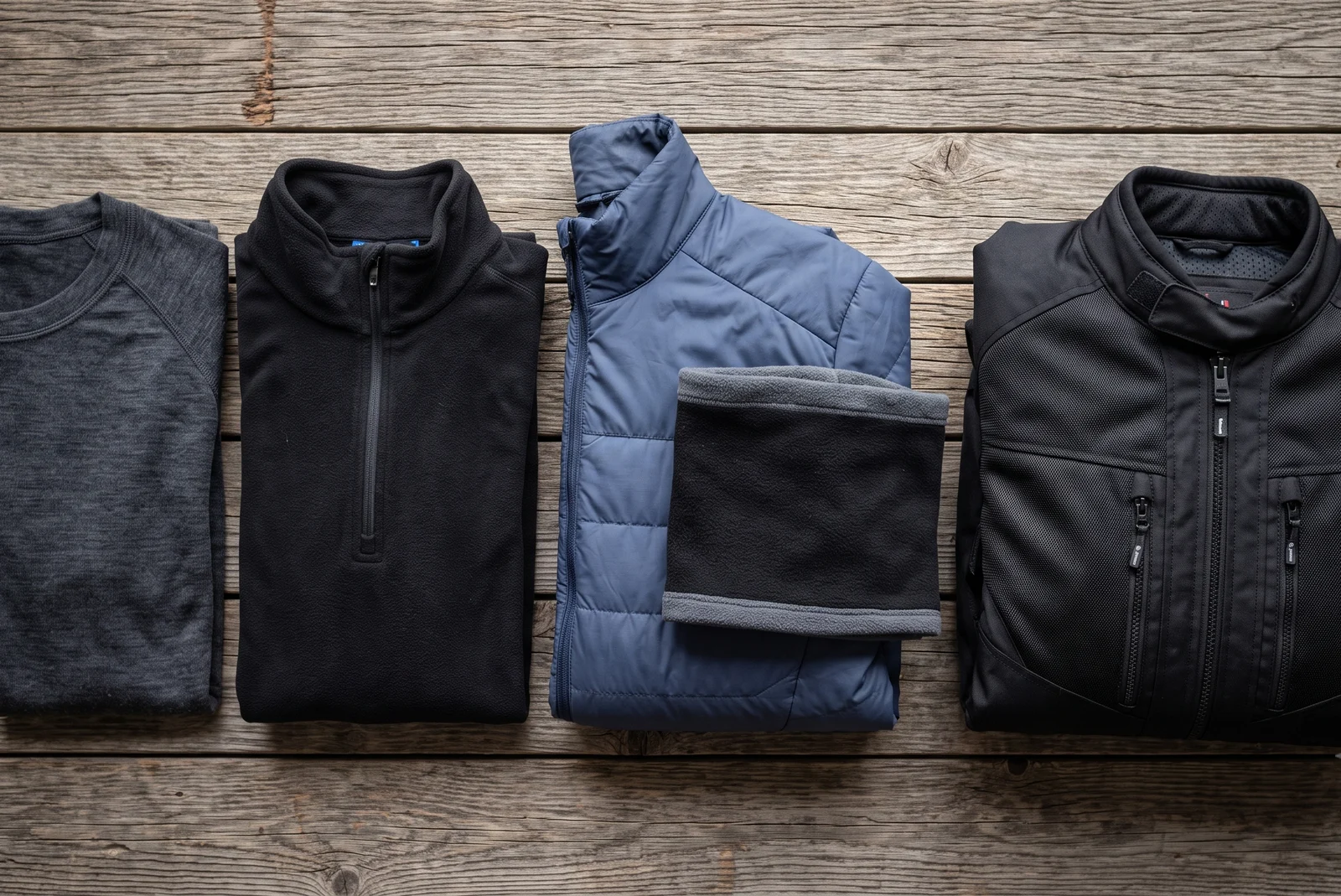
Base layer — move sweat away. Synthetic or merino wool, fitted close. Never cotton. A cotton t-shirt absorbs sweat, holds it against your skin, and then cools you continuously through the rest of the day; it’s the single most common cold-weather mistake and it’s free to fix. And you will sweat, even in the cold — loading the bike, walking around at a fuel stop, riding hard on a twisty road. One thing riders get wrong when they buy one: you need a heavier base layer than a hiker does at the same temperature, because you’re producing almost no heat of your own — which weight to buy covers what the numbers on merino actually mean.
Mid layer — trap air. Fleece, a light down or synthetic insulated jacket, or a wool jumper. This is where the actual warmth lives, because still air is what insulates. Use two thinner mid layers rather than one thick one: it gives you the ability to shed half when the day warms up, and two layers trap air between them as well as within them.
Outer layer — stop the wind. This is where the physics of riding overrides normal outdoor-clothing logic. On a mountain walk, a very warm mid layer with a breathable shell is fine. On a motorcycle, a 100 km/h airstream will strip heat out of any insulation the wind can reach. Windproofing beats insulation on a bike. A moderately warm but genuinely wind-tight setup outperforms a very warm but permeable one every time.
Which produces the cheapest good advice in this article: if your riding jacket isn’t fully windproof, put a packable rain oversuit over it. It costs very little, packs to nothing, and works as a wind shell as well as a rain shell — the reason so many experienced tourers carry one all year rather than only when rain is forecast. Our rain gear guide covers the options.
Two fit points that undo good layering:
- Don’t over-layer inside your gear. Compressing the insulation squeezes out the trapped air that was doing the work, and tight gear also restricts circulation to your hands and feet — making the cold parts colder.
- Seal the gaps. Neck, wrists and waist are where the airstream gets in. A neck tube or buff, gauntlet gloves worn over the jacket cuff, and a jacket that actually closes at the waist are worth more than an extra jumper.
Hands, Feet and Face — Where the Money Goes
Your core can be perfectly warm while your hands become unusable. Extremities lose heat fastest, and the body prioritises the core when it’s cold, deliberately reducing blood flow to the fingers and toes. That’s the physiology working correctly and it’s inconvenient for someone operating levers.
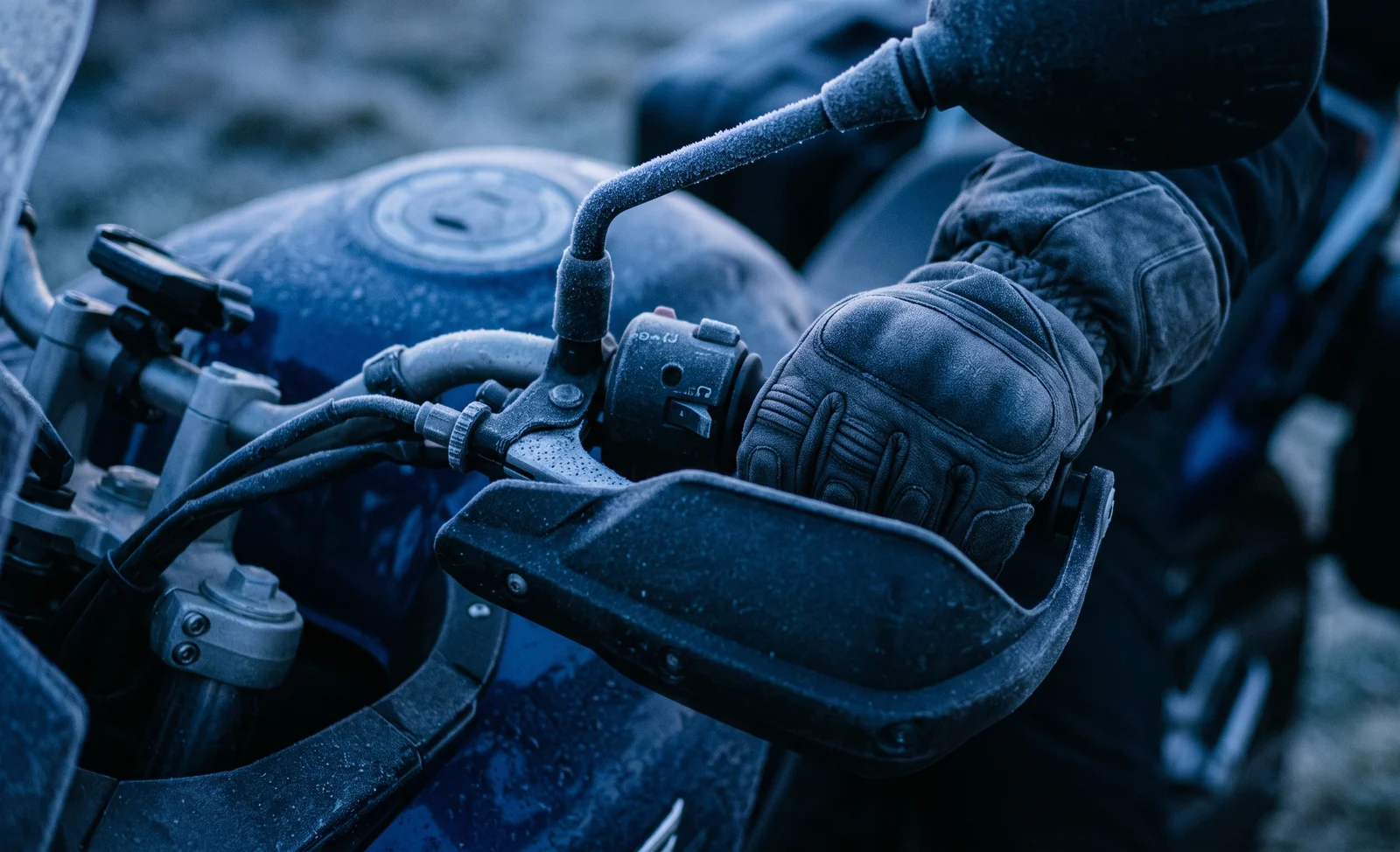
Hands first, always. Heated grips are the highest-value cold-weather modification on most bikes: relatively cheap, always there, and warming the exact surface you’re holding. Their limitation is that they only heat the palm — the backs of your hands are still in the airstream — which is why they pair so well with handguards, which move the wind rather than fighting it, or with genuinely windproof winter gloves.
Disclosure: some links below are affiliate links. If you buy through them we may earn a small commission at no extra cost to you.
Check heated grips on Amazon →
Beyond that, heated clothing that runs off the bike — glove liners, jacket liners, insoles — is the step change for people riding through real winters. Our heated gear guide covers what’s worth buying, and heated gloves are ranked separately by wattage because that is the figure that decides whether a pair keeps up below freezing; the practical caution is to check your bike’s spare electrical capacity before hanging a full heated jacket liner off it, particularly on smaller bikes.
Feet. Thin socks under roomy boots beat thick socks in tight ones, because compressed insulation doesn’t insulate and restricted circulation makes cold feet colder. Waterproof boots matter more than they seem, since wet feet in cold air lose heat dramatically faster than dry ones — see the waterproofing options in our adventure boots guide.
Face and neck. A neck tube stops the chimney effect up your jacket, and a balaclava under the helmet handles the rest. Be aware that anything covering your mouth pushes warm, wet breath up the inside of the visor, which brings us to the other cold-weather problem.
Fogging: the Cold Hazard That Isn’t About Temperature
Warm breath meets a cold visor and condenses on the inside. It happens fastest exactly when you least want it — at low speed, stopped at junctions, in traffic — and a fogged visor at a junction is a genuine hazard, not an annoyance.
The reliable fix is a Pinlock-style anti-fog insert: a second lens sealed to the inside of the visor with a trapped air gap between the layers, which keeps the inner surface above the dew point. It works far better than sprays and coatings, which need reapplying and degrade. Inserts are specific to the visor model, so buy the one for your helmet rather than a generic lens.
Find the Pinlock insert for your helmet →
Beyond that: cracking the visor a millimetre at low speed clears fog quickly at the cost of a cold face; a breath deflector or a balaclava with a proper nose flap directs your breath downward instead of up the visor; and never wipe the inside of a visor with a glove, which scratches the coating you’re relying on.
The Road Changes Too
Cold air is only half the problem. The surface is the other half, and it’s the half that ends rides.
Cold tyres grip less until they warm, and warm slowly. We’re not going to give you a temperature threshold or a grip percentage, because we couldn’t find one published by a tyre manufacturer that we could verify — the figures circulating online come from forums and retailer blogs. The behaviour, though, is not in dispute: treat the first several kilometres of a cold ride as reduced grip. Progressive inputs, gentler lean angles, earlier braking. Give the tyre time.
Ice you can’t see. Frost lingers longest where the sun doesn’t reach: shaded corners, tree-lined lanes, the north side of a hill, and dips where cold air pools. Bridges and overpasses freeze before the road either side of them, because they lose heat from below as well as above and have no ground warmth underneath — so a bridge deck can be icy while the approach is merely wet. On a motorcycle, hitting ice mid-corner is generally unrecoverable, which makes anticipation the only real defence: read the shade, ease off before the shaded bit, and be upright and steady when you cross a bridge on a frosty morning.
Slick surfaces multiply in the cold. Painted lines, manhole covers, tram rails, metal bridge plates and wet leaves are all more slippery than the tarmac around them and take longer to dry or thaw. Cross them upright and neutral, with no braking, no acceleration and no steering input.
Road salt. Where it’s used it makes surfaces greasy, and it’s corrosive to your bike — a wash after salty rides genuinely extends the life of fasteners and electrics, and the anti-corrosion treatments covered in our winter storage guide apply just as much to a bike still being ridden.
Less daylight, lower sun. Cold seasons come with short days and a sun that sits low enough to blind you and the drivers around you at the exact times you’re likely to be riding. Ride with a clear visor once the light drops — a tinted one that was perfect at noon is a liability at four in the afternoon — and assume the driver facing that low sun hasn’t seen you.
Wet is more likely too. Everything in our wet-riding guide applies, with the added twist that cold rain drains your reserves far faster than warm rain.
Planning a Cold Ride
- Check the overnight low, not just the daytime high. A morning start after a frost is a different ride from the same route at noon.
- Start later. In cold seasons the middle of the day is genuinely the best of it — the reverse of the riding in heat advice to ride the cool ends of the day.
- Fuel more often. Not because the bike uses more, but because a fuel stop is a warming stop, and stopping every 45 minutes to an hour keeps you ahead of the cold rather than behind it.
- Eat and drink. Staying warm burns energy, and people drink far too little in cold weather because they don’t feel thirsty. Dehydration blunts judgement exactly like it does in the heat.
- Carry a bail-out. A spare dry base layer, a warm hat for stops, and enough of a plan to stop somewhere warm if the day turns. On a longer trip, that’s the difference between an adjusted plan and a bad decision at dusk.
- Tell someone your route if you’re riding remote, cold and alone. Our solo camping safety guide covers the wider version.
The Bottom Line
Cold riding is genuinely good riding. The roads are empty, the air is clear, and a bright cold morning on an empty road is one of the best things motorcycling offers. It just requires being honest about two things.
The first is that the wind, not the thermometer, sets what your body is dealing with — and at road speed a mild autumn morning is a sub-zero one for any skin you leave exposed. Layer for that: wicking base, air-trapping mid, genuinely windproof outer, and spend on your hands before anything else.
The second is that the cold takes your hands and your judgement in that order, and that the CDC’s own list of hypothermia signs includes fumbling hands and confusion. That’s why the discipline is to stop on a schedule rather than when you feel like it, and to treat a struggle with a zip as information rather than comedy.
Do those two things, keep the first kilometres gentle, respect the shade and the bridges, and the cold season turns into what it should be: the quiet half of the year when the good roads belong to you.
Frequently Asked Questions
How cold is too cold to ride a motorcycle?
There's no single number, because the air temperature isn't what your body is dealing with — the wind at road speed is. Using the US National Weather Service's own wind chill formula, 5°C air at 100 km/h works out to about −3.4°C on exposed skin, and 0°C air at the same speed to about −10.6°C. So the more useful question isn't 'how cold is the air' but 'am I equipped for what the wind makes of it'. In practice, most riders find that with proper layering, windproof outer gear and heated grips, anything down to around freezing is comfortable enough to ride well. Below freezing the limiting factor usually stops being your comfort and becomes the road surface — ice you can't see is a much harder problem than cold you can dress for.
What's the right way to layer for cold-weather riding?
Three layers, each with one job. A base layer against the skin whose job is moving sweat away — synthetic or merino, never cotton, because cotton holds moisture against you and wet fabric strips heat fast. A mid layer whose job is trapping air: fleece or a light insulated jacket, and it's better to use two thinner mid layers than one thick one, since you can shed half. And an outer layer whose job is stopping wind and water. That last one is where riders most often go wrong: a warm but wind-permeable jacket is useless at road speed, because a 100 km/h airstream will pull the heat straight out of it. If your riding jacket isn't genuinely windproof, a cheap packable rain oversuit worn over the top is the single most effective cold-weather item you can buy.
What are the signs that I'm dangerously cold rather than just uncomfortable?
The CDC lists the adult signs of hypothermia as shivering, exhaustion or feeling very tired, confusion, fumbling hands, memory loss, slurred speech and drowsiness — and says that a body temperature below 95°F (35°C) needs immediate medical attention. Read that list again as a rider, because two of those items are exactly the faculties you need to operate a motorcycle: fumbling hands and confusion. The genuinely dangerous part is that the confusion arrives before you can reliably notice it. That's why the rule for cold riding is to stop on a schedule rather than on how you feel — and why, if you find yourself struggling with a zip or a fuel cap, that's not a funny moment, it's the signal to get inside and warm up properly before riding on.
Do heated grips and heated gear actually make a difference?
Yes, and disproportionately, because hands are both the first thing to lose function and the thing you steer and brake with. Heated grips warm the palms, which is why many riders pair them with proper windproof gloves or handguards that stop the wind hitting the backs of the hands, since grips do nothing for that side. Heated gear that runs off the bike's electrical system — jacket liners, gloves, insoles — goes further, and for regular winter or shoulder-season mileage it changes what's possible. Our heated gear guide covers the options. Two practical notes: check your bike's spare alternator capacity before adding a full heated jacket liner, and remember that no heated garment works well under gear that lets wind through.
Are motorcycle tyres less grippy in the cold?
They grip less until they've warmed up, and they take longer to warm up when it's cold — that much is uncontroversial. What we won't give you is a temperature threshold or a percentage, because we couldn't find one stated by a tyre manufacturer that we could verify; the numbers circulating online come from forums and retailer blogs rather than the people who make the rubber. The practical version is simple enough: treat the first several kilometres of a cold ride as low-grip, brake and lean progressively rather than sharply, and don't expect the tyre to answer instantly when you ask it something. Add to that the specific cold hazards — frost in shaded corners, ice on bridges and overpasses, wet leaves, and painted lines and manhole covers that go slick well before the tarmac does.