
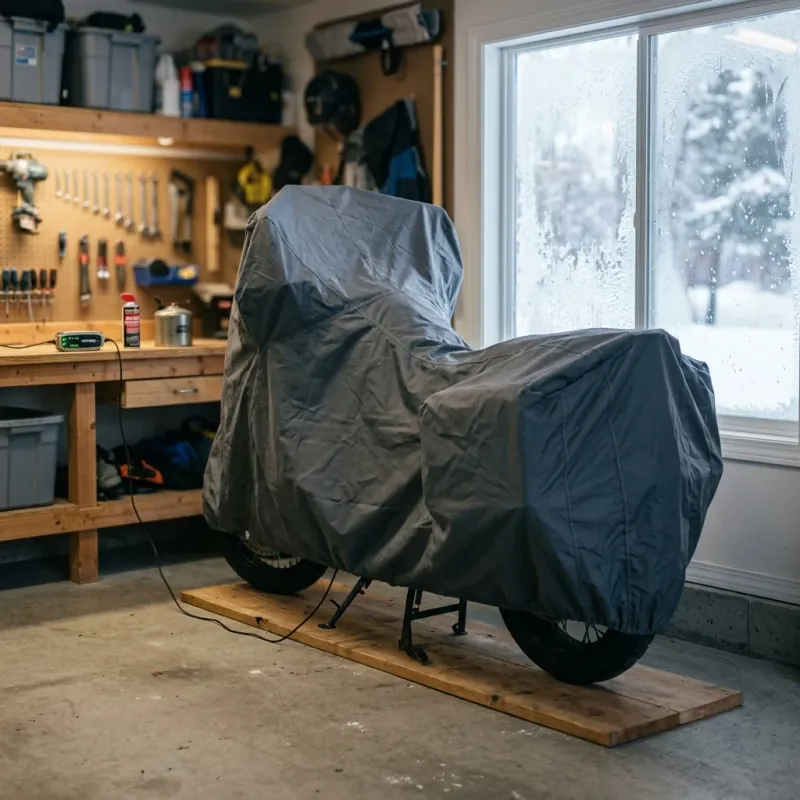
Every riding season ends the same way for most of us: one last cold ride, and then the bike sits. What happens over the next few months is decided almost entirely in the hour before you walk away from it. Do that hour right and the bike wakes up in spring exactly as you left it. Skip it and you come back to a dead battery, a varnished carburettor, a bloom of surface rust, or a flat-spotted tyre — none of them caused by the cold itself, all of them caused by neglect the cold merely exposed.
The trouble with most winterizing checklists is that they’re written as if everyone’s winter is the same. It isn’t. A bike laid up on the Turkish coast or the Algarve, where “winter” means a few weeks of rain and single-digit nights, needs something very different from a bike facing an Anchorage or interior-Scandinavia January where the air itself can crack a battery. This guide gives you the full lay-up process — and then scales the parts that actually depend on temperature to the winter you really have.
First, How Cold Is Your Winter?
This is the question that should shape your whole approach, and almost no guide asks it. The physics of a laid-up motorcycle change with temperature — not gradually and vaguely, but around a few specific thresholds. Find your band and read the rest of the guide through it.
Mild winters — above freezing (much of the Mediterranean coast, coastal Turkey, southern Portugal and Spain). Freezing is essentially a non-issue here. Your enemies are moisture and stale fuel: condensation inside the tank and engine, corrosion from damp and salty coastal air, and petrol going off. A battery maintainer is a nice-to-have rather than a rescue; the fuel, oil, corrosion and moisture steps below matter far more than anything temperature-related.
Cold winters — roughly 0 to -10°C (the UK, the Netherlands, much of central Europe, coastal Scandinavia). Now freezing becomes a real threat to one component: the battery. A low or flat battery can freeze in this range and be destroyed, so keeping it fully charged — on a maintainer, or removed and topped up indoors — moves from optional to important. This is also peak road-salt season, and salt-laden air is brutal on unprotected metal, so corrosion protection earns its keep.
Hard-freeze winters — below -10°C (Anchorage and much of the northern US and Canada, interior Scandinavia, Alpine valleys, Denver cold snaps). Here the default advice flips: take the battery out and store it somewhere heated. A healthy battery on a maintainer is still safe, but if the power ever drops or the battery self-discharges, it can freeze and crack in a matter of a cold night. Everything else in the guide still applies — you’re just doing it with less margin for error, and paying extra attention to the condensation that comes with big temperature swings.
Keep your band in mind as you go. Where a step changes with temperature, we’ll say so.
The Lay-Up Process, Step by Step
1. Wash it, then protect the metal
It feels backwards to wash a bike you’re about to hide under a cover, but dirt, road grime and especially road salt hold moisture against the metal and accelerate corrosion all winter. Wash it, and let it dry completely — trapped water is the whole problem you’re trying to avoid.
Then, on exposed metal, apply a corrosion protectant. One product worth knowing here is ACF-50, an anti-corrosion compound originally developed for aviation: it forms a thin film that chemically neutralises road salt, ejects moisture from crevices, and lasts months on exposed metal — up to a year on sheltered spots like under the tank and seat. It’s especially worth it if you’re in a salt-and-damp climate or storing anywhere near the coast.
Disclosure: some links below are affiliate links. If you buy through them we may earn a small commission at no extra cost to you.
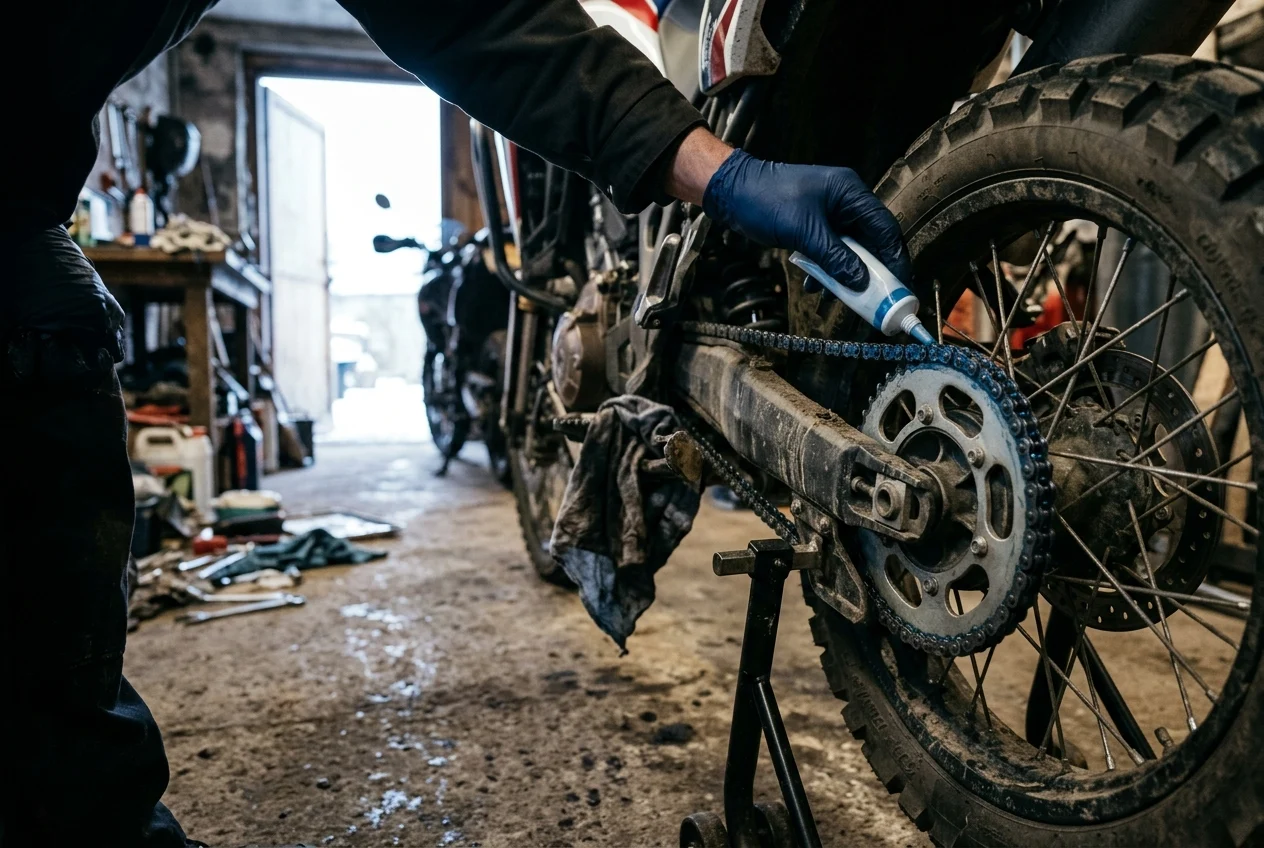
Don’t forget the chain. It’s the moving part most exposed to a damp, salty winter, and a neglected one can surface-rust badly over a few idle months. Clean it, then — on a sealed (O-ring) chain — apply a lube or wax whose job in storage is to protect the outer links from corrosion; the grease sealed inside the O-rings handles the actual lubrication, so you’re proofing against rust, not re-oiling the bearing surfaces. Warm the chain with a short ride first if you can, so the lube creeps in and displaces moisture before the bike sits.
2. Fill the tank and stabilize the fuel
This one catches people out every spring. Untreated petrol starts to break down within a few months, and can varnish a carburettor or gum up injectors in around six — leaving a brown residue that turns a simple spring start into a workshop job. Two things fix it:
- Fill the tank right up. A full tank leaves little air space for condensation to form, which protects the tank walls from rust.
- Add a fuel stabilizer. Products like STA-BIL Storage are rated by the manufacturer to keep fuel usable for up to 24 months, and are formulated for the ethanol blends most pump fuel now contains (ethanol attracts water, which is its own corrosion problem). Dose it to your tank size, then run the engine for a few minutes so treated fuel reaches the whole fuel system, not just the tank.
Check STA-BIL Storage on Amazon →
3. Change tired oil (and fog the cylinders for a long lay-up)
Used engine oil carries combustion acids and moisture, and over a long, still winter those sit against bearings and cylinder walls and quietly etch them. If your oil has a season on it, change the oil and filter before storage — it’s the cheapest engine insurance there is. If it’s genuinely fresh, you can leave it; just don’t store on oil that’s already overdue.
For a long lay-up (roughly four to six months or more), riders storing bikes over a full off-season often “fog” the cylinders: remove the spark plugs, put a small amount of oil (or fogging oil) into each cylinder, turn the engine over a few times to coat the bores, and refit the plugs. It leaves a protective film on the cylinder walls through the months the engine sits dry. For a short lay-up in a mild climate, this is usually overkill.
On oil choice, follow your manual’s specified grade and viscosity rather than any generic recommendation — the point here isn’t the brand, it’s that the oil going into storage is clean.
4. Sort the battery — scaled to your winter
The battery is the component most likely to die over winter, and the one where your climate band matters most.
A quick bit of why: a fully charged lead-acid battery is almost impossible to freeze — its electrolyte is acidic enough to act like antifreeze, resisting freezing down to around -60 to -70°C. But as a battery discharges, the electrolyte turns more and more into plain water, and a fully flat battery will freeze at about 0°C. Freezing expands the electrolyte, distorts the internal plates, and can crack the case outright. So the rule is simple: a charged battery is a safe battery; a flat one is a fragile one.
What that means for you:
- Mild band (above freezing): freezing isn’t a threat, but batteries still self-discharge in storage. A battery maintainer (trickle charger) keeps it healthy and ready; not strictly essential over a short mild winter, but cheap and hassle-free.
- Cold band (0 to -10°C): keep it fully charged — on a maintainer, or remove it and store it indoors, topped up. A neglected battery that self-discharges here is a battery that can freeze.
- Hard-freeze band (below -10°C): the safe default is to remove the battery and store it somewhere heated, still on a maintainer. Relying on a maintainer alone in a hard freeze is a gamble on the power never dropping.
A good modern maintainer charges, maintains and desulfates automatically, and the better ones have a temperature sensor so they adjust to ambient conditions. The NOCO GENIUS1 and the multi-chemistry Battery Tender Junior are two long-proven choices; both are made in versions that handle lithium (LiFePO4) as well as lead-acid — just check the specific model matches your battery chemistry before you buy. That check matters more than it sounds: several of the maintainers riders recommend most often are specified for lead-acid only, and our battery maintainer comparison lays out what each manufacturer actually publishes.
Check NOCO GENIUS1 on Amazon →
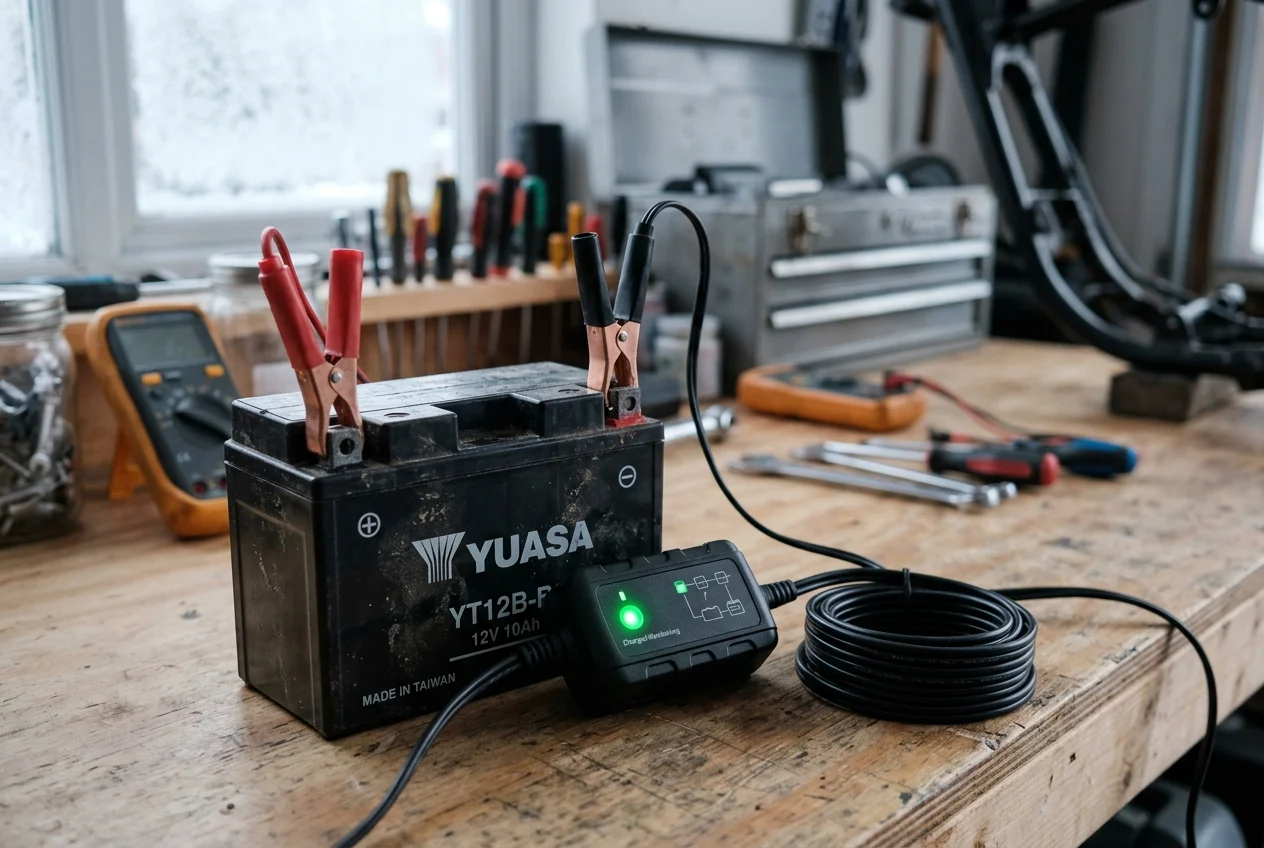
One critical note for lithium (LiFePO4) batteries: never charge a lithium battery below 0°C. Charging a sub-freezing lithium cell causes metallic lithium to plate onto the anode — permanent damage that also makes the cell unsafe. Storing a lithium battery cold is fine; charging it cold is not. If your bike runs a lithium battery and lives somewhere that freezes, bring the battery indoors to charge. Good smart chargers won’t let you charge below freezing, but many basic ones will.
5. Tyres: inflate them and take the weight off
Cold air contracts, so tyre pressure drops in storage — and a tyre sitting under the bike’s full weight in one spot for months can develop a flat spot. Two easy measures handle both:
- Inflate to the manufacturer’s recommended pressure (a little above normal is fine for storage, though not for riding).
- Get the weight off the tyres if you can. A centre stand is ideal — but note that many adventure bikes don’t have one from the factory (the Ténéré 700 is a well-known example), and the swingarm-spool paddock stands sold for sportbikes generally won’t fit an ADV bike. If your bike has a centre stand, use it; if not, an accessory centre stand or a suitable ADV-compatible stand does the job. Failing that, rotate the tyres a little every few weeks to change the contact point, and keep them off cold concrete on a board or mat. Mild flat spots often relax once the tyre warms up again, but on a long lay-up, taking the weight off is the reliable fix.
6. Cover it — and understand why waterproof isn’t automatically better
This is the step most people get backwards. The instinct is to buy the most waterproof cover you can. But a sealed, non-breathable cover traps moisture against the bike: humid air sits underneath it, and when the air warms faster than the machine does — which it always will, because the metal has far more mass — that humidity condenses onto the cold engine, frame and fasteners. A cover with nowhere for it to go feeds the exact rust you’re trying to prevent.
So the rule is airflow, not sealing:
- Dry, stable, heated space: a breathable dust cover is the right call. It keeps dust off and lets moisture escape, and it doesn’t need to be waterproof.
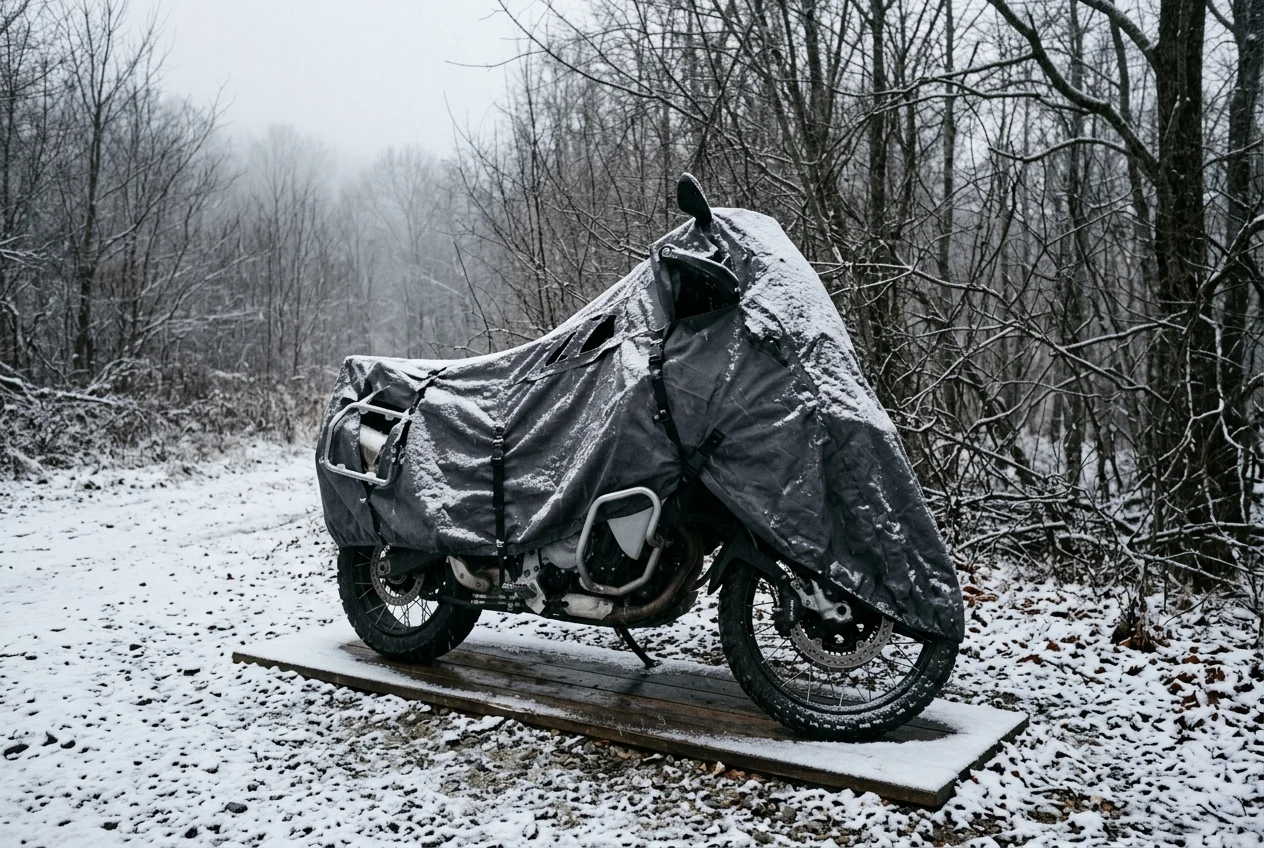
- Outdoors — and an unheated garage or carport counts as outdoors, because the temperature swings like the outside and the floor gives off damp: you need genuine waterproofing and venting, so warm, damp air can leave rather than condensing inside.
Either way, park the bike on wood, cardboard, plastic or a mat rather than bare concrete or dirt — the ground is a constant source of rising moisture, and a good cover is designed to draw air in from underneath rather than seal against the floor.
Which specific cover, how to size one over a tall screen and panniers, and what the manufacturers do and don’t publish about their fabric: best motorcycle covers for winter storage.
7. Manage moisture — and mice
Two smaller enemies round out the list.
Damp. In a closed garage or under a cover, a hanging moisture absorber (the refillable calcium-chloride kind, like DampRid) pulls humidity out of the air and lowers the corrosion and mould risk. Cheap, and genuinely effective in a small enclosed space.
Rodents. A stored bike is a warm, sheltered home, and mice will nest in an airbox or exhaust and chew wiring given the chance. The classic defence is to plug the exhaust outlets and airbox intake with steel wool — rodents can’t chew through it the way they can a rag — optionally with a few drops of peppermint oil, which they dislike. Cleaning the bike thoroughly first removes the food smells that attract them. Write yourself a note to remove the steel wool before you start the bike in spring — a plugged exhaust is a memorable spring mistake.
Check DampRid Absorber on Amazon →
If you’ve no garage at all: portable shelters
Storing outdoors with no walls is the hardest case, but a portable motorcycle shelter — a steel frame under a waterproof cover — beats a bare cover in wind and snow. Something like the VEVOR shelter, a powder-coated steel frame under a heavy 600D cover with roll-up mesh windows, is the type to look for. The one rule: it must have proper ventilation windows. A sealed tent over a bike in an unheated yard is just a bigger condensation trap. Combine it with the vented cover, the ground barrier and a corrosion protectant, and consider bringing the battery indoors regardless of your climate band.
Check VEVOR Shelter on Amazon →
Don’t “Start It Every Couple of Weeks”
This is the most common well-intentioned mistake, so it’s worth stating plainly: periodically starting and idling a stored bike does more harm than good. A brief start never gets the engine hot enough to burn off the water that combustion naturally produces, so each short run actually deposits condensation in the oil and exhaust — rust and sludge, not protection. The consensus among mechanics is clear: if you can take the bike for a real 30-minute-plus ride on a dry, mild winter day that reaches full operating temperature, do that; otherwise, winterize it properly and leave it alone. A stable, dry storage environment protects a bike far better than fussing with it ever will.
The Paperwork: Insurance and Registration
If you’re laying the bike up for months, there may be money to save and rules to follow — and this varies by country, so treat this as a prompt to check your own rather than gospel. In the UK, for instance, a bike kept off the road can be declared SORN (Statutory Off Road Notification), and many insurers offer a reduced “laid-up” policy that covers fire and theft while the bike isn’t being ridden. In the US and Canada, many states and provinces let you file a non-operation status for the off-season — California’s Planned Non-Operation (PNO), for example, swaps full registration for a small fee for any year the bike stays off public roads — and insurers commonly offer a reduced “storage” or comprehensive-only policy. Other countries have their own equivalents, or none at all. It’s worth five minutes with your insurer and licensing authority before winter — our adventure motorcycle insurance guide covers how touring and storage cover fit together.
Spring: The Wake-Up Checklist
When the season turns, undo what you did — in the right order:
- Remove the exhaust/airbox steel wool before anything else.
- Refit or reconnect the battery, and check it’s holding charge.
- Check tyre pressures and look for any flat spots or cracking.
- Look underneath for oil or fuel leaks that appeared over winter.
- Check brakes — discs can develop surface rust that clears with gentle use.
- Start it, let it reach operating temperature, and take a short, easy first ride before trusting it on a long one.
The Bottom Line
Winter doesn’t damage motorcycles — moisture, stale fuel and neglect do, and the cold just sets the stage. The riders who pull a perfect bike out of storage every spring aren’t lucky; they spent one focused hour in autumn doing the boring things right. Protect the metal, stabilize the fuel, keep the battery charged or bring it inside, take the weight off the tyres, and cover the bike with something that breathes. Then match your effort to your winter: on a mild coast, moisture is the whole game; in a hard freeze, the battery is where you can’t afford a mistake.
Do that, and the first warm day of spring is what it should be — a ride, not a repair. If you want to keep working on the bike over the off-season, our Ténéré 700 field-maintenance guide and used adventure motorcycle buying guide — the latter useful if you’re eyeing a bike that’s been sitting in someone’s shed all winter — are good places to spend a cold afternoon. And when you’re ready to plan where spring takes you, start with how to plan a long-distance motorcycle trip. If someone is buying for a rider this winter, a battery maintainer and a can of corrosion spray are two of the most-used items on our adventure motorcyclist gift guide — unexciting to unwrap, and the reason a bike starts in March.
Disclosure: Some links in this article are affiliate links. If you buy gear through them, Bikes & Bays earns a small commission at no extra cost to you. We only link to gear that earns its place, and skip the button when nothing’s worth recommending.
Frequently Asked Questions
How cold does it have to be before my motorcycle battery is at risk of freezing?
It depends almost entirely on how charged the battery is, not just the air temperature. A fully charged lead-acid battery is extraordinarily hard to freeze — its acidic electrolyte behaves like antifreeze and won't freeze until roughly -60 to -70°C, colder than anywhere on Earth gets in winter. The danger is a discharged battery: as it loses charge the electrolyte becomes more like plain water, and a fully flat battery freezes at around 0°C — and freezing expands the electrolyte, buckles the plates and can crack the case, killing the battery. That's why the single rule that matters is 'keep it fully charged or bring it somewhere warm.' A battery on a maintainer is safe in almost any winter; a neglected, self-discharged one can freeze on a night barely below zero. Lithium (LiFePO4) batteries are a separate case — see the battery section.
Do I really need to change the oil before storage if I changed it recently?
If the oil is genuinely fresh — changed in the last ride or two — you can usually leave it. The reason storage guides push an oil change is that used oil carries combustion acids and moisture, and those sit against your engine's internals for months and quietly corrode them. If your oil has a season of riding on it, changing it before lay-up is cheap insurance; if it's nearly new, top up to the right level and store it. Either way, don't store the bike on oil that's overdue for a change.
Should I use a fully waterproof cover for winter storage?
Not necessarily — and outdoors in an unheated space, a fully waterproof, non-breathable cover can make things worse. As temperatures swing, the bike pulls moisture out of the air; a sealed cover traps that moisture against cold metal and it can't escape, which encourages exactly the corrosion you're trying to prevent. For an unheated garage or indoor space, a breathable cover is usually the better choice. For outdoor storage you want a genuinely waterproof cover that is also vented, so warm damp air can escape rather than condensing inside. And keep the bike off bare concrete — park it on wood, cardboard or a mat so ground moisture doesn't rise into it.
How often should I start my motorcycle during winter storage?
The honest answer most mechanics give is: don't. Briefly starting and idling a bike doesn't get the engine hot enough to burn off the water that combustion produces, so each short start actually introduces condensation into the oil and exhaust — the opposite of what you intended. If you can take it for a proper 30-minute-plus ride on a mild, dry winter day that reaches full operating temperature, that's fine and even good. But a two-minute start in the garage every couple of weeks does more harm than good. Winterize it properly and leave it alone, or ride it for real.
Can I leave my motorcycle outdoors all winter?
You can, but it's the hardest case and you have to prepare for it. Outdoors you're fighting rain, road salt in the air, temperature swings and condensation, and in a hard-freeze climate you should seriously consider removing the battery to somewhere heated. Use a vented waterproof cover, get the bike off the ground, apply a corrosion protectant like ACF-50 to exposed metal, and if you have no walls at all, a portable shelter with proper ventilation windows is worth it. A dry, stable indoor space is always better if you can find one — even a rented storage unit — because most of what damages a stored bike is moisture and temperature cycling, not cold itself.