
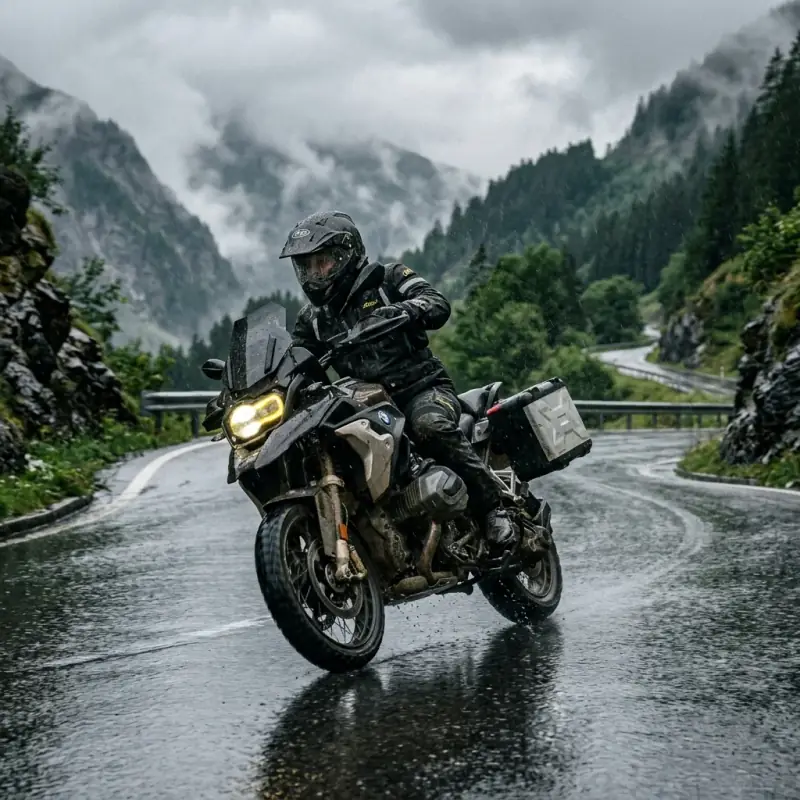
On a Sunday ride you treat rain as a reason to stay home. On a tour, that option disappears. You’re three days from your own front door with a ferry booked, and the rain is simply part of the route. That reframes wet riding completely. It stops being an emergency to survive and becomes a skill to have, one that turns a grey, streaming mountain pass from something you dread into just another kind of good day out. And like any skill, most of it is technique rather than nerve.
The good news is that a modern motorcycle on decent tyres has far more grip in the wet than most riders use. The crashes don’t usually come from the bike running out of traction on its own; they come from a rider asking for grip too suddenly — a sharp stab of brake, a fistful of throttle, an abrupt change of direction — at the moment the road can least give it. This guide is about riding the wet the way it wants to be ridden: reading where the grip is, being smooth enough not to break it, and being able to see where you’re going. It’s written with touring and adventure riders in mind, the people who actually have to ride the rain rather than wait it out.
What Actually Makes a Wet Road Dangerous
It helps to know what you’re up against, because each hazard has a specific answer.
Less grip, so longer stopping. Water between tyre and road reduces friction, so the tyre reaches its limit and slides sooner under braking. The common rule of thumb is to allow for roughly double your dry braking distance in the rain — partly the reduced grip, partly the reduced visibility that gives you less warning. The practical consequence is simply more space and earlier, gentler braking.
The first few minutes are the worst. During a dry spell, oil, diesel, rubber and dust build up on the tarmac. When rain first falls it floats that film to the surface, and for a short window the road is far more slippery than it will be later — as a rough guide, the first 10–15 minutes after a dry period. It’s genuinely worth easing right off, or pausing under a bridge for a few minutes, at the start of a shower. Once it’s rained steadily for a while, the road washes clean and grip improves.
Standing water and aquaplaning. Deep enough water at high enough speed can lift a tyre off the road entirely, and the risk rises with speed, water depth and — critically — how worn your tyres are, because tread is what channels water away, so keep them at your manual’s pressures and well clear of the wear bars. This is one more reason a wet tour is no place for tyres near the end of their life; if yours are marginal, our adventure tyres guide is worth a look before you go.
Smooth Is the Whole Technique
If there’s one word for wet riding, it’s smooth. Every control input — throttle, brakes, steering — should be rolled on and off gently and progressively, because it’s the suddenness of an input, not its size, that breaks traction.
- Throttle: feed it in gently, especially cracking it open from closed and when the bike is leant over. A snatch of power spins up the rear far more easily on a wet road.
- Brakes: squeeze, don’t grab. Apply both brakes smoothly and progressively, and lean a little more on the rear brake for stability than you might in the dry. Do your braking while the bike is upright, before the corner, not mid-lean. Engine braking — simply rolling off the throttle — is a gentle way to shed speed that preserves traction nicely.
- Steering and lean: keep the bike more upright and reduce your lean angles; enter corners slower and avoid abrupt changes of direction. You can lean a wet bike more than you think, but there’s no prize for finding the limit in the rain.
- Look further ahead than usual, and keep a relaxed grip. A tense, stiff hold on the bars transmits every twitch into the steering and tires you out fast; loosening up lets the bike settle and lets you feel what the front is doing. Staying relaxed is a real technique, not just advice to calm down.
Leave far more following distance than you would in the dry. That doubled stopping distance has to come from somewhere, and the easiest place to find it is the gap in front.
One modern caveat worth stating: nearly every adventure bike this guide’s readers ride has ABS as standard, and many have a dedicated rain mode that softens throttle response and lets the traction control and ABS step in sooner. If you have a rain mode, use it when the road turns wet. But the electronics are a backstop for a mistake, not a substitute for the technique above — ABS can rescue a panic stop, yet it can’t conjure grip you don’t have for cornering or accelerating, and it works best when you’re already braking progressively rather than stabbing at the lever. Stay smooth and the electronics quietly widen your margin; ride like it’s dry and count on them to sort it out, and you’ll eventually find their limit at the worst possible moment.
Read the Road for Grip
In the wet, the road surface stops being uniform and becomes a patchwork of grippy and slippery. Learning to read it is half the battle.
Seek out the dry line. On a road that’s drying, or sheltered by trees or buildings, there’s often a strip with noticeably more grip — ride it where it’s safe to. On a multi-lane road, be aware that the two channels where truck tyres run collect the deepest water and the highest aquaplaning risk, so they’re worth avoiding in heavy rain.
Avoid the shiny stuff. Some surfaces are far more slippery than plain wet tarmac, and they’re usually easy to spot because they shine:
- Painted road markings — lines, arrows, crossings — are slick when wet; try not to brake, accelerate or turn on top of them.
- Manhole covers, drain grates and metal expansion joints turn to ice in the rain.
- Diesel and oil spills show up as rainbow sheens, often at junctions and roundabouts where vehicles brake.
- The greasy centre of a lane, where oil drips collect, is slipperier than the tyre tracks either side.
None of these means panic; it means plan your braking and steering to happen on clean tarmac, and just coast smoothly across the slippery patches when you can’t avoid them.
See, and Be Seen
Wet-weather crashes aren’t all about grip; a lot come down to nobody being able to see anything.
Keep your own vision clear. A fogged or streaming visor is dangerous, and the single best fix for fogging is a Pinlock insert. It’s a second lens that clips inside your visor and seals to it with a silicone bead, trapping a thin cushion of air like double glazing so the inside surface doesn’t chill to the point of fogging; the insert itself is made of a moisture-absorbing material that soaks up condensation. It’s the solution that actually holds up over hours of wet riding, where sprays and coatings fade. Most modern helmets are Pinlock-ready — check whether yours is when you’re choosing one, which our adventure helmets guide factors in.
Disclosure: some links below are affiliate links. If you buy through them we may earn a small commission at no extra cost to you.
Find the Pinlock insert for your helmet →
One caution: on a polycarbonate visor, stick to visor-safe anti-fog products and avoid automotive rain-repellents, which can craze or damage the plastic. And since rain usually comes with grey, flat light, this is the time for a clear visor, not a tinted one — swap it before you set off rather than squinting through a dark visor under a black sky.
Be visible to everyone else. Spray, gloom and busy wipers make you hard to spot from a car. Ride with your headlight on, favour brighter or reflective gear in bad weather, and assume you haven’t been seen at junctions. Position yourself out of the worst of the spray thrown up by trucks, which can blind you for a critical second or two.
Stay Dry, Warm and Sharp
Here’s the part that’s easy to underrate: being cold and wet doesn’t just make you miserable, it makes you a worse rider. As you chill, your concentration fades, your hands get clumsy on the controls, and your reactions slow — exactly when the conditions demand the opposite. Staying dry is a safety measure, not a comfort one.
For riders whose main gear isn’t fully waterproof, a packable rain oversuit that goes on over everything is cheap insurance that lives in a pannier and comes out when the sky turns. The classic budget choice is a Frogg Toggs suit — light, waterproof, and small enough that there’s no excuse to leave it at home.
Check the Frogg Toggs Hogg Togg on Amazon →
If you’d rather compare properly before buying, our rain gear guide goes through the oversuits worth carrying, why seam sealing matters more than the fabric, and the boot covers that fix the place most riders actually get wet.
Cold, wet hands are the first thing to go and the most dangerous, because they’re on the controls — a good pair of waterproof gloves (or waterproof over-gloves stashed for emergencies) is worth the space; the waterproof picks in our adventure gloves guide cover the options. And note that keeping dry on the bike and keeping dry in camp are two different problems — if your trip involves nights under canvas, our guide to motorcycle camping in the rain handles the second half.
On Tour: Wet Gravel and a Loaded Bike
Two things change once you add touring reality to wet riding.
A loaded bike stops and steers differently. All that luggage adds weight and shifts the balance, which lengthens braking still further and makes smoothness matter even more. Give yourself extra margin over what an unladen bike would need.
Wet dirt is a different sport. If your route leaves the tarmac, wet ground raises the stakes sharply — mud and wet clay can be genuinely treacherous, and grip can disappear without warning. The standing position and weighting from our off-road riding tips for loaded bikes become more important, not less, and the honest skill is knowing when a wet trail has crossed the line from fun to foolish on a fully loaded bike. There’s no shame in turning around.
The Bottom Line
Rain isn’t the enemy most new riders think it is. A sound bike on good tyres has grip to spare in the wet; the trick is to use it gently. Ride smooth — roll the throttle and brakes on and off rather than snatching them — keep the bike upright, look well ahead, and read the road for the grippy line and the slippery traps. Give the greasy first few minutes of a shower the respect they deserve, keep your visor clear so you can actually see, and stay warm and dry enough to keep thinking clearly. Do those things and a wet ride stops being something to endure and becomes just another set of conditions you know how to handle.
That’s the difference between a rider who cancels when it clouds over and one who rides the whole trip as planned. When the day’s riding is done and you’re setting up camp in the drizzle, our guide to staying dry while motorcycle camping in the rain picks up exactly where this one leaves off.
Disclosure: Some links in this article are affiliate links. If you buy gear through them, Bikes & Bays earns a small commission at no extra cost to you. We only link to gear that earns its place, and skip the button when nothing’s worth recommending.
Frequently Asked Questions
Is it harder to brake in the rain on a motorcycle?
Yes, significantly. Wet roads offer less grip, so your tyres can't slow the bike as hard before they slide, and a common guideline is to allow for roughly double your dry braking distance in the rain — partly because you physically can't stop as quickly, and partly because rain cuts visibility so you get less warning of hazards. The technique that follows from that is to brake earlier, more gently, and more progressively than you would in the dry: squeeze the brakes on smoothly rather than grabbing them, lean a little more on the rear brake for stability than you might in the dry, and leave a much bigger gap to whatever's in front. Sudden, hard braking is what breaks traction and puts riders down in the wet.
Why is the start of a rain shower the most dangerous time to ride?
Because of what's already on the road. During a dry spell, oil, diesel, rubber dust and general grime build up on the tarmac, and when the first rain falls it lifts that film and floats it on top of the water, making the surface far more slippery than it becomes later. As a rough guide the first 10–15 minutes of rain after a dry period are the worst, and many experienced riders deliberately ease right off or pull over for a few minutes at the start of a shower to let the road wash clean. Once it's been raining steadily for a while, grip actually improves compared with that greasy first few minutes.
How do I stop my visor fogging up in the rain?
Fogging happens because your warm, humid breath meets the cold inside of the visor. The most effective fix is a Pinlock insert — a second lens that clips inside the visor and seals against it with a silicone bead, trapping a thin layer of air like double glazing while the insert's moisture-absorbing (hydrophilic) material soaks up condensation before it can fog. Most mid-range and premium helmets are Pinlock-ready, and it's the solution that actually works in sustained wet riding. Anti-fog sprays and coatings are a cheaper stopgap. Cracking the visor open a small amount to vent also helps in a pinch — just be aware that on a polycarbonate visor you should stick to visor-safe products and avoid automotive rain-repellents, which can craze the plastic.
Can you ride an adventure motorcycle off-road in the rain?
You can, but wet dirt changes the game and deserves respect. Mud and wet clay can get extremely slippery, wet rock and tree roots are treacherous, and grip can vanish without warning — so the smoothness that matters on wet tarmac matters even more off it. Slow down, stay relaxed and let the bike move around under you, keep your inputs gentle, and be honest about when a trail has turned into something that's no longer sensible on a loaded touring bike. Our loaded-bike off-road guide covers the standing position and weighting that help; add wet ground on top and the margin for error just gets smaller.