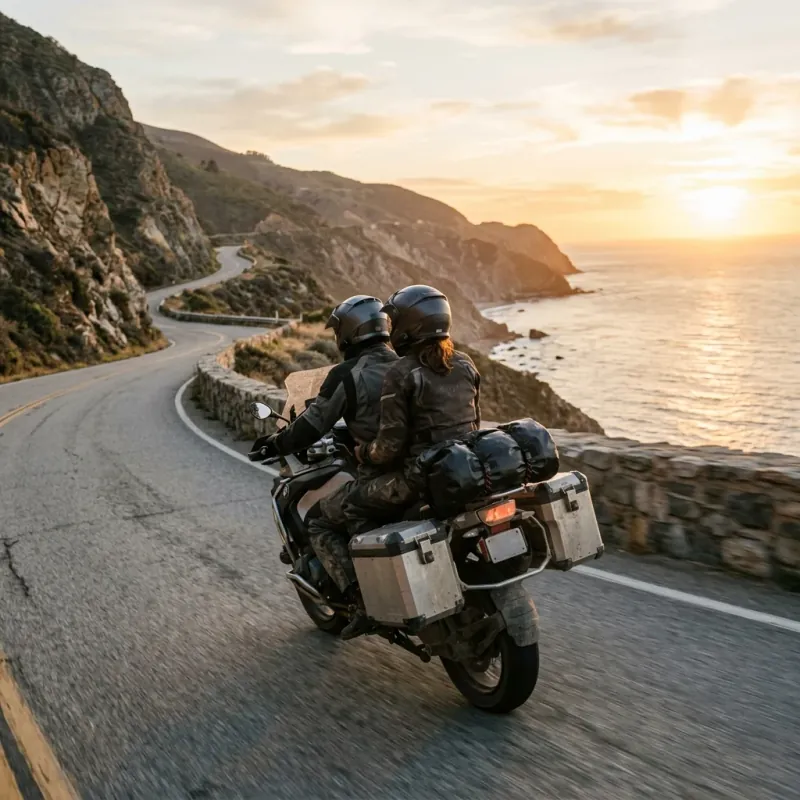
The first time you ride two-up after years of riding alone, the bike feels like someone swapped it for a similar-looking one overnight. It pulls away reluctantly, it steers slowly, it stops later than you asked, and it wallows through corners you’ve taken a thousand times. None of that is the passenger doing anything wrong. It’s simply that a motorcycle designed around one person is now carrying nearly double the load it was set up for, and almost every characteristic you rely on has shifted.
The good news is that most of it is fixable before you leave the driveway, and the fixes are printed in your owner’s manual. The rest is technique, communication, and one piece of arithmetic that decides whether the trip you’re planning is actually possible.
This guide is aimed at adventure and touring riders — the loaded, long-distance, sometimes-unpaved version of two-up rather than a ride to the pub — and it starts with the part most articles skip entirely.
Start With the Weight, Because It Decides Everything Else
Every motorcycle has a published maximum load covering rider, passenger, luggage and accessories combined. On adventure bikes it typically lands somewhere between about 186 kg and 235 kg — and a rider and passenger in full riding gear will usually account for around 170 kg of that between them.
Which leaves less than most people expect for everything else. On a Ténéré 700, rated at 186 kg, that arithmetic leaves roughly 16 kg — before the panniers themselves, never mind what goes in them.
We pulled the published figures for nine adventure bikes straight from their manuals in a separate piece: how much weight your adventure bike can actually carry. It’s worth five minutes before you plan a two-up trip, because it reframes the whole exercise. There are also sub-limits that bite specifically when a passenger is aboard — Honda caps total luggage on the XL750 Transalp at 19.5 kg, and KTM limits the 890 Adventure’s luggage rack plate to 5 kg, which matters enormously once the pillion seat is occupied and the only place left for luggage is high and behind the rear axle.
Two manufacturers go further and attach a speed limit to a loaded bike: Royal Enfield’s Himalayan 450 manual says not to exceed 110 km/h (68.3 mph) when carrying a pillion or a payload on an accessory-equipped bike, and Honda’s Transalp manual says never to exceed 130 km/h (80 mph) for the load being carried. If you were planning a two-up motorway blast, at least two makers have an opinion about it.
The practical conclusion for most riders: two-up and camping is a stretch on a middleweight. Either go two-up and sleep in beds, or go solo and camp. Trying to do both is where bikes get overloaded.
Setting the Bike Up
Three jobs, ten minutes, and they make more difference than anything else in this guide.
1. Rear preload
A rear spring set for one person sits too deep in its travel with two aboard, which uses up the suspension you were relying on for bumps and slackens the steering geometry as the back squats.
Every adjustable bike has a specified setting for this and it’s in the manual. Royal Enfield’s Himalayan 450 handbook, for instance, tells riders to use the third notch solo and the final notch when fully loaded to gross vehicle weight — noting that the fully loaded setting is the compromise between handling and stability. Your bike’s numbers will differ; use yours, not that one. BMW is the most precise of the manuals we’ve read, giving 30 turns of rear preload between solo and two-up-with-luggage on the R 1300 GS plus a conversion rule of two turns per extra 10 kg — we’ve collected those load settings in the suspension setup guide.
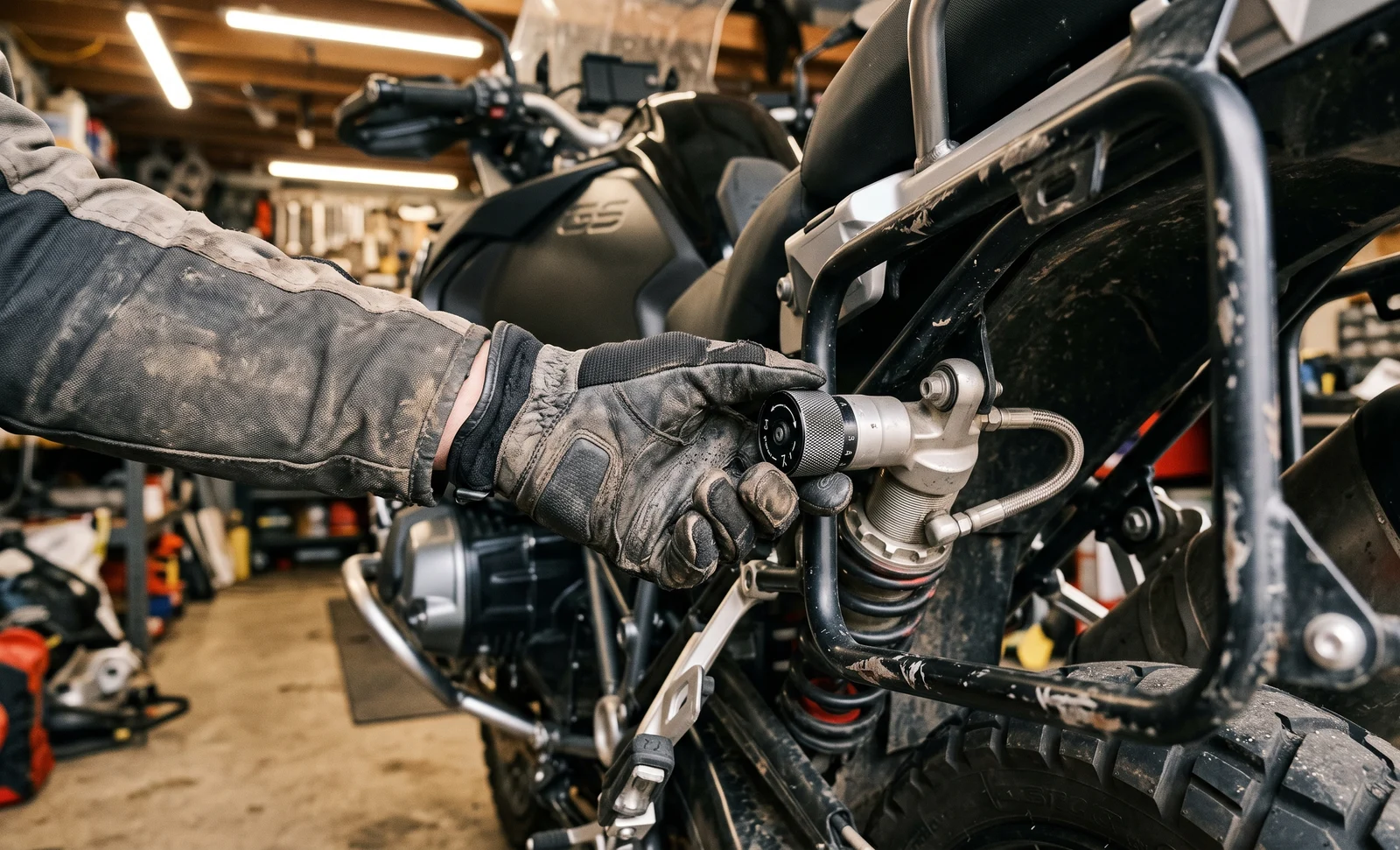
If you tour two-up regularly and the bike still wallows at maximum preload, that’s the signal that uprated springs or a better shock would be a genuinely worthwhile upgrade. It won’t raise the manufacturer’s weight limit — nothing does — but it will make the bike feel like itself again within that limit.
2. Tyre pressures
Manufacturers publish separate pressures for solo and two-up riding, and this is the cheapest, most-ignored setup change there is. Honda’s XL750 Transalp manual specifies:
- Rider only: front 225 kPa (33 psi), rear 250 kPa (36 psi)
- Rider and passenger: front 225 kPa (33 psi), rear 280 kPa (41 psi)
That’s about 4 psi more in the rear and nothing at the front. Different bikes specify differently — some raise the front as well — so read yours. And note how seriously manufacturers treat the link between pressure and load: Suzuki publishes the V-Strom 800DE’s 430 kg gross vehicle weight rating explicitly “at the tire pressure (cold)” of the stated figures. The load rating assumes the pressures.
Check them cold, with a gauge you trust, before a loaded day. An under-inflated rear tyre carrying two people and luggage runs hot, and heat is how tyres fail.
3. Headlight aim, brakes, chain
A squatting rear end lifts the headlight beam into oncoming drivers’ eyes. Most bikes have a simple beam adjuster; use it, and put it back afterwards.
Then check the things about to be worked hardest. Brake pads and fluid, because stopping distances lengthen with the extra mass. Tyres for wear and damage, because they’re carrying it. And chain tension and lubrication, since it’s transmitting more torque under load — our chain guide covers checking slack against the manual’s figure, which is worth doing before a loaded trip rather than during one.
Briefing the Passenger
An unbriefed passenger isn’t a passenger, they’re a moving mass with opinions. Five minutes of conversation before the first ride prevents most of what goes wrong.
Gear, properly. A helmet that actually fits them — not a spare two sizes out — plus a jacket with armour, gloves, long trousers and boots that cover the ankle. Passengers hit the ground at the same speed the rider does. If they’re borrowing your spares, check the fit before the day rather than in the car park.
The getting-on protocol. This is where bikes get dropped, and it’s entirely avoidable. Agree it out loud:
- Rider gets on first, both feet down, bike upright and stable, front brake held.
- Rider says “on” — the passenger doesn’t move until then.
- Passenger mounts from the left, using the rider’s shoulder for balance and the left footrest, swinging the right leg over cleanly and high enough to clear the luggage.
- Passenger settles, gets both feet on the pegs, and says “ready”.
- Reverse it, one instruction at a time, at the end.
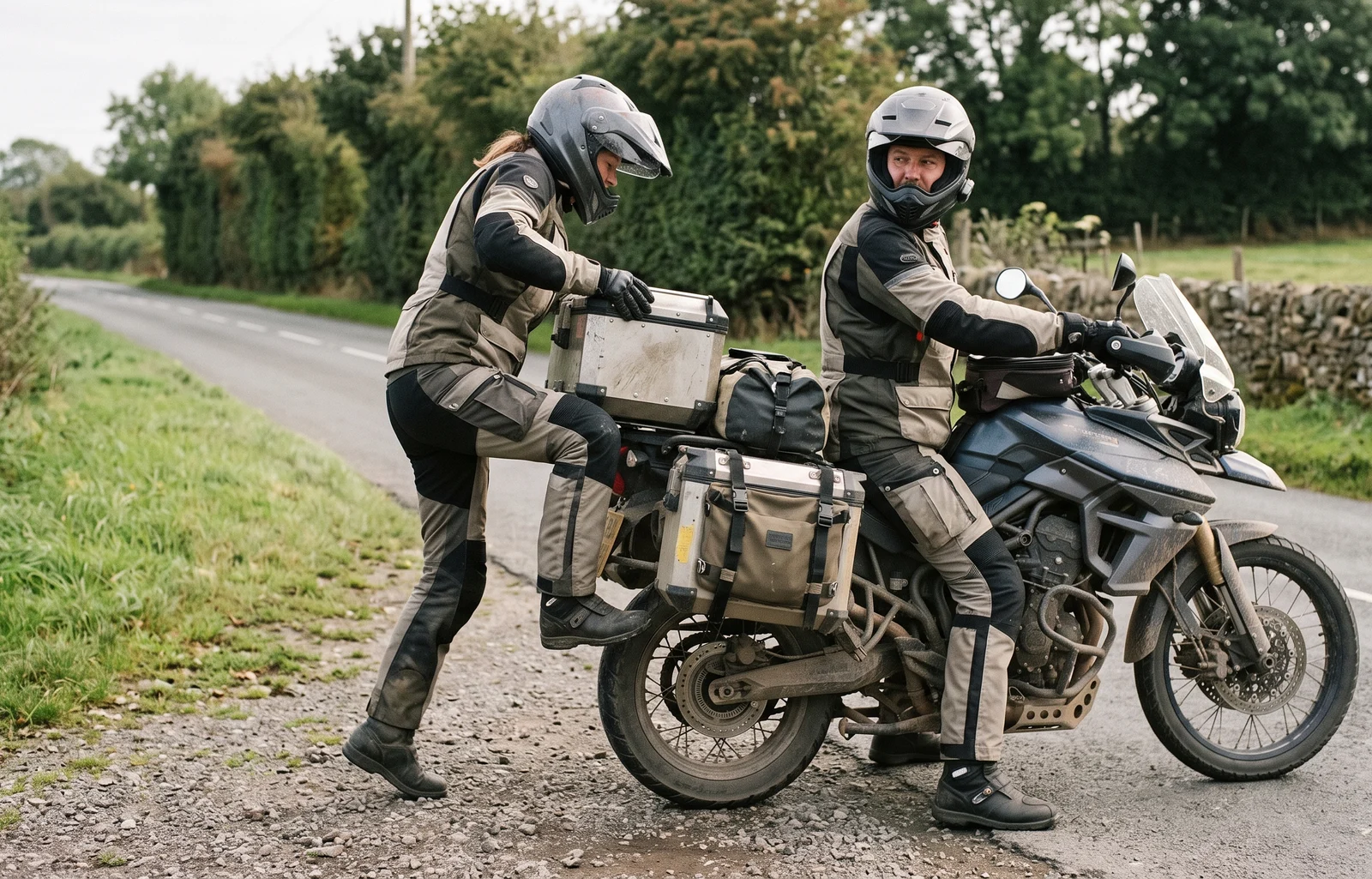
The same discipline applies at every stop. The most common two-up drop is a passenger getting off while the rider still has the bike on the sidestand and is looking the other way.
Feet stay on the pegs. Always. Including at traffic lights, including in queues. Feet come down out of instinct, find an exhaust or a moving wheel, and the passenger’s leg is somewhere you can’t see it.
Corners: neutral, and look over the inside shoulder. The passenger should stay in line with the bike and let it do the leaning. Telling them to “lean with the bike” invites over-enthusiastic leaning and a rider fighting the bike back upright. The more useful instruction is to look over your inside shoulder through the bend — it turns their head and shoulders the right way naturally, without any conscious leaning at all.
Hold on where it doesn’t unbalance you. Grab rails if the bike has usable ones, or the rider’s hips and waist. Shoulders are the worst option, because under braking all the passenger’s weight goes forward through your upper body exactly when you need to be stable on the controls. A pillion belt is a cheap fix on bikes with poor grab rails.
Agree on signals. Even with an intercom, have physical ones: a tap on the shoulder for “I need to stop”, a squeeze for “slow down”. Intercoms fail, and a shout inside a helmet at 100 km/h reaches nobody.
What Changes in Your Riding
The bike is heavier, longer to stop, and slower to change direction. All of the adjustments follow from that.
Everything gets smoother. Sharp throttle, abrupt gearchanges and grabbed brakes all translate into helmet-bumping in the seat behind you, and every bump erodes the passenger’s confidence in you. Smoothness is not politeness here — a relaxed passenger who trusts the rider stays neutral and stable, and a nervous one tenses up and moves around. Your smoothness is a handling input.
Brake earlier, and use both. The stopping distance goes up with the mass and there’s no way around it. Brake earlier and more progressively than you would solo; the passenger’s weight arriving on your back mid-stop is the thing to avoid. Practise a couple of firm stops in a quiet place before a big day so you both know what it feels like.
Low speed is where the bike feels worst. Getting under way, U-turns, car parks, filtering — with the extra mass high up, the balance point is much less forgiving. Take low-speed manoeuvres slowly and deliberately, use the rear brake to steady the bike, and don’t attempt a tight U-turn on a camber with a passenger aboard until you’ve practised it somewhere flat and empty.
Wind and overtakes. A loaded bike is slower to accelerate, so overtakes need more road than you’re used to judging. And a two-up bike presents more surface area to crosswinds and lorry wash. Leave bigger gaps for both.
Off pavement, reconsider. This is the honest bit. A fully loaded two-up adventure bike on loose gravel is a different machine — heavier, higher, and with a passenger who can’t see what’s coming and can’t weight the pegs to help. Everything in our off-road riding tips for loaded bikes matters more, and the threshold for “let’s not” should be much lower than when you’re solo. There’s no shame in riding the tarmac route two-up and saving the trail for a solo day.
Making a Long Two-Up Day Bearable
The rider has controls, a view, and something to do. The passenger has none of those, plus more wind and less room to move. Long days punish them more.
Shorter legs, real stops. Whatever your solo rhythm is, cut it. Stop before the passenger asks, get helmets off, walk about. A fuel stop with the engine running isn’t a break.
An intercom changes the day. Not for chatting — for the small things that make a passenger feel like a participant rather than luggage. “Bumpy bit coming”, “we’ll stop in twenty minutes”, “you okay?” Our intercom guide covers the options, and it’s genuinely the highest-value two-up purchase after the passenger’s own gear.
Disclosure: some links below are affiliate links. If you buy through them we may earn a small commission at no extra cost to you.
Compare the Cardo Packtalk Edge and Sena 50S on Amazon →
Comfort is a real problem, not a soft one. Standard pillion seats on adventure bikes are frequently an afterthought — small, hard and sloped. A pad or a better seat pays for itself on the second day — and pillion-sized cushions exist precisely because the rear seat is the narrowest, least supported perch on the bike. A backrest, where one is available for your bike, changes long motorway legs completely by giving the passenger something to push against instead of gripping.
Tell them the plan. Route, rough distances, where the stops are. Not knowing how long a leg is makes it feel twice as long, and a passenger who knows the plan can also be a useful second pair of eyes.
Motion sickness is common and manageable. Looking ahead over the rider’s shoulder rather than down or sideways helps most people, as does fresh air and avoiding a heavy meal beforehand. Keeping your inputs smooth is, again, part of the fix.
Heat and cold hit them harder. A passenger generates no heat working the controls and sits in your turbulence rather than clean air. In the cold they’ll be colder than you — see our cold-weather riding guide for the layering that actually works — and in the heat they’re just as prone to the dehydration covered in our hot-weather guide, while being less likely to say so.
Where the Luggage Goes Now
The pillion seat was your best luggage space, and you’ve just given it away. That leaves panniers and whatever sits behind the passenger — which is the worst possible place for weight, being both high and a long way behind the rear axle.
Three rules follow:
- Heavy items go low and forward, in the bottom of the panniers, as close to the bike’s centre as you can get them. The full logic is in our packing guide.
- Respect the sub-limits. Rack and top-box limits are much tighter than the total, and they’re the ones you’ll break first with the pillion seat occupied.
- Soft luggage saves real weight before you pack anything, because you’re not carrying racks and cases — several kilos that can go into the payload budget instead. Our soft versus hard panniers comparison covers the trade-offs.
The Rules
Worth knowing, because the specifics are more prescriptive than most riders realise.
The UK’s Highway Code, in its rules for motorcyclists, requires that:
- You must not carry a pillion passenger unless the motorcycle is designed to do so
- The passenger must sit astride the machine on a proper seat, facing forward, with both feet on the footrests
- You must not carry more than one pillion passenger
- Provisional licence holders must not carry a pillion passenger at all
- Both rider and passenger must wear a helmet
Other countries differ in the details — minimum passenger ages, requirements that the passenger’s feet reach the pegs, and so on — so check the rules where you’re going rather than assuming. If your trip crosses borders, our European border crossing documentation guide covers the wider paperwork picture.
The Bottom Line
Riding two-up well is mostly a setup and communication problem, not a heroic skill. Put the preload where the manual says, put the rear pressure up to the loaded figure, aim the headlight, and check the brakes. Give the passenger proper gear, an agreed on-off routine, and one clear instruction about corners. Then ride smoother and brake earlier than you think you need to, and stop more often than you would alone.
The one thing you can’t fix with technique is the weight budget. Read your bike’s maximum load, weigh what you’re actually carrying, and be honest about whether two people plus a camping kit fits. On most mid-size adventure bikes it doesn’t — and a brilliant two-up trip with a small bag each and a room booked beats a miserable overloaded one with a tent every single time.
Frequently Asked Questions
What do I need to change on the bike before carrying a passenger?
Three things at minimum, and all three are in your owner's manual. Increase rear suspension preload — Royal Enfield, for example, tells Himalayan 450 riders to use the third notch solo and the final notch when fully loaded. Raise the rear tyre pressure to the loaded figure: Honda's XL750 Transalp manual specifies 250 kPa rear for rider only and 280 kPa rear with a passenger, an increase of about 4 psi. And re-aim the headlight, because a loaded rear end tips the beam upward into oncoming traffic. Beyond that, check your brakes and tyres properly, since both are about to work harder than they've ever worked on your bike.
How should a passenger sit and hold on?
Astride the bike on a proper passenger seat, facing forward, with both feet on the footrests at all times — including when the bike is stopped at lights, which is when feet come off and boots find hot exhausts. For holding on, the options in rough order of preference are the grab rails if the bike has good ones, the rider's hips or waist, or a purpose-made pillion belt. Gripping the rider's shoulders is worse than it looks, because it transmits the passenger's weight forward under braking and unbalances you exactly when you need stability. The single most useful instruction to give: look over the rider's inside shoulder in corners, and otherwise stay neutral — no leaning independently of the bike.
Is it legal to carry a passenger on any motorcycle?
No, and the rules vary by country. In the UK, the Highway Code's rules for motorcyclists state that you must not carry a pillion passenger unless the motorcycle is designed to do so, the passenger must sit astride on a proper seat with both feet on the footrests, you may carry no more than one pillion, provisional licence holders must not carry a passenger at all, and both rider and passenger must wear a helmet. Elsewhere the details differ — some jurisdictions set a minimum passenger age or require the passenger's feet to reach the pegs — so check the rules for the countries you'll ride through rather than assuming your home rules travel with you.
Can I carry a passenger and camping gear on a mid-size adventure bike?
Usually not within the manufacturer's published limit, and this surprises people. Take a Yamaha Ténéré 700, rated at a maximum load of 186 kg (410 lb) covering rider, passenger, luggage and accessories. A rider in full gear at around 95 kg plus a passenger in full gear at around 75 kg is already 170 kg, leaving roughly 16 kg for the panniers themselves and everything in them — which a camping kit exceeds comfortably. Some bikes have more headroom, but the pattern holds across the class. Two-up plus a full camping load generally means either a bigger bike, a much shorter kit list, or nights in beds rather than a tent.
How do I stop my passenger feeling sick or miserable on a long day?
Plan the day around them, not around your usual pace. Passengers get a worse deal than riders on every axis: no controls to occupy them, no advance warning of what the bike is about to do, a smaller view, more wind, and less ability to shift position. The fixes are unglamorous and they work — shorter legs between stops than you'd ride solo, real breaks rather than fuel-and-go, an intercom so they know what's coming and can say when they've had enough, and letting them look ahead over your shoulder rather than at the back of your helmet, which helps a lot with motion sickness. Also tell them the plan before you set off: where you're going, roughly how long the legs are, and where the stops will be. Uncertainty is most of what makes a long pillion day feel endless.