
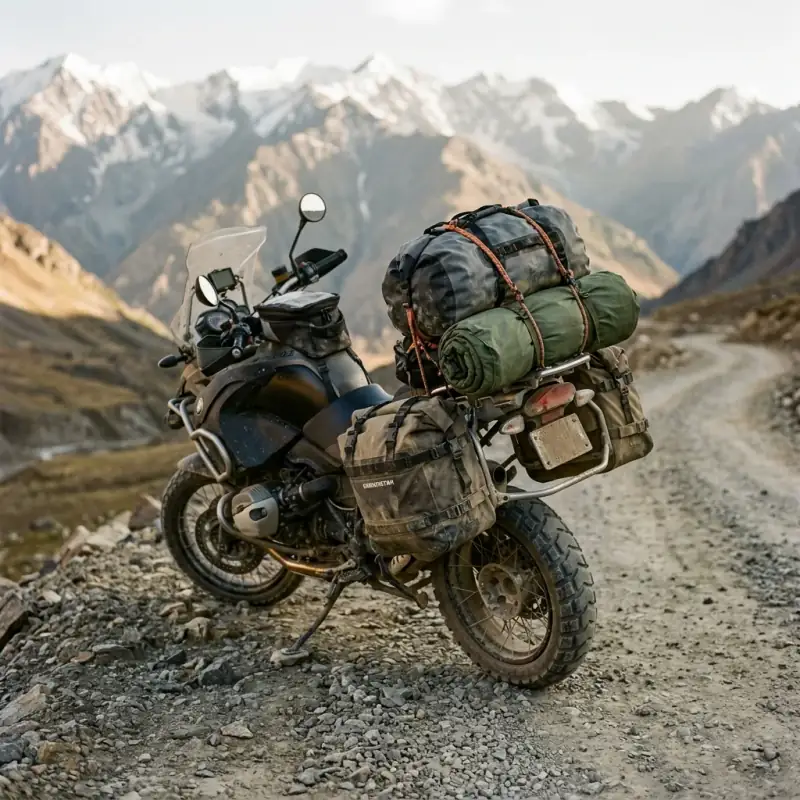
There’s a number in your owner’s manual that most riders have never looked at, and it quietly decides what kind of trip your motorcycle can actually do.
It’s the maximum load — the total weight of rider, passenger, luggage, the contents of the luggage, and every accessory you’ve bolted on. Manufacturers publish it, they mean it, and it is consistently far lower than riders assume. Do the arithmetic on a mid-size adventure bike with two people aboard and you’ll frequently find the camping gear has nowhere legal to go.
This isn’t a rule-of-thumb article. Every figure below was taken from the manufacturer’s own owner’s manual or official specification sheet, and the source is named in each row. Along the way we hit several limits that almost nobody talks about: a maximum luggage weight of 19.5 kg on one popular bike, a 5 kg limit on a luggage rack plate, and two manufacturers that impose a speed limit on a loaded bike.
Three Names for the Same Idea
Manufacturers describe this in incompatible ways, which is half the reason riders can’t find the number.
- Maximum load / maximum weight capacity / maximum payload — what you’re allowed to add. Yamaha, Honda, Triumph and Royal Enfield use this style. It’s the directly useful figure.
- G.V.W.R. / maximum permissible total weight / permitted total weight — the bike plus everything. Suzuki, KTM, Harley-Davidson and BMW use this style. To get the useful number you subtract the bike’s kerb weight yourself.
- Maximum axle load — a separate cap on how much can sit over each end. KTM and Harley-Davidson publish these. You can be under the total and still over the rear.
They’re not interchangeable, and mixing them up is how you end up comparing a 450 kg figure against a 186 kg one and concluding one bike carries two and a half times more than the other. It doesn’t.
The Chart: Published Maximum Loads, 9 Adventure Bikes
Manufacturer Max Load — Side by Side
| Motorcycle | Kerb / curb weight | What the maker publishes | Load you can add | Source |
|---|---|---|---|---|
| Most capacityKTM 890 Adventure | 200 kg without fuel | Max permissible total weight 450 kg | ≈ 235 kg | KTM owner's manual |
| Triumph Tiger 900 Rally | — | Max payload 222 kg | 222 kg | Triumph owner's handbook |
| Honda XL750 Transalp | 210 kg (463 lb) | Max weight capacity 207 kg · max luggage 19.5 kg | 207 kg | Honda owner's manual |
| Suzuki V-Strom 800 | 223 kg (492 lb) | G.V.W.R. 430 kg | ≈ 207 kg | Suzuki owner's manual |
| Lightest bikeRoyal Enfield Himalayan 450 | 195 kg | GVW 394 kg · max reference payload 196 kg | 196 kg | Royal Enfield owner's manual |
| Harley-Davidson Pan America 1250 Special | 254 kg (559 lb) | GVWR 455 kg · axle 181 kg front / 302 kg rear | ≈ 201 kg | Harley-Davidson spec sheet |
| Suzuki V-Strom 800DE | 230 kg (507 lb) | G.V.W.R. 430 kg | ≈ 200 kg | Suzuki owner's manual |
| Triumph Tiger 900 GT Pro | — | Max payload 194 kg | 194 kg | Triumph owner's handbook |
| Least capacityYamaha Ténéré 700 | 208 kg (459 lb) | Maximum load 186 kg (410 lb) | 186 kg | Yamaha owner's manual |
Notes on the figures, because the detail matters:
- KTM publishes a dry-ish weight (200 kg without fuel) and a 450 kg total. With the manual’s stated 20-litre tank, a full fill is roughly 15 kg of petrol, which puts the ready-to-ride bike near 215 kg and the addable load near 235 kg. That last step is our arithmetic, not KTM’s published number — treat it as an estimate.
- Suzuki’s G.V.W.R. comes with a condition. The manual states the 430 kg rating “at the tire pressure (cold)” of 225 kPa front / 280 kPa rear for the 800DE. The rating assumes you’re running the specified pressures. Ride under-inflated and you’ve quietly moved outside the terms of the number.
- Triumph’s two Tiger 900 variants differ by 28 kg — 194 kg for the GT Pro, 222 kg for the Rally. Same model name, very different answer. This is why “how much can a Tiger 900 carry” has no single answer, and why you need your manual.
- Kerb weights are given only where the same manufacturer document supplies them, which is why the Triumph rows are blank rather than filled from a third-party spec site.
- BMW R 1300 GS and Honda Africa Twin are absent. Both are obvious candidates, and we couldn’t retrieve a maximum load figure from a manufacturer source we could verify, so we’ve left them out rather than publish a number we can’t stand behind. If you own one, the figure is in your manual and on the bike’s own label — and it’s worth five minutes to go and read it.
Now the Arithmetic That Ruins Everyone’s Weekend
Take the Ténéré 700, because it’s a bike this site knows well and because it has the tightest limit here: 186 kg.
| What you’re loading | Realistic weight |
|---|---|
| Rider, dressed to ride (helmet, jacket, trousers, boots, gloves) | ~95 kg |
| Passenger, dressed to ride | ~75 kg |
| Subtotal — two people | ~170 kg |
| Remaining for everything else | ~16 kg |
Sixteen kilograms. Now price that out honestly: soft panniers and their mounting hardware, a tent, a sleeping bag, a mat, a stove and fuel, cookware, water, tools, spares, a couple of days of clothes, a first aid kit, chargers. A pared-down solo motorcycle camping kit doesn’t fit in 16 kg — our camping gear checklist alone runs past it long before you’ve added water. And the panniers themselves have to come out of that budget before you’ve put anything in them.
That’s the headline finding, and it isn’t a trick of the example: on a mid-size adventure bike, two people plus a camping kit does not fit inside the manufacturer’s published limit. Riders do it anyway, constantly, and mostly get away with it. But “mostly get away with it” is a different statement from “the bike is rated for it”, and it’s worth knowing which one you’re doing.
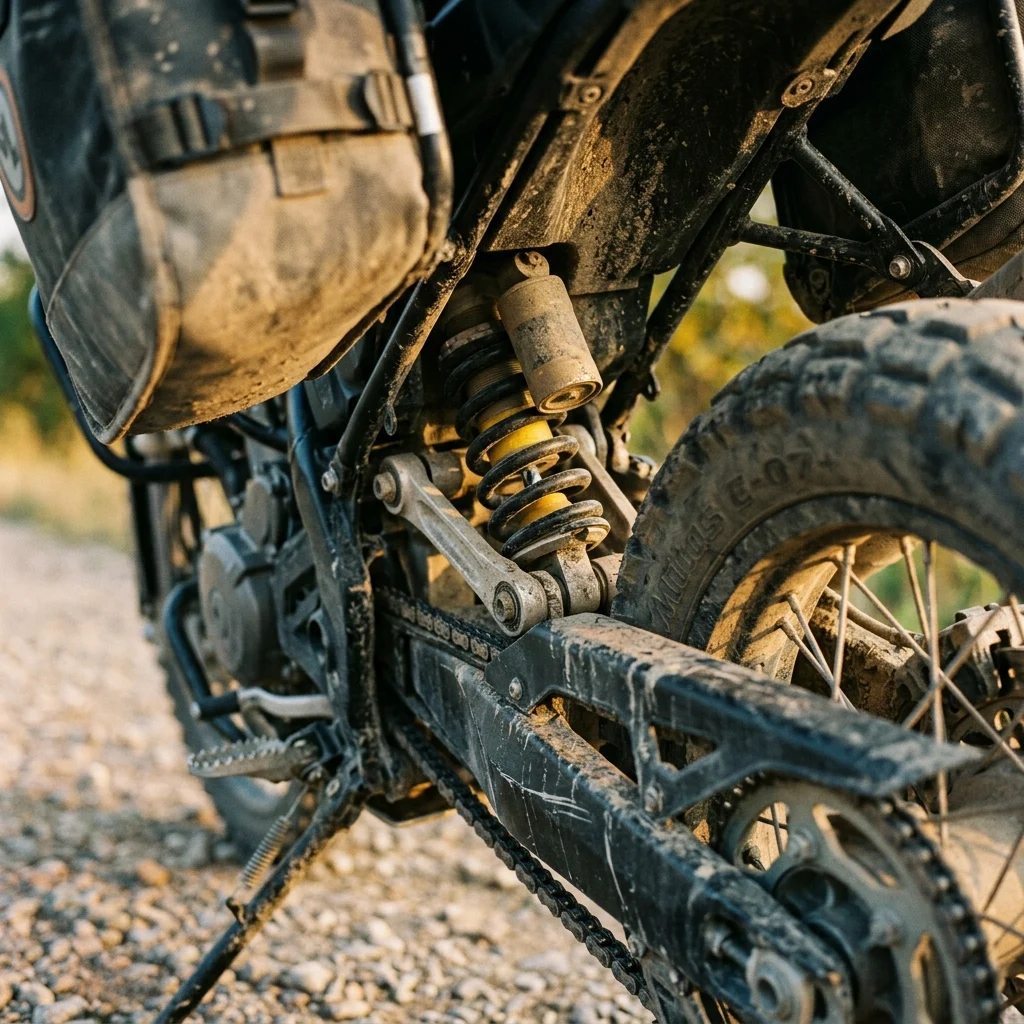
If you’re planning to ride two-up, the practical consequences of all this — how the bike behaves, what to change, what to leave at home — are the subject of our guide to riding two-up on an adventure bike.
The Sub-Limits Nobody Mentions
The total is only the first test. Manufacturers set local limits too, and these are the ones that catch experienced riders.
Honda caps Transalp luggage at 19.5 kg
Honda’s XL750 Transalp manual lists a maximum weight capacity of 207 kg and, separately, a maximum luggage weight of 19.5 kg (43 lb). That’s not 19.5 kg per side. That’s the lot: panniers, top box, roll bag, tank bag and everything inside them.
Nineteen and a half kilos is a tent, a sleeping bag, a mat, and then you start making hard choices. It’s a genuinely restrictive number and it’s printed in the manual of one of the best-selling middleweight adventure bikes on sale.
KTM caps the rack plate at 5 kg
The 890 Adventure manual states a maximum permissible load on the luggage rack plate of 5 kg (11 lb). Many aluminium top boxes weigh close to that empty. The rack plate limit is separate from — and much tighter than — the bike’s total.
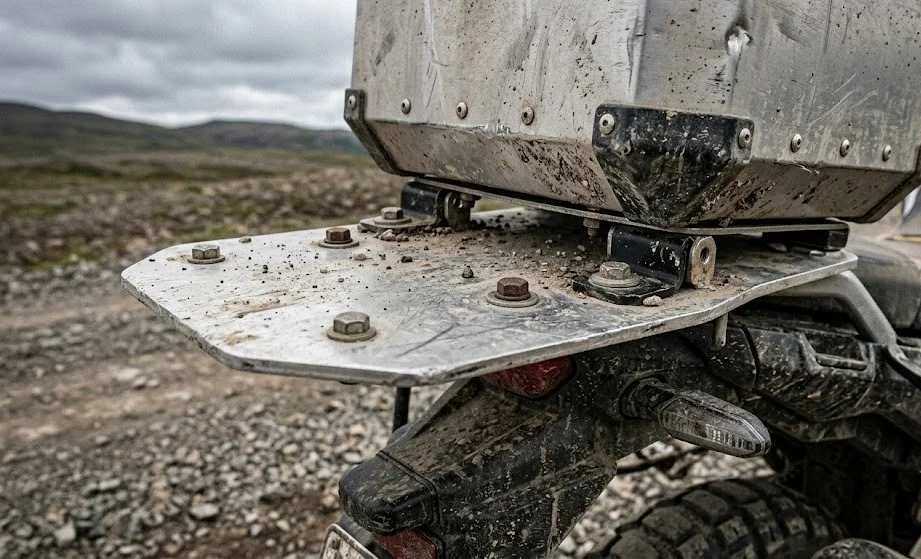
The physics behind it is straightforward: weight sitting high and a long way behind the rear axle has an outsized effect on stability, and it’s the classic reason a bike that felt fine in the car park starts weaving at motorway speed. This is also why our packing guide puts heavy items low and forward and treats the top box as the place for a jacket and a sandwich, not tools.
KTM and Harley publish axle limits
KTM: 175 kg maximum front axle load, 275 kg rear. Harley-Davidson on the Pan America Special: GAWR 181 kg front, 302 kg rear, inside a 455 kg total.
Because adventure luggage lives behind the rider, the rear axle limit is the one you’ll reach first. You can be comfortably under the total and still overloading one end of the motorcycle.
Two manufacturers impose a loaded speed limit
This is the finding that surprised us most, and it comes straight from the manuals.
Royal Enfield, Himalayan 450 owner’s manual: “Do not exceed 110 km/h (68.3 mph) when riding solo, carrying a pillion or payload on an accessory equipped motorcycle.”
Honda, XL750 Transalp owner’s manual: “Always ride at a safe speed and never exceed 130 km/h (80 mph) for the load you are carrying.”
Neither is a legal speed limit. Both are the manufacturer telling you the envelope it validated the loaded motorcycle inside. If you’ve ever wondered whether a fully-laden adventure bike is happy sitting at an autobahn cruise, at least two makers have answered in writing.
Why the Number Exists
It’s tempting to read a maximum load as legal cover — a figure lawyers invented. It isn’t. Every part of it is doing a job.
Suspension travel is finite. Springs are chosen for an expected load range. Past it, the suspension sits deep in its travel with little left for a pothole, which is exactly when it bottoms out — mid-corner, on a bump, with a passenger aboard. Setting the preload your manual specifies for a loaded bike restores most of that travel and costs nothing — BMW, KTM, Yamaha and Royal Enfield all publish load settings, which we’ve collected in our suspension setup guide for loaded touring. Uprated springs genuinely help too and are among the best upgrades for a two-up tourer, but neither moves the manufacturer’s number, because the number isn’t only about springs.
Brakes size to a mass. More mass, more energy to shed, longer stopping distance and more heat in the system. Honda’s own loading warning says it plainly: carrying extra weight affects handling, braking and stability. On a wet road that penalty compounds with the reduced grip covered in our wet-riding guide.
Tyres have load indexes. The load rating stamped on the sidewall is a real limit, and it interacts with pressure — which is precisely why Suzuki ties its G.V.W.R. to a stated cold pressure. Under-inflate a heavily loaded tyre and you get more flex, more heat, and the failure mode nobody wants at speed. If you’re near the limit, set pressures to the manual’s loaded figure and check them cold, properly, before every big day. Our tyre pressure guide collects the published figures for nine bikes, including the separate “full payload” pressures KTM specifies.
Geometry moves. A squatting rear end slackens the steering and lightens the front. The bike stops turning in the way you learned it turns, which matters most on exactly the loose surfaces adventure riders seek out — see our off-road riding tips for loaded bikes for how much technique has to change.
How to Find and Use Your Own Number
- Get the figure. Owner’s manual first — check both the loading section near the front and the specifications table at the back, because manufacturers often print it twice under different names. Then look for a label on the bike (swingarm, headstock, under the seat). Then the registration document.
- Convert it if necessary. If your maker publishes a total (G.V.W.R. / permissible total weight), subtract the kerb weight from the same document to get what you can add. Don’t mix a total from one source with a kerb weight from a spec website; they may be measured differently.
- Weigh yourself dressed. Not your gym weight. Helmet, jacket, trousers, boots, gloves, whatever’s in the pockets. It’s usually 5–8 kg more than people assume.
- Weigh the luggage empty. Panniers, racks, mounts and straps are part of the payload and are easy to forget — a set of hard cases with racks can be well over 20 kg before anything goes in.
- Weigh the packed load on bathroom scales. Stand on the scales holding each bag. It takes ten minutes and it’s the only honest way to find out.
- Check the sub-limits. Total, luggage limit, rack limit, axle limits, and any speed or tyre-pressure conditions attached.
If the sum doesn’t fit, the options are the obvious ones and they’re all better than ignoring it: carry less, ship some of it ahead, move to a bike with more capacity, or don’t take the passenger on the camping legs. Our two-week packing guide is largely an exercise in the first of those, and the soft versus hard luggage comparison is relevant to the second — soft luggage saves several kilos of racks and cases before you’ve packed a thing.
The Bottom Line
The published maximum loads on adventure motorcycles are lower than the marketing photographs suggest. Between roughly 186 kg and 235 kg, across the nine bikes here, covering rider, passenger, luggage and everything in it. Two adults in riding gear eat most of that on their own.
None of which means you can’t tour. It means the honest version of adventure touring on a middleweight is a solo rider travelling light, or two people travelling very light indeed and staying in places with beds. The bikes are brilliant at the first. They’re being asked to do something outside their published envelope in the second, and the manufacturers have said so in print — including, on two of these bikes, with a speed limit attached.
Go and read your own manual. It takes five minutes, the number is in there twice, and it may well change what you pack for next summer.
Frequently Asked Questions
How much weight can an adventure motorcycle carry?
Less than almost everyone assumes. Across the nine bikes in this guide — all figures taken from the manufacturers' own owner's manuals or official spec sheets — the published maximum load lands between roughly 186 kg and 235 kg (about 410 to 520 lb), and that figure has to cover rider, passenger, all luggage, everything in the luggage, and any accessories bolted to the bike. A Yamaha Ténéré 700, for example, is rated at 186 kg (410 lb) total. Once a 95 kg kitted rider and a 75 kg kitted passenger are aboard, that leaves about 16 kg for everything else — which is less than a typical motorcycle camping kit weighs before you add the panniers themselves.
Where do I find my own motorcycle's maximum load?
Three places, in order of reliability. First, the owner's manual — usually in the loading or safety section near the front, and again in the specifications table at the back, listed as 'maximum load', 'maximum weight capacity', 'G.V.W.R.' or 'maximum permissible total weight'. Second, a label on the bike itself; many models carry a load or tyre-information sticker on the swingarm, headstock or under the seat. Third, the registration document, which in many countries lists a permissible gross weight. Watch out for two traps: the figure changes between model years and between markets, and some manufacturers quote a maximum *load* (what you can add) while others quote a maximum *total weight* (bike plus load), which you have to subtract the bike's kerb weight from to get anything useful.
What happens if I exceed the motorcycle's weight limit?
Nothing dramatic in the first mile, which is exactly why it's easy to ignore. What changes is everything that depends on load: the suspension runs out of usable travel and starts bottoming, braking distances lengthen, the steering geometry alters as the rear squats, tyres run hotter and are stressed beyond their load rating, and the bike becomes less willing to change direction — all of it worst in the emergency you didn't plan for. Manufacturers take it seriously enough to attach their own conditions: Royal Enfield's Himalayan 450 manual tells riders not to exceed 110 km/h (68.3 mph) when carrying a pillion or a payload on an accessory-equipped bike, and Honda's Transalp manual says never to exceed 130 km/h (80 mph) for the load being carried. Those are the makers' words, not ours.
Is the luggage weight limit different from the total payload?
Often yes, and this catches people out badly. Honda publishes a maximum weight capacity of 207 kg for the XL750 Transalp — but separately caps maximum luggage weight at 19.5 kg (43 lb). KTM's 890 Adventure manual limits the luggage rack plate to 5 kg (11 lb), which an empty top box can approach on its own. These sub-limits exist because a load's position matters as much as its mass: weight carried high and far behind the rear axle has far more effect on handling than the same weight low and central. So there are really two tests to pass — the total, and wherever the manufacturer has set a local limit.
Can I fit stiffer suspension to raise the weight limit?
No. Uprated springs and a better shock will make an overloaded bike feel much better, and if you tour two-up or heavily loaded they're among the most worthwhile upgrades you can buy — but they don't change the manufacturer's rating. The published limit reflects the whole system: frame, subframe, wheels, brakes, tyre load ratings and axle loads, not just the springs. KTM, for instance, publishes separate maximum axle loads (175 kg front, 275 kg rear on the 890 Adventure) alongside the 450 kg total, and Harley-Davidson does the same for the Pan America. Better suspension fixes the symptom you can feel. It doesn't raise the number.