
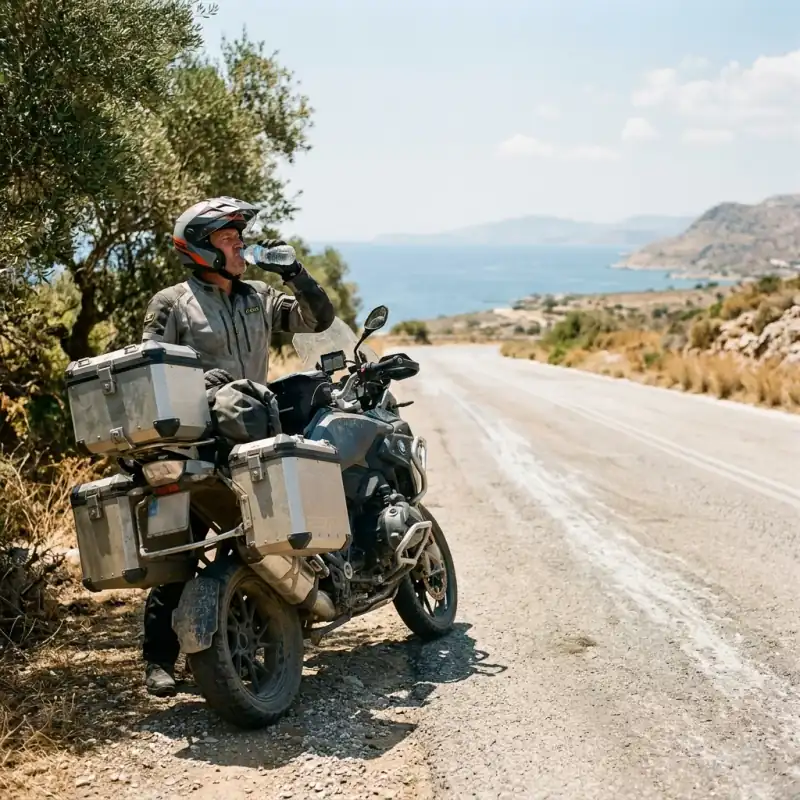
Heat is the danger that doesn’t announce itself. Cold you feel coming — your hands go numb, you start shivering, you know to stop. Heat works the other way. On a moving bike, the wind evaporates your sweat the instant it forms, so you can be pouring out fluid and feel bone dry the whole time. By the point you’re properly thirsty, you’re already behind; by the point you feel foggy and irritable, your judgement — the thing keeping you upright at 110 km/h — has already dulled. Nobody plans to get caught out by heat. They just don’t notice it happening.
This guide is about riding a long, hot day well: how to dress for it, how to stay ahead of the fluid you’re losing, how to plan the day so the worst of the heat works for you instead of against you, and — the part most guides skip — how to tell ordinary end-of-day tiredness from the first real signs of heat illness. It leans toward adventure and touring riders putting in big days in seriously hot places: a Mediterranean coast in August, inland Anatolia, southern Spain, anywhere the midday sun turns tarmac into a griddle.
Why Heat Is More Dangerous on a Bike Than It Feels
Two things make heat sneaky on a motorcycle, and they compound each other.
The first is that the wind hides how much fluid you’re losing. Standing still in 35°C you’d feel sweat running off you and instinctively drink. Riding, that sweat flashes off your skin the moment it appears, so the feedback loop that normally tells you to hydrate never fires. Riders in hot, dry air can lose a serious amount of fluid an hour this way. The exact figure varies by source and conditions, but something like the better part of a litre an hour is a sensible planning number for a hot day, and it can be more; all of it invisible.
The second is that dehydration attacks judgement before anything else. Even mild dehydration — on the order of a couple of percent of body weight, which is easy to hit on a hot morning — is widely reported to blunt concentration, reaction time and decision-making. On a bike those are exactly the faculties you’re relying on to read a corner, judge a gap, or notice the gravel on the apex. So the danger isn’t just feeling rough at the end of the day; it’s that your riding quietly gets worse in the middle of it, at the moment you’re least able to notice.
A rough way to think about the threshold: humidity matters as much as raw temperature, so the heat index — the “feels like” figure that combines the two — is what to watch. Once it’s past about 95°F (35°C) you should be actively managing heat rather than just enduring it; past roughly 110°F (43°C) it’s genuinely hazardous and worth reshaping your day around. Treat those as guidelines rather than hard rules — how you personally cope depends on fitness, hydration and acclimatisation as much as the number.
Dress for the Heat (Without Undressing for the Crash)
The instinct when it’s hot is to take gear off. It’s the wrong instinct — a summer get-off strips skin just as efficiently as a winter one, and hot tarmac is more abrasive, not less. The goal is to lose heat, not protection. That splits into two regimes depending on how hot it actually is.
When the air is cooler than you (up to roughly your body temperature), airflow is king. A well-vented mesh jacket lets moving air pull heat and sweat off you, and it’s hard to beat in warm-but-not-extreme conditions. Pair it with light colours, which reflect rather than soak up the sun. Our adventure motorcycle jackets guide breaks down the ventilated options and where the armour sits; the summer-glove picks in the adventure gloves guide follow the same logic; short, vented, but still armoured.
When the air is hotter than you are — very roughly the mid-30s°C and beyond — airflow flips from friend to enemy. A blast of air that’s hotter than your skin stops cooling you and starts doing the opposite: drying you out faster and pushing heat into you, the way a fan-forced oven cooks quicker than a still one. This is the counter-intuitive bit that catches riders out in a heatwave: past a certain point, more mesh and more wind makes things worse, not better. In that range the smart move is to cover skin against direct sun and switch your cooling strategy to evaporation you control.
That’s where a wetted evaporative layer earns its place. An evaporative cooling vest — soak it, wring it out, wear it under a vented jacket — holds water in a special fabric and cools you as it slowly evaporates over a few hours, effectively giving you a controlled version of the sweat-cooling the dry wind keeps stealing. TechNiche’s HyperKewl vests are one widely sold example; the manufacturer rates them for something like 5–10 hours of cooling per soak and a soak time of a minute or two, and they re-wet at any fuel-stop tap. It won’t turn 42°C into pleasant, but it takes the edge off the worst of the day.
Disclosure: some links below are affiliate links. If you buy through them we may earn a small commission at no extra cost to you.
Check the HyperKewl cooling vest on Amazon →
A base layer matters too, but pick a technical wicking one, not cotton — cotton soaks and stays wet against your skin in a clammy way, while a wicking layer moves moisture out to evaporate. And keep a light neck buff or gaiter in the mix; a bare neck is a surprisingly large window for the sun.
And think about the sun, not just the heat. A bright day is a full day of glare, so run a tinted visor or sunglasses under a clear one to cut the eye-fatigue that builds over hours in the saddle. Put sunscreen on the parts that catch direct sun all day too — the backs of your hands and your neck especially, the bits your gear leaves exposed — because sunburn is its own slow drain on a long ride.
Check SPF50 sport sunscreen on Amazon →
Hydration Is the Whole Game
If you do one thing from this guide, make it this: drink before you’re thirsty, and keep sipping. Thirst is a lagging indicator in the heat, and on a bike it lags even further because the wind masks your fluid loss. Waiting until you want a drink means topping up a deficit rather than preventing one.
The single biggest practical upgrade is a hydration pack — a bladder in a small backpack with a bite valve you can reach on the move. It changes the behaviour entirely: instead of gulping half a bottle at each fuel stop (which your gut can’t absorb all at once anyway), you take small, frequent sips every few minutes, which is exactly how the body wants the fluid delivered. For riding specifically, a low-bounce design matters. The packs built for enduro and adventure riders, like USWE’s Moto Hydro line with their snug “no bounce” harness, are made to sit still over body armour rather than flapping around at speed. A 3-litre pack is plenty for a day; the adventure-fit versions are cut to go over a protective jacket.
Check the USWE Moto Hydro on Amazon →
Two refinements make a hot day easier:
- Add electrolytes on long or very sweaty days. When you sweat you lose salts, not just water, and drinking only plain water for hours can leave you low on them. Alternating water with an electrolyte mix (tablets or powder you add to the bladder or a bottle) helps you actually hold onto the fluid you’re drinking.
- Start cold and it stays cooler longer. Freezing a bottle of water overnight and dropping it in a pack, or filling the bladder with ice and water, buys you cold drink well into a hot morning. Cold fluid is also a small but real way to shed core heat from the inside.
Shop electrolyte tablets on Amazon →
If you’re wild camping in the heat, carrying enough water becomes a genuine planning problem rather than an afterthought — remote coastal spots rarely have a tap, so work out where you’ll refill before you commit to a night out there.
Cool the Places That Cool You Fastest
Your body sheds heat fastest where big blood vessels run close to the surface — the neck, the wrists, the head. You can target those directly.
An evaporative neck gaiter — the kind you wet at a stop and pull on — sits right over the blood flow to your head and gives a disproportionate amount of relief for something so small and cheap. The evaporative-fabric ones (Ergodyne’s Chill-Its gaiters are a common example) activate with a splash of water, carry a sun rating for the back of your neck, and re-wet in seconds at any tap. It’s a small, cheap thing that earns its space on a brutal day.
Check the Ergodyne cooling gaiter on Amazon →
At stops, get water onto your wrists and the back of your neck, and get your helmet off in the shade so the heat trapped against your head can escape. Those spots sit right over blood heading back to your core, so a minute or two cooling them goes further than the same minute spent anywhere else.
Ride the Day, Not Just the Road
In real heat, when you ride is as important as how you’re dressed. Reshaping the day is free and it’s the most effective single change you can make.
- Ride the cool ends. Early morning and the last of the evening are dramatically more pleasant and safer than the midday peak. On a hot trip, starting at first light and being done by early afternoon turns a survival exercise into a good ride. This is also just good touring rhythm — our long-distance trip planning guide covers building a day around conditions rather than mileage.
- Take the middle of the day off. The Mediterranean worked this out centuries ago, and as a rider you can borrow the siesta: park up in the shade through the worst two or three hours, eat, drink, and let the peak pass. In much of southern Europe and Turkey the shops and sights are shut then anyway, so you lose very little by resting through it.
- Mind the traffic queues. Heat and stop-start traffic are a bad pairing: with no airflow, engine heat radiates up at you and your own cooling stalls. Ferry queues, town centres and the tailbacks around coastal hotspots are where riders overheat — including the bike. If you’re crawling, that’s the moment to be sipping water, not gritting it out.
- Check the bike, not just yourself. Hot asphalt plus an underinflated tyre is a blowout risk, so keep pressures right, and keep an eye on the temperature gauge — even a liquid-cooled ADV engine (which is most of them now) leans on airflow it isn’t getting in a slow crawl, and the cooling fan cutting in is your cue that both of you are working hard. A hot coastal run like the Aegean coast route or the Mediterranean coastal roads is exactly the kind of ride where the heat and the traffic both peak at once.
Know the Line: Tired, or in Trouble?
This is the part worth reading twice, because it’s the difference between a rough afternoon and a hospital.
Heat exhaustion is the warning stage — your body coping hard but still coping. According to health authorities like the CDC, the signs are heavy sweating; cool, pale or clammy skin; a fast, weak pulse; dizziness, headache, nausea, and a heavy, drained weakness. If that’s you or someone in your group: stop, get into shade, get fluids in, open or remove gear, and cool the head, neck and wrists with water. Treated promptly, heat exhaustion resolves. Ignored, it progresses.
Heat stroke is the emergency stage. The body’s cooling system has failed. The tell-tale flip is that heavy sweating stops and the skin turns hot and dry (though it can still be damp), body temperature climbs fast, and — the sign that matters most — the person becomes confused, disoriented, slurring, or stops making sense. That mental change is the red line. Heat stroke can bring on seizures or unconsciousness and can be fatal or cause lasting damage. If you see it: treat it as a 911-level emergency, call the local emergency number, move the person into shade, and cool them as aggressively as you can — water, wet cloths, fanning, ice to the neck and armpits if you have it; while help comes.
The practical takeaway for riders is the transition. Everyone gets tired and hot on a long summer day; that alone isn’t alarming. The moment to act hard is when “tired and hot” becomes “stopped sweating and not thinking straight.” If you ride in a group, make that an explicit thing you watch for in each other, because the person tipping into heat stroke is often the last to realise it.
The Bottom Line
Heat rarely drops a rider dramatically. It works quietly: a little more fluid lost than you notice, a little slower on the controls than you’d like, a little foggier in the head than you’d admit — until a decision you’d normally make easily goes wrong. Everything in this guide is aimed at keeping that slow slide from starting. Drink ahead of your thirst and make sipping effortless. Dress for the sun and switch to evaporative cooling when the wind turns against you. Ride the cool ends of the day and rest through the furnace in the middle. And keep one line filed away where you can’t lose it: when the sweating stops and the thinking goes, that’s not fatigue, that’s the emergency, and it’s time to stop and call for help.
Do that, and a genuinely hot ride becomes what it should be — a long, bright, memorable day — instead of the one that got away from you. When the weather turns the other way, the same “manage the conditions, not just the road” thinking carries over to our guides on motorcycle camping in the rain and — the mirror image of this article — riding in cold weather, where the danger runs the opposite way: cold takes your hands and your judgement long before you’d admit you’re struggling.
Disclosure: Some links in this article are affiliate links. If you buy gear through them, Bikes & Bays earns a small commission at no extra cost to you. We only link to gear that earns its place, and skip the button when nothing’s worth recommending.
Frequently Asked Questions
What temperature is too hot to ride a motorcycle?
There's no single cut-off, because humidity matters as much as the number on the thermometer — the heat index (temperature plus humidity) is the better measure. As a rough guide drawn from riding and heat-safety sources, once the heat index climbs past about 95°F (35°C) the strain on your body starts to bite and you should be actively managing it with hydration, ventilation and breaks; above roughly 110°F (43°C) it becomes genuinely dangerous and worth avoiding the worst of the day entirely. Those are guidelines, not hard lines — a fit, well-hydrated rider in dry air copes better than the numbers suggest, and a tired, dehydrated one in humidity struggles sooner. The more useful habit is to watch yourself, not just the forecast.
Is mesh gear or a ventilated waterproof jacket better in summer heat?
It depends on how hot it actually is. Below body temperature, flowing air cools you, so a mesh jacket that lets a lot of air through is hard to beat. But once the air is hotter than you are — very roughly the mid-30s°C and up — that same airflow stops cooling and starts drying you out faster while adding heat, a bit like a fan-forced oven. In that range, many riders do better covering up against the sun and leaning on evaporative cooling (a wetted cooling vest or neck gaiter) than on raw airflow. A ventilated adventure jacket with a waterproof liner you can remove is the versatile compromise for a trip that mixes hot valleys with cool mountain mornings. Whatever you choose, don't strip off armour to cool down — road rash doesn't care about the weather.
How much water should I drink on a hot motorcycle ride?
More than thirst tells you to, and before you feel you need it. Riders can lose a large amount of fluid per hour in real heat — estimates vary, but the better part of a litre an hour is a reasonable planning figure for a hot day, and sometimes more — much of it evaporating instantly in the wind so you never feel sweaty. The practical approach is small, frequent sips rather than one big drink at a fuel stop, which is far easier with a hydration pack you can drink from on the move. On long or very hot days, plain water alone can leave you low on the salts you're sweating out, so alternating with an electrolyte drink helps. If you've stopped needing to pee, or your urine is dark, you're already behind.
What's the difference between heat exhaustion and heat stroke, and how do I spot it on a ride?
It's the single most important thing to know, because one is a warning and the other is an emergency. Heat exhaustion looks like heavy sweating, cool or clammy skin, a fast weak pulse, dizziness, headache, nausea and weakness — if you feel that, stop in the shade, get fluids in, loosen or open your gear and cool your head and neck. Heat stroke is when the body's cooling fails: the tell-tale flip is that heavy sweating stops and the skin goes hot and dry (or still damp but the person is clearly unwell), body temperature climbs fast, and — most importantly — the person becomes confused, disoriented, or worse. That is a medical emergency: stop riding, call the local emergency number, and cool the person aggressively while you wait. If you're riding in a group in heat, watch each other for the moment 'tired' tips into 'not making sense' — that's the line that matters.