
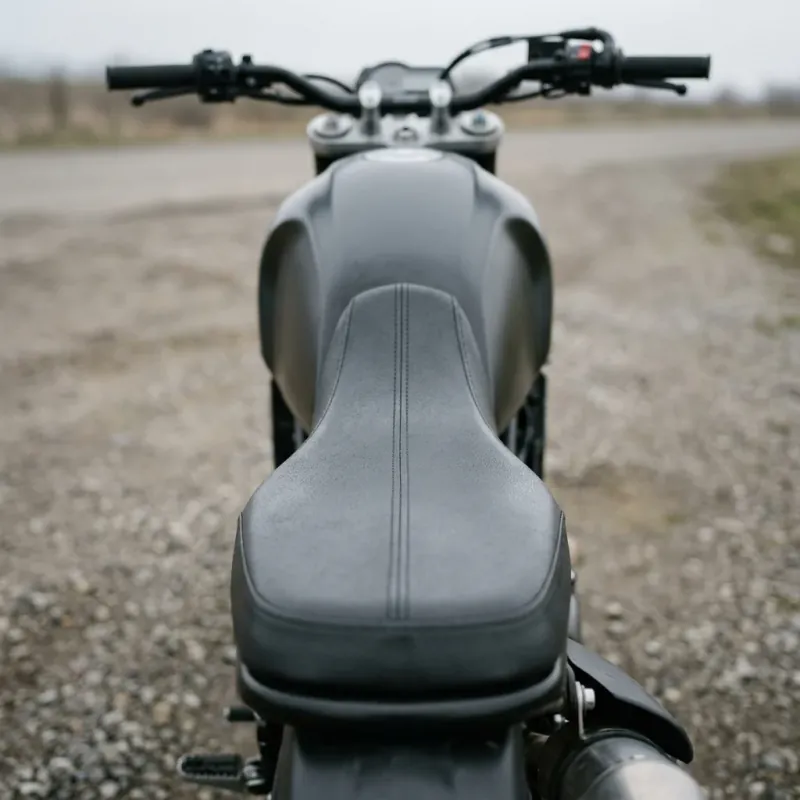
Picture the third morning of a long trip. The bike is loaded, the road is good, and somewhere around the two-and-a-half hour mark you start doing the thing every touring rider does without noticing: shifting one hip, then the other, then standing on the pegs for a moment at every excuse the road offers. By hour four you are planning fuel stops around your body rather than the tank.
The usual explanation is that the seat is too thin, and the usual fix is to put something soft on top of it. Both are wrong, and the second one can make the problem worse.
Numbness is a circulation threshold, not a padding shortage. There is a measured number for it, it is not on any motorcycle spec sheet, and once you know it the whole category rearranges itself — including which of these products is worth buying, and which of the claims printed on them survives contact with independent evidence.
Disclosure: some links below are affiliate links. If you buy through them we may earn a small commission at no extra cost to you.
The number that isn’t on any spec sheet
Motorcycle seats are sold on adjectives. Comfort foam, gel inserts, ergonomic shaping — none of it comparable between two products.
The measurement that would make it comparable exists, but it was taken in a different industry. NIOSH — the US federal occupational health institute — spent years studying bicycle police officers, who spend around 25 hours a week in a saddle, after they reported groin numbness and worse. The resulting workplace document puts hard figures on what happens where a rider meets a seat.
On a traditional saddle, pressure in the groin region measured about 2.90 psi during riding, reaching as high as 5.37 psi.
That means nothing on its own. This is the sentence that gives it meaning, and NIOSH supplies it in the same document as a reference point:
The pressure on an arm blood pressure cuff needed to restrict blood flow in the arteries is about 120 mm Hg, which is equal to 2.32 pounds per square inch.
So a typical seat pressure sits above the pressure at which blood stops moving through an artery. Not near it. Above it. The numbness is not your imagination and it is not softness you are lacking — it is perfusion, and the clock starts as soon as you sit down.
The same research measured the fix. Saddles built without a protruding nose brought the same region down to 1.02 psi — a reduction of at least 65%. In the peer-reviewed write-up of the intervention study, 121 officers were enrolled across five US metropolitan areas and 90 were reassessed after six months on the new saddles: perineal pressure fell 66% (P < 0.001), and the proportion reporting no numbness over the previous six months rose from 27% to 82%.
An honest limit on all of that: this is bicycle research. A motorcycle saddle is wider, you are not pedalling, and your weight is not shared with the bars and pegs in the same way. We could not find an equivalent set of pressure measurements taken on a motorcycle seat, and we are not going to invent one by transplanting a bicycle figure. What crosses over is the physiology, not the number: an artery closes at a given pressure whatever is underneath it. That is why the useful question is how widely is the load spread, and why “softer” and “better” are not the same word.
Three products, one idea, none of them mentioning the research
Here is what makes this category strange. Read the product copy for three unrelated products at three different prices and they are all describing the same physics, in slightly different words, without any of them citing a study.
Airhawk, on its Dual Sport cushion: the front has been “tapered down and away from the rider’s groin area to minimise unwanted pressure.”
Wild Ass, on its Sport line: a “narrow front with tapered cells and a back cut-out area to reduce contact with sensitive areas.”
Seat Concepts, on its Comfort foam: the shape “maintains a similar contour to stock at the front of the seat so the rider’s legs are not spread farther apart, but tapers out towards the mid-point to distribute rider weight over a greater area.”
Spread the load, unload the front. That is the no-nose principle from the NIOSH work, sold three times over as a feature.
The air cushions have a longer pedigree than most buyers realise, and Airhawk sets it out on its own site: in 1973 the technology was developed for the medical field — wheelchair seating, back supports, mattress covers — “to help minimize the risk of developing pressure sores,” and in 1997 it was adapted to transport, military and motorcycle seating. The thing strapped to your saddle is pressure-injury equipment with a motorcycle cover on it, which is a better reason to take it seriously than anything in the marketing.
The spec nobody puts in a comparison table
Cushions are marketed on overall size. But if the front is what presses into the groin, the front width is the number that should decide the purchase — and only the two adventure-specific cushions publish it at all.
Cushion dimensions — and the front width most listings omit
| Cushion | Back width | Front width | Length | Built for |
|---|---|---|---|---|
| ADV defaultAirhawk Dual Sport | 28 cm / 11″ | 14 cm / 5.5″ | 30 cm / 11.8″ | Dual sport |
| ADV altWild Ass Sport | 31 cm / 12.5″ | ~15 cm / 6″ | 31 cm / 12.5″ | Dual sport, ADV |
| Wild Ass Saddle | 33 cm / 13″ | Not published | 29 cm / 11.5″ | Small cruiser |
| Wild Ass Smart | 39.5 cm / 15.5″ | Not published | 36 cm / 14″ | Large cruiser |
| Airhawk Medium Cruiser | 36 cm / 14.2″ | Not published | 36 cm / 14.2″ | Cruiser |
| Wild Ass Pillion | 22 cm / 9″ | Not published | 29 cm / 11.5″ | Passenger |
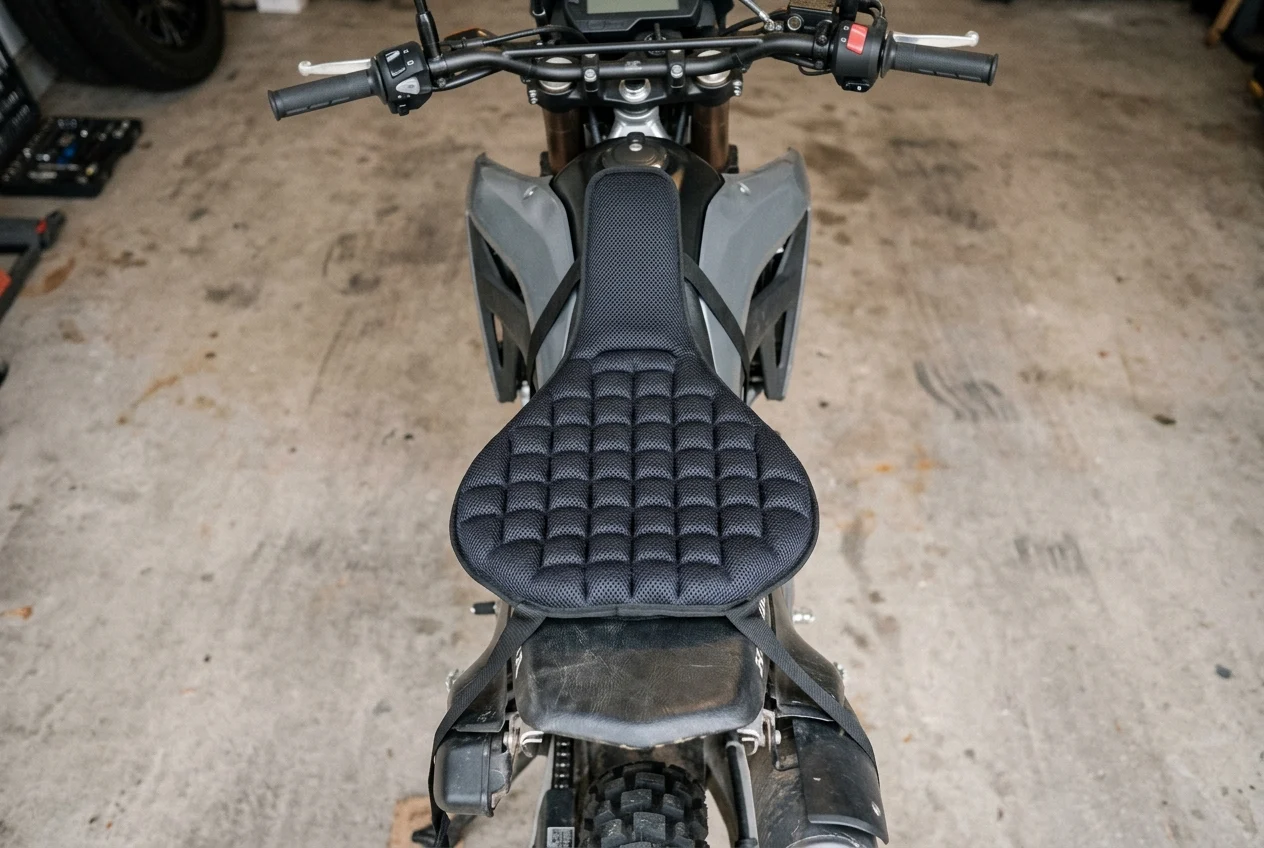
Two things fall out of that table. The adventure cushions are not a marketing label — they are a measurably different shape, cut to 5.5 and 6 inches at the front while the cruiser products do not publish the figure at all. And the popular choice is frequently the wrong one: the Wild Ass Smart is the model you see photographed most, and at 15.5 inches it is wider than the sitting area of most adventure saddles.
How to size it, in the manufacturer’s own words: “measure the WIDTH of your seat at the widest point WHERE YOU SIT.” Not the widest point of the seat. The widest point of the part you use.
What the neutral evidence says about gel, air and foam
Every air-cushion maker will tell you gel traps heat. Both of the biggest ones publish something to that effect. They also both sell air cushions, which makes them the wrong people to ask about gel.
There is a place where these three materials have been compared by researchers who sell none of them: wheelchair seating, where the stakes are pressure injuries rather than a sore afternoon. Two findings matter.
On spreading pressure, air wins. A rapid review of interface pressure in wheelchair users with spinal cord injury found air cushions more consistently effective than gel and foam, with seven studies favouring air over gel and three favouring gel over polyurethane foam. A separate comparative study found a dual-compartment air cushion gave the best pressure distribution and the largest contact surface of the models tested.
On heat, gel wins — which is the opposite of the marketing. A 2024 systematic review and meta-analysis in the Australian Occupational Therapy Journal pooled the microclimate data and found foam-gel cushions ran significantly cooler than air cushions and significantly cooler than foam. But foam beat foam-gel on moisture, running significantly drier. The authors’ conclusion is worth quoting flat: “Not one cushion is ideal in managing all aspects of microclimate.”
| Material | Pressure spread | Temperature | Moisture |
|---|---|---|---|
| Air | Best | Warmer than gel | Not measured |
| Gel / foam-gel | Middle | Coolest | Dampest |
| Foam | Weakest | Middle | Driest |
So the sellers are right about the thing they measure and wrong about the thing they assert. There is no winning material — each one trades away a different part of the problem. If numbness is your complaint, air is the evidence-backed choice. If a hot, wet seat on a summer afternoon is your complaint, air is not obviously the answer and sheepskin belongs in the conversation.
The limit on this evidence, stated plainly: it is wheelchair research. Static seating, indoors, with participants who often have impaired sensation and a genuinely different tissue risk. You move, you get airflow, and you can stand up. We are borrowing the ranking and the trade-off logic, not the numbers.
Before you buy anything, check three free things
NIOSH lists three things that set seat pressure: the rider’s weight and body shape, the shape and cushioning of the seat, and how far forward the body is tilted. That third one is posture, and on a loaded adventure bike posture is largely set by suspension.
Set sag for the load. A rear that has sagged under luggage rotates your hips and slides your weight forward onto the narrow nose of the seat — precisely the region a cushion exists to unload. Our loaded suspension setup guide works through the manufacturers’ own preload figures. That guide also draws a distinction worth carrying here: preload is the right adjustment for luggage and the wrong adjustment for harshness, which lives in damping and spring rate.
Stand up, and stop apologising for it. Clinical guidance for wheelchair users recommends pressure relief of 15–60 seconds every 15–60 minutes to restore tissue perfusion, and pressure-relief manoeuvres have been measured producing large falls in interface pressure and significant increases in buttock blood flow. That protocol is written for people who cannot feel the pressure building — which is exactly what makes your situation easier. You get the warning signal. Twenty seconds on the pegs is the motorcycle version of the same manoeuvre, and the ache is the timer. Worth knowing how hard this is even for people at medical risk: in one study participants managed fewer than one full pressure relief per hour seated.
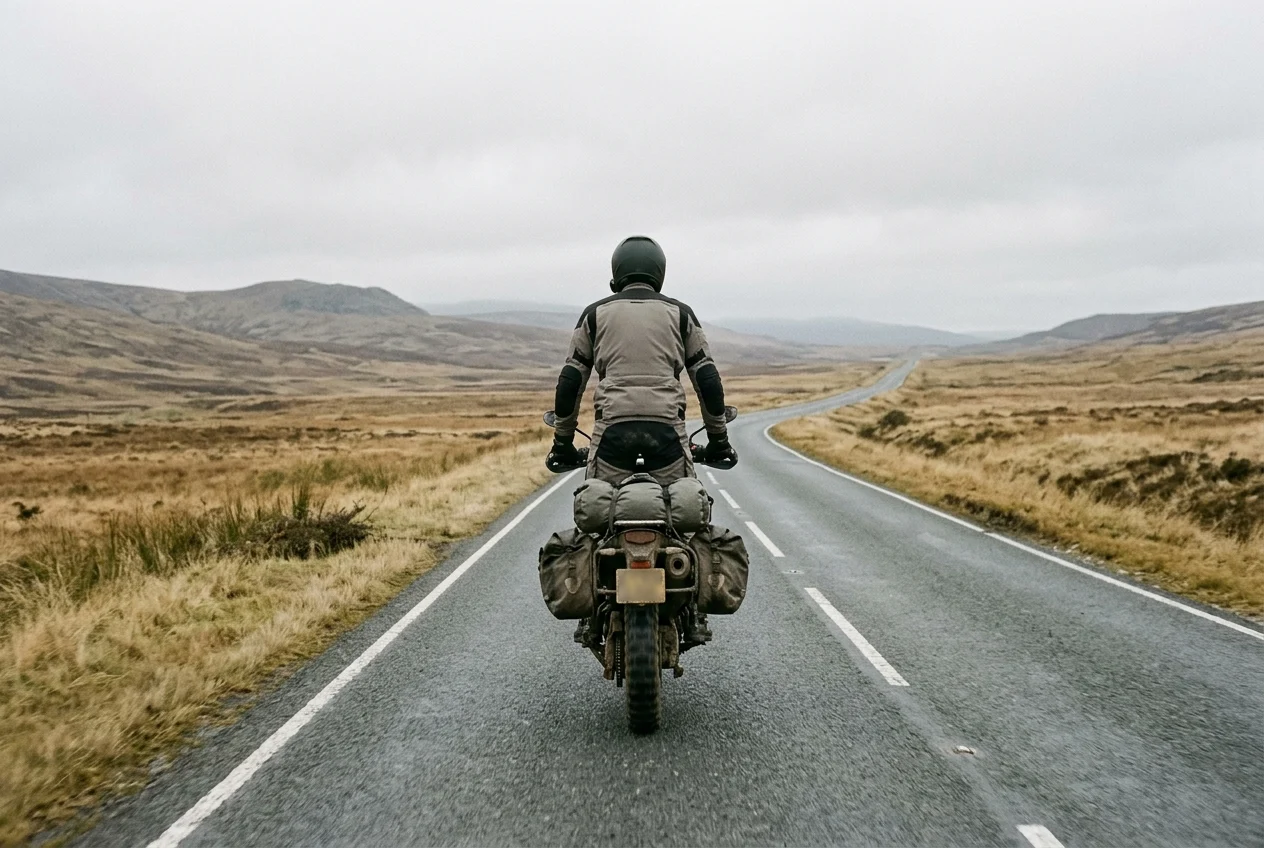
Separate the complaints. Numbness in the hands is bar vibration, not seat pressure — different cause, different fix. Harshness over bumps is suspension. Tyre pressure sits underneath both. A cushion solves none of these, and buying one to fix them is how people end up concluding cushions do not work.
The cushions
Airhawk Dual Sport — the narrowest published front
The adventure default, and the reason is in the dimensions: 30 cm long, 28 cm across the back, 14 cm across the front. That 5.5-inch nose is the narrowest published figure in the category, and Airhawk’s own description — tapered down and away from the groin — is aimed at the same target the research identifies.
Be precise about how far that goes, though. NIOSH measured saddles with the nose removed entirely. A narrow-fronted pad sitting on top of a seat that still has its nose is moving in the right direction, not reproducing the experiment. It unloads the front; it does not delete it.
Construction is a multi-cell inflatable bladder in polyurethane under a breathable spacer-mesh cover with a non-skid bottom. It is light, it packs down, and it goes on today, which is the whole argument for a cushion over a seat. It sat at around $99 at retail in September 2026 — a retail figure rather than a manufacturer one, because Airhawk’s catalogue pages do not publish prices, so treat it as the shape of the number and check the listing.
Check Airhawk Dual Sport on Amazon →
Wild Ass Sport — same idea, three material tiers
Wild Ass sells four shapes and three material grades, and the shape is what matters: Sport, at 12.5 × 12.5 inches with a stated 6-inch front, is the one built for “narrow seat profiles of Dual Sport, Adventure Touring, Sport Touring.” The company describes a narrow tapered front and a back cut-out to reduce contact with sensitive areas — again, the same principle.
The tiers, from the manufacturer’s store in September 2026: Sport Lite at $114.99 in lightweight polyurethane; Air Gel Sport at $204.99, three-layer polyurethane with gel inside each air cell for vibration absorption, and with the useful property that you can deflate the bladder completely and still have the gel under you; and Sport Classic at $259.99 in what Wild Ass calls medical-grade neoprene. Pricing is set by tier, not by shape — all four shapes cost the same at each grade.
Given what the microclimate evidence says about gel running cooler and air spreading pressure better, the Air Gel tier is the one that hedges most sensibly between the two.
Check Wild Ass Sport Lite on Amazon →
Check Wild Ass Air Gel Sport on Amazon →
Do not buy the Smart by mistake. It is the model that appears in most photographs of this brand, it is 15.5 inches wide, and it is built for large cruisers. On a narrow adventure saddle it will overhang the sides and sit on the tapers rather than the flat.
Alaska Leather Sheepskin Buttpad — the honest outlier
This one is in the guide because it solves a different problem, and to its credit the manufacturer does not pretend otherwise. Alaska Leather’s copy talks about breathability and staying cool in summer and warm in winter. It makes no pressure-reduction claim, and you should not expect one.
What it does address is the axis the 2024 meta-analysis measured separately from temperature: moisture. Wool holds a large fraction of its own weight in moisture — the standard textile figure for saturation regain is roughly a third — before it feels wet against you, and the pile lifts you off a seat surface that has been baking in the sun. If your complaint is a hot, damp seat rather than a dead leg, this is the correct product and it costs a fraction of the others.
There is a Dualsport cut at 15 × 22 inches for $89.99, with smaller sizes from $45, attached by an adjustable strap and quick-release fasteners. Check stock before planning around it — the Dualsport size was listed as backordered when we checked in September 2026.
Check Alaska Leather Sheepskin Buttpad on Amazon →
Using it wrong is the most common failure
If you buy an air cushion and hate it, there is a good chance you inflated it like a cushion. Wild Ass’s own instruction is the opposite of intuition, and it is the clearest practical proof of everything above:
“LESS is more!” Inflate no more than halfway, then release air as needed. Properly inflated, you should be suspended 1/8″ – 1/4″ off your seat. If you have to adjust your mirrors, you have added too much air.
The goal is not a thicker seat. It is to float a few millimetres clear so the load spreads across the whole contact area. Over-inflating shrinks the contact patch, which raises pressure — the exact thing you bought the cushion to lower. The mirror test is a genuinely good field check: if the cushion has changed your eye height enough to matter, let air out.
Does a cushion undo the seat height you fought for?
Less than people fear, and the answer falls straight out of that instruction. Correctly inflated, a cushion is holding you 1/8 to 1/4 of an inch — roughly 3 to 6 mm — off the seat. That is inside the range that manufacturers’ own low-seat options move you down, which is typically 15–30 mm. If you have lowered your bike specifically to get a foot down, a properly set cushion costs you a fraction of what the lowering gained.
The failure mode is over-inflation, and it is the same mistake as before. Pump it hard and you are perched on a firm dome that both raises you further and concentrates pressure — losing the standover and the comfort in one move. This is the strongest practical argument for the mirror test: on a bike you were already tiptoeing, eye height that has visibly changed means you have taken away reach you could not spare.
Two honest caveats. A cushion also adds a slightly rounded, less grippy surface than a seat cover, so the first stop on a slope deserves a moment’s thought. And if you are at the absolute limit of your reach, a foam-and-cover kit is the better answer than a pad, because it changes shape without adding anything on top — which is the same reason it appears further down this page for riders whose seat is simply old.
The adventure-bike contradiction: a lower seat costs you comfort
There is a tension inside this topic that our own seat height chart and short rider guide run straight into, and it deserves stating rather than glossing.
Adventure seats are narrowed toward the front on purpose, because a narrow seat lets your legs drop closer to vertical and you reach the ground more easily. Lowering kits do the same thing more aggressively. The geometry that helps you get a foot down is the geometry that concentrates pressure.
Seat Concepts says the cost out loud on its own product pages: low seats “have less foam and may be firmer than standard/tall options, as material must be removed to achieve the lower height.” Less material carrying the same load, in the region where load is already concentrated.
None of that means don’t lower your seat. Being able to hold the bike up is worth a great deal, and a bike you can stand over is a bike you ride. It means the two decisions are linked, and if you have lowered your seat you should expect the comfort bill to arrive on a long day — and budget for a cushion as part of the lowering, not as a separate surprise.
If you are a woman, the saddle is narrower than it looks
There is a measured anatomical difference here that gets almost no coverage, and it interacts badly with narrow adventure seats.
Your weight should land on the ischial tuberosities — the sit bones. How far apart those sit varies, and it varies systematically by sex. A 2021 study in Scientific Reports measured 90 adults (45 male, 45 female) and found external ischial tuberosity width of 112.6–115.4 mm in men and 125.9–128.0 mm in women, a gap of 12.6–13.7 mm that held across both measurement methods used. The authors’ conclusion was that “gender variability should be considered in seat cushion design.”
Roughly 13 millimetres wider apart, on a seat that the manufacturer has deliberately narrowed. If the supported flat of the saddle is not wide enough to catch both sit bones, they land on the tapering sides instead, and the load goes into surrounding soft tissue rather than through bone — the shortest route to the threshold at the top of this article. That is a mechanical reason, not a marketing one, why the same seat can be markedly worse for a woman rider, and it is worth reading alongside our guide to motorcycles for women.
So what do you actually do with that? Three things, in order. Measure before you buy — the same instruction as everyone else, but the number matters more here: find the widest point where you actually sit, and if it is narrow, the front-width table above is doing more work for you than for anyone. Prefer the wider supported platform over the narrowest nose. The Airhawk Dual Sport’s 5.5-inch front is the sharpest taper here, but its back is 28 cm; the Wild Ass Sport is 31 cm across and squarer, which puts more flat area under sit bones that sit further apart. If both fit your seat, that squarer shape is the one to try first. And weigh a foam kit more heavily than a man with the same complaint would, because reshaping the seat widens the supported area itself — Seat Concepts’ whole stated approach is to taper out toward the mid-point and spread weight over a greater area — where a pad can only redistribute across whatever platform is already there.
Stated limits: one study, 90 participants, a single population with a mean age around 21.6, measured seated rather than on a motorcycle. Treat 13 mm as the average difference found in that sample, not a fact about every rider. It is, however, the only open measurement we could find that reports both sexes.
When the answer is a seat, not a cushion
A cushion sits on top and comes off when you sell the bike. A seat changes the shape permanently, adds no bulk, cannot slide, and does not need inflating. The reason to choose one over the other is usually the calendar.
Foam-and-cover kits. Seat Concepts is the established adventure name and sells both DIY kits — new foam and cover fitted to your existing seat pan — and complete seats on their own pan. Its Ténéré 700 Comfort options were listed in a $269.99–$399.99 range in September 2026. The critical figure is not the price: the company states a lead time of roughly six to eight weeks for seats not in stock.
Fully custom. Russell Cycle Products builds its Day-Long saddles around your original seat, which you ship to them, along with your height, weight, inseam and waist measurements and photographs of you seated on the bike. The published price list, dated effective 1 September 2026, runs from $600 for an S-1 solo in all vinyl to $1,215 for an S-4 dual in all leather, with backrests at $160–$250 and heating at $215 solo. Forums routinely quote this saddle at around $500; the manufacturer’s own cheapest option is $600, which is the sort of gap worth checking before you budget.
Neither of these is on Amazon and neither carries a link here, because we do not link to products a reader cannot buy through the link they are given.
One more reason to think about foam rather than a cushion: your seat is probably worse than it was. Flexible polyurethane foam accumulates permanent deformation under repeated load — the property is called compression set and it has its own test standard, ASTM D3574, which also covers fatigue under repeated force and recovery after unloading. A high-mileage seat is not a seat you have broken in. It is a seat that has hollowed under your sit bones, concentrating load exactly where you least want it. We are not going to put a number on how fast that happens, because we could not find one that was not either a vendor claim or a specification lifted from a patent application.
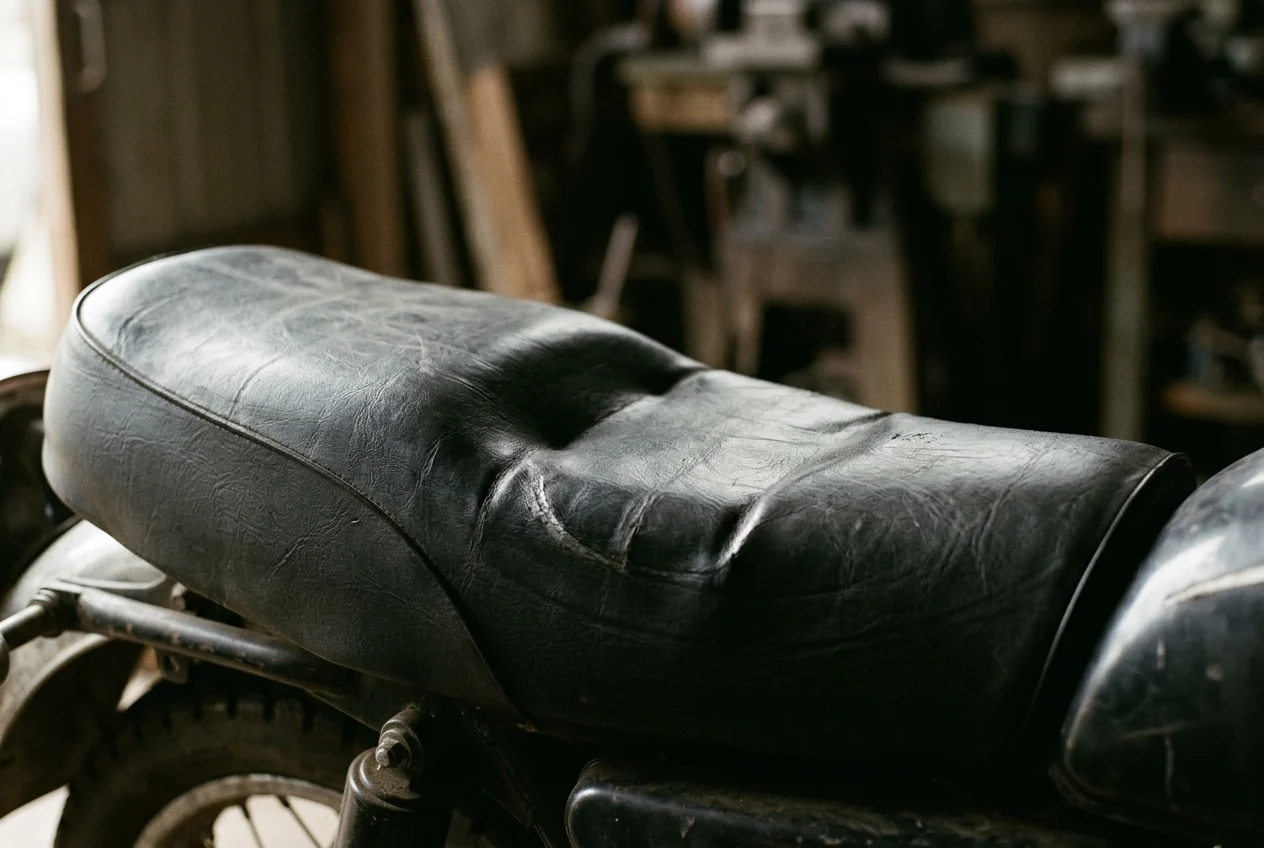
It is worth going and looking at your own in low, raking light — from the side, late in the day, rather than straight down in a bright garage. A hollow that is invisible from above shows up immediately as a shadow, and if you find one, the money is better spent on foam than on anything that straps over the top of it.
A note on these numbers
Prices and dimensions above came from manufacturers’ own pages read in September 2026 — Wild Ass’s store, models and FAQ pages; Alaska Leather’s product pages; Seat Concepts’ Ténéré T700 page; Russell Cycle Products’ price list, which carries its own effective date of 1 September 2026; and Airhawk’s official regional application chart for the Dual Sport dimensions. One exception is flagged where it appears: the Airhawk Dual Sport’s ~$99 is a retail figure, because Airhawk’s own catalogue pages publish no prices at all.
Deliberate omissions. No motorcycle-specific seat pressure figure appears here, because we could not find one — the psi values are from cycling research and are labelled as such every time they appear. No claim that gel hardens in the cold, splits, or develops pockets, and no repetition of the claim that air cells do not degrade over time: every source for those was a company selling the competing product, and none of them is a measurement. No lifespan or mileage figure for foam. And no first-hand testing claims, because this is a research guide rather than a review — we have not ridden on these cushions.
Related guides
- Loaded ADV suspension setup — sag sets your hip angle, and your hip angle sets seat pressure. Free, and it comes first.
- Adventure bike seat height chart — the other half of the trade-off: what lowering a seat costs you in foam.
- Best ADV bikes for short riders — where narrow saddles are the solution rather than the problem.
- Best motorcycles for long-distance touring — range, wind and seat are the three things that decide a touring day. This is the third one.
- Riding two-up on an adventure bike — pillion seats are worse than yours, and a passenger changes your sag as well.
- Adventure motorcycle tyre pressure — the layer underneath both comfort and harshness.
Frequently Asked Questions
Why do my legs and groin go numb on a motorcycle?
Because the load is concentrated rather than spread, and concentrated load slows the blood supply. Numbness is a perfusion problem, not a padding shortage — which is why the intuitive fix of adding something soft on top can fail or even backfire. Soft material lets the sit bones sink through it until they are carrying the same load on a smaller area, and a smaller area at the same load means higher pressure. The reliable fix is a wider, flatter supported area under the sit bones and less material pressing into the soft tissue in front of them, which is what every product in this category is trying to do, whether it is an air cushion, a gel pad or new foam. There is a measured pressure threshold behind all of this, borrowed from cycling research, and the article opens with it. Three things set that pressure: your weight and body shape, the shape of the seat, and how far forward you are tilted — so posture and suspension sag belong in the diagnosis before any purchase does.
Is a gel or an air seat cushion better?
They win different things, and the honest answer is that neither wins outright. The clearest neutral evidence comes from wheelchair cushion research, where air, gel and foam have been compared by people who do not sell any of them. For spreading pressure, air leads: a rapid review of cushions used by people with spinal cord injury found air cushions more consistently effective than gel and foam, with seven studies favouring air over gel. For heat, the result runs the other way. A 2024 systematic review and meta-analysis in the Australian Occupational Therapy Journal found foam-gel cushions ran significantly cooler than both air and plain foam cushions — which is the opposite of the claim made by the two largest sellers of air cushions. Plain foam, meanwhile, was significantly drier than foam-gel. The authors' own conclusion is that no single cushion manages every part of the microclimate. Buy for the problem you actually have.
What size seat cushion fits an adventure bike?
Measure the width of your seat at the widest point where you actually sit, then match it — that is the manufacturers' own instruction, and it beats guessing from the bike model. The number that matters for an adventure bike is not the overall width but the width of the front of the cushion, because that is the part that ends up under your groin. Two cushions are built specifically for narrow dual-sport saddles and both publish it: the Airhawk Dual Sport measures 30 cm long by 28 cm across the back and just 14 cm (5.5 inches) across the front, and the Wild Ass Sport is 12.5 by 12.5 inches with a stated 6-inch front. Cruiser cushions do not publish a front width at all, and the popular Wild Ass Smart is 15.5 inches wide — wider than the sitting area of most adventure saddles. Buying the wrong variant is the most common mistake in this category.
Is a cushion or a replacement seat the better fix?
It depends far more on your calendar than on your budget. A cushion goes on today and comes off when you sell the bike, and it is the only option if a trip is close. A replacement seat or a foam-and-cover kit changes the shape permanently, adds no height and no bulk, and does not slide — but Seat Concepts states a lead time of roughly six to eight weeks for seats not in stock, and a fully custom builder like Russell Cycle Products needs your original seat shipped to them along with your height, weight, inseam and waist measurements. If your departure is inside eight weeks, the decision is already made for you. There is also a case for the seat rather than the cushion if your foam is simply old: flexible polyurethane foam takes a permanent compression set, a property with its own test standard, so a high-mileage seat is not a seat you have broken in but one that has hollowed under your sit bones.
Does a seat cushion work if the real problem is the suspension?
No, and this is worth checking before spending anything. NIOSH lists three things that determine seat pressure: the rider's weight and body shape, the shape and cushioning of the seat, and how far forward the rider's body is tilted. That last one is posture, and on a loaded adventure bike posture is set by suspension sag. If the rear has sagged under luggage, your hip angle changes and your weight moves forward onto the narrow part of the seat, which is exactly the region a cushion is trying to unload. Set preload for the load first — our suspension guide walks through the manufacturers' own figures. It is also worth separating two different complaints: harshness over bumps lives in damping and spring rate, and vibration numbness in the hands comes from the bars, not the seat. A cushion addresses none of those.