
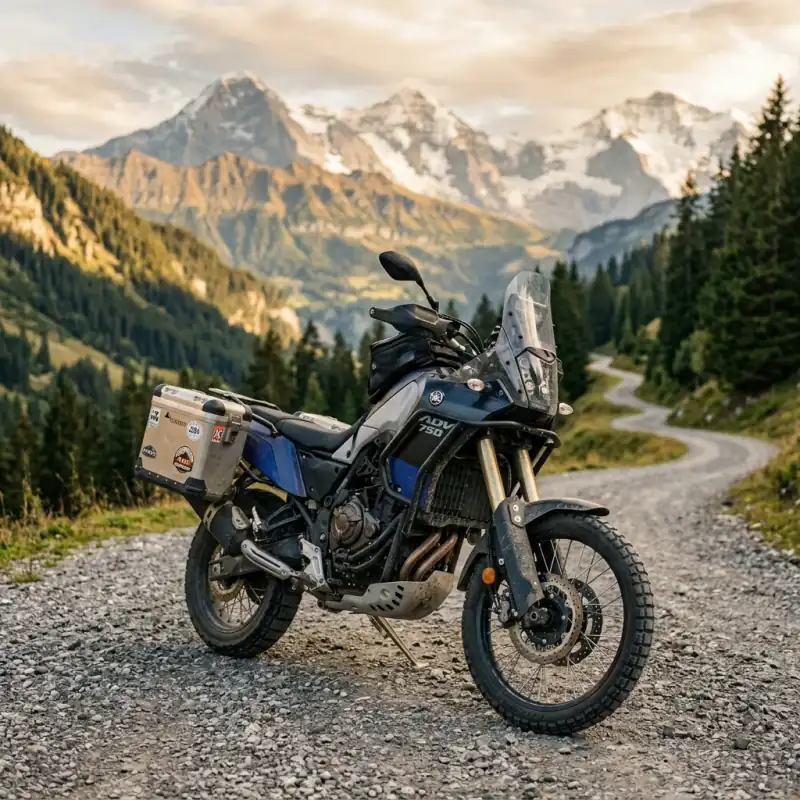
There’s a reason the middleweight is the default recommendation in adventure riding. The 650–900cc adventure class is the sweet spot of the entire segment: light enough to pick up alone when you drop it on a trail, big enough to carry you and a pillion and two weeks of luggage across a continent, and — critically — thousands cheaper than the 1250–1300cc flagships that get all the magazine covers.
The big GS-class bikes are magnificent machines. They’re also 250-plus kilos, expensive to buy, expensive to crash, and intimidating the moment the tarmac turns to gravel. For the riding most people actually do — mixed-surface touring, mountain passes, the occasional forest track to a quiet bay — a middleweight does the same job with less weight, less money, and far less anxiety.
This guide compares eight midsize machines from the major manufacturers — Yamaha, Honda, Suzuki, KTM, Aprilia, Triumph, BMW and Moto Guzzi — ranks them by what actually matters (weight, seat height, road/off-road bias, price), and — most importantly — helps you match the right one to your riding. The single question that decides everything comes at the end, but you can skip to it now: how much of your riding is genuinely off-road?
Quick Comparison: 2026 Middleweight ADV Class
Prices are approximate 2026 MSRP and vary significantly by market and spec. Weights are manufacturer wet/kerb figures. Fuel capacities are manufacturer figures; the range beside each is a realistic loaded-touring estimate at roughly 5 L/100 km (47 US mpg) — your real mileage moves with pace, load and how hard you ride the dirt.
| Bike | Engine | Wet weight | Seat height | Fuel / est. range | Approx. price | Best for |
|---|---|---|---|---|---|---|
| Yamaha Ténéré 700 | 689cc twin | 208 kg (459 lb) | 875 mm (34.4 in) | 16 L / ~300 km (4.2 gal / ~186 mi) | ~$10,999 | Off-road capability + simplicity |
| Honda Transalp XL750 | 755cc twin | 216 kg (476 lb) | 850 mm (33.5 in) | 16.9 L / ~330 km (4.5 gal / ~205 mi) | ~$10,199 | Road-biased value all-rounder |
| Suzuki V-Strom 800DE | 776cc twin | 230 kg (507 lb) | 855 mm (33.7 in) | 20 L / ~400 km (5.3 gal / ~249 mi) | ~$11,799 | Do-everything comfort |
| Aprilia Tuareg 660 | 659cc twin | ~204 kg (450 lb) | 860 mm (33.9 in) | 18 L / ~360 km (4.8 gal / ~224 mi) | ~$12,200 | Best-handling off-roader |
| KTM 890 Adventure R | 889cc twin | 215 kg (474 lb) | 880 mm (34.6 in) | 20 L / ~400 km (5.3 gal / ~249 mi) | ~$16,299 | Hardcore off-road performance |
| Triumph Tiger 900 Rally Pro | 888cc triple | ~228 kg (503 lb) | 860–880 mm (33.9–34.6 in) | 20 L / ~400 km (5.3 gal / ~249 mi) | ~$16,900 | Premium touring + character |
| BMW F 900 GS | 895cc twin | ~219 kg (483 lb) | 870 mm (34.3 in) | 14.5 L / ~280 km (3.8 gal / ~174 mi) | ~$13,500 | Lighter big-brand all-rounder |
| Moto Guzzi V85 TT | 853cc twin | ~229 kg (505 lb) | 830 mm (32.7 in) | 23 L / ~450 km (6.1 gal / ~280 mi) | ~$12,900 | Road touring + low seat + style |
Price and weight confidence: the Ténéré 700, Transalp, V-Strom 800DE and 890 Adventure R prices were checked against the manufacturers’ own US sites on 1 September 2026, and the weights for those same four were re-checked on 9 September 2026 — Yamaha’s 459 lb wet, Honda UK’s 216 kg kerb for the 2026 E-Clutch Transalp, Suzuki’s 230 kg curb and KTM’s 215 kg fully fuelled. All four are full-tank figures, so they compare like for like. The Tuareg 660, Tiger 900, F 900 GS and V85 TT figures come from an earlier pass and are approximate — confirm those four before you budget.
If you only read one row, read the last two columns. Price and “best for” sort this class faster than any spec sheet. But glance at the fuel column too: the difference between the 14.5 L BMW and the 23 L Guzzi is a real fuel stop — nearly 170 km (105 miles) of touring range — that shapes how each bike tours.
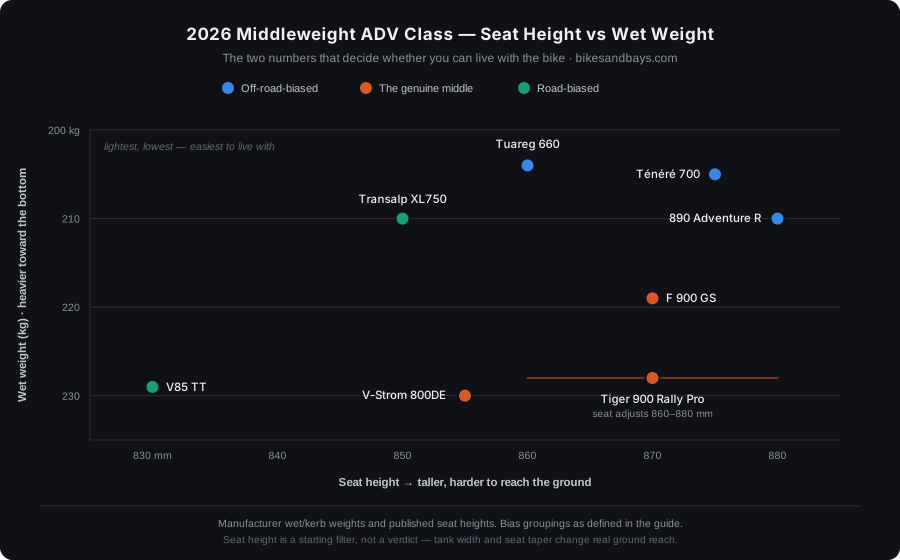
Plotted against each other, the two numbers you actually live with show a trade-off the table hides: nothing in this class is both low and light. The lowest seat here belongs to the Moto Guzzi V85 TT at 830 mm — and it pays for that with 229 kg, near the top of the class. The lightest bike is the Aprilia Tuareg 660 at 204 kg, and it sits at 860 mm. The closest thing to a bike that is both is the Honda Transalp: second-lowest seat at 850 mm, near the light end at 216 kg. If you are short and want something you can pick up alone, that gap is the whole decision, and it is why the cheapest bike here keeps winning arguments it has no business winning.
How to Read This Class: Road Bias vs Off-Road Bias
Every bike here handles mixed touring. The real spectrum is how far each leans toward the dirt:
- Off-road-biased — Ténéré 700, KTM 890 Adventure R, Aprilia Tuareg 660. 21-inch front wheels, long-travel suspension, tall seats, minimal or defeatable electronics. Superb once the tarmac ends; a little busier and taller on the road.
- Road-biased — Honda Transalp, Moto Guzzi V85 TT, Tiger 900 GT variants. The Guzzi and the Tiger GT run 19-inch fronts; the Transalp keeps a 21 but tunes everything else for the road. More wind protection, plusher road manners, lower seats. Happier eating motorway miles; capable but not eager on hard trails.
- The genuine middle — Suzuki V-Strom 800DE, BMW F 900 GS, Tiger 900 Rally. 21-inch front, but tuned to keep road comfort. The “one bike for everything” answers.
Nail your position on that spectrum before you fixate on a model, and the shortlist writes itself.
The Eight, Ranked by What Matters
1. Yamaha Ténéré 700 — the off-road benchmark
Around $10,999. The bike that defined the modern middleweight ADV movement, and still the reference point everyone else is measured against. A 689cc CP2 parallel twin with a torquey, characterful delivery, a rally-derived chassis, 21-inch front wheel, and — deliberately — a short electronics list. The 2025 update brought a ride-by-wire throttle, two riding modes, traction control that is simply on or off, and ABS you can switch off at the rear or fully. That’s about it.
That simplicity is the point. There’s less to break, less to distract, and a chassis that’s earned its reputation as one of the best-balanced off-road platforms in the class. The trade-offs are honest: a small 16-litre tank that has you looking for fuel around 300 km (185 miles), minimal wind protection, a firm seat, and no cruise control. Owners logging serious mileage report it as rugged and fixable, exactly what you want far from a dealer.
Buy it if capability and simplicity matter more than comfort features.
Disclosure: some links below are affiliate links. If you buy through them we may earn a small commission at no extra cost to you.
Shop Ténéré 700 touring accessories on Amazon →
2. Honda Transalp XL750 — the value all-rounder
Around $10,199 — usually the cheapest serious bike in the class. Honda’s revived Transalp pairs a 755cc parallel twin with road-friendly manners, genuine refinement, and Honda’s reputation for going the distance. A 21-inch front keeps it competent on gravel, but the tuning, ergonomics and wind protection all lean toward comfortable road touring.
For a rider doing 70% pavement and 30% light trails, the Transalp is arguably the smartest spend in this entire guide. It gives up outright off-road edge to the Ténéré and KTM, but wins on price, smoothness and everyday usability.
The 2026 bike is a bigger change than the price suggests. It gets Honda’s E-Clutch: it works the clutch for you when pulling away and shifting, and the lever still works if you want it. It also adds weight, which is easy to miss. Honda UK lists the 2026 Transalp at 216 kg kerb, against 210 kg for the 2025 bike, so a used 2025 is the lighter machine. The first-generation bike’s suspension was widely criticised as too soft, and the 2026 update is reported to add damping adjustment to the Showa units and a standard skid plate.
Buy it if you want the most bike for the money and most of your miles are paved.
3. Suzuki V-Strom 800DE — the do-everything pick
Around $11,799. Suzuki’s 776cc twin is the class’s great compromiser, and that’s a compliment. A 21-inch front wheel and long-travel suspension give it real off-road intent, while a comfortable riding position, effective screen and a friendly torque curve keep it genuinely pleasant on long road days. Full electronics package — multiple traction and ABS modes, including a proper off-road setting.
The one number to watch is weight: at around 230 kg it’s among the heaviest here, which you’ll feel in tight technical terrain. On everything else — comfort, spec, price, versatility — it’s hard to fault. A superb one-bike-for-everything choice.
Buy it if you want a single bike that does all of it well and none of it badly.
4. Aprilia Tuareg 660 — the rider’s off-roader
Around $12,200. The enthusiast’s pick. Aprilia’s 659cc twin is wrapped in a sharp, fully-sorted chassis that’s one of the best-handling in the class, on-road and off. Fully adjustable suspension, a genuinely capable off-road setup, and a punchy, willing engine make it the middleweight that flatters a skilled rider the most.
The costs of that focus: a slightly smaller dealer network than the Japanese options, and a bike optimised for riding rather than plush touring. It rewards commitment. For a rider who prioritises how a bike feels when pushed on a mixed-surface road or trail, nothing here is more satisfying.
Buy it if handling and off-road ability top your list and you don’t mind a smaller support network.
5. KTM 890 Adventure R — the hardcore option
Around $16,299. The most off-road-focused bike in this guide, and it doesn’t pretend otherwise. An 889cc twin, long-travel WP suspension, an 880 mm seat, aggressive ergonomics and a full suite of rider aids built for serious dirt. In the right hands it’s closer to a rally bike than a tourer.
That capability comes with the tallest seat here and a firm, purposeful ride that’s less relaxing on long pavement stints. It’s more bike than most riders need — but for those who genuinely ride hard off-road, it’s the standout. Compare it directly in our KTM 890 Adventure R vs Ténéré 700 breakdown.
Buy it if serious off-road performance is the whole point of the bike.
6. Triumph Tiger 900 Rally Pro — premium character
Around $16,900 for the Rally Pro. The priciest bike here, and the one with the most personality. Triumph’s 888cc triple gives it a distinctive three-cylinder character — smoother and more revvy than the twins — plus a premium finish, excellent electronics, and comfortable long-haul touring manners. The Rally trims add off-road hardware; the GT trims lower the seat and lean road.
You’re paying a premium over the Japanese twins for that triple-cylinder character, build quality and badge. Whether that premium is worth it comes down to how much the engine character matters to you; on capability alone, the cheaper twins on this list do most of the same job.
Buy it if you want premium touring feel and the character of a triple, and the budget stretches.
7. BMW F 900 GS — the lighter big-brand all-rounder
Around $13,500. BMW’s 2024-generation F 900 GS shed meaningful weight over its predecessor and pushed the recipe more off-road, with a 21-inch front and a sharper stance than the old F 850 GS. An 895cc twin, strong electronics, and the dealer network and accessory ecosystem that come with the badge.
It sits in the genuine middle of the class — more off-road intent than a Transalp, more road comfort than a KTM 890 R — and gives GS-curious riders a lighter, cheaper way into the brand than an R 1300 GS. Options and accessories add up fast, so watch the out-the-door price.
Buy it if you want a middleweight with big-brand support and a balanced road/dirt setup.
8. Moto Guzzi V85 TT — road touring with style
Around $12,900. The outlier, in the best way. Moto Guzzi’s 853cc transverse V-twin is a road-biased touring middleweight with a classic aesthetic, a friendly 830 mm seat — the lowest here — and relaxed, characterful road manners. It’s not built to be raced down a trail, and doesn’t try to be.
For a rider who wants mixed-road touring, easy manageability at stops, and a bike that looks and feels like nothing else in the class, the V85 TT is a genuinely compelling left-field choice. It’s also the only shaft-drive bike here — no chain to clean, oil or adjust — and its 23-litre tank gives it the longest touring legs in the group. Light off-road use only.
Buy it if you tour mostly on-road, want a low seat, and value character and style.
Which Middleweight Should You Buy?
Strip away the brand loyalty and it comes down to three questions:
1. How much of your riding is genuinely off-road?
- Mostly pavement (70%+): Transalp 750, V85 TT, or Tiger 900 GT.
- A true 50/50 split: V-Strom 800DE, BMW F 900 GS, or Tiger 900 Rally.
- Off-road is the point (50%+): Ténéré 700, Aprilia Tuareg 660, or KTM 890 Adventure R.
2. Can you comfortably manage the seat height and weight? Sit on the bike fully loaded, on a slight slope, before you buy. A tall off-road bike you can’t flat-foot at a gravel junction is a bike you’ll drop and grow to resent. Our best ADV bikes for short riders guide covers lowering options in detail, and the adventure bike seat height chart lines up 16 current models from lowest to tallest so you can see where each of these eight actually sits.
3. What’s the honest budget — out the door, with luggage? The Transalp starts just over $10k; the Tiger 900 Rally Pro pushes past $16.9k before accessories. Panniers, crash protection, a taller screen and heated grips add $1,000–2,500 to any of these. Budget for the built bike, not the showroom sticker. And if the numbers are tight, buying one of these a couple of years used is often the smarter spend.
Get those three right and there is no wrong answer in this class. That’s what makes the middleweight segment special: the floor is high, the value is real, and the bike you can actually handle will take you further than the bigger, heavier one you can’t.
For where to point it once you’ve bought it, see our complete adventure motorcycle camping & touring guide and the best long-distance touring motorcycles roundup for the bigger-bike context.
Related Guides
For more on choosing and setting up an adventure bike, see our best motorcycles for long-distance touring, best ADV bikes for short riders, and best motorcycles for beginners guides, plus the Ténéré 700 vs Africa Twin comparison.
A note on the prices: US MSRP, excluding destination and dealer charges. See the price-confidence note under the comparison table for which figures are verified. MSRP moves with model-year updates.
Disclosure: Some of the links in this article are affiliate links. If you buy gear through them, we may earn a small commission at no extra cost to you. It helps fund the research that makes these independent comparisons possible. Prices and specifications are approximate and change frequently — always confirm current figures with the manufacturer or dealer before buying.
Frequently Asked Questions
What counts as a mid-size adventure motorcycle?
Broadly, the 650–900cc class — parallel twins and singles that sit between the small-displacement beginner ADVs (300–500cc) and the big 1200–1300cc flagships like the BMW R 1300 GS or KTM 1290. The defining trait isn't the exact displacement, it's the balance: enough power for two-up motorway touring and passing, but a wet weight (typically 200–230 kg) low enough that most riders can pick the bike up alone after a slow-speed drop off-road. That combination is why this class has become the default recommendation for riders who actually leave the pavement.
Is a middleweight ADV bike enough for two-up loaded touring?
Yes, for the vast majority of riders. A Ténéré 700, Transalp 750, V-Strom 800DE or Tiger 900 will carry a rider, pillion and full luggage across a continent without complaint. Where the big 1250–1300cc bikes pull ahead is sustained high-speed autobahn cruising two-up with luggage, and outright effortlessness on long motorway days. If your touring is mostly A-roads, mountain passes and the occasional motorway link, a middleweight does everything a big GS does at 40–60 kg less weight and several thousand less in price. The weight saving matters far more the moment the tarmac ends.
Ténéré 700 or Honda Transalp 750 — which should I buy?
It comes down to where you ride. The Ténéré 700 is the more capable off-road tool: 21-inch front wheel, long-travel suspension, minimal electronics, a chassis built to be thrown down a trail. The Transalp 750 is the more comfortable road bike: smoother, better wind protection, more refined electronics, and around $800–1,000 cheaper. Riders doing 70% pavement and 30% gravel are usually happier on the Transalp. Riders doing serious off-road, or who value ruggedness and simplicity, lean Ténéré. Both are excellent; they're optimised for different halves of the same trip. If the V-Strom 800DE is also on your list, the [comparison table](#quick-comparison-2026-middleweight-adv-class) puts all three side by side.
How important is seat height when choosing a mid-size adventure bike?
Very — it's the single biggest reason riders end up unhappy with an otherwise great bike. Off-road-biased middleweights (Ténéré 700, KTM 890 R, Tuareg 660) sit around 860–890 mm, which is tall for many riders. Road-biased options (Transalp, V-Strom 800DE has an 855 mm seat, Tiger 900 GT) or bikes with low-seat accessories are far more manageable at stops and on loose ground. A bike you can't flat-foot at a gravel junction is a bike you'll drop. Always sit on the bike loaded before buying, and factor in lowering links or low seats where offered. See our short-rider ADV guide for the fit details.
Are middleweight adventure bikes good for beginners?
The tamer ones can be, with caveats. A Honda Transalp 750 or Suzuki V-Strom 800DE is manageable enough for a confident newer rider stepping up, thanks to modern rider aids (traction control, ABS modes) and friendly power delivery. The sharper off-road machines — KTM 890 Adventure R, Aprilia Tuareg 660 — are more bike than most beginners need. If this is your first big bike, prioritise low seat height, ride-by-wire smoothness and weight you can handle, and consider starting one class down. Our beginner ADV guide walks through the honest trade-offs.