
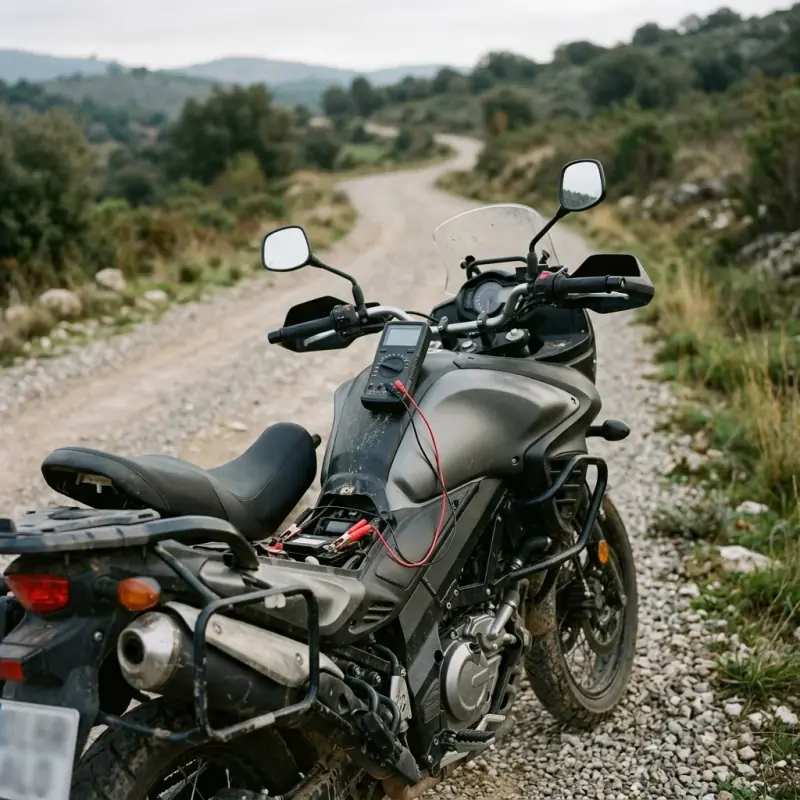
A bike that won’t start is often not a broken bike. On a trip it is frequently one of a short list of conditions the machine has decided to enforce: a stand that is down, a gear that is engaged, a kill switch that got knocked, a key it does not recognise, a fall it believes it just had. The battery gets blamed first because it is the part everyone can name. The makers’ own guidance mostly does not start there.
We read the starting, battery and troubleshooting pages of the owner’s manuals for nine adventure bikes from seven makers, plus Yamaha’s workshop documents for the Ténéré 700, Yuasa’s technical manual and guides, and Honda’s own “won’t start” page. Every figure below was checked against the page it came from. All nine bikes are fuel-injected; the one carburettor note is from Honda’s own page.
The order, on one screen
- Neutral (or clutch in), stand up, kill switch on, dash self-check finished, fuel in the tank.
- Dropped it? Check for damage, then switch the ignition off and on.
- Two keys on one ring, a metal sticker on the key, or a dead fob.
- Cranks briskly but won’t fire: fuel, fuses, plug, warning light, then stop.
- Cranks slowly, clicks or does nothing: terminals, voltage, cranking test, then charge or jump only as your manual allows.
The rest of this guide is the evidence for each line, and where the makers disagree.
Start with what the bike does when you press the button
The most useful diagnostic tool at the roadside is your ears and the dashboard. Honda’s own troubleshooting page splits the problem the same way, on whether any indicator comes on when you switch the ignition on: if the display and meter stay dark, it points to complete battery exhaustion or an electrical fault and tells you to see a dealer, and if they light, it walks you through a short list of simple checks.
| The bike does | Usually points to | Check first | Go to |
|---|---|---|---|
| Nothing, dash dark | Power not reaching the bike | Terminals, main fuse | Step 5 |
| Dash lights, no crank | A lockout, or low voltage | Neutral, stand, kill switch | Steps 1, 3, 5 |
| Weak click or chatter | Battery can’t carry the load | Voltage, terminals | Step 5 |
| Cranks slowly | Weak battery, or cold | Terminals, charge | Step 5 |
| Cranks fast, won’t fire | Fuel, fall sensor, key | Tank, ignition cycle, key | Steps 2, 3, 4 |
| Fires, then dies | Stand-in-gear cut-out, fuel | Stand, gear, tank | Steps 1, 4 |
That table is our grouping of the causes in the manuals’ charts, not a table from any of them. The manuals never describe a click. Yamaha’s owner chart does separate the two crank speeds: an engine that “turns over quickly” means the battery is good and sends you on to the ignition, while one that turns over slowly sends you to the battery leads and a charge.
Step 1: rule out the start procedure (two minutes)
Modern bikes will not start unless a set of conditions is met, and a bike that is refusing on purpose looks exactly like a broken one. Honda’s consumer page lists, in order: fuel, the engine stop switch (“first and foremost”), neutral, the side stand, the levers, the warning lamp, and only then the battery. It adds that on a bike without a fuel meter you should open the tank and look with a torch, and that the side stand is sometimes not fully raised because of dirt or rust on its joint.
- Neutral, or clutch in with the stand up. Yamaha, Honda and Suzuki give the same rule, and KTM’s chart has a row for it: “the engine only turns if the clutch lever is drawn” means the bike is in gear, or in gear with the side stand folded out. BMW says you cannot start with the side stand extended and a gear engaged. Triumph’s Tiger 900 needs the clutch pulled for the starter to operate at all.
- Kill switch to run. It is step one or two of the starting sequence in the Yamaha, Honda, Suzuki, Triumph and Royal Enfield manuals. BMW calls it the emergency-off switch, and on the KTM it shares the start button, which must sit in the middle position. If you stopped the engine with it, Suzuki says to turn the ignition off too, because leaving it on may run the battery down.
- Let the dash finish its self-check. Yamaha has you confirm the indicator lights come on and go off; KTM says to press start only after the function check has finished; Suzuki says the malfunction light must have gone out.
- The throttle: your own manual outranks any guide. Honda and Triumph start with the throttle closed, and Honda says you may open it about 3 mm if the bike will not start; Suzuki says about an eighth of a turn. KTM’s chart says the opposite, with a row for “throttle opened while starting” and the action “when starting, DO NOT open the throttle”.
- On a carburettor bike, Honda’s page adds the fuel valve (on, or reserve, waiting for fuel to reach the carburettor) and the choke for cold starts.
If the bike still does nothing, Yamaha’s owner’s manual has a test for the interlock system (the bike should start in neutral with the stand down, and should stall if you lower the stand while it is in gear) and says that if any step fails a neutral, stand or clutch switch may not be working. Its service manual explains the logic: the starter can only operate if the bike is in neutral, or the clutch is pulled and the stand is up, and otherwise a relay stays open so no current reaches the starter.
Step 2: after a drop, switch the ignition off and on
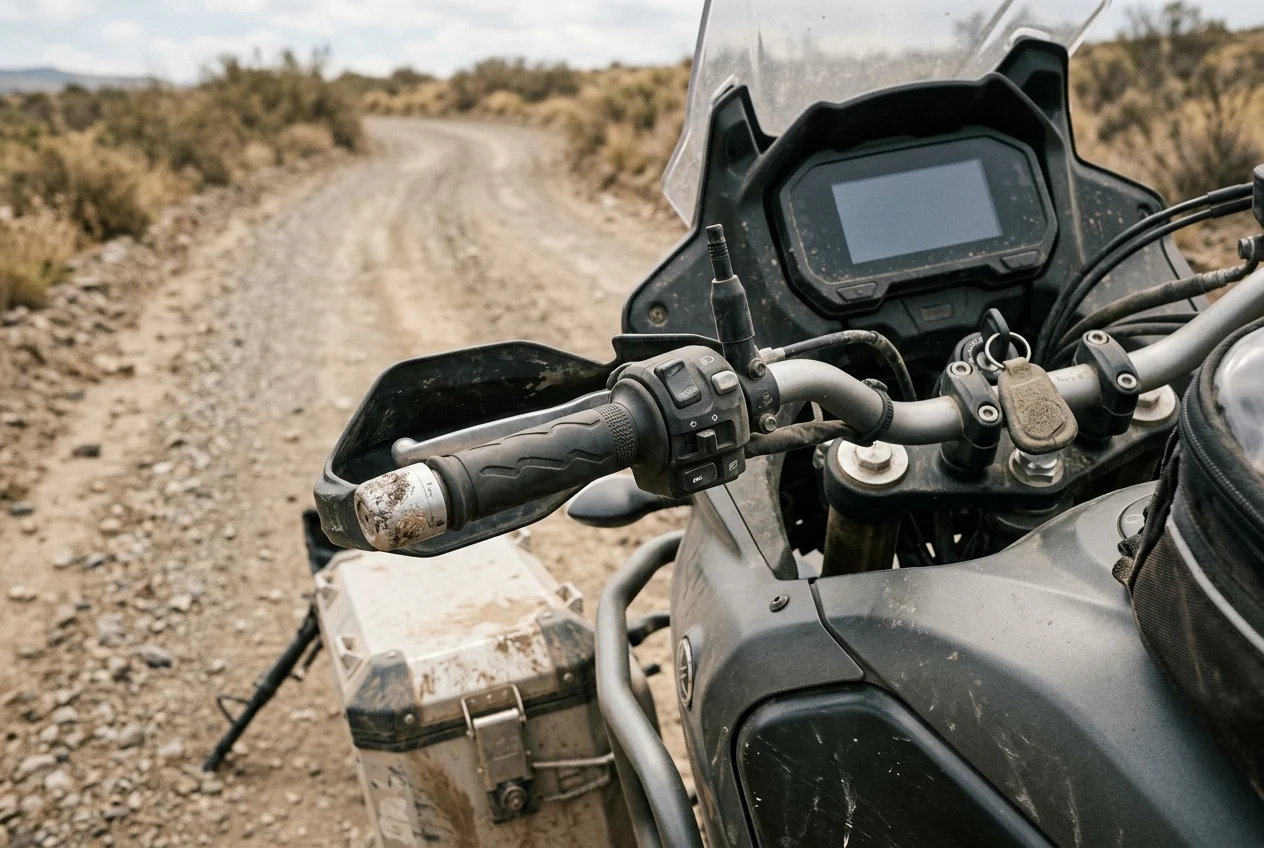
For an adventure rider this is the most useful line in the manuals, because a loaded bike goes over. Five of the seven makers document a sensor that shuts the engine down after a fall, and all five describe a reset step.
| Maker | To reset | Also note |
|---|---|---|
| Yamaha Ténéré 700 | Power off, then on | Warning light is “not a malfunction” |
| BMW R 1300 GS | Ignition off/on, or emergency-off on/off | Stand it up, check for damage |
| Honda Transalp, Africa Twin | Ignition off, then on | Sensor also stops the fuel pump |
| Suzuki V-Strom 800DE | Ignition off, then on | Light can take minutes to clear |
| Royal Enfield Himalayan 450 | Both switches off, wait, on | Upright, neutral, on the centre stand |
Yamaha is explicit about what happens if you skip it: failing to cycle the power “will prevent the engine from starting even though the engine will crank when pushing the start switch”. That is the exact symptom of a bike that cranks but will not fire after a drop. BMW’s version is a dash message headed “Motorcycle has fallen over” that says the engine cannot be started, with the remedy to raise the bike, check for possible damage, then turn the ignition off and on again “or turn emergency-off switch on and then off again”. Royal Enfield’s sensor is documented as acting when the bike falls with the engine running and a gear engaged.
We did not find a fall sensor described in the KTM 890 Adventure R or Triumph Tiger 900 manuals, so do not assume your bike has one or lacks one. Search your own manual for “fall”, “turnover” or “lean angle”.
- Check for damage before you reset anything. BMW says to raise the bike and check for possible damage, and Suzuki says that after a fall you should turn the ignition off immediately and have the bike inspected, because falling may damage parts that are not visible.
- If the malfunction light stays on after the reset, stop. Yamaha says not to start the engine while it remains lit.
- Cycle it deliberately. KTM says not to switch the ignition off and on in rapid succession, and Suzuki says its warning light can take a few minutes to go out.
If the drop was the whole story, our off-road riding guide covers how to lift a loaded bike without hurting your back.
Step 3: the key, the immobilizer and the fob
An immobilizer that does not recognise the key will let the bike crank and refuse to fire, or refuse to do anything at all. The manuals give four specific causes.
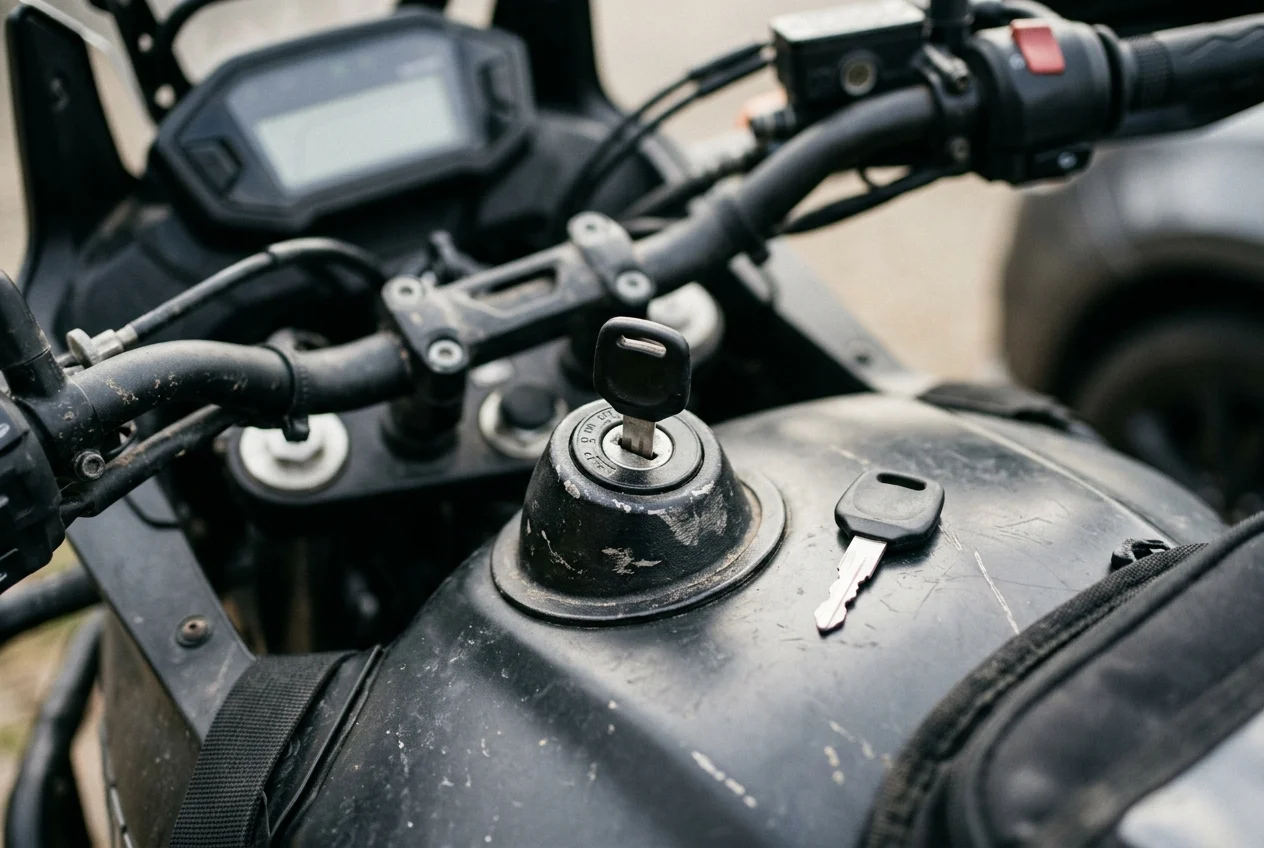
- Two keys close together. BMW warns that an additional key on the same ring as the key in use can confuse the electronics so that no enabling signal is sent. Yamaha says not to put two immobilizer keys on one ring, Triumph says two keys near the switch can interrupt the signal, and Suzuki warns against attaching two or more immobilizer keys to one holder. Honda’s chart says to check that no other key of its immobilizer system (Honda calls it HISS), spare included, is near the ignition switch.
- A flash code. Yamaha’s T7 flashes its immobilizer light slowly five times then quickly twice to indicate possible transponder interference. Its remedy is to keep other immobilizer keys away from the main switch, try the code re-registering key, and if the bike starts, switch off and go back to the standard key.
- Something metal on the key. Honda’s chart says to check for metallic seals or stickers on the key, and Suzuki says metal, magnetic and radio-transmitting items disturb the immobilizer signal.
- A dead fob. On a keyless BMW R 1300 GS, if the radio key’s battery is dead, the manual has you remove the rider’s seat and insert the dead, “folded-in” radio key into the ring antenna under it; the engine then has to be started within 30 seconds. The fob’s working range is about 1 m, and the ignition switches itself off after roughly 90 seconds if the key is missing.
Carry the spare key, but not in the same pocket or on the same ring as the one you ride with.
Step 4: it cranks briskly but won’t fire
If the bike spins briskly and never catches, the battery is probably not the problem (though KTM notes that a weak battery can also cause odd symptoms, especially when starting). You are back to the start procedure, fuel and the electronics that control them. This is where the makers’ charts thin out and hand over to a workshop.
- Fuel. Check the tank again, and check the throttle rule above. KTM’s manual says you can hear the fuel pump work for about two seconds after you switch the ignition on, and Yuasa’s guide says never to jump-start a fuel-injected motorcycle if the fuel pump does not activate. If your bike normally makes that sound and now does not, that is worth knowing before you reach for jump leads.
- Fuel quality, for riders who fill from remote pumps and cans. Honda says not to use stale or contaminated petrol; KTM says inadequate fuel quality quickly clogs the fuel filter, and its charts list a very dirty fuel screen or filter among the causes of low power; Triumph says to avoid filling in rainy or dusty conditions where airborne material can contaminate the fuel; Yamaha’s pre-ride checks include making sure the tank breather hose is not obstructed.
- Fuses. Know where your fuse box is and carry a spare of every rating in it; your manual lists them. We deliberately give no fuse map here because ratings and positions vary by model and year. KTM’s chart lists fuse 3 for this symptom.
- Honda’s “if the engine does not start” method. The Transalp manual prints a specific procedure: hold the throttle fully open and press the start button for 5 seconds (the engine will not start at that point, by design), then release both and repeat the normal starting sequence with the throttle closed, waiting 10 seconds between attempts. That is Honda’s method for its own bike, not a general trick, and KTM’s chart says the opposite about the throttle.
- The spark plug. Yamaha’s chart for the T7 has you remove the plug and look at it. Wet: wipe it with a dry cloth and correct the gap, or replace it. Dry: have a dealer check the bike. It then adds compression as the last step, and again sends you to a dealer.
- A malfunction light. Triumph says that if the malfunction light flashes when the ignition is switched on, the engine will not start and you should contact a dealer. Honda says to contact a dealer as soon as possible if the warning lamp is on, and KTM lists an injection fault and says to read the fault memory with its diagnostic tool.
Royal Enfield’s manual, after listing its starting steps, tells you to have the bike checked at a service centre to find and correct the reason for not starting, and Honda’s own page warns that starting over and over or removing parts can cause more damage. Past this point, a workshop is the honest answer.
Step 5: it cranks slowly, clicks or does nothing: the battery
Terminals first, and what drained it
Start with the terminals, because it costs nothing. Yamaha’s manual says the lead connections need to be checked and, if necessary, tightened. Honda’s chart lists a loose battery connection and terminal corrosion. Royal Enfield says poor contact or loose terminals may cause ECU failure, and Yuasa says loose cables can mimic a dead battery.
If the bike died overnight, ask what was left connected. Yamaha says a battery discharges more quickly on a bike with optional electrical accessories, and KTM says a 12 V battery discharges steadily each day even with no load. Our power and charging guide covers how much surplus your charging system actually has for GPS, USB and heated gear.
Measure it
Set a multimeter to DC volts and read across the terminals with the engine and everything else off. Any basic digital meter will do; the AstroAI below is listed as measuring AC and DC voltage and having a continuity buzzer, which is also how you check a fuse.
Check the AstroAI multimeter on Amazon →
| Reading | Means | Source |
|---|---|---|
| 12.8 V or more | Full (sealed battery) | Yamaha, Yuasa (AGM) |
| About 12.6 V | Full (conventional lead-acid) | Yuasa, CTEK, Battery University |
| About 12.1 V | About half charged | Yuasa |
| 11.9-12.0 V | About a quarter charged | Yuasa, Yamaha |
| Under 11.8 V | Empty | Yuasa |
| Under 12 V, dash dark | Charge at the terminals, don’t jump | BMW R 1300 GS |
Yuasa and Yamaha take these as resting readings, after the battery has stood for a while and, after a charge, for 30 minutes to an hour, so at the roadside treat the number as an estimate. Two more cautions. Yamaha’s own example is the reason not to over-trust a low reading: 12.0 V is not a dead battery, it is a battery at roughly a quarter charge. And Yamaha’s “under 12.0 V, replace the battery” applies only after a full charge and a 30-minute rest, so it is a workshop verdict, not a roadside one. Lithium batteries follow different curves, so use your maker’s figures.
The reading that matters more is the one while cranking. Yuasa’s technical manual says to connect the meter across the terminals, press the starter and watch the voltage: a battery that drops below 9.5 V while the engine is cranking over needs replacing. Its procedure assumes a fully charged battery, so on a flat one a low reading tells you the battery is flat, not that it is worn out. Royal Enfield’s manual names 10 V as the level a battery is drained below by holding the starter down too long.
Crank without cooking the starter
Where a manual gives a figure, five seconds is the ceiling.
| Maker | Crank | Rest |
|---|---|---|
| Yamaha Ténéré 700 | Release after 5 s | Wait 10 s |
| Honda Transalp | 5 s, then ignition off | Wait 10 s |
| Triumph Tiger 900 | 5 s at most | Wait 15 s |
| KTM 890 Adventure R | A short press | Wait 15 s; stop after 6 tries |
| Royal Enfield Himalayan 450 | 5 s at most | Wait 5 s; 15-20 s after three tries |
| Suzuki V-Strom 800DE | Under 5 s | No figure given |
| BMW R 1300 GS | No figure given | Starter may lock out for about 1 min |
Suzuki, Triumph and Royal Enfield each say that holding the button down runs the battery down, and KTM says that after six failed attempts you should stop and look for another fault.
Jump-starting: the makers and the battery maker disagree
This is where roadside advice most often goes wrong, because the internet repeats one rule as if it were universal. The sources we read do not.
| Source | On jump-starting | Donor engine |
|---|---|---|
| BMW R 1300 GS, F 850 GS | Prints a procedure | Running |
| Honda Transalp | Not recommended (car battery) | Not stated |
| Honda Africa Twin | ”Do not jump-start” | Not stated |
| Triumph Tiger 900 | Warns against jump leads | Not stated |
| Yamaha, KTM, Suzuki, Royal Enfield | Print none | Not stated |
| Yuasa (battery maker) | Allowed, incl. a jump pack | Car off |
BMW’s is the only maker’s procedure we found, and it comes with conditions that show how careful a maker is when it does allow it: jump at the battery terminals only, never through the power socket; the donor battery must be 12 V; use leads with fully insulated clips; do not disconnect the bike’s own battery; run the donor’s engine; wait a few minutes between attempts to protect the starter and the donor battery; and do not use start sprays. Both engines then idle for a few minutes before the leads come off, negative first. That is for those bikes, not a universal recipe.
Yuasa takes the opposite line on the donor, and it gives the clearest sequence we found from a battery maker. If your manual is silent, this is the one to know, attributed to Yuasa and not to your bike’s maker:
- Connect the red clamp to the dead battery’s positive terminal and the other red clamp to the donor’s positive terminal.
- Connect a black clamp to the donor’s negative terminal, and the other black clamp to a grounded, unpainted metal part of the motorcycle, typically the chassis, away from the battery.
- Start the motorcycle with the good battery. In Yuasa’s words, “do NOT start the car.”
- Let it run a few minutes, then remove the clamps in the reverse order. Never let the two clamps touch each other; the spark can ignite the hydrogen a battery gives off.
AAA’s guidance for cars says to start the working car and wait a few minutes, so advice derived from car practice can contradict Yuasa’s. Honda’s Transalp manual says jump starting “using an automobile battery can damage your vehicle’s electrical system and is not recommended”, its Africa Twin manual (a lithium battery) says not to jump-start, and Triumph warns against attaching jump leads because of the spark risk near battery gases. If your maker says no, do not treat a pack as a loophole.
There is one more BMW rule that overrides all of it. A fully discharged battery, under 12 V with the indicator lights and multifunction display staying dark when the ignition is switched on, must be charged directly at the terminals of the disconnected battery, not jumped.
A portable jump starter is a 12 V source you can carry, and Yuasa lists it as an acceptable one, but none of the nine manuals addresses it. The AstroAI S8 below is listed on Amazon as able to start motorcycles and has reverse-polarity protection; we have not tested it. Its listing also describes a boost override for batteries below 9 V, and BMW’s rule above is a reason to read that against your manual before you use it.
Check the AstroAI S8 jump starter on Amazon →
What about push-starting? No manual we read describes it, so we cannot give you a procedure. What Yamaha’s manual and BMW’s F 850 GS manual do say is not to roll or tow the bike a long way with the engine off, because the transmission is properly lubricated only while the engine is running.
Charging it, and checking the bike is charging
Yamaha says a sealed VRLA battery (the maintenance-free type on the T7) needs a special constant-voltage charger and that a conventional one will damage it. Honda says not to use an automobile-type charger and to remove the battery first, and its Africa Twin manual says to use only a charger recommended by the lithium battery’s maker. Our battery maintainer guide covers which chargers suit lead-acid and lithium and why the chemistry matters more than the brand.
A bike that starts on a jump and then flattens the battery again has not been fixed. Yuasa’s quick check: connect the meter across the battery, start the engine and hold 3,000 to 4,000 rpm. If the voltage stays between 13.0 and 14.5 V the charging system is probably working; if it sits at the resting figure (usually under 13 V), it is not, and that is a stator or regulator job for a workshop. Yamaha’s own T7 specification is a regulated 14.3-14.7 V, so use your bike’s figure if the manual gives one; Suzuki’s V-Strom 800DE also has a charging-system warning light.
When it is not a roadside fix
Knowing where to stop is part of the skill, and the manuals are clear about how not to get the bike home. KTM says towing with a towing vehicle, where the wheels stay on the road and rotate, is not an appropriate recovery method because it can damage the drivetrain or transmission, and that a broken-down bike should go on a trailer or the loading area of a transport vehicle, properly secured. Yamaha says not to tow the motorcycle for long distances even in neutral.
Before you are in that position, work out how you will call for help. Where there is no signal, the satellite messenger guide covers your options, and our solo camping safety guide covers the wider routine. Check that your policy or a breakdown club actually covers a motorcycle at the roadside and across borders; our insurance guide explains what touring policies commonly leave out.
What to carry
- Your manual, saved as a PDF on your phone before you leave. “Read your own manual” is the advice of this whole guide, and there is no signal where you will need it. Yamaha, BMW, Honda, Suzuki and Royal Enfield publish theirs (links below).
- A multimeter, spare fuses of every rating in your fuse box, and the wrench or socket for your battery terminals.
- The spare key, stored separately from the one you ride with.
- A way to charge or boost, chosen against what your manual says: a jump pack where your maker allows it, or a plan for finding mains power.
Our overlanding tool kit covers the mechanical spares, and the Ténéré 700 field maintenance guide shows how one bike’s kit is built. A flat tyre is a different problem with its own procedure, in our roadside puncture guide.
Cold mornings and bikes that have been sitting
Cold. Battery University’s figures show why a flat battery is worse in winter: the acid in a discharged lead-acid battery is weak enough to freeze at about -15 °C, whereas a fully charged starter battery resists freezing down to about -55 °C (Battery University’s examples are a specific gravity of 1.15 against 1.265, a measure of acid strength). Two makers give a cold or hard-start tip. BMW says that for a cold start you should pull the clutch, and notes that repeated brief load on the battery raises its temperature and so the power available to start. Suzuki says that if the engine is hard to start you should squeeze the clutch lever in neutral and keep pressing the starter. Our cold weather riding guide covers the rest of that season.
Standing. BMW says that for breaks of more than four weeks you should connect a trickle charger, because the vehicle electronics (the clock, for one) discharge the battery, and KTM says to recharge a 12 V battery every three months when the bike is not used. Yamaha adds that you should not leave the key in the on position without the engine running. Two guides help before it happens: how to store a motorcycle over winter and the power and charging guide.
What we read
Owner’s manuals and handbooks, read at the starting, battery and troubleshooting pages (page numbers are the printed ones):
- Yamaha Ténéré 700 owner’s manual, EU edition BAG-F8199-E0: pp. 4-1, 4-7, 4-33/34, 6-2/3, 7-29, 7-34. And Yamaha’s 2024 Ténéré 700 service manual, with its Basic Service Information volume: pp. 12-14, 2-8, 8-9 to 8-11.
- BMW R 1300 GS rider’s manual (US model): pp. 60, 90-93, 150, 218-220, 260. BMW F 850 GS rider’s manual, EU and US editions (jump-starting and starting pages).
- Honda XL750 Transalp owner’s manual (2025): pp. 97-98, 147, 158, 166. Honda CRF1100 Africa Twin owner’s manual (2022 edition): p. 341.
- KTM 890 Adventure R owner’s manual (2024, art. no. 3214932en, a retailer-hosted copy of KTM’s manual): pp. 72-73, 79-80, 138, 158.
- Suzuki V-Strom 800DE owner’s manual: pp. 2-91, 2-97 to 2-102.
- Royal Enfield New Himalayan 450 owner’s manual: pp. 66, 72-73.
- Triumph Tiger 900 GT, GT Pro and Rally Pro owner’s handbook (November 2023 issue, an importer-hosted copy): pp. 68, 105, 175.
Other sources:
- Honda Global, “Motorcycle Won’t Start? Simple Check Items”.
- Yuasa, Technical Manual (voltage chart, cranking test and charging-system check, pp. 21-22), Motorcycle Battery Jump Start Guide and Motorcycle Battery Charging Guide.
- CTEK, “Motorcycle Battery Voltage”.
- Battery University, BU-903 (state of charge) and BU-410 (charging at high and low temperatures).
- AAA, “How to jump a battery”, which is written for cars.
Manuals are model-year specific and change. If your bike is not on this list (Kawasaki, Ducati, Husqvarna and Aprilia are not, and neither are carburettor and kick-start bikes), your own manual is the source that counts.
Related guides
- Ténéré 700 roadside maintenance: one bike’s full field kit and the jobs that are not roadside jobs.
- Motorcycle battery maintainers: the chemistry question that decides which charger is safe for your battery.
- How to fix a flat tyre on the road: the other common roadside failure.
- Used adventure motorcycle buying guide: where electrical faults show up when you buy second-hand.
Frequently Asked Questions
Why does my motorcycle click but not start?
A click or chatter usually means the starter relay is closing but the battery cannot carry the current the starter asks for, so check the terminals and the battery voltage first. Treat that as the common reading, not something the makers define: none of the nine manuals we read describes a click. AAA's car guidance says rapid clicking when the key is turned generally points to a battery issue, and Yuasa, the battery maker, says loose cables can mimic a dead battery. Yuasa's cranking test gives you a number to work with: with a meter across the battery terminals, a battery that drops below 9.5 V while the starter turns needs replacing.
Why does my motorcycle crank but not start?
If it turns over briskly and does not fire, the battery is probably not the problem (Yamaha's chart reads a fast crank as a good battery), so work through the start procedure, fuel, the fall sensor, the key and the fuses. KTM's chart for this exact symptom lists an operating error, no fuel, a blown fuse, a fuel-injection fault and a throttle opened during starting. If the bike has been dropped, Yamaha, BMW, Honda, Suzuki and Royal Enfield all describe a sensor lockout that needs a reset. Honda's chart adds the immobilizer: if its indicator stays lit, another key near the ignition or a metal sticker on the key can be the cause.
Why won't my motorcycle start after I dropped it?
Almost certainly the fall or lean-angle sensor. Yamaha says its sensor stops the engine in a turnover and that the bike will then crank but not start until you turn the vehicle power off and back on. Honda's Transalp and Africa Twin manuals say the same and add that the sensor also stops the fuel pump. BMW says to stand the bike upright, check for damage, then cycle the ignition or the emergency-off switch. Suzuki warns that the warning light can take a few minutes to clear after you switch off, and tells you to have a fallen bike inspected by a dealer because a fall can damage parts you cannot see.
Can you jump-start a motorcycle with a car?
The sources do not agree, so read your own manual first. BMW's R 1300 GS and F 850 GS manuals print a jump-start procedure with the donor vehicle's engine running and a 12 V donor battery. Honda's Transalp manual says jump starting from an automobile battery is not recommended, its Africa Twin manual says not to jump-start at all, and Triumph's Tiger 900 handbook warns against attaching jump leads to the battery. Yamaha, KTM, Suzuki and Royal Enfield print no procedure. Yuasa, the battery maker, says a motorcycle can be jumped from another bike, a car battery or a portable jump starter, but with the car switched off.
How long should you crank a motorcycle before stopping?
Five seconds at most, then rest. Yamaha says to release the start switch after 5 seconds and wait 10 seconds before pressing it again so battery voltage can recover. Honda gives the same figures. Triumph says no more than five seconds and then a 15-second wait, and KTM asks for 15 seconds between attempts and says to stop after six failed attempts and look for another fault. BMW's starter has an overheating protection that can lock it out for about a minute. Holding the button down rarely helps: Suzuki, Triumph and Royal Enfield each say it can run the battery down.
What voltage should a healthy motorcycle battery read?
It depends on the battery type and on resting it first. Yuasa puts a fully charged conventional lead-acid battery at about 12.6 V and a fully charged sealed AGM battery at 12.8 to 13.0 V, and its chart runs down to about 11.9 V at a quarter charge. Yamaha says no charging is needed at 12.8 V or more on the Ténéré 700's sealed battery, and its own example puts 12.0 V at roughly 20 to 30 percent charge. BMW treats anything under 12 V with a dark dash as fully discharged. Lithium batteries read differently, so use the maker's figures.