
Sales are not evenly good. That sounds obvious and almost nobody shops that way.
The instinct in a sale is to treat the percentage as the variable and the product as fixed: this is thirty per cent off, so it is thirty per cent better value than it was yesterday. But motorcycle gear divides into categories that respond to discounting in genuinely different ways, and the same reduction can be free money in one and a slow mistake in another.
This is the framework we use, in four tiers. It applies in November and it applies in March, which is why it is written without a single date in it.
The organising principle: distance from your body
Every tier below is really one measurement — how close the item sits to your skin, and therefore how much of its value depends on it fitting you specifically.
A roll-top dry bag works identically for every rider alive. A jacket only works if the armour ends up over the joints it was designed to cover. Between those two extremes sits everything else, and that axis predicts how well a category rewards a discount better than price, brand or category name does.
Disclosure: some links below are affiliate links. If you buy through them we may earn a small commission at no extra cost to you. We cannot see the price you are shown — the button goes to the current listing.
Tier 1: Buy without thinking
Consumables you already use.
These are the purchases where a sale is unambiguously good, because the decision was made long ago and the only open question is when you restock. Chain lube and cleaner. Corrosion inhibitor. Fuel stabiliser if the bike is going to sit. Replacement earplugs. Spare inner tubes if you run tubes.
The reason this tier is so clean is that there is no fit risk, no model-year risk, no returns risk, and no chance of ending up with something you do not want — you will use it regardless of what happens next. The only failure mode is buying a five-year supply of something with a shelf life, and even that is a minor error.
Earplugs deserve a specific mention because they are the one item in this tier that most riders under-buy. Wind noise on a motorcycle is generated by air moving over the helmet rather than by the engine, which is why a quiet bike does not save you, and the exposure is cumulative across a riding career. Filtered plugs cut the roar while passing the frequencies you need — engine note, horns, sirens, the intercom. The earplug guide covers the filter types.
Tier 2: Buy freely
Sizeless durables with long service lives.
This is where most sale money should go, and where most riders spend the least of it, because none of it is exciting enough to be marketed hard.
Camping and sleep systems. The single largest return on money in adventure motorcycling, and the category where late-season discounting cuts deepest because the whole market is out of season at once. There is an order to buy it in that matters more than the brands, and it is not the order most riders use — that is its own guide: Black Friday motorcycle camping gear.
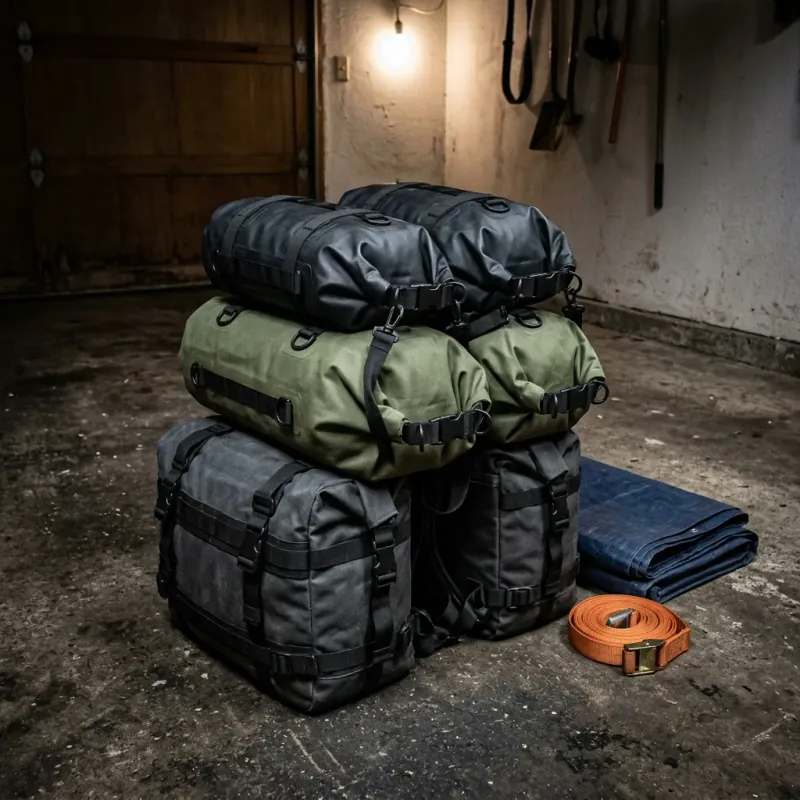
Luggage and dry bags. No fit risk, no revision cycle, and the failure mode announces itself on arrival rather than three hundred miles into a wet day. Soft luggage is rarely genuinely waterproof on its own, and roll-top dry sacks are the cheap fix that most riders keep meaning to buy. See the dry bag guide and, if you are still choosing a system, soft versus hard panniers.
Tools and roadside kit. Sizeless, rarely revised, and something you hope never to need — which is exactly why it is easy to postpone at full price. One caution: judge a kit by whether it contains the specific sizes your bike uses, not by the piece count on the box. A ninety-piece set full of sockets that do not fit anything on your motorcycle is worse than a twelve-piece set that does. The tool kit guide covers what actually earns its weight.
Battery maintainers. The least interesting item on this page and probably the highest return. A battery left to sulphate over four months of winter costs several times what a maintainer does, and the maintainer then does it again every year. Pair it with the rest of the winter storage routine.
Tier 3: Buy only if you had already decided
Things where the discount is real but the decision has to precede it.
Sized apparel you have physically worn. If you know that this jacket in this size fits you over your usual layers, a sale is an excellent time to buy it, and last season’s colourway is the cleanest discount in all of motorcycle apparel — same garment, same shell, same armour, same certification, a colour fewer people wanted. What makes this tier three rather than tier two is the conditional: it only holds if you have worn it.
Tyres in your size. Real savings exist, but a tyre model name is not a buyable thing — the same model exists in a dozen sizes and the discounted one is frequently a size that does not sell. Read your sidewall before you read the price, and read the date code too, for reasons the Black Friday guide sets out. Our tyre guide covers which model suits which riding.
Electronics one generation back. Often the smartest purchase in motorcycling, because software moves and hardware does not have to — a headset that has been on shelves for years can be running the current networking protocol after a free update. But this is category-specific rather than universal, and it inverts entirely for helmets. That whole argument is its own post.
Tier 4: No discount fixes these
The four purchases that stay bad however good the number is.
Protective gear you have not worn
Helmets, jackets, trousers, boots and gloves are protective equipment, and their protection depends on position. Limb armour is certified under EN 1621-1 and back protectors under EN 1621-2, each with a Level 1 and a Level 2 where the higher level transmits less force — but every one of those ratings assumes the armour is sitting over the joint it was designed for. A jacket bought a size out puts the shoulder pad somewhere other than your shoulder, and the certification on the label becomes a number about a garment rather than a fact about you. Our protection guide goes through the levels properly.
Sale stock compounds this. The discounted sizes are the ends of the range, because the middle cleared months ago at full price. And sale purchases are frequently final sale, or returnable on a shorter window, or returnable at your own cost from a warehouse in another country.
Bike parts bought by model name
Crash bars, racks, screens, luggage mounts and skid plates are fitment-specific, and the same model name can take different parts across model years — a bike that keeps its name for eight years does not keep its subframe geometry for eight years. Buy these against a part number confirmed for your year, or do not buy them in a hurry at all.
Subscription hardware without the subscription
A satellite messenger is the clearest case. The device sends nothing without an active service plan, and across a few years the plan usually costs more than the hardware did. A deep discount on the unit is genuinely valuable if you had already decided to pay for the service — and it is money spent on an ornament if you had not.
Decide the subscription question first. Then the hardware discount is a bonus rather than a reason. Our satellite messenger guide covers how the plan tiers differ, which is the part that actually decides the total cost.
Anything you had not thought about before the offer appeared
The quiet one, and the most expensive over a riding career.
There is a real difference between a discount you found and a purchase that found you. The first is you executing a plan more cheaply. The second is a category entering your life because it was marketed well in a week when you happened to be looking at gear.
The test is simple and slightly uncomfortable: would you buy this in March, at full price? If not, the sale has not made it a good purchase. It has made a purchase you did not want cheaper, which is a different thing entirely.
The inversion: what would guarantee you waste money?
Sometimes the fastest way to a good decision is to ask what a bad one would look like, then avoid exactly that. A rider who wanted to waste the most money possible in a sale would:
- Shop without a list, so every offer is evaluated against nothing.
- Buy sized gear in a size they have never worn, in the sizes that are left.
- Buy on brand recognition rather than on whether the item fits their actual riding.
- Buy a mesh intercom in a different brand from their riding group.
- Buy the fifth jacket while running tyres past their wear indicators.
- Buy hardware that needs a subscription they have not committed to.
- Buy anything at all inside the first hour of noticing it exists.
Every one of those is avoidable for free, and avoiding them is worth more than any percentage on the page.
That last habit — the fifth jacket while the tyres are done — deserves naming. Apparel is marketed constantly and consumables are marketed never, so sale attention flows toward the wrong end of the bike. If you only take one thing from this page: before you spend on gear, price the maintenance you have been postponing. It is almost always the better purchase, and it never goes on sale in a way anyone advertises.
Where to go from here
- Black Friday motorcycle gear 2026 — this framework applied to the specific November window, with the dates and the traps.
- Helmet and intercom deals — the two categories where an identical discount means opposite things.
- Black Friday motorcycle camping gear — tier two in detail, in the order worth buying it.
- The motorcycle gear buying calendar — when each category actually drops, so you know what is worth waiting for.
- Motorcycle camping gear checklist — the list to build from, if you do not have one yet.
Tier 4 is the one to reread. Tiers 1 through 3 will save you money, and most riders work them out eventually on their own. Tier 4 is where the expensive mistakes live, and none of them look like mistakes at the moment you make them — they look like good prices on reasonable things.
Frequently Asked Questions
Is it worth buying motorcycle gear on sale?
It depends almost entirely on how close the item sits to your body. Consumables, luggage, camping equipment, tools and dry bags are sizeless commodities with long service lives, and a discount on them is a straightforward transfer of value to you. Sized protective gear — helmets, jackets, trousers, boots, gloves — is a different proposition, because the discounted stock is usually the sizes that did not sell, returns on sale items are often restricted, and a protective garment in the wrong size does not do the job you bought it for. The reliable rule is that the further a category sits from your skin, the better it rewards a discount.
What motorcycle gear should you never buy on sale?
Four things. Anything sized that you have not physically worn, because fit on protective equipment is functional rather than cosmetic. Anything bike-specific bought by model name rather than by part number, since crash bars, racks, screens and luggage mounts change across model years even when the bike's name does not. Anything whose usefulness depends on an ongoing subscription you have not decided to pay for, such as a satellite messenger. And anything you had not thought about until the offer appeared — that is not a discount you found, it is a purchase that found you.
Are last season's colours a good way to save money on riding gear?
They are the single cleanest discount in motorcycle apparel. A colourway that did not sell is the same garment, from the same production run, with the same shell fabric, the same armour and the same certification as the version that did. The only difference is that fewer people wanted it in that finish. If you already know the model fits you, buying the unloved colour is real money saved with nothing given up, and it applies equally to helmets, jackets and luggage.
Should I buy a satellite messenger on sale?
Only once you have decided to pay for the plan. A satellite messenger is a subscription device — the hardware sends nothing without an active service plan, and over a few years the subscription typically costs more than the unit did. A large discount on the hardware is genuinely useful if you were always going to activate it, and it is money spent on an ornament if you were not. Decide the plan question first, then treat the hardware discount as a bonus rather than as the reason.
How do I stop myself overbuying during a sale?
Write the list before the sale starts, ideally in October, and treat it as closed. A list written in advance is built from things you have actually noticed missing on real rides; a list assembled during a sale is built from whatever was promoted well. The second habit that helps is to price each item against what it replaces rather than against its own list price — a jacket is competing with the jacket you already own, not with its own former price. If the thing you own still does the job, the correct discount is zero.