

Almost every rider has had the experience: you pull off after a long motorway run, take the helmet off, and the world sounds like it’s happening in another room. It clears up by dinner, so you file it under “long day” and forget it. That muffled hour is your ears telling you they took damage — temporary damage that day, but the kind that stops being temporary if you keep collecting it.
The thing that surprises people is where the noise comes from. It isn’t the engine, or not mostly. Above about 40 mph the dominant sound at your ear is wind — air tumbling over and around the helmet — and it climbs steeply with speed. A helmet doesn’t fix that, because the helmet is what the air is tumbling over.
This guide covers the earplugs worth buying in 2026, but it starts with the part most roundups skip: how loud it actually is, and why the big number printed on the packet isn’t the protection you’ll get. Get those two things right and almost any decent plug works. Get them wrong and the most expensive plugs in the world won’t help.
How Loud Is It Under There?
The numbers are worth stating plainly, because they change how seriously you take this.
A study of the motorcyclist’s acoustic environment by Binnington, McCombe and Harris, published in the British Journal of Audiology in 1993, found that wind noise becomes the dominant sound source at around 40 mph (65 km/h) and then rises with the logarithm of speed — from about 90 dB(A) at 40 mph to 112 dB(A) at 100 mph. Independently, ISVR Consulting — the University of Southampton acoustics group that measured under-helmet noise for the UK Home Office — reports that daily noise exposure for working motorcyclists without hearing protection may regularly exceed 90 dB(A).
Now set that against the exposure limits. NIOSH recommends 85 dBA as an eight-hour time-weighted average, using a 3 dB exchange rate — meaning every 3 dB increase halves the time you can safely be exposed. Run that logic forward from 85 dBA over eight hours and you reach single-digit hours at 90, and minutes rather than hours by the time you’re into the 100s. NIOSH’s own estimate is that forty years of exposure at 85 dBA carries an 8% excess risk of occupational hearing loss, against 25% at the 90 dBA limit OSHA enforces.
Two things follow from this that riders routinely get wrong.
Your helmet is not hearing protection. It’s a crash helmet. The noise is aerodynamic — generated by airflow over the shell and around the opening — so putting a shell over your head doesn’t remove the source. Researchers from the University of Bath and Bath Spa University, publishing in the Journal of the Acoustical Society of America, identified the region under the helmet near the chin bar as a significant path for the noise reaching a rider’s eardrums. And ISVR puts the improvement available from helmet-side fixes — screen height, better sealing — at roughly 5 to 8 dB at the ear. Real, but not remotely sufficient by itself. If you’re shopping for a quieter lid anyway, our adventure helmets guide covers the models, but treat a quiet helmet as a bonus on top of plugs, not a substitute for them.
The damage is cumulative and painless. There’s no sharp moment. You just ride a lot of days, and one year you notice you’re asking people to repeat themselves in restaurants.
The Ratings Maths Nobody Puts on the Packet
This is the section that should change what you buy, so it’s worth reading carefully.
NRR and SNR are not the same scale
NRR (Noise Reduction Rating) comes from the American standard ANSI S3.19. SNR (Single Number Rating) comes from the European ISO 4869-2. They measure the same intent with different test protocols, and there is no exact conversion between them — as a rough tendency, SNR figures come out a few decibels higher than NRR for the same product.
You don’t have to take that on trust, because at least one manufacturer publishes both. Loop’s Quiet 2 is labelled SNR 24 and NRR 14. Same plug, same physics, two numbers ten decibels apart. So when you’re comparing a European filtered plug rated SNR 20 against an American foam plug rated NRR 33, you are not comparing like with like — and the gap is smaller than it looks.
The labelled number is a laboratory ceiling, not your result
Those ratings come from tests with expert fitting under ideal conditions. Actual humans, wearing them under a helmet, at the roadside, in a hurry, do worse.
Regulators account for this openly. NIOSH derates by protector type: earmuffs lose 25% of the labelled figure, formable foam plugs lose 50%, and other earplug types lose 70%. OSHA’s simpler rule for a mixed group of users is (NRR − 7) ÷ 2.
Run a foam plug labelled NRR 33 through the OSHA formula and you get 13 dB. Run it through the NIOSH foam derating and you get around 16. Either way, the honest expectation for a foam plug in a real ear is somewhere in the teens, not the thirties.
That is still a huge amount at 100 dB(A) — the difference between “damaging in minutes” and “manageable for a day”. But it reframes the shopping decision completely:
Fit beats rating. A filtered plug rated SNR 20 that seals properly in your ear canal every single time will out-protect a foam plug rated NRR 33 that you jam in half-inserted at a petrol station. The number on the box is the ceiling. Your fit is what you actually get.
Which is why “filtered vs foam” is a real choice, not a compromise
Solid foam attenuates high frequencies more than low ones. That’s why deep foam can leave a ride feeling oddly muted — speech, sirens and intercom prompts lose clarity while the low rumble carries on. Filtered plugs put a small acoustic channel through the plug to flatten that response: everything gets quieter more evenly, so a horn still sounds like a horn and your passenger still sounds like a person.
For touring — navigating, riding in company, using an intercom, threading through traffic in an unfamiliar country — that’s usually worth more than the extra decibels of foam. For a long, fast, empty motorway transit where you have nothing to listen to, foam wins on raw numbers and costs pennies. Plenty of riders carry both.
Motorcycle Earplugs Compared — Side by Side
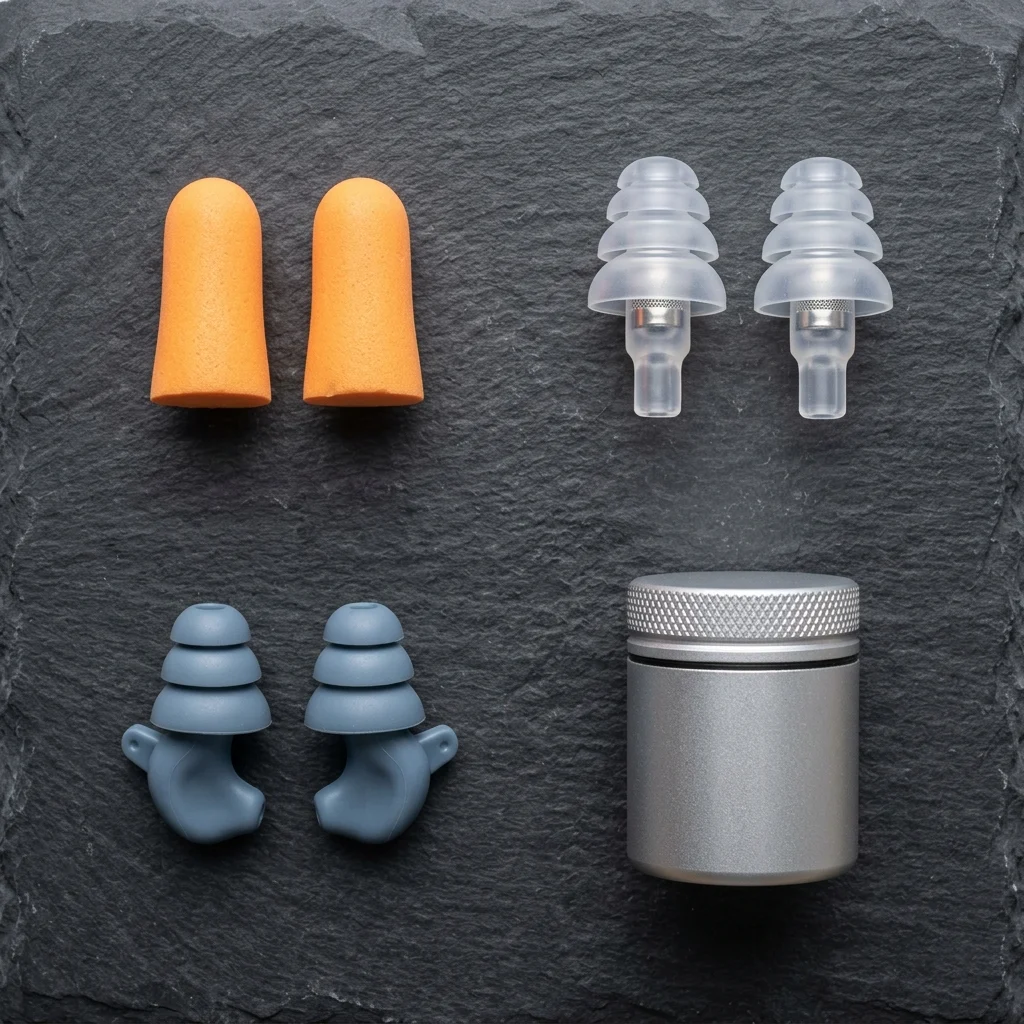
8 Earplugs — Side by Side
| Earplug | Type | Maker's rating | Best for | Price | Rating |
|---|---|---|---|---|---|
| Best OverallAlpine MotoSafe Pro | Filtered, reusable | SNR 17 + SNR 20 (both pairs) | Touring, learning your preference | $$ | |
| Best ValueHoward Leight MAX-1 | Disposable foam | NRR 33 | Maximum attenuation, long transits | $ | |
| Alpine MotoSafe Race | Filtered, reusable | SNR 20 | Motorway speeds, single pair | $$ | |
| EarPeace Moto Original | Filtered, reusable | Up to 26 dB (3 filter sets) | Tuning attenuation to the ride | $$ | |
| Best Fit FixDecibullz Custom Molded | Custom thermoplastic | NRR 31 | Ears that reject standard plugs | $$ | |
| Alpine MotoSafe Tour | Filtered, reusable | SNR 17 | Town, slower roads, maximum awareness | $$ | |
| EarPeace Moto PRO | Filtered, reusable | Up to 24 dB (one fixed filter) | One filter, nothing to swap | $$ | |
| Loop Quiet 2 | Silicone, reusable | SNR 24 / NRR 14 | Camp and ferry sleep, not the ride | $$ |
On price tiers: $ is genuinely trivial — a box of foam plugs costs less than a coffee per pair; $$ covers essentially every reusable filtered plug on the market, which cluster in a narrow band. We don’t print exact prices because they move constantly with colour, pack size and sales — check the live figure on each button. And note the ratings column carefully: SNR and NRR are different standards and should not be read as one league table.
1. Alpine MotoSafe Pro — Best Overall
Alpine’s MotoSafe range is the default answer for touring riders for one structural reason: it exists in two filter strengths, and the Pro pack contains both. You get the Tour filter (SNR 17) and the Race filter (SNR 20) in the same box, in the same soft thermoformable body that adapts to your ear canal.
That matters because the right amount of attenuation isn’t a fixed property of you — it’s a property of the ride. A day of alpine hairpins with a pillion and an intercom wants the lighter filter. A 500 km motorway slog to reach the good roads wants the heavier one. Buying both at once means you find out which you actually prefer instead of guessing once and living with it.
The filter is the point of the design: rather than sealing you off, it passes sound through a channel intended to keep the reduction relatively even across frequencies, so engine note, indicator, intercom and horn all stay recognisable while the wind roar drops. The bodies are hypoallergenic and silicone-free, and they’re reusable, so the running cost after the first purchase is nothing.
Our take: the recommendation because it removes the hardest decision — how much attenuation you want — by giving you both and letting the road answer. Rated below a theoretical maximum only because SNR 20 is not the biggest number available; it’s simply the most useful one for a rider who still needs to hear things. If you buy one thing from this page, buy this and keep the spare pair in the tank bag.
Disclosure: some links below are affiliate links. If you buy through them we may earn a small commission at no extra cost to you.
Check Alpine MotoSafe Pro on Amazon →
2. Alpine MotoSafe Race — The Single-Pair Version
If you already know you ride fast roads and want the stronger filter, the Race is the Pro’s heavier half sold on its own at SNR 20. Same body, same acoustic filter concept, one pair instead of two.
It’s the pick for riders whose typical day is a long, quick one: motorway transits, autoroute mileage between destinations, dual carriageway commuting. At those speeds the wind noise is doing the damage, and the extra few decibels over the Tour filter is where you want to be.
Where it fits: functionally identical to the Pro minus the choice, so buy it only if you’re confident which filter you want. If you’re not sure, the Pro costs a little more and settles the question. There’s also a MotoGP-branded variant of the Race on Amazon under a separate listing if the graphics matter to you; the acoustic spec is the same 20 dB SNR.
Check Alpine MotoSafe Race on Amazon →
3. Alpine MotoSafe Tour — Maximum Awareness
The Tour filter is the lighter one, at SNR 17. Less attenuation, more of the world left in.
That sounds like the worse product and isn’t, depending on the riding. City work, tight mountain roads, riding in a group, anywhere you’re making constant decisions off sound — the traffic behind you, the note of your own engine, a passenger’s voice — is exactly where over-attenuating makes you a slightly worse rider. Three decibels doesn’t sound like much, but the exchange-rate logic runs both ways: it’s a meaningful change in what reaches you.
Where it fits: the specialist of the three, and rated slightly lower here purely because most touring riders spend more of their mileage at speeds where the heavier filter serves them better. If your riding is mostly under 100 km/h and busy, this is the right one, and it’s the reason the Pro pack is such good value — you get this one and the Race.
Check Alpine MotoSafe Tour on Amazon →
4. Howard Leight MAX-1 — Best Value, Biggest Number
Nothing on this page attenuates like foam, and nothing costs less. The Howard Leight (Honeywell) MAX-1 is a polyurethane foam plug rated NRR 33 — the top of the disposable foam class — sold in boxes of 200 pairs, which works out to a trivial cost per ride.
The bell-shaped body is designed to be easy to roll and insert and to resist backing out of the ear canal, which is the classic foam failure mode. They’re single-use in the industrial sense, though riders routinely get several days out of a pair before they stop springing back.
Two honest caveats. First, apply the derating: NRR 33 on the box realistically means something in the teens in a real ear, per NIOSH and OSHA guidance. It’s still the most attenuation here by a distance. Second, foam’s frequency response isn’t flat, so speech and warning sounds lose more clarity than with a filtered plug — which is precisely why we’d reach for these on an empty motorway and the Alpines in traffic.
The value case: at this price there’s no argument for not having a box in the garage and a handful in the tank bag. Rated just below the Alpines despite the bigger number because clarity matters on the kind of riding this site is about — but if your ears are ringing after rides and you buy nothing else today, buy these.
Check Howard Leight MAX-1 on Amazon →
5. EarPeace Moto Original — Tunable Attenuation
EarPeace’s Moto Original takes the “how much attenuation?” question and answers it with three interchangeable filter sets — Medium, High and Max — rated by the maker at up to 26 dB, in a contoured body shaped to sit flat under a helmet, supplied in an aluminium case.
The idea is the same as buying the Alpine Pro pack, executed differently: instead of two complete plugs you swap the filter cartridge. Riders who like fiddling will prefer it; riders who want to grab and go may not. The low-profile shape is the other genuine argument for it, because a plug that protrudes gets nudged by the helmet lining every time you put the lid on, and a nudged plug is an unsealed plug.
Where it fits: the closest competitor to the Alpine Pro, and it comes down to which mechanism you’d actually use. Rated marginally lower only because swapping small filters at the roadside is more faff than swapping whole plugs, and because EarPeace states its figure as “up to 26 dB” rather than a single standardised SNR or NRR you can line up against the others. Note the naming: EarPeace now sells this one as the Moto Original, and the Moto PRO badge has moved to a different plug — a single fixed filter rated up to 24 dB, two pairs in the box. Fewer parts to lose, but no tuning, so buy on which of those you want.
Check EarPeace Moto Original on Amazon →
6. Decibullz Custom Molded — Best Fix for Awkward Ears
Some people simply cannot get standard plugs to seal. Ear canals vary enormously in shape, and if yours reject every off-the-shelf plug, no amount of buying more off-the-shelf plugs will fix it — which, given everything above about fit beating rating, is a real safety problem and not a comfort complaint.
Decibullz solve it by making you the mould. You heat the thermoplastic moulds in boiling water, let them cool briefly, and press them into your own ears to set the shape. If you get it wrong, they’re re-mouldable — you can reheat and start again, which is the feature that separates them from custom plugs you only get one shot at. The maker states an independently tested NRR 31 to ANSI S12.6, and the kit ships with several tip options.
Where it fits: not the first plug to try, but the one to buy when the others have failed you. A custom-shaped plug that seals every time and stays sealed under a helmet is worth more in practice than a higher-rated plug you can never quite get right. Rated below the filtered options for touring only because the attenuation is broadly foam-like rather than flat — you’re solving fit here, not frequency response.
Check Decibullz Custom Molded on Amazon →
7. Loop Quiet 2 — Great for Camp, Not for Riding
The Loop plugs are everywhere, they’re comfortable, and they’re the clearest illustration of this article’s central point — which is mainly why they’re here.
The Quiet 2 is a soft silicone plug that Loop rates at SNR 24 / NRR 14. Read those two numbers again: that is one product, two standards, and a ten-decibel gap in apparent performance. If you’ve ever wondered why the “best earplug” lists on the internet contradict each other, this is why.
They’re designed for sleep, focus and noise sensitivity rather than riding, and there’s no motorcycle-specific filter tuning here. But if your trip involves campsites, ferry cabins and hostel dorms — and on a long tour it does — a pair in the tank bag earns its space for the nights, and the ring-shaped body makes them easy to pull out.
Where it fits: the lowest score on this page, and deliberately so — as riding plugs there’s no reason to choose them over the Alpines or the foam. As camp and ferry plugs they’re excellent, and a rested rider is a safer rider, so they’re not a frivolous purchase for a touring kit. Just don’t buy them thinking the SNR 24 makes them stronger than an NRR 20-something plug; it doesn’t work like that.
Check Loop Quiet 2 on Amazon →
Fitting Them Properly (This Is the Bit That Decides Everything)
Given the derating maths, insertion technique is worth more than an upgrade. Two techniques cover everything here.
Foam plugs — roll, pull, hold.
- Roll the plug between finger and thumb into the thinnest possible cylinder. Not squashed flat; rolled thin.
- Reach over your head with the opposite hand and pull the top of your ear up and back. This straightens the ear canal, which is not a straight tube. Skipping this step is the single most common reason plugs don’t work.
- Insert while it’s still thin, and hold it in place for 20–30 seconds while the foam expands against the canal wall.

Filtered and moulded plugs — same ear pull, gentle twist. Pull the ear up and back the same way, then insert with a small twisting motion until it seats. It should feel snug and slightly “sealed”, not perched.
How to know you got it right: with plugs in, your own voice should sound noticeably deeper and louder inside your head. If it doesn’t, you haven’t sealed. Then put your helmet on and check again — the lining commonly drags a plug half out as it passes over your ear, which is the fitting failure specific to riders. Seat the plug, fit the lid, then reach up and press each plug home before you set off.
A last practical note: put them in before the helmet and take them out after. Two minutes of unprotected 100 dB(A) at each end of every ride adds up over a touring season, and it’s free to avoid.
Where They’re Legal
Worth checking before a trip, because the rules genuinely vary and the penalties in some places aren’t trivial.
- United Kingdom: no law prohibits earplugs or headsets for riders.
- United States: there’s no federal rule and it’s a state matter. Some states permit hearing protection explicitly, at least one restricts riders to custom-moulded plugs, and riders have been ticketed in states where plugs are prohibited. Because these statutes change, check the American Motorcyclist Association’s state law database for your own state rather than trusting any blog’s table — including ours, which is why we haven’t published one.
- France: Article R412-6-1 of the Code de la route prohibits a driver wearing at the ear “any device capable of emitting sound”, with exceptions for hearing-correction devices, priority vehicles and riding instruction. Penalties include a fourth-class fine, licence points and, in some cases, licence suspension. On the plain wording that provision targets earphones, headsets and in-ear intercoms — devices that emit sound — rather than passive plugs, which emit nothing. That is our reading of the text, not legal advice. If you tour France with an in-ear intercom, this is the article to know about.
If your route crosses several countries, this belongs on the same checklist as the rest of your paperwork — our guide to European border crossing documentation covers the wider set.
The Bottom Line
The case for earplugs isn’t comfort, though they are more comfortable. It’s that wind noise under a helmet passes the level at which damage accumulates before you even reach motorway speed, that the damage is painless and permanent, and that a helmet takes only a handful of decibels off it.
So: buy filtered plugs for touring, because hearing your surroundings is part of riding well. Keep a box of foam for the long fast days when there’s nothing to listen to. Ignore the temptation to shop by the biggest number, because NRR and SNR aren’t the same scale and neither one is what you’ll actually get. And spend your effort on the fit, because that’s the variable you control — pull the ear up and back, seat the plug, then check it again after the helmet goes on.
Do that from now on and, thirty years from now, you’ll still be able to hear the bike. Which was always the point.
They’re also the easiest thing to buy for a rider who isn’t you, because there’s no size to get wrong — which is where our gift guide for adventure motorcyclists starts.
Disclosure: Some links in this article are affiliate links. If you buy gear through them, Bikes & Bays earns a small commission at no extra cost to you. We only link to gear that earns its place, and skip the button when nothing’s worth recommending.
Frequently Asked Questions
How loud is riding a motorcycle, really?
Loud enough that the number surprises most riders. A study of the motorcyclist's acoustic environment published in the British Journal of Audiology found that wind noise becomes the dominant sound source at around 40 mph (65 km/h) and rises with speed — roughly 90 dB(A) at 40 mph, climbing to 112 dB(A) at 100 mph. ISVR Consulting, which measured helmet noise for the UK Home Office, similarly notes that daily noise exposure for working motorcyclists can regularly exceed 90 dB(A). For scale, NIOSH sets its recommended occupational limit at 85 dBA averaged over eight hours, and halves the safe time for every 3 dB above that. At the levels a helmet sees at motorway speed, the safe exposure is measured in minutes, not hours. That is the whole case for earplugs in one paragraph.
Doesn't my helmet protect my hearing?
Not really, and this is the most common misconception in riding. A helmet is a crash-protection device, not a hearing protector — the noise is generated by air flowing over and around the helmet and reaching your ears, so covering your head doesn't remove the source. Research from the University of Bath and Bath Spa University published in the Journal of the Acoustical Society of America identified the area under the helmet near the chin bar as a significant route for noise reaching the rider's eardrums. ISVR Consulting puts the gain from helmet modifications — taller screen, better sealing — at only about 5 to 8 dB at the ear. That's a worthwhile improvement, but it's nowhere near enough on its own at 90 to 110 dB(A).
What's the difference between NRR and SNR on earplugs?
They are two different standards measuring the same idea, and they are not interchangeable. NRR (Noise Reduction Rating) comes from the American standard ANSI S3.19 and is what you'll see on US packaging. SNR (Single Number Rating) comes from the European ISO 4869-2 and is what you'll see on EU packaging. There's no exact conversion between them because the test methods differ, though SNR figures tend to run a few decibels higher than NRR for the same product. The cleanest proof is a product that publishes both: Loop's Quiet 2 is labelled SNR 24 and NRR 14 — one plug, one performance, two very different-looking numbers. So never compare an SNR plug against an NRR plug as if the numbers were on the same scale.
Do earplugs really cut the noise by the number on the box?
No, and this matters more than which plug you buy. Those figures come from laboratory testing with an ideal fit, and real people don't achieve that. NIOSH's guidance is to derate the labelled figure by protector type: earmuffs lose 25%, formable foam plugs 50%, and other earplug types 70%. OSHA's simpler rule of thumb for a mixed workforce is (NRR − 7) ÷ 2. Take a foam plug labelled NRR 33: derate it and you might realistically be getting somewhere in the mid-teens of decibels. That's still an enormous difference at 100 dB(A) — but it means a well-fitted 'weaker' plug beats a badly-fitted 'stronger' one every time. Fit is the variable you control; the number on the box isn't.
Is it legal to wear earplugs while riding a motorcycle?
It depends where you are, and it's worth checking rather than assuming. In the UK there is nothing in law banning earplugs or headsets for riders. In the US there's no federal rule and it varies by state — some permit plain hearing protection, at least one restricts it to custom-moulded plugs, and riders have been ticketed in states where it's prohibited, so check the American Motorcyclist Association's state law database for your own state rather than trusting a blog table that may be out of date. France is the case most European tourers ask about: Article R412-6-1 of the Code de la route prohibits wearing at the ear 'any device capable of emitting sound' while driving, with penalties including a fine and licence points. On the face of the wording that targets earphones, headsets and in-ear intercoms rather than passive foam or filtered plugs, which emit nothing — but that's our reading of the text, not legal advice, and if in doubt ask locally.
Which earplugs let me still hear traffic and my intercom?
Filtered plugs — the type with a small acoustic filter rather than a solid plug of foam. Solid foam attenuates low frequencies less than high ones, which is why heavy foam can leave speech and sirens sounding muffled and distant while the low rumble persists. Filtered plugs (Alpine's MotoSafe range, EarPeace's Moto plugs, and similar) aim for a flatter reduction, so everything gets quieter together and speech, warning sirens and intercom audio keep their character. They protect you by a smaller number than deep foam, but for touring riders who need to hear a satnav prompt, a passenger or a horn, that trade is usually the right one. Foam earns its place on very long, very fast, uncomplicated days — where maximum attenuation matters more than nuance.