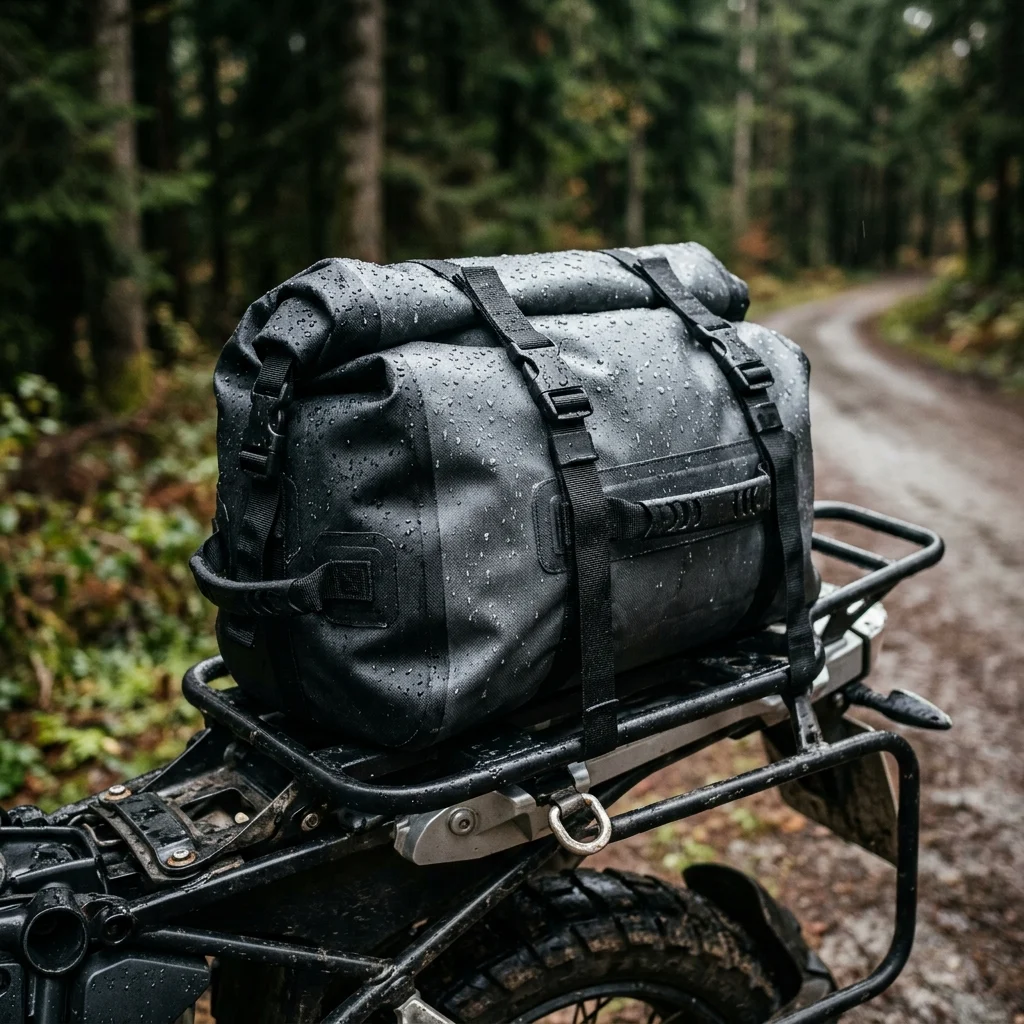
Ask a hundred motorcycle campers about the worst night they’ve had and most of the stories end the same way: a wet sleeping bag. Not a crash, not a breakdown — a soaked bag stuffed in “water-resistant” luggage that turned out to be resistant right up until it wasn’t.
A dry bag fixes that for the price of a tank of fuel. It’s the single highest-value piece of kit on a camping bike, and yet it’s the one people cheap out on or skip. This guide sorts the ones worth buying in 2026 by how you’ll actually use them — a rugged roll bag or duffel strapped to the outside for bulk, and lightweight liners inside your panniers for the gear that can’t get wet — and every spec below is checked against the manufacturer’s own numbers, not marketing copy.
Nelson-Rigg SE-2005 Adventure Dry Bag (39L)
Best all-round motorcycle dry bag — rugged 39L PVC tarpaulin, heat-welded seams, and a strap-and-D-ring system built for a bike, not a kayak.
Check Nelson-Rigg Adventure Dry Bag on Amazon →The One Thing That Decides Whether You Stay Dry
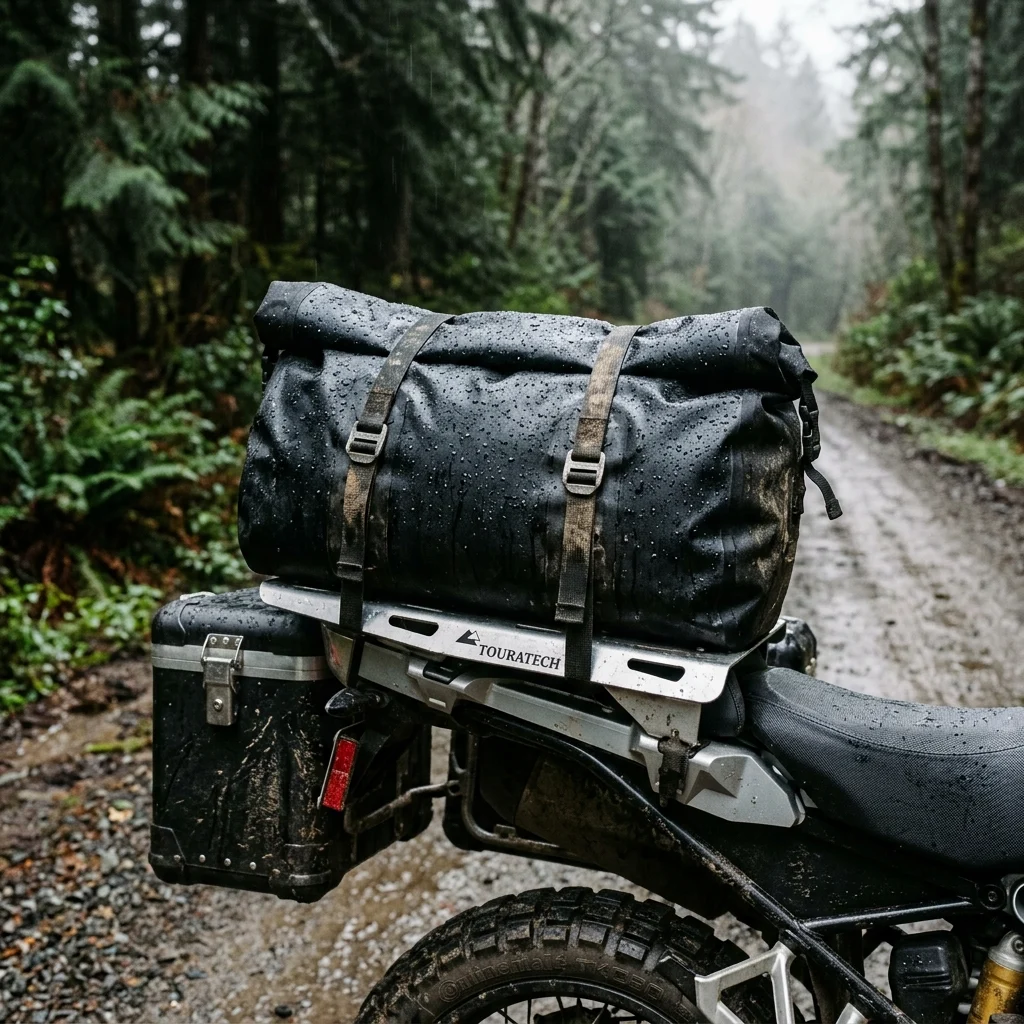
Every dry bag sells itself as “waterproof.” What actually separates the ones that keep your gear dry from the ones that let you down comes down to three things, and none of them is the sticker.
Seams. The bags that hold up use welded (heat-fused) seams rather than stitched ones. A sewn seam has a line of needle holes that eventually wick water; a welded seam is a continuous waterproof join with nothing to leak through. Every bag here uses welded or tape-sealed seams — that’s not a coincidence, it’s the filter.
The closure. A roll-top only seals if you roll it down at least three to four times before clipping the buckle. The buckle holds the roll in place; it doesn’t make the seal. The most common “my dry bag leaked” story is really “I rolled it twice and called it done.” Buy slightly bigger than your load so there’s always a few inches of empty bag to fold down.
The mount — the motorcycle-specific bit. A paddling dry bag keeps water out but has one carry strap and nothing to hold it to a bike. Bungee it on and it shifts, sags into the wheel, or departs at motorway speed. A motorcycle dry bag adds a strap system and multiple lash points engineered for vibration, wind blast and the odd tip-over. That mounting is most of what you’re paying the extra for, and it’s worth it.
Our approach, and the structure of this guide: a rugged roll bag or duffel on the outside for bulk, lightweight dry sacks as liners inside the panniers for anything you truly can’t afford to get wet. Belt and braces beats one big bag.
Dry Bags Compared — Side by Side
5 Dry Bags — Side by Side
Click any column to sort ↕| Bag | Material | Best use | Price | Rating |
|---|---|---|---|---|
| ToughestSea to Summit Big River | 420D TPU-coated nylon | Hard external use | $$$ | |
| Best All-RoundNelson-Rigg Adventure Dry Bag | 24oz PVC tarpaulin | One-bag solo kit | $$ | |
| Nelson-Rigg Hurricane Dry Duffle | 24oz PVC tarpaulin | Big / two-up loads | $$$ | |
| Sea to Summit Lightweight Dry Sack | 70D PU-coated nylon | Pannier liners | $$ | |
| Best BudgetEarth Pak Waterproof Dry Bag | PVC tarpaulin | Value all-rounder | $ |
On the price tiers: $ is genuinely budget — the kind of bag that costs less than a tank of fuel; $$ is the mid-ground most motorcycle-specific bags sit in; $$$ is the premium, coated-fabric, buy-it-for-life end (and the Kriega system below sits above even that). We don’t publish exact prices because they shift constantly with size, colour and sales — check the live figure on each button. But the gap between the budget and premium ends is large, which is exactly why matching the bag to the job below matters more than buying the most expensive one.
1. Nelson-Rigg SE-2005 Adventure Dry Bag — Best All-Round
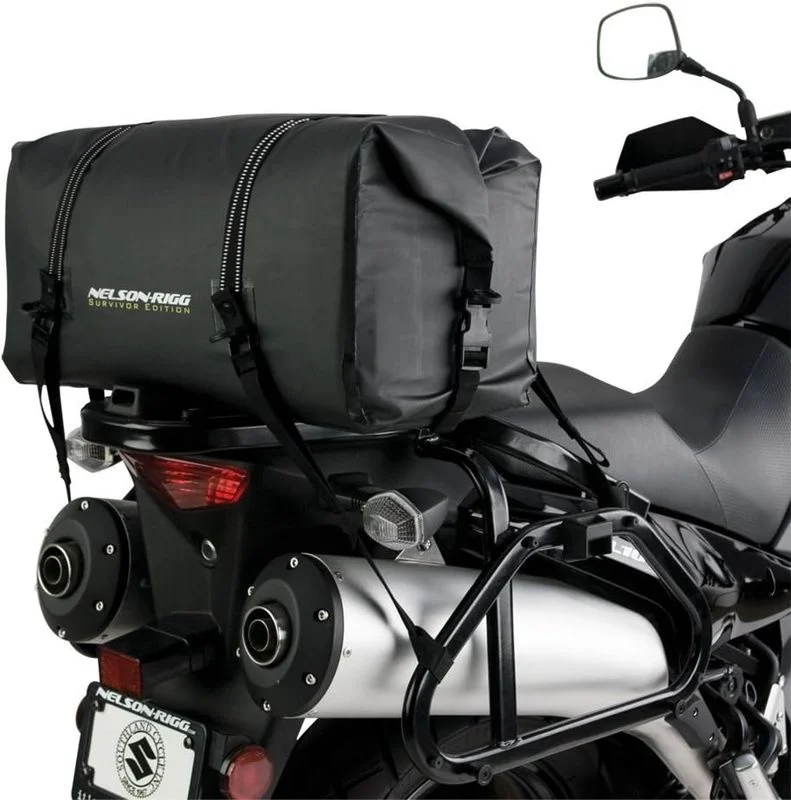
For most riders wanting one bag that does the whole job, this is it. The SE-2005 holds around 39 litres — enough for a solo tent, bag, pad and clothes — in a body made from 24-ounce UV-coated tarpaulin PVC with electronically heat-welded seams and an airtight roll closure. It measures roughly 51 × 25.5 × 30.5 cm, so it sits neatly across a rack or pillion seat.
What makes it a motorcycle bag rather than a generic sack is the mounting: quick-release buckles, nylon webbing and multiple D-rings let you strap it down in several configurations, and a shoulder strap makes it carryable off the bike. It’s the least glamorous pick here and the one we’d hand a first-time camping rider without hesitation.
Our take: the default because it’s the only bag here that arrives ready to mount to a bike — the strap-and-D-ring system is included, where the Big River and Earth Pak leave you to supply your own tie-downs. PVC tarpaulin isn’t as abrasion-tough as the Big River’s coated nylon, but for a bag that mostly sits on a rack rather than grinding against one, it’s more than enough, and it undercuts the Sea to Summit on price. If you want one bag and don’t want to assemble a mounting solution, this is it.
Check Nelson-Rigg Adventure Dry Bag on Amazon →
2. Sea to Summit Big River — Toughest Fabric
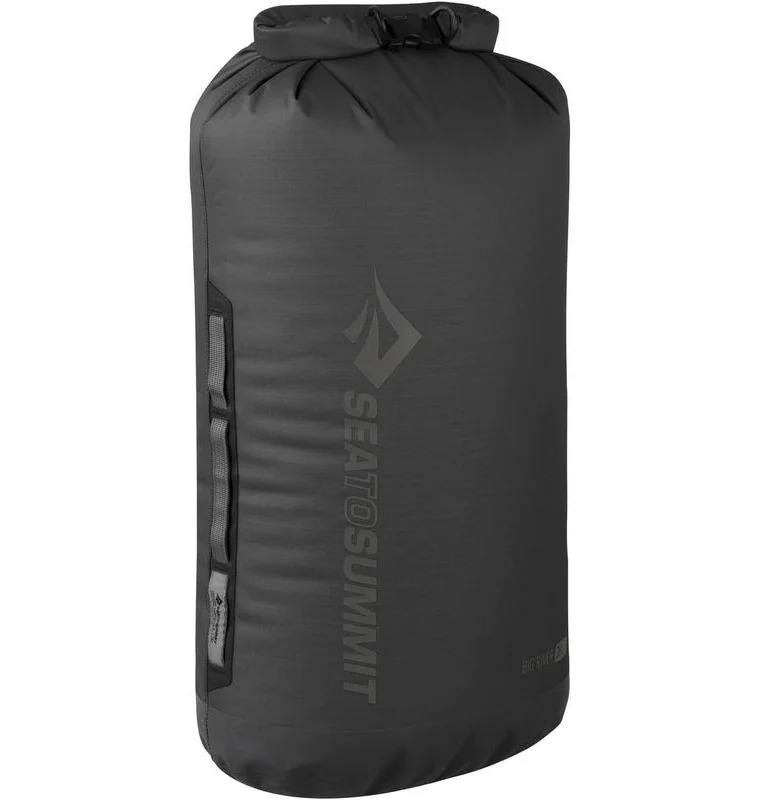
If your dry bag lives strapped to the outside of the bike, in the weather, rubbing against a luggage rack for years, the Big River is the one built for that life. It’s made from TPU-coated 420D nylon with a 10,000 mm waterhead rating and waterproof, double-stitched, tape-sealed reinforced seams — a genuinely heavy-duty fabric that shrugs off abrasion far better than lighter sacks. The Hypalon non-wicking roll-top and replaceable Field Repair Buckles are the kind of details that matter on a long trip.
It comes in a wide size range (5, 8, 13, 20, 35 and 65 litres), and the oval base resists rolling around on the seat. Sea to Summit even lists motorcycle touring among its intended uses — rare honesty from a brand rooted in paddling.
The verdict: our highest score, with one condition — it earns it if the bag lives outside in the elements for years. The 420D coated nylon and 10,000 mm waterhead out-spec the Nelson-Rigg’s PVC on abrasion resistance and outright waterproofing, and the replaceable buckles mean a failed clip doesn’t retire the bag. The trade is that it’s heavier, costs more, and you provide the motorcycle mounting yourself. Choose it over the Nelson-Rigg when durability matters more than out-of-the-box convenience; skip it if the bag will spend its life inside a pannier, where you’re paying for toughness you won’t use.
Check Sea to Summit Big River on Amazon →
3. Sea to Summit Lightweight Dry Sack — Best Pannier Liner
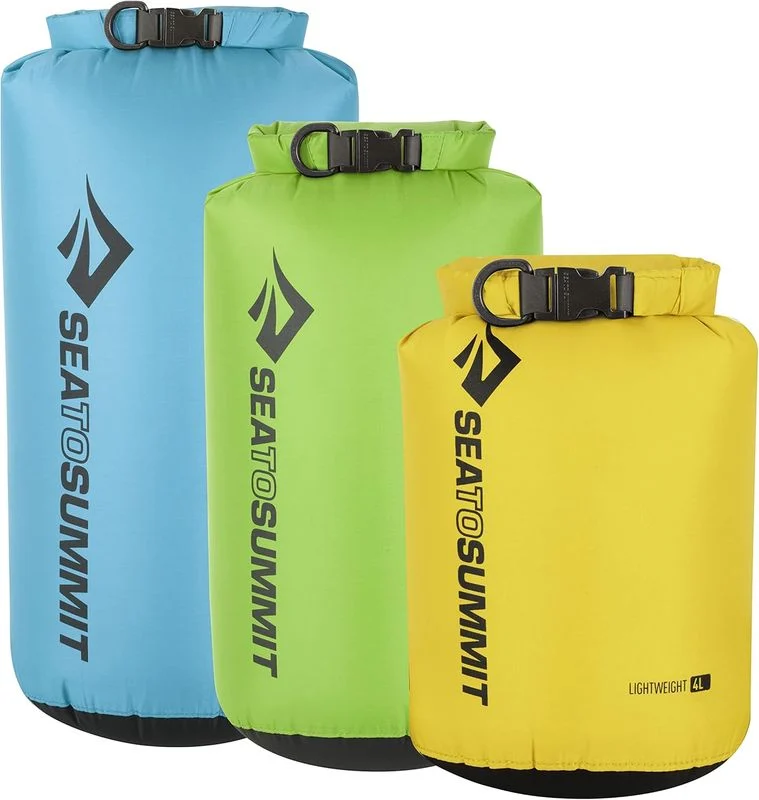
This is the other half of our system. Where the Big River is a tough external bag, the Lightweight Dry Sack is built to live inside your panniers as a liner: 70D PU-coated nylon, a 10,000 mm waterhead, tape-sealed seams, and a Hypalon roll-top with a D-ring — at a featherweight that barely registers (the 35-litre version weighs under six ounces). It comes in sizes from 1 to 35 litres, and the three-piece set (4/8/13 L) is the tidy way to organise a kit by category.
Because the fabric is light, it’s not the one to strap bare to the outside where it’ll abrade — that’s the Big River’s job. Inside a pannier, it’s the perfect insurance around your sleeping bag and dry clothes.
Where it fits: the deliberate opposite of the Big River, and rated a little lower only because it’s specialised, not worse. The 70D fabric that makes it wonderfully light is exactly why it shouldn’t be strapped bare to the outside where it’ll abrade — this is an inside-the-pannier bag. Buy the set, sort your kit into 4/8/13 L sacks by category, and you protect the sleeping bag and organise the load at the same time, which one giant roll bag can’t do. Pair it with an external bag rather than treating it as one.
Check Sea to Summit Lightweight set on Amazon →
4. Earth Pak Waterproof Dry Bag — Best Budget
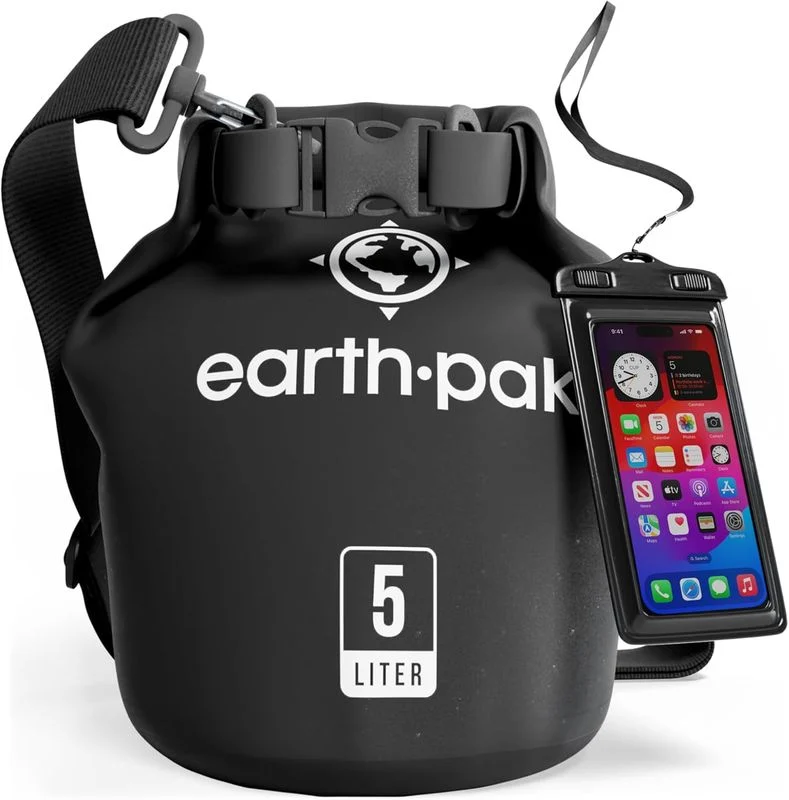
You don’t need to spend a lot to keep gear dry, and the Earth Pak proves it. It’s a roll-top PVC bag that does the core job well, comes in a full range of sizes (5 to 55 litres), throws in an IPX8-rated waterproof phone case, and — unusually at its price — carries a five-year warranty. It was a New York Times Wirecutter pick and has thousands of positive owner reviews. Smaller sizes come with a single shoulder strap; the 30-litre and up come with backpack-style straps.
The trade-off versus the premium bags is fabric toughness and mounting sophistication — it’s a general-purpose dry bag, not a motorcycle-specific one, so you’ll provide the tie-down straps. As a liner, a spare, or a value first bag, it’s hard to argue with.
The value case: it does the same core job as bags costing several times more — roll-top, welded construction, keeps your gear dry — and the five-year warranty is genuinely generous at this price. Rated below the others not because it fails, but because it’s a general-purpose bag doing motorcycle duty: no bike mounting (bring your own straps) and less abrasion-resistant fabric for years of external rubbing than the Big River. As a liner, a spare, or a first bag for someone testing whether they’ll stick with camping, it’s the value-per-euro winner here.
Check Earth Pak Dry Bag on Amazon →
5. Nelson-Rigg Hurricane Dry Duffle 40L — Best for Big or Two-Up Loads
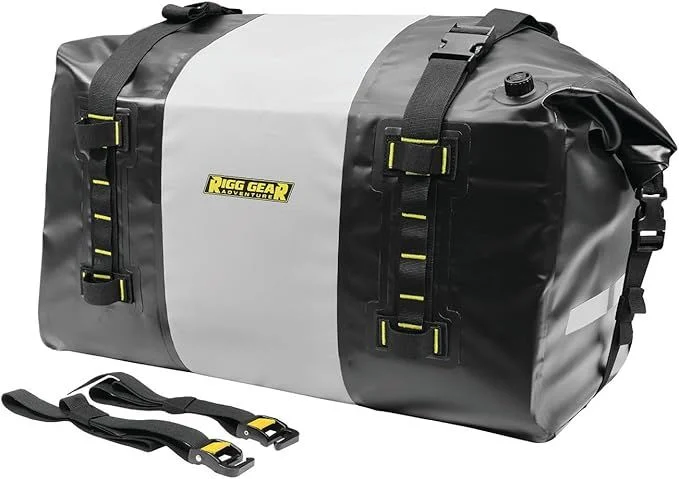
When one 30-litre bag isn’t enough — two-up touring, longer expeditions, or you just carry more — the Hurricane Dry Duffle steps up. It’s built from the same rugged 24-ounce UV-coated tarpaulin PVC with electronically heat-welded seams, a full-length roll-top with quick-release buckles, the patented Rigg Straps mounting system, a purge valve to compress the air out, and reflective accents for visibility. The duffle comes in 25, 40 and 60 litre sizes; a 2025 Rider Magazine review called the 40-litre the sweet spot for larger bikes and longer trips.
When to size up: essentially the SE-2005’s bigger sibling — same 24oz PVC, same heat-welded waterproofing, same Nelson-Rigg mounting DNA — in a duffel shape that swallows more and adds a purge valve to squeeze the air out of a half-empty load. Rated a touch below the SE-2005 only because the extra size is wasted weight and bulk for a solo rider; buy it when you genuinely need 40L+ (two-up, expedition, or you just carry a lot), and default to the smaller roll bag if you don’t.
Check Nelson-Rigg Hurricane Duffle on Amazon →
A Word on Kriega (and Why It’s Not a Numbered Pick)
If you ask experienced adventure riders for the premium benchmark, many will say Kriega US-drypacks — a modular system of 5, 10, 20 and 30-litre packs that are fully waterproof and clip together into larger setups, with a mounting system riders consistently praise. We rate them highly. The reason they don’t get a pick-number and a button here is simple and it’s the same standard we hold every product to: Kriega isn’t reliably sold on Amazon, so we can’t point you to a verified listing. If you want the premium option, buy it direct from Kriega or a moto retailer — it’s genuinely excellent kit, we just won’t fake a link for it.
How to Choose: A 30-Second Decision
- Want one bag, done? Nelson-Rigg SE-2005 Adventure Dry Bag (39L).
- Bag lives outside in the weather for years? Sea to Summit Big River.
- Splitting the load across panniers? Sea to Summit Lightweight Dry Sack liners.
- On a budget, or need a spare/liner? Earth Pak.
- Carrying big or two-up? Nelson-Rigg Hurricane Dry Duffle 40L.
- Money no object, want the premium system? Kriega, bought direct.
A note on fit before you buy: a 39–40 litre roll bag or duffel is roughly the footprint of a rolled tent, sleeping bag and pad together, and on most mid-size and larger ADV bikes it sits across the rack or pillion seat without drama. But racks and subframes vary a lot, so measure yours and check two things before you commit: that the loaded bag clears your exhaust and indicators, and that it doesn’t push so far back it unsettles the bike two-up. If your rack is small or you’re on a lighter dual-sport, splitting the load into pannier liners plus a smaller tail bag usually rides better than one big bag hanging off the back.
Whatever you pick, size up a little so the roll-top seals with room to spare, and protect the sleeping bag first.
The Bottom Line
A dry bag is the rare piece of kit where the cheap version and the expensive version both work — the difference is how many years and how much abuse they take, not whether your gear stays dry tonight. So the honest advice is: don’t overthink it, but don’t skip it. Get a rugged roll bag or duffel for the outside, line your panniers with lightweight dry sacks, roll every closure down four times, and the rain stops being something you fear and becomes something you barely notice.
This pairs directly with our guide to staying dry motorcycle camping in the rain — the dry bag is step one of that whole system. For where it all goes on the bike, see the 2-week packing layout; for the bags it straps to, our panniers and soft vs hard luggage guides; and to protect the one item that matters most, the sleeping bag guide.
Disclosure: Some links in this article are affiliate links. If you buy gear through them, Bikes & Bays earns a small commission at no extra cost to you. We only recommend kit we’d run on our own bike, and we only link products with a verified listing.
Frequently Asked Questions
What size dry bag do I need for motorcycle camping?
For a solo camping kit — tent, sleeping bag, pad, and a change of clothes — a single 30–40 litre roll bag or duffel is the usual sweet spot, and it's why the 39L and 40L bags here are the popular all-rounders. If you're splitting your load across panniers, a set of smaller 8–20 litre dry sacks used as liners inside them works better than one big bag, because you can organise by category and stuff them into odd spaces. Two-up or on longer expeditions, step up to a 40–60 litre duffel. The rule of thumb: buy slightly bigger than you think, because a roll-top only seals properly with a few empty inches to fold down.
Are roll-top dry bags actually waterproof?
A well-made one is, with a caveat: the seal comes from folding the top down at least three to four times and clipping it, not from the buckle alone. Roll it too few times and water tracks in through the opening. The bags that hold up best use welded (heat-fused) seams rather than stitched ones, because a sewn seam has needle holes that eventually weep. Every bag in this guide uses welded or tape-sealed seams. Even so, treat 'waterproof' as 'keeps rain and splashes out and survives a brief dunk,' not 'submarine' — for full submersion you want a bag that specifically states it.
Do I need a motorcycle-specific dry bag or will any dry bag do?
Any quality dry bag keeps your gear dry, but a motorcycle-specific one adds the thing that matters on a bike: secure mounting. Bags built for riding come with strap systems (like Nelson-Rigg's Rigg Straps) and multiple lash points designed to survive vibration, wind blast at speed, and a tip-over, whereas a paddling dry bag has a single carry strap and will shift or fly off if you just bungee it on. Our approach: a rugged motorcycle roll bag or duffel on the outside for bulk, and lightweight dry sacks as liners inside panniers for everything you can't afford to get wet.
What's the difference between a cheap dry bag and an expensive one?
Mostly material, seams, closure hardware, and warranty. Budget bags (like the Earth Pak) use PVC tarpaulin, roll-top closures and do the core job well, which is why they're the value pick. Premium bags (Sea to Summit's Big River, the Kriega system) use tougher coated fabrics, replaceable field-repair buckles, higher waterhead ratings, and better abrasion resistance for years of external mounting against luggage racks. If the bag lives strapped to the outside of the bike in the weather, the extra durability earns its cost; if it's a liner living inside a pannier, a cheaper one is fine.
Down or synthetic gear aside, why does the dry bag matter so much?
Because the sleeping bag is the one item that ruins a trip if it gets wet, and 'water-resistant' luggage doesn't reliably protect it in sustained rain. A dedicated dry bag around your sleep system turns a soaking day into a non-event — you arrive, and the thing you sleep in is bone dry regardless of what the weather did. It's the highest-value few euros in the whole camping kit, which is exactly why we treat it as non-optional rather than a nice-to-have.