
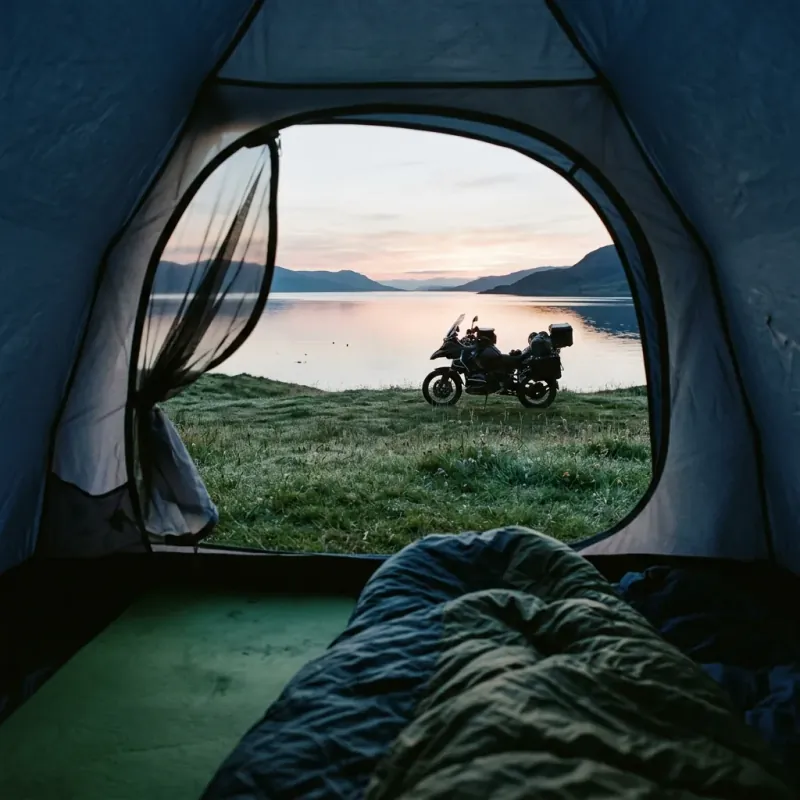
If you spend sale money on exactly one part of adventure motorcycling, spend it here.
Camping gear is the best-behaved category in the whole sport when it comes to discounts, and for three structural reasons rather than any particular deal. None of it is sized, so there is no fit risk and no returns problem. Late November is deep off-season, so retailers are clearing inventory rather than defending margin on something people are actively buying. And the service life is long — a good sleeping pad bought once is still working in a decade, which spreads the cost across enough trips that the purchase price stops mattering.
What decides how much you get out of it is not which brand you pick. It is the order you buy in.
Why the order matters more than the brand
Most riders assemble a camping setup in the order the items appear in their imagination. That means the tent first, because the tent is what you picture, followed by whatever looked good next.
The order that actually produces comfortable nights runs almost backwards from that, because it follows heat loss rather than visibility. On a cold night you lose warmth to the ground faster than to the air, and you lose it through gear you cannot see from outside the tent.
So the sequence below is sorted by comfort gained per pound spent, which in a sale is the only sorting that matters.
Disclosure: some links below are affiliate links. If you buy through them we may earn a small commission at no extra cost to you. We cannot see the price you are shown — the button goes to the current listing.
1. The sleeping pad — buy this first
Here is the physics, stated plainly, because it explains the whole ordering.
Your body weight compresses the insulation underneath you. Crushed down or synthetic fill has close to zero insulating value — at that point it is fabric. Meanwhile the ground behaves as a heat sink and pulls warmth out of you by direct conduction all night. The pad’s R-value is the only thing standing between the two.
A great bag on a bad pad is a bag with a hole in the bottom of it.
The one specification you can trust in a sale
Since 2020 the outdoor industry has rated pads to a single test procedure, ASTM F3340-18: the pad sits between a cold plate and a warm plate, and the energy needed to hold the warm plate at temperature yields the R-value. The major manufacturers all use it.
That makes R-value one of the very few numbers in outdoor gear that means the same thing on two different brands’ listings. When you are comparing two discounted pads, you are comparing like with like — which is unusual enough to be worth exploiting.
Rough targets for motorcycle camping: R-1 and up for Mediterranean summer, R-3 and up for three-season touring, R-4.5 and up for cold shoulder-season or alpine nights. And R-values stack, so a cheap closed-cell foam mat under an inflatable both raises the total and gives you a backup if the inflatable punctures at three in the morning.
The sleeping pad guide ranks the compact options by weight, warmth and packed size.
2. The sleeping bag — and the rating trap
The second half of the sleep system, and the place where sale listings do the most damage.
Buy on Comfort, not on the headline
Two standardised lab tests exist: EN 13537, the older European standard, and ISO 23537, the current one. Both work the same way — a heated manikin in a climate-controlled chamber on a standardised pad — and both produce three figures: Comfort, Limit and Extreme.
Comfort is the number to buy on. Limit is a harder night. Extreme is a survival rating, not a camping rating, and it is the number a certain kind of listing puts in the product title.
The trap in a sale is the bag that publishes one temperature with no standard reference at all. That number has not been measured against anything, and untested ratings are systematically optimistic — the more confident the marketing language on the listing, the more likely it is that no laboratory was involved. An unrated bargain bag and a rated bag at a similar discounted price are not the same product, whatever the two numbers on the page suggest.
Give yourself margin. The sleeping bag guide covers down against synthetic, which matters more on a motorcycle than it does for a hiker because your bag lives in a pannier in the rain.
3. Dry bags — the cheapest problem you can permanently solve
Soft luggage is rarely genuinely waterproof on its own. Manufacturers describe panniers as water-resistant, riders read that as waterproof, and the difference reveals itself somewhere in the third hour of a wet day when the sleeping bag turns out to be damp.
Roll-top dry sacks in a set of sizes fix this permanently for very little money. There is no fit risk, no revision cycle, no rating to interpret and no way to get it wrong. It is the purest tier-one purchase in adventure motorcycling and the one riders most consistently postpone.
Buy a set rather than one large bag. Separating sleep gear, clothing and electronics means a single failure does not soak everything, and small bags pack into odd spaces that one big bag cannot use. The dry bag guide covers the fabric weights and closure types worth paying for.
4. The tent — genuinely last
This is the recommendation riders argue with, so here is the reasoning.
The tent is the most visible item, the most heavily marketed and the one you picture when you imagine the trip. It therefore absorbs a disproportionate share of the budget while contributing less to whether the night is actually pleasant than the pad underneath you does. A competent, unremarkable two-person tent plus a good sleep system beats an excellent tent plus a mediocre one, every time, in every season.
Two things worth checking on any discounted tent:
Buy one person more than you are. A tent rated for two people is sized for two people lying shoulder to shoulder with nothing else inside. On a motorcycle you also have a helmet, boots and at least one pannier that you do not want outside. A two-person tent for a solo rider is the standard advice for exactly this reason.
Check the pitched footprint, not just the packed size. Wild camping spots on a motorcycle are frequently small, awkward and sloped, and a long tunnel-style tent that packs beautifully can be impossible to site on the flat two metres you actually found.
The tent guide covers the options by pitch type, and the ultralight guide covers the weight end.
5. The disproportionate ones
Three items that cost little and change the evening more than their price suggests.
A camp chair. The most mocked item in motorcycle camping and one of the best. Sitting on the ground is fine for twenty minutes and tiring for three hours, and the difference between an evening you enjoy and an evening you endure is often just having somewhere to sit with a back on it. Compact chairs now pack to roughly the size of a water bottle. See the camp chair guide.
A stove that boils water quickly. Not a kitchen — a way to have coffee before you break camp and something hot after a long wet day. Integrated systems boil fast and are foolproof; separate burners are lighter and more flexible. Either beats not bothering. The stove guide and cookware guide cover the split.
The stove question nobody asks until they are abroad
Buy the stove in November and you will not think about fuel until you are three countries away and the shop only has the wrong cartridge. Worth five minutes now.
Gas cartridges fall under EN 417, but that standard covers more than one fitting, and they do not interchange. The screw-on cartridges that almost every backpacking stove uses — MSR, Jetboil, the budget titanium burners — take the Lindal valve, a threaded, self-sealing fitting you can unscrew mid-canister without losing the gas.
Campingaz is the other system, and it is the one you will meet across a lot of Europe and the UK: older pierceable C206 cylinders, and the newer Easy-Clic CV fitting. A standard screw-on stove will not fit either of them. That is the whole problem in one sentence, and it turns up in exactly the places where the campsite shop is your only option.
Two ways to handle it. Either check before the trip which fitting is actually stocked where you are going and carry enough of the right one, or pack a Campingaz CV to EN 417 adapter — small, cheap, and it turns a dead evening into a hot meal. Riders heading well outside Western Europe should also read the stove guide’s case for liquid fuel, which sidesteps cartridge availability entirely at the cost of weight and maintenance.
A power bank sized for the trip, not for the phone. Multi-day camping means the phone, the intercom, the action camera and possibly a satellite messenger all want charging from the same source. Buy on real capacity and port count rather than on the number printed largest. The camping power guide covers what actually gets through a week.
Three traps specific to camping gear in a sale
The confident, unrated sleeping bag. Covered above, and worth repeating because it is the most common bad purchase in the category. No EN or ISO reference means no test.
The “2-person” anything. Tents, and to a lesser extent cookware, are sized to a laboratory definition of a person that does not account for riding kit. Assume the number on the box is one higher than the number of humans it comfortably serves.
Gear for the trip you are planning rather than the trip you keep doing. The most seductive error in the whole category. Kit bought for a hypothetical two-week expedition tends to be wrong in ways that only reveal themselves on the two-night trips you actually take. If most of your camping is one or two nights within a few hundred miles of home, buy for that and upgrade when the longer trip is booked rather than imagined. The beginner’s first overnight guide is the honest starting point.
If you are starting from nothing
A first setup, in the order to buy it, with the reasoning compressed:
- Sleeping pad with an R-value matched to your season — the highest return in the category.
- Sleeping bag rated to EN 13537 or ISO 23537, bought on the Comfort figure with margin.
- A set of dry sacks in mixed sizes, because the rest of the list is worth less wet.
- A tent one person larger than your party, chosen on pitched footprint.
- A chair, which will surprise you.
- A stove, if you want mornings to be good rather than merely early.
That is a complete, genuinely comfortable motorcycle camping setup, and every item on it is sizeless, discountable and likely to outlast the bike you currently own. The full gear checklist covers the smaller things once the structure is in place, and how to pack for a two-week camping trip covers where it all goes.
Related reading
- Black Friday motorcycle gear 2026 — the overview, including the dates and the traps in every other category.
- What adventure gear is worth buying on sale — the four-tier framework this post is an application of.
- Helmet and intercom deals — the two categories where an identical discount means opposite things.
- The motorcycle gear buying calendar — when each category drops, if you would rather wait than buy now.
- Motorcycle camping in the rain — the test everything above eventually faces.
The test for all of it arrives at about two in the morning, somewhere with no phone signal, when the temperature has dropped further than the forecast said and you find out what your pad’s R-value actually was. Nothing about that night depends on which brand you bought or what you paid. It depends on whether you spent the money in the right order.
Frequently Asked Questions
What motorcycle camping gear is worth buying on Black Friday?
Nearly all of it, which makes camping equipment unusual. The category is sizeless, so there is no fit risk and no returns problem. It is out of season in late November, so retailers are clearing rather than protecting margin. And the service life is long enough that a good sleeping pad or set of dry bags bought once will still be working in ten years. The order matters more than the brand: buy the sleeping pad first, the bag second, dry bags third, and the tent last, because that sequence buys the most comfort per pound spent.
Should I buy the sleeping bag or the sleeping pad first?
The pad, almost always. Your body weight crushes the insulation underneath you, so the part of the bag you are lying on contributes close to nothing, while the ground acts as a heat sink and pulls warmth out of you through direct conduction all night. The pad's R-value is what stops that. A warm bag on a thin pad is still a cold night, and riders discover this in the shoulder season after spending most of the budget on the wrong half of the system. If money only stretches to one good item, make it the pad.
How do I tell a genuinely warm sleeping bag from a badly rated one in a sale?
Look for EN 13537 or ISO 23537 on the specification, and then buy on the Comfort figure rather than the headline number. Those are the only standardised lab tests, and they are run the same way for every brand — a heated manikin in a climate chamber on a standardised pad — which makes the numbers comparable. A bag that publishes a single temperature with no standard reference has not been tested to anything, and the descriptions that most often accompany an untested rating are the ones that sound most confident. In a sale, an unrated bargain bag and a rated one at a similar price are not the same product.
Are sleeping pad R-values comparable between brands?
Yes, and this is genuinely useful when comparing sale prices. Since 2020 the outdoor industry has used a single test procedure, ASTM F3340-18, in which the pad is measured between a cold plate and a warm plate and the energy needed to hold the temperature gives the R-value. The major pad manufacturers all rate to it, so an R-4.5 from one brand means the same thing as an R-4.5 from another. That makes R-value one of the very few specifications in outdoor gear you can use to compare two discounted products directly.
What is the biggest waste of money in motorcycle camping gear?
Buying the tent first. It is the most visible item, the most heavily marketed, and the one riders imagine when they picture the trip — so it absorbs a disproportionate share of the budget while contributing less to whether the night is actually pleasant than the pad underneath you does. Most riders are well served by a competent, unglamorous two-person tent and the money moved to the sleep system. The second biggest waste is any item bought for a trip that is still hypothetical: gear for the ride you are planning tends to be wrong, and gear for the ride you keep doing tends to be right.