
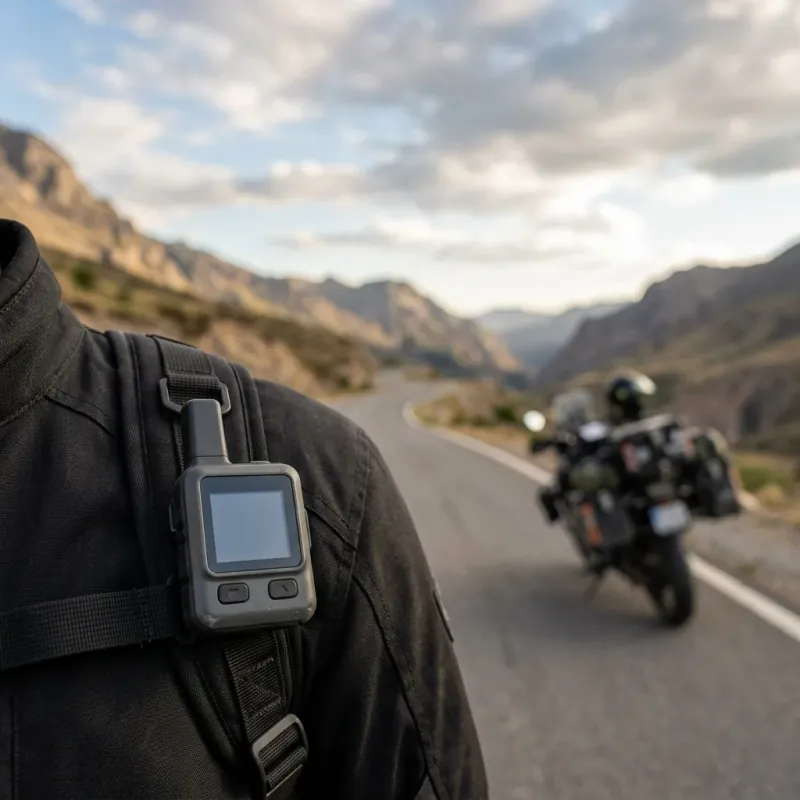
For about a decade the answer to “do I need a satellite messenger?” was simple: if you ride alone, off the tarmac, or anywhere with real gaps in mobile coverage, yes.
Then phones learned to talk to satellites, and a lot of riders quietly decided the problem was solved.
It isn’t, but it has changed — and the change is much more specific than the marketing suggests. We went through Apple’s and Google’s own support documentation, and then through the plan pages of the three main device brands, to work out exactly where the phone is now enough and where it isn’t. The line turns out to run straight through the middle of the routes this site covers.
First, What Your Phone Actually Does
Two features get muddled together constantly, including by people selling phones. They are not the same thing and the difference matters enormously to a touring rider.
Emergency SOS via satellite — the rescue button
This is the one everybody’s heard of. On an iPhone 14 or later, when you have no cellular or Wi-Fi coverage, you can text emergency services via satellite. It’s free for two years after activation of the phone.
Apple publishes the country list, and here it is in full as it stands: Andorra, Australia, Austria, Belgium, Canada, France, Germany, Iceland, Ireland, Italy, Japan, Luxembourg, Mexico, the Netherlands, New Zealand, Portugal, Spain, Switzerland, the UK and the US.
Read that list against a European touring map and the shape of the gap becomes obvious. Not on it: Turkey. Greece. Croatia. Slovenia. Albania. Montenegro. Bosnia. Serbia. Romania. Bulgaria. Norway. Sweden. Finland. Denmark. Poland. Czechia. Morocco.
That’s the entire Balkan route, all of Turkey, the Greek islands, the Norwegian fjords and Morocco — in other words, most of the places where you’d actually be out of coverage. Iceland is covered, which is a genuinely useful thing to know before riding the Ring Road.
One feature that deserves more attention than it gets: Apple says that if your iPhone or Apple Watch detects a severe crash or a hard fall and you don’t respond, the automatic notification to emergency services may be sent over satellite if you’re outside cellular coverage. For a solo rider who goes off the road unseen, that’s a meaningful piece of automation — inside those 20 countries.
Android: Google’s Satellite SOS is available on Pixel 9 and later (excluding the 9a) and Google’s help page lists Canada, the US and Puerto Rico plus other regions. Google’s own instructions are a useful dose of realism: your phone connects to satellites in fixed positions, you have to face the right direction and tilt the device, and trees, terrain or buildings will block the connection, at which point you must move somewhere with a clear view of the sky.
Messages via satellite — the one that isn’t there yet
Here is the feature that would genuinely replace a dedicated device, and the one almost nobody checks the coverage on. Starting with iOS 18, an iPhone 14 or later can send and receive normal texts over satellite.
Apple’s own page: “Messages via satellite is available in the United States, Canada, Mexico, and Japan.”
Four countries. Not one of them in Europe. And Apple explicitly says the feature shouldn’t be used in emergencies — that’s what Emergency SOS is for.
So for a European or Turkish tour, your phone gives you a rescue button (in 20 countries) and nothing else. It will not send “the pass was closed, I’m a day behind, don’t worry.” That message — the one you actually send nine times out of ten — still needs hardware.
The Devices Worth Considering
Four devices cover the realistic range. All of them require an active subscription; none of them do anything useful out of the box without one.
Garmin inReach Mini 2 — the default
The one you’ll see clipped to the most jackets, and it earns it. Garmin’s own launch material gives 3.5 oz (about 100 g), just under 4 inches tall, up to 14 days of battery in the default 10-minute tracking mode and up to 30 days at 30-minute intervals, two-way messaging and interactive SOS over the Iridium network, with Garmin Response as the 24/7 coordination centre. Launch price was $399.99.
Why it suits motorcycles: small enough to live on a shoulder strap and be forgotten, a battery that outlasts any realistic trip between charges, and pairing with the Garmin Explore app so you type messages on a phone rather than on the device.
Disclosure: some links below are affiliate links. If you buy through them we may earn a small commission at no extra cost to you.
Check the inReach Mini 2 on Amazon →
Garmin inReach Messenger Plus — when text isn’t enough
Garmin’s newer device adds photo and voice messages over satellite. From Garmin’s press release: text messages up to 1,600 characters, 30-second voice messages, photo sharing, IPX7, and up to 600 hours of battery with a text and location sent every 10 minutes in low-power messaging mode. Suggested retail price at launch was $499.99.
Whether the extra capability is worth the extra money depends on who’s waiting at home. For a solo rider whose family worries, a voice message is a different category of reassurance than a text. For pure logistics, it’s overkill.
Check the inReach Messenger Plus on Amazon →
ZOLEO — the value option, and the most motorcycle-aware packaging
ZOLEO’s published specs: 150 g (5.3 oz), 9.1 × 6.6 × 2.7 cm, IP68 plus MIL-STD 810G, over 200 hours of battery, Iridium network. It can send check-ins and trigger an SOS on its own, but for full messaging it works as a satellite bridge for your phone — the app switches between satellite, cellular and Wi-Fi depending on what’s available.
The reason it’s here rather than in a footnote: ZOLEO sells a bundle with a RAM mount and a 12V charging lead — the only packaging any of these brands offers that acknowledges some customers ride motorcycles. If you want the device permanently mounted and permanently charged, that kit saves you assembling it yourself.
The trade-off is real. Lean on the phone-bridge design and your emergency communications depend on a phone that may be hot, soaked or flat. On a bike, none of those is hypothetical.
Check the ZOLEO mount kit on Amazon →
SPOT X — the one that works when your phone doesn’t
SPOT X is the outlier, and its outlying feature is the point. Official specs: 7.0 oz (198.4 g) with lithium batteries, 16.6 × 7.4 × 2.4 cm, 240 hours (10 days) of battery in 10-minute tracking mode, IP67 and submersible to 1 m for 30 minutes, on the Globalstar network rather than Iridium.
It has a physical QWERTY keyboard and its own dedicated US mobile number, so people can text you directly. That combination means it functions with no phone involved at all — which is exactly the scenario a soaked, dead phone creates on day nine of a wet tour.
The Subscription Is the Real Purchase
Hardware is a one-off. The plan is forever, and it’s where the comparison gets genuinely awkward — because the brands don’t publish this information to the same standard.
ZOLEO publishes everything on one page:
| Plan | Monthly | Messages | Notes |
|---|---|---|---|
| Prepare | $19.99 | 50/month | extra messages $0.50 each |
| Protect | $34.99 | Unlimited | subject to fair use |
Plus a one-time $19.99 activation fee, a three-month minimum term, and — usefully for seasonal riders — a $4.50/month pause option after that initial term. Location Share+ is $6/month on top.
Read that three-month minimum before you buy for a two-week trip: ZOLEO applies proportional early-cancellation charges inside the initial term, and the pause option only becomes available once you’re through it. A fortnight in Albania costs you a quarter of a year of subscription either way.
SPOT publishes everything too:
| SPOT X plan | Contract (12 mo) | Flex (monthly) | Custom messages |
|---|---|---|---|
| Basic | $11.95/mo | $14.95/mo | 20 |
| Advanced | $19.95/mo | $29.95/mo | 100 |
| Unlimited | $29.95/mo | $39.95/mo | Unlimited |
One-time $29.95 activation, plus a $34.95 charge on Flex plans. SPOT Gen4, the one-way tracker with no keyboard, runs $11.95/month on contract with unlimited SOS, Help, Check-in and custom messages.
Garmin is the one we can’t complete honestly. Garmin’s plan tiers are documented on its own blog — Enabled, Essential, Standard and Premium, with SOS included on all of them, and the genuinely valuable detail that you can suspend a subscription free for up to 12 months and reactivate with no fee. That suspend option is worth real money to anyone who tours for two months a year.
What we could not verify from a Garmin source is the price table. The figures that circulate widely ($14.99 / $29.99 / $49.99 plus activation) match what Garmin’s own press release implies at the bottom end — it states plans are available “for as little as $14.99 per month” — but the full table lives behind Garmin’s account portal and we couldn’t pull it from an open Garmin page. So we’re publishing the $14.99 floor, which is Garmin’s own wording, and telling you to check the rest on Garmin’s site rather than repeating numbers we can’t stand behind.
A related warning that applies to all of them: the plan details printed on an Amazon listing are not authoritative. The ZOLEO listing we link to describes plans at $20/$35/$50 for 25/250/unlimited messages, which does not match ZOLEO’s own current plan page. Buy the hardware wherever it’s cheapest; read the plan terms on the operator’s site.
What Actually Matters on a Motorcycle
Most reviews of these devices are written by hikers. Four things are different for us.
It has to be outside, and ideally on you. Every one of these needs a clear view of the sky — Apple’s guidance is “outside with a clear view of the sky and horizon”, Google’s warns that terrain and buildings will block the link. A device in a pannier is decoration. So is one inside a tent: the evening “made it, camping here, no signal” message means getting out of the tent and standing in whatever weather drove you into it, which is worth knowing before you’re lying in a sleeping bag deciding whether it can wait until morning. And there’s a harder question underneath: if you’re separated from the bike, on the wrong side of a hedge and not moving, a unit mounted to the handlebars is a unit you can’t reach. We’d put it on the jacket.
Cold and vibration eat batteries and mounts. Manufacturer battery figures are measured in mild conditions — SPOT states its 240 hours is based on a full charge at 77°F with clear sky visibility. Assume less in an Alpine October, and use a mount built for a motorcycle rather than a bicycle bracket.
Gloves. Any interaction that needs a fingernail on a small button is one you won’t do at the roadside in the rain. Test it wearing what you actually ride in.
Redundancy has a point of diminishing returns. A satellite messenger, a shared route, and a check-in schedule cover the same failure from three angles — and the check-in schedule is free. Our solo camping safety guide covers the plan side of this in detail; the device is only half the system.
So Which One?
If you ride Western Europe, mostly on tarmac, and want a way to summon help: your iPhone 14+ probably covers you, free, for two years, in those 20 countries. Check the list against your actual route before you rely on it, and understand that you’re buying an SOS button, not a communications channel.
If you ride Turkey, the Balkans, the Nordics, Morocco, or anywhere off the phone map: you need a device. The inReach Mini 2 is the safe default and the one we’d fit to a long trip — with one honest asterisk on that recommendation. It’s the only device here whose full running cost we couldn’t verify from the manufacturer. ZOLEO and SPOT publish complete plan tables; Garmin publishes a floor of $14.99 a month and keeps the rest behind its account portal. So price the Garmin plan you’d actually use on Garmin’s own site before you commit, because that’s the number that decides whether it beats ZOLEO for you, and it’s the one number this comparison can’t hand you.
If cost is the deciding factor: ZOLEO is the cheapest true two-way messenger to run, and its mount kit is the least fiddly way to put one on a motorcycle. Accept the phone dependency.
If you want something that works when the phone is dead: SPOT X, for the keyboard and the phone number.
If you tour seasonally: the ability to pause matters more than the monthly rate. Garmin’s free 12-month suspend and ZOLEO’s $4.50/month pause are both worth reading carefully before you pick a brand — a plan you can park for eight months of the year changes the annual arithmetic completely.
The Honest Caveat
None of these devices makes the mountain safer. They make the aftermath faster, and only sometimes.
Press SOS and your alert and coordinates reach a monitored centre that contacts local emergency services and, on the two-way devices, tells you they’ve done it. What happens after that depends on the country, the weather, the terrain and whether anyone can physically reach you. Nobody publishes a response time. Nobody promises one.
What you’re buying is the difference between “nobody knows where I am” and “someone knows exactly where I am and has been told.” On a solo trip through the empty parts of the map, that difference justifies the subscription on its own. It just isn’t a safety net — and it’s a fair bet that the effect safety researchers call risk compensation applies here as much as it does to every other piece of protective equipment: the device changes what you’re willing to attempt. That’s the thing to watch in yourself, because the SOS button doesn’t shorten the distance to the nearest hospital.
Disclosure: Some links in this article are affiliate links. If you buy gear through them, Bikes & Bays earns a small commission at no extra cost to you. We only link to gear that earns its place, and skip the button when nothing’s worth recommending.
A note on the prices: these are indicative figures as of August 2026, not live quotes. Hardware prices and subscription tiers both change, and plans differ by region — check the provider’s own current pricing page before you commit.
Frequently Asked Questions
Do I still need a satellite messenger if my phone has satellite SOS?
It depends almost entirely on where you ride. Apple's Emergency SOS via satellite works in 20 countries and regions as of this writing, including the UK, Ireland, France, Germany, Italy, Spain, Portugal, Austria, Switzerland, the Netherlands, Belgium, Luxembourg, Iceland and Andorra. It does not work in Turkey, Greece, Croatia, Albania, Montenegro, Norway or Morocco — which between them cover most of the routes on this site. And even where it works, it's for emergencies: Apple's satellite texting feature, Messages via satellite, is only available in the United States, Canada, Mexico and Japan. If your riding stays inside Western Europe and you only want a way to call for rescue, your phone may genuinely be enough. If you ride the Balkans, Turkey, North Africa or the Nordics, or you want to send a routine 'delayed, camping here tonight' message, a dedicated device is still the only option.
What does a satellite messenger subscription actually cost?
More than people expect, and the pricing is published inconsistently across brands. ZOLEO lists two plans openly: Prepare at $19.99/month for 50 messages and Protect at $34.99/month for unlimited, both with a one-time $19.99 activation fee and a three-month minimum, plus a $4.50/month pause option after that term. SPOT publishes contract plans at $11.95, $19.95 and $29.95 a month for 20, 100 and unlimited custom messages, with a $29.95 activation fee, and month-to-month Flex plans at higher rates. Garmin does not publish its plan table on an open page — its own press material says inReach subscriptions start 'for as little as $14.99 per month', and Garmin's blog confirms the tier structure (Enabled, Essential, Standard, Premium) and that you can suspend a subscription free for up to 12 months. We're not quoting Garmin's full price list here because we couldn't verify it from Garmin itself.
Which satellite messenger is best for a motorcycle specifically?
The motorcycle-specific requirements are different from hiking: you want it mounted or on your body rather than in a pannier, ideally powered or easy to charge, and usable without taking gloves off. The Garmin inReach Mini 2 is the default for good reason — about 100 g, up to 14 days of battery in default 10-minute tracking, two-way messaging and SOS on the Iridium network. ZOLEO is the value pick and sells a kit that includes a RAM mount and a 12V charging lead, which is the most motorcycle-aware packaging any of these brands offer. SPOT X is the one with its own keyboard and its own US phone number, so it works when your phone is dead. All of them need an active subscription to send anything at all.
Does a satellite messenger work inside a pannier or under a jacket?
No, and this is the failure that catches people out. Every one of these devices needs a clear view of the sky to reach a satellite — Apple's own guidance for phone-based satellite is that you must be outside with a clear view of the sky and the horizon, and Google's is blunter still, warning that trees, terrain or buildings will block the connection and you'll have to move. A device buried in a pannier or under a waterproof layer is a device that can't call for help. Mount it on the outside of the bike, on a shoulder strap, or on the outside of a tank bag — and remember that if you're unconscious in a ditch, whatever is attached to you is more useful than whatever is attached to the bike.
Will an SOS button guarantee I get rescued?
No, and be suspicious of anyone who implies otherwise. What these services actually provide is a monitored alert: your message and coordinates reach a staffed coordination centre, which contacts the relevant local emergency services and relays information back to you where the device supports two-way messaging. What happens next depends on the country you're in, the terrain, the weather, whether a helicopter can fly, and how far the nearest rescue team is from you. No manufacturer publishes a response time and none of them promise one. A satellite messenger converts 'nobody knows where I am' into 'someone knows exactly where I am and has been told' — which is an enormous improvement and is not the same as a guarantee.