
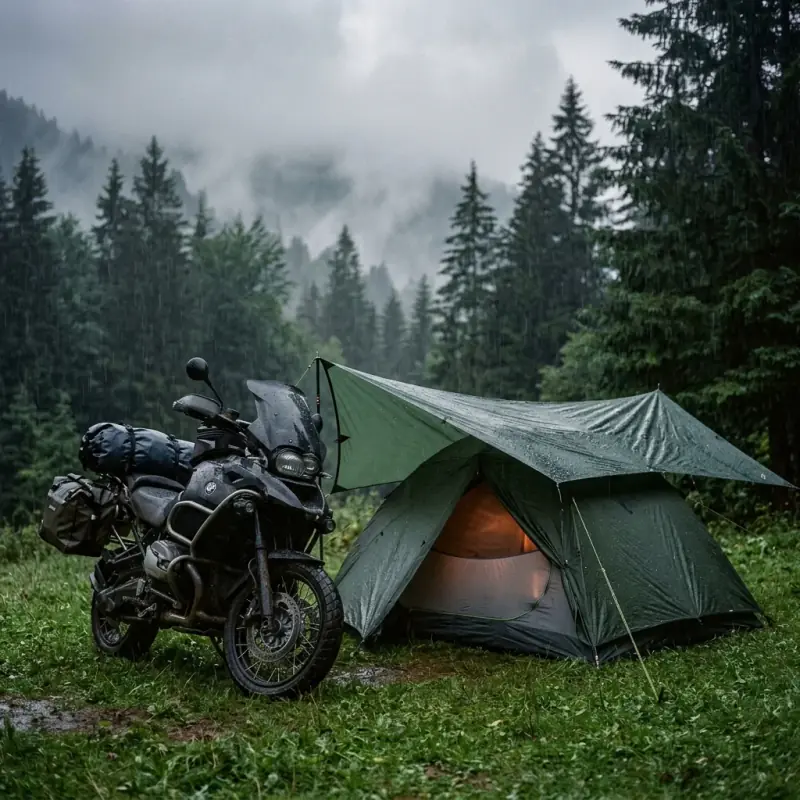
Every experienced motorcycle camper has the same story. Not the sunset over the bay — the night it rained. The night a tent that seemed fine in the shop turned into a cold puddle, or the morning of packing a soaked, doubled-weight bag onto the bike with numb fingers while the rain kept coming.
Rain ends more motorcycle camping trips early than terrain, mechanical trouble, or nerves ever do. And here’s the part that stings: it’s nearly always lost before the first drop falls — in the tent you chose, the way you packed, and where you decided to pitch. Get those right and a wet night is a non-event you’ll barely remember. Get them wrong and no amount of grit at 2 a.m. saves it.
This is a guide to getting them right. It separates the two completely different problems rain creates, explains what the waterproof numbers on your gear actually mean, and lays out the wet-weather system we’d run on a bike where every litre of pannier space is fought for.
The Two Problems Rain Creates (They’re Not the Same)
When people say “my tent leaked,” they’re usually describing one of two entirely different failures, and the fixes have almost nothing in common.
Problem one is water getting in — through the fly, up through the floor, or in around a badly sealed seam or zip. This is what “waterproof” ratings address, and it’s the one most people obsess over.
Problem two is water forming on the inside — condensation, which no amount of waterproofing prevents and which, on a cold clear night, can leave you wetter than actual rain would. Almost every “the rain got in” complaint on a night it barely drizzled is really condensation.
You have to win both. A £600 tent with a 5,000 mm fly will still soak your sleeping bag if you seal it up tight against a cold night and let your own breath rain back down on you. Understanding which battle you’re fighting is most of the skill.
What “Waterproof” Actually Means: Hydrostatic Head
The waterproof rating you see on a tent — “3,000 mm HH” — is its hydrostatic head: a lab measurement of how tall a column of water the fabric holds back before water is forced through it. Higher number, more water pressure resisted. It’s the standard way tent and outdoor-fabric makers quantify waterproofness.
For the flysheet, the practical thresholds line up like this:
- ~1,500 mm — roughly the minimum that keeps light rain out; fine for fair-weather nights, marginal for a trip you can’t reschedule.
- ~2,000 mm — the sensible three-season standard; holds up to several hours of heavy rain when the tent is pitched well.
- 3,000 mm and up — built for sustained downpours and long exposure; what you want when you don’t get to choose your weather.
The floor is a different story, and this is the number people miss. Groundsheets are commonly rated far higher — around 5,000 to 10,000 mm — for a specific reason: when you kneel or lie down on saturated ground, your body weight concentrates pressure on that fabric that can easily exceed what falling rain puts on the fly. A floor that’s merely “waterproof” on paper can weep through under your knee at 3 a.m. on wet grass. If a spec sheet only quotes one figure, that’s a small red flag.
But the rating is not the whole truth. Waterproofness in the real world also depends on taped or sealed seams, how taut you pitch, the coating’s age (proofing degrades with UV and abrasion over years), and construction quality. A 2,000 mm tent pitched drum-tight with sealed seams will out-perform a 4,000 mm tent pitched slack with a leaky zip. Treat the number as a floor, not a guarantee.
Our take: For loaded motorcycle camping in genuinely mixed weather, we’d not go below a 2,000 mm fly, and we treat 3,000 mm as the comfortable default. The weight penalty over a fair-weather tent is small; the penalty for guessing wrong is your whole trip. If you’re still choosing a shelter, our best motorcycle camping tents and ultralight tent roundups compare specific models with this in mind.
Condensation Is Not a Leak
Here’s the failure that catches beginners hardest. You pitch on a cold, clear night — no rain at all — and wake to a wet inner tent, a damp sleeping bag, and the certainty that your tent is faulty. It isn’t.
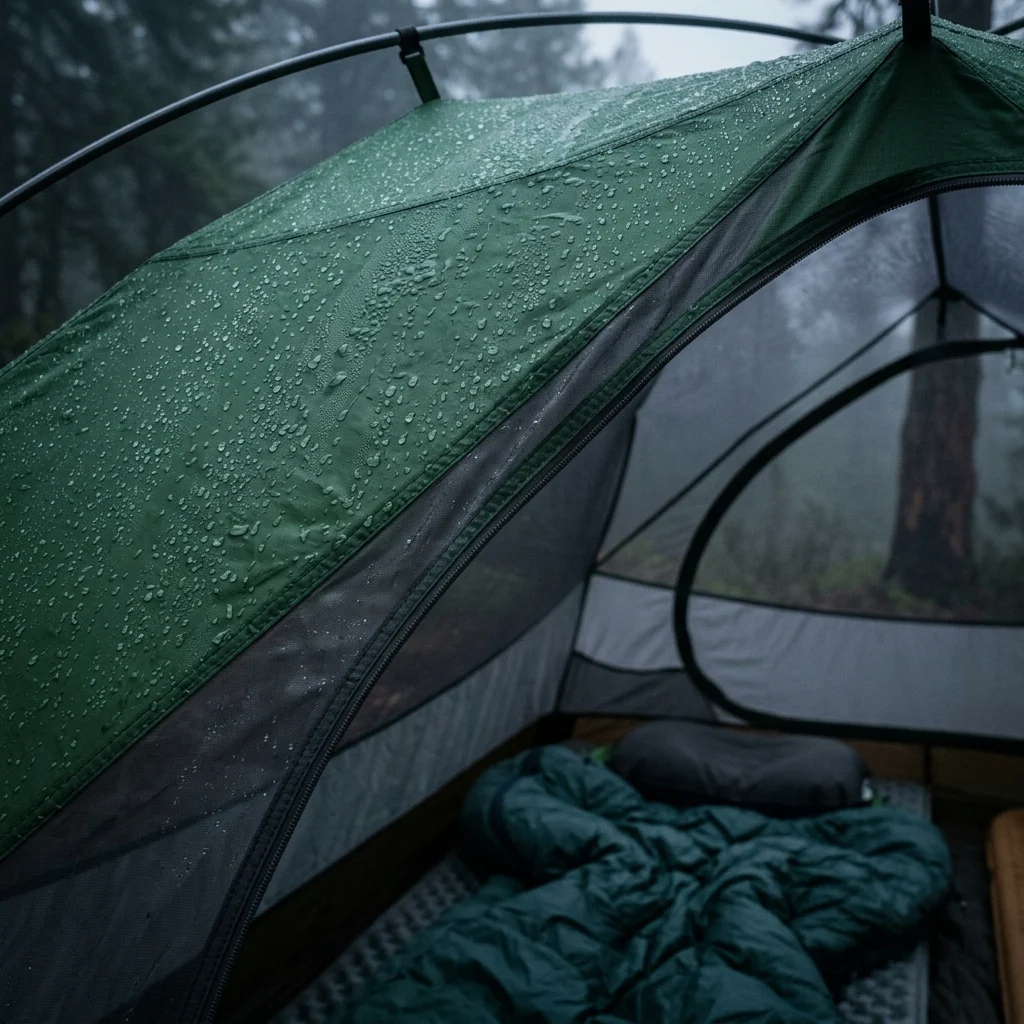
Condensation forms when warm, humid air meets a colder surface. Inside a tent, that humid air comes from your own breath (a lot of it, over eight hours), from damp clothing and riding gear, from wet ground, and from cooking. It hits the cold inner face of the fly and turns straight back into water — the same physics as a mirror fogging in a hot shower. The colder and clearer the night, the worse it gets, because the fly gets colder.
This is why double-wall tents are worth the extra weight for wet-country touring. The moisture from inside passes through the breathable inner and collects on the fly, keeping it off you and your gear. A single-wall tent has nowhere to put that water except back on you. It’s also why sealing yourself in tight to stay warm backfires — you trap the very moisture that then rains back down.
Beating condensation is about airflow, not waterproofing:
- Ventilate deliberately. Open the fly vents, and leave a vestibule door cracked so humid air has somewhere to go. A sealed tent is a wet tent.
- Pitch the fly taut so it doesn’t sag against the inner. Where the two walls touch, condensation wicks straight through to the inside.
- Face a door into a light breeze if there is one, to keep air moving through.
- Avoid low, damp ground — hollows, riverbanks, meadow bottoms — where cold, moist air pools overnight.
Do those and a “leaky” tent usually turns out to be perfectly dry.
Our Wet-Weather System for Motorcycle Camping
Waterproof ratings and condensation control are the theory. Here’s how we’d actually run a wet trip on a bike, where you can’t just throw a dry set of everything in the back seat.
One note on scope before the system: this section is about the camp. Staying dry on the bike is a separate equipment problem with separate answers — packable oversuits, boot covers and the overlaps that decide where water actually gets in — and we’ve covered it properly in our motorcycle rain gear guide. Arriving dry makes everything below much easier.
Pack dry — waterproof-ish is not waterproof
The single biggest difference between a miserable wet trip and a fine one is that your dry stuff stays dry. “Water-resistant” panniers, “shower-proof” roll bags, and taped-but-old luggage all let you down in a sustained soaking — usually the sleeping bag, which is the one thing you cannot afford to get wet.
The fix is a dry bag inside whatever luggage you run: a roll-top waterproof sack that seals your sleep system and dry clothes off from everything else. It’s cheap insurance and it’s the backbone of riding in the rain without dread. We’ve written the specifics up separately — which sizes, closures, and materials actually hold water out — in our best dry bags for motorcycle camping guide. If you take one thing from this article, make it this: protect the sleeping bag first.
Pitch smart: the site matters as much as the tent
Where you put the tent decides half the outcome before you unroll it.
- Pick high ground, or at least a gentle slope — never a hollow or a flat spot that becomes a puddle. Look at where water would run and pool if it rained hard, and don’t camp there. Dry-looking gravel washes and riverbeds are the classic trap; they can flood shockingly fast.
- Pitch taut and stake everything, especially in wind-driven rain. A saggy fly touching the inner is how “waterproof” tents wet through.
- Use the vestibule as an airlock and a garage. It keeps rain out of the inner when you come and go, and it’s where wet gear lives (below).
The wet-riding-gear problem
This is the motorcycle-specific bit no backpacking guide covers: after a day riding in rain you arrive with a soaked jacket, boots, and gloves, and they cannot come into your sleeping space or they’ll humidify the whole tent and soak your bag by morning.
Give them the vestibule. Park the jacket and gloves there, off the wet ground on top of a dry bag; stand the boots upside down under the fly lip so they drip outward and don’t fill with rain. It won’t dry them overnight, but it quarantines the water they’re carrying. In the morning, a wet jacket going back on is grim but survivable; a wet sleeping bag is trip-ending. Protect the bag, accept the jacket.
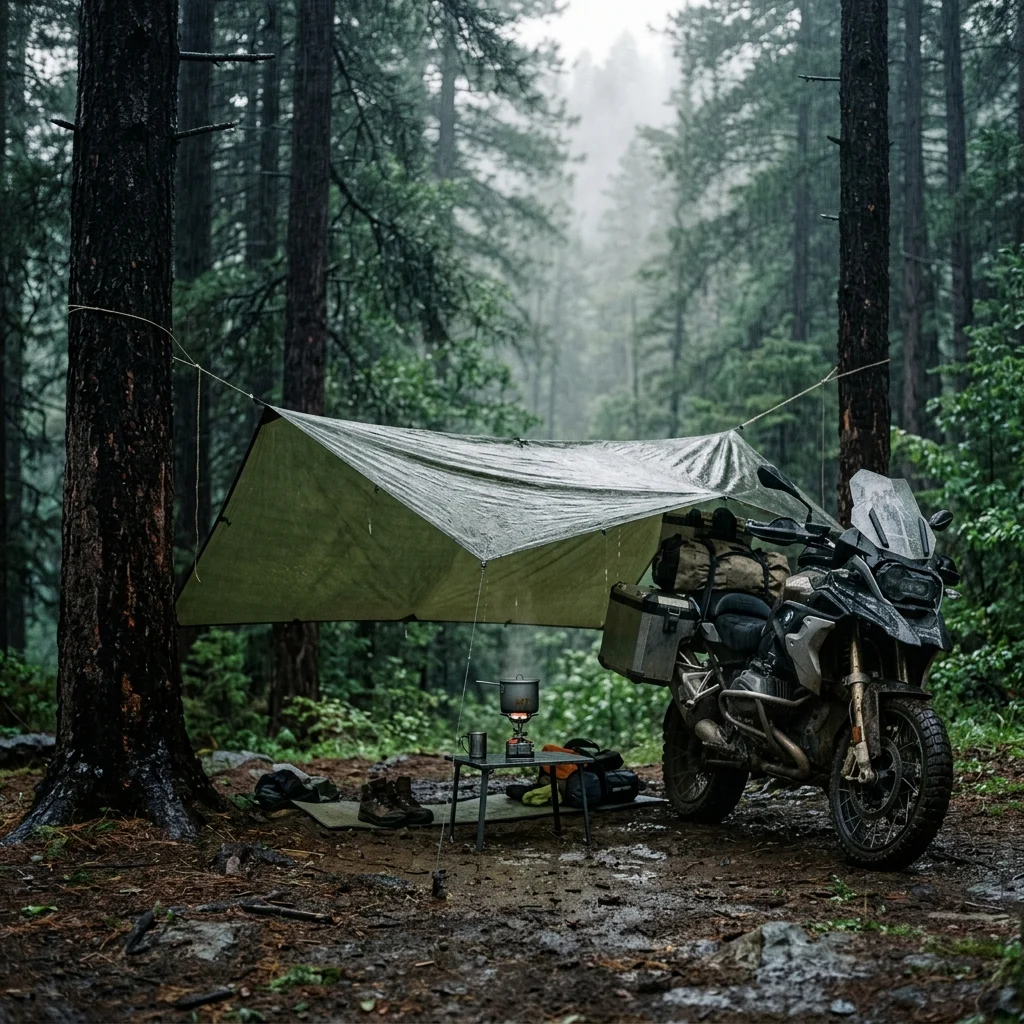
If you camp in the wet for more than a night or two, a lightweight tarp is the upgrade that changes the whole experience: strung between the bike and a couple of stakes, it gives you a covered porch to cook and de-kit under — far bigger than any tent vestibule — so the wet gear and the stove stay out of your sleeping space entirely. A 3 × 3 m (10 × 10 ft) square is the sweet spot: big enough to cover the bike’s tail and a cooking spot, small enough to pack behind a pannier. Two that riders reach for again and again are the DD Tarp 3×3 — a 790 g ripstop square with 19 reinforced tie-out points, so you can rig it a dozen ways off the bike — and the ultralight, fully seam-taped Aqua Quest Guide in its 10 × 10 ft size. Look for that size, genuine full waterproofing and plenty of tie-outs, and skip the flimsy eyelet-only picnic tarps that tear at the first grommet. And on a long wet stretch, don’t be a hero about it: a night in a cheap hostel or a room to properly dry everything out mid-trip resets the whole system, and it’s what most riders actually do rather than chasing an impossible fully-dry camp for two weeks straight.
Sleep system: assume it might get damp
Even with good discipline, humidity creeps in over several wet days. Build the sleep system to tolerate it.
Choose synthetic insulation if rain is likely. Down packs smaller and is warmer for its weight, but soaked down loses its loft and stops insulating, and it dries slowly. Synthetic fill keeps a usable amount of warmth even when damp and dries far faster — the more forgiving choice for unpredictable weather. We break the trade-off down fully in our sleeping bag guide. Whichever you pick, keep it sealed in a dry bag until it’s inside the tent.
Don’t skip the sleeping pad in the wet. A pad isn’t only comfort — its insulation (R-value) stops the cold, often damp ground from stealing your body heat all night. On wet ground that heat drain is worse. Our compact sleeping pad roundup covers packable options that fit panniers.
Drying out on the move
Multi-day rain means you never fully dry — you manage moisture instead. Pack the wet tent outside your dry bags (in an outer pannier pocket or a separate stuff sack) so it never touches the sleeping gear. When the sun does come out, stop for twenty minutes and drape the fly over the bike or a fence — a short midday dry-out resets the whole system and does more for morale than anything else on a long wet stretch.
Disclosure: some links below are affiliate links. If you buy through them we may earn a small commission at no extra cost to you.
Shop wet-weather camping essentials on Amazon →
The Mistakes That Actually Soak People
Nearly every wet-night disaster traces back to one of these, and all of them are avoidable for free:
- Trusting “water-resistant” luggage instead of a real dry bag around the sleeping gear.
- Sealing the tent up tight against the cold, then drowning in their own condensation.
- Pitching in a hollow that turns into a pond, or a dry wash that floods.
- A slack pitch — the fly sags onto the inner and wicks water through.
- Bringing soaked riding gear into the sleeping area and humidifying everything.
- Skipping seam checks on an older tent. Factory seam tape peels and coatings degrade with UV and years of use — run a hose or shower over a tent that’s a few seasons old before the trip, watch the seams and floor corners for weeping, and re-seal with seam grip if it leaks. Far better to find out in the garden than on a mountainside.
None of those is about spending more money. They’re about understanding what you’re fighting.
The Bottom Line
Motorcycle camping in the rain has a bad reputation it mostly doesn’t deserve. The riders who hate it are usually the ones who lost the fight before it started — wrong tent for the weather, sleeping bag in a “waterproof-ish” bag, tent pitched in the wrong spot and sealed up tight. The riders who shrug at rain aren’t tougher; they just made the boring decisions right in advance.
Buy the waterproofing you’ll actually need, not the minimum. Protect the sleeping bag above all else. Pitch high, pitch taut, and ventilate against your own breath. Give wet gear its own space. Do that and rain stops being the thing that ends the trip and becomes just weather — the kind that empties the good campsites and leaves the best bays to you.
If you’re newer to all this, our first-overnight guide for beginners walks through the whole setup from scratch, and the complete packing layout shows where the wet-weather kit actually goes on the bike. Planning to wild camp in it? Know the country-by-country rules first.
Disclosure: Some links in this article are affiliate links. If you buy gear through them, Bikes & Bays earns a small commission at no extra cost to you. We only link to gear that earns its place, and skip the button when nothing’s worth recommending.
Frequently Asked Questions
What hydrostatic head rating do I actually need for a tent in the rain?
For the flysheet, 1,500 mm is roughly the minimum that keeps light rain out, 2,000 mm is the sensible standard for a three-season tent and will hold up to a few hours of heavy rain, and 3,000 mm or more is what you want for sustained downpours or a trip where you can't choose your weather. The floor should be rated much higher — commonly 5,000 to 10,000 mm — because when you kneel or lie on saturated ground your body weight concentrates far more pressure on that fabric than falling rain ever puts on the fly. Rating isn't the whole story, though: taped seams, a taut pitch, and fabric that hasn't aged out all matter as much as the number.
Why is the inside of my tent wet even though it didn't leak?
That's almost always condensation, not a leak. Warm, humid air — from your breath, damp gear, wet ground, and cooking — hits the colder inner face of the fly and turns back into water, exactly like a bathroom mirror fogging. A single person breathes out a surprising amount of moisture overnight. It's why a tent can be bone dry outside and dripping inside after a clear, cold night. The fix is ventilation and a taut pitch, not more waterproofing.
Down or synthetic sleeping bag for wet motorcycle trips?
Synthetic, if rain is a real possibility and you can afford the extra bulk in your panniers. Down gives you the best warmth for its weight and packs smaller, but when it gets soaked the feathers lose their loft and it stops insulating — and it dries slowly. Synthetic fill keeps a usable amount of warmth even when damp and dries much faster. On a multi-week trip through unpredictable weather, that reliability usually beats down's packability. If you do run down, protecting it in a proper dry bag is non-negotiable.
Where do I put soaking-wet riding gear when I'm camping?
Not in the sleeping area, and not stuffed in a pannier where it'll stay wet and start to smell. The vestibule — the covered space under the fly outside the inner tent — is what it's for: park the wet jacket, boots and gloves there, off the ground on a dry bag or the bike's footpeg-height line, so they drip outside your living space. Boots go upside down under the vestibule lip. It won't dry them, but it keeps the water they're carrying out of your bed.
How do I get a dry space to cook and sit when it's raining all evening?
A tarp is the answer most experienced riders reach for, and it's the one thing this guide would add to a wet-weather kit. Rig a lightweight tarp between the bike, a tree, and a couple of stakes to make a covered porch bigger than the tent's own vestibule — somewhere to cook on the stove (never inside the tent), take off wet gear, and sit out a downpour without being sealed in your inner. It packs down to almost nothing and it's the difference between a wet evening spent hunched in the tent and one spent comfortably under cover watching it come down. Pitch it with a slope so water runs off one corner rather than pooling in the middle.