
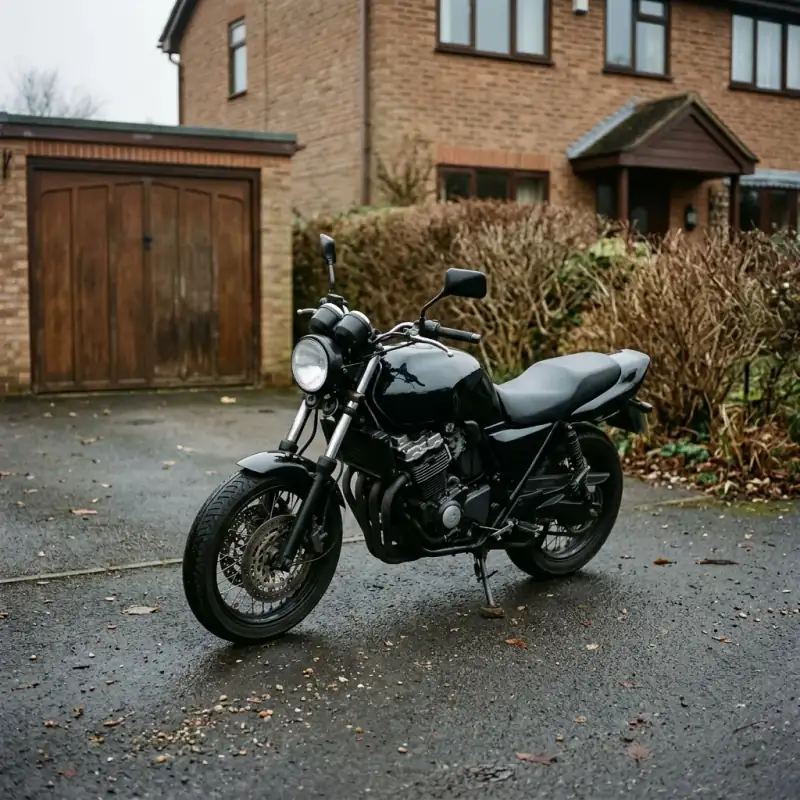
The first year of riding has a shape you can set your watch by. The money goes on the bike, then the helmet, then a jacket, and by the time all three are paid for the budget is finished. What’s left over is a rider with a working motorcycle and none of the small, unglamorous things that turn out to matter — which they discover one at a time, usually at the least convenient moment.
That gap is the gift. It’s also, conveniently, the part of motorcycling where you can buy for someone without knowing their size, their armour preferences or their inseam.
The same rule applies: nothing that has to fit
Worth repeating from our main gift guide, because it bites hardest with new riders: don’t buy them sized gear.
Helmets, gloves, boots and jackets are protective equipment fitted to a specific person, and a new rider’s kit is precisely where fit matters most — they haven’t yet learned to tell a good fit from a bad one, so a badly-fitting gift becomes a badly-fitting habit. There’s a second problem too: buying someone a helmet reads as a comment on their judgement.
Tools and consumables carry none of that baggage. They read as practical.
Disclosure: some links below are affiliate links. If you buy through them we may earn a small commission at no extra cost to you.
The gaps, in the order they bite
1. Hearing — and it’s already happening
Wind noise under a helmet passes the level at which hearing damage accumulates well before motorway speed. It’s generated by air moving over the helmet shell rather than by the engine, so a quiet bike doesn’t help, and the damage is painless and permanent — which is exactly why a new rider has no reason to act on it.
Filtered plugs cut the roar while letting through what a rider needs to hear: engine note, sirens, traffic. A set with two filter strengths removes the guesswork about which suits their riding.
Check Alpine MotoSafe Pro on Amazon →
The full comparison of filtered versus foam, and why the advertised numbers aren’t what you actually get, is in our earplugs guide.
2. Tyre pressure — the most consequential number they aren’t checking
If you buy one practical thing, buy this one.
Tyre pressure changes braking distance, grip and steering feel more than almost anything else under a rider’s control, and it falls slowly — a PSI or two a month through normal permeation, with roughly another PSI for every 10°F the weather drops — so there’s no moment where it announces itself. A new rider without a gauge simply doesn’t know. A new rider without a way to add air knows but can’t act.
A compact 12V inflator with a built-in gauge solves both halves at once and lives under the seat.
Check portable tyre inflators on Amazon →
Two details make this a better gift than it looks. The first is that forecourt airlines are built for car tyres and are not always well maintained, so “I’ll just do it at the garage” is a weaker plan than it sounds — a gauge they own and trust is the point. The second is that pressure must be checked cold — a tyre warmed by twenty minutes of riding reads high, which means the rider who checks at the end of a journey is systematically under-inflating.
Neither of those is obvious, and neither is in the owner’s manual in a form anyone reads. A gauge that lives with the bike is what turns the knowledge into a habit.
What the numbers should actually be, and why the sticker on the swingarm isn’t always the answer for a loaded bike, is covered in our tyre pressure guide.
3. The first puncture
It happens to everyone and it never happens near home. On a tubeless tyre, a plug kit turns a recovery-truck afternoon into a twenty-minute roadside job, and it packs down to something that disappears under the seat next to the inflator.
The two together are the single most useful pairing on this list — a plug kit without a way to reinflate is half a solution.
Check the Stop & Go tubeless kit on Amazon →
If their bike runs tubed tyres — common on spoked adventure wheels — a plug kit won’t help and tyre irons are the relevant gift instead.
Check Motion Pro tyre irons on Amazon →
Check which one they have before buying. Our roadside puncture guide covers both jobs.
4. The chain
On a chain-driven bike this is the maintenance task with the shortest interval and the highest skip rate — hundreds of miles, not thousands, and always at an inconvenient moment. New riders skip it because they’re missing one of the three things needed, which a bundled kit fixes permanently.
A neglected chain wears the sprockets with it, so this cheap gift protects an expensive part.
Check the Motul Chain Care Kit on Amazon →
Our chain cleaning walkthrough is worth sending along with it.
5. Somewhere to put the phone
Phone-as-satnav is the default now, and new riders usually start by putting the phone in a pocket and stopping to check it — which is both annoying and worse for concentration than a mount.
One caveat that catches new riders out: mounting a phone rigidly to the handlebars can permanently damage its camera, which is a manufacturer-acknowledged failure rather than an internet rumour — we cover the detail and the source in the main gift guide. Buy the dampener with the mount, not after.
Check Quad Lock handlebar mount on Amazon →
If you don’t know what phone they have or want something case-agnostic, a clamp-style mount sidesteps the compatibility question entirely.
Mount ecosystems don’t mix — our phone mount comparison explains which commits you to what.
6. The battery, once winter arrives
A new rider learns this the hard way in their first spring. A bike left standing for months flattens its own battery, and a flat lead-acid battery sulphates and permanently loses capacity — so the bill isn’t a jump start, it’s a new battery.
A smart maintainer prevents it and costs a fraction of the replacement.
Check NOCO GENIUS1 on Amazon →
Add a corrosion spray if you want the complete first-winter gift. A first-year rider has usually never seen what a single gritted winter does to fasteners and fork lowers, and the spray is far cheaper than the first time they find out.
Our winter storage guide is the checklist version.
7. Somewhere to put everything else
New riders discover fast that a motorcycle has nowhere to put a wallet, a phone, a bottle of water or a jacket layer. A tank bag is usually the first luggage anyone buys, and it’s the one that stays useful after they’ve bought panniers.
Check the Nelson-Rigg tank bag on Amazon →
One reason this suits a gift specifically: it straps on rather than sticking on. Magnetic tank bags are the usual default and they are useless on the plastic tank covers a lot of modern bikes wear, so buying magnetic means knowing what their tank is made of. A strapped bag sidesteps the question.
8. Power that doesn’t depend on the bike
Phone running navigation all day plus a camera plus a headlamp adds up faster than new riders expect, and the bike only charges what’s plugged into it — which a new rider discovers the first time they arrive somewhere on 4%.
For a bike specifically, the thing to look for is not capacity but whether it tolerates being carried badly. A bank that lives loose in a tank bag gets rained on and shaken all day, so an IPX rating and a low weight matter more than an extra 5,000 mAh that mostly adds bulk.
Check Nitecore NB10000 Gen 4 on Amazon →
9. Talking to the people they ride with — maybe
An intercom is a genuinely transformative gift and the one most likely to go wrong as a surprise, because units pair most reliably within the same brand and a new rider may not have a settled riding group yet.
If you know what their friends run, buy into that ecosystem. If you don’t, ask.
Check Cardo Spirit on Amazon →
Our intercom comparison covers which units talk to which.
When each of these actually becomes useful
Gifts land better when they arrive slightly before the need rather than long after it. A rough first-year shape, which also tells you what to buy depending on where they are:
Weeks 1-4 — everything is new and nothing has gone wrong yet. This is earplugs season. Hearing damage starts on the first motorway ride and the rider notices none of it, so the gift that matters most is the one they’d never think to ask for. A phone mount lands well here too, because the “stop and check the map” ritual is still fresh enough to be annoying.
Months 2-4 — the first maintenance reality. The chain gets noticeably dry, the tyres are down a few PSI from where they started, and the rider realises nobody is going to do these things for them. Chain kit, gauge and inflator all land in this window.
The first puncture — unschedulable, universal. Statistically it arrives somewhere inconvenient, and a rider without a plug kit discovers what a recovery call costs. This is the one gift whose value is invisible right up until the moment it’s enormous.
First autumn — storage. The bike starts sitting for weeks. Battery maintainer and corrosion spray belong here, and they’re a natural pairing for a birthday in September or October.
First spring — the bill. This is when a rider who skipped the maintainer finds out that a flat battery is often a dead battery. If you’re buying for someone who has just been through that, the maintainer is a slightly pointed but genuinely welcome gift.
The practical version: if they’re brand new, buy hearing and navigation. If they’ve had the bike a season, buy maintenance. If they’re heading into winter, buy storage.
If they haven’t bought the bike yet
Someone in the licence-and-shopping phase is the hardest person on this list to buy for, because almost everything depends on a bike that doesn’t exist yet. Mounts, luggage, chain kit and battery maintainers are all either bike-specific or premature.
Three things work anyway.
Training. The most useful gift at this stage by a distance, and it doesn’t depend on which bike they end up with.
Earplugs. They’ll need them on day one of riding anything, including the training bikes.
A gift card to the shop they’ll use. This is the honest way to help with sized gear. A new rider needs a helmet and a jacket that fit them specifically, and the shop’s fitting service is a substantial part of what they’re buying. Handing over the budget without choosing for them is not a cop-out here; it’s the correct answer.
What to avoid entirely at this stage: anything bolted to a bike, and anything sized. Both are guesses about decisions they haven’t made.
What to skip for a new rider
Anything sized. Covered above, and it matters double here.
A tool roll they can’t use yet. A comprehensive tool kit is a great gift for someone who already does their own maintenance and a shelf ornament for someone who doesn’t. If they’re heading that way, our tool kit guide is the honest starting point — but a chain kit they’ll use beats a socket set they won’t.
Performance parts. Exhausts, filters and levers are fitment-specific, opinion-specific, and occasionally the reason a warranty claim gets refused.
A second bike-specific accessory before you’ve checked the bike. Crash bars, racks and screens vary by model and model year.
Anything that implies they ride badly. High-vis, a “loud pipes” novelty, a book about crashing. Well-meant, poorly received.
The gift that isn’t an object
If you want to spend real money on someone in their first year, spend it on rider training rather than kit.
An advanced or off-road course does more for a new rider’s safety and enjoyment than any object on this list, because it changes what they can do rather than what they own. It doesn’t wrap well, which is the only real argument against it.
If they’re still choosing the bike itself, our beginner adventure bike guide is a better place to point them than any accessory.
Frequently Asked Questions
What should you buy someone who just got their first motorcycle?
Buy into the gap between what they bought and what they need. New riders spend their budget on the bike, the helmet and a jacket, and almost none of them budget for the unglamorous things that come up in the first six months: a way to check and correct tyre pressure, a way to deal with a puncture, chain maintenance, and something to keep the battery alive when the bike sits. Those are all sizeless, all inexpensive relative to the bike, and all things a new rider genuinely does not have. Avoid buying them sized gear — helmets, gloves, boots and jackets are protective equipment fitted to the individual, and a new rider's kit is exactly where fit matters most.
Is it rude to buy safety gear for a new rider?
It depends entirely on the category. Buying them a helmet reads as a comment on their judgement and is a fit problem besides, so skip it. Buying earplugs, a tyre gauge and inflator, or a puncture repair kit reads as practical rather than preachy, because these are tools rather than a verdict on how they ride. The general rule: gifts that help them look after the bike land well; gifts that imply they are unsafe do not. If you are worried about their safety specifically, funding a rider training course is far more effective than any object, and is the one 'safety gift' experienced riders consistently endorse.
What do new riders forget to buy most often?
A tyre pressure gauge and some way of adding air. Tyre pressure is the single most consequential maintenance number on a motorcycle — it changes braking, grip and handling more than almost anything else a rider controls — and it drops slowly enough that a new rider has no reason to notice until something feels wrong. The second most-forgotten is chain care on a chain-driven bike, which needs cleaning and lubricating on a schedule measured in hundreds of miles. Neither is exciting and both get skipped, which is exactly what makes them good gifts.
How much should you spend on a gift for a new motorcyclist?
Less than you think, because the useful things are cheap. Earplugs, a chain care kit and a puncture plug kit are all small-money items that a new rider will use within the first season. Spending more does not buy more usefulness here — a £200 intercom is a lovely gift but it solves a problem they may not have yet, whereas a £15 set of earplugs solves one they already have and don't know about. If you want to spend properly, put the money toward rider training or a track day rather than an object.
Should I buy a beginner an intercom?
Only if you know who they ride with. Intercom systems pair most reliably with units from the same maker, so the right purchase depends on what their riding group already runs — and a new rider often does not have a settled group yet. If they mostly ride alone, the value is music and navigation prompts rather than conversation, which is real but much smaller. This is the one item on this list where asking beforehand is better than surprising them.