
It’s 3 a.m. in the Pyrenees in May. Outside it’s 5°C and dropping. You’re inside a $380 down bag rated to -7°C, in a tent that cost almost as much, and you’re shivering. Not the romantic shoulder-season shiver — the real one, where you pull your knees to your chest and decide you’ll start the bike at first light just to get warm. You spent the money. The bag is fine. The problem is the $25 closed-cell foam pad you bought to save weight.
This is the failure mode nobody warns motorcycle campers about: a sleeping bag is half of a sleep system, and the wrong half of your budget will freeze you regardless of the brand on the bag. The bag is what insulates the top of you. The pad is what stops the ground from pulling all of that warmth back out by morning. Get either one wrong and you have a $500 problem with a $25 cause.
This guide is the best sleeping bag for motorcycle camping breakdown that fixes that — and the rest of the system around it. By the end you’ll know which insulation actually fits your trip, what those EN/ISO numbers on the tag really mean, what fill power gets you (and what it doesn’t), how to pair the bag with a pad that earns its place in the pannier, and seven specific bags worth your money across three price tiers. Read the table first; everything else is the explanation.
The 5-Minute Decision Box
If you have one minute, this is the section. Find the row that describes your trip, buy in that range, and stop reading.
| Use Case | Insulation | Temp Rating (Comfort) | Approx. Budget |
|---|---|---|---|
| Summer only, mild climate | Synthetic | 40°F / 5°C | $60-100 |
| Three-season Europe (most riders) | Down or hybrid | 30°F / -1°C | $180-300 |
| Cold/wet shoulder-season, long trips | Hydrophobic down 850+ fill | 20°F / -7°C | $350-500 |
| Wet climates (UK, NW Spain, coastal Turkey) | Synthetic or hydrophobic down | 25°F / -4°C | $150-350 |
If you’re not sure which row you are, read the next two sections — they’ll decide it for you in five minutes.
Down vs Synthetic: The Honest Take
This is the question every motorcycle camper asks first and the answer most blog posts get wrong by hedging. The short version: there is a right answer for most riders, and it changed in the last decade.
Down. Warmer per gram than anything else made — a 30°F / -1°C down mummy can weigh 1.5 lb (680 g) where the synthetic equivalent weighs 3 lb (1.36 kg). Compresses to roughly half the volume of synthetic of equal warmth, which on a motorcycle is the spec that matters most. Lasts 15-20 years if you keep it dry and store it loose. The failure mode is the famous one: get it soaked through and it clumps, insulates almost nothing, and takes 24-48 hours of dry weather to fully recover. Price climbs steeply — premium down at 850-fill costs three to four times what budget synthetic does.
Synthetic. Still insulates when damp (somewhere around 50% of dry R-value when wet — cold but not lethal). Dries in hours, not days. Cheaper at every tier. The trade-offs are predictable: bulkier in the pannier, heavier on the bike, and the insulation breaks down faster. A synthetic bag has a usable life of 5-10 years against down’s 15-20. The cheaper construction is also part of why budget synthetic bags rarely publish honest temperature ratings.
The honest verdict for motorcycle camping. For roughly 80% of riders doing three-season touring across Europe, the answer in 2026 is hydrophobic down. DWR coatings on the down clusters — DownTek, Sea to Summit’s Ultra-Dry, Nikwax Hydrophobic Down — close most of the wet-weather gap that used to make synthetic the safer pick. Sea to Summit publishes lab figures showing roughly 60% better loft retention and 60% faster drying versus untreated down. It’s not waterproof, and the DWR breaks down over years, but the comfort margin is large enough to matter.
For riders going specifically to rainy regions like Scotland in October, the Black Sea coast in spring, or Lofoten any time of year, synthetic still wins on the margin. The bag is going to get wet, and you don’t want a multi-day recovery in the middle of a trip. Our country-by-country wild camping guide for Europe covers which regions to plan for.
For riders on a hard budget: a synthetic bag at $80-100 lets you camp now. Buy down when the bag matters more than the savings.
Temperature Ratings: Decoding the EN/ISO Label
This is where you stop being a tourist in gear shops and start reading the spec sheet like the brands hope you don’t.
The standard. Two test protocols are valid: EN 13537 (the older European standard) and ISO 23537 (the current spec, with a 2022 update). Both use the same method — a heated manikin on a standardized R-4.8 pad inside a climate-controlled chamber, with the bag held at steady-state thermal equilibrium. The results differ by ±1-2°C between standards, not enough to change your buying decision. If a bag doesn’t publish either, the rating is unverified.
The three numbers every bag should publish.
- Comfort temperature. The lowest temperature at which a “standard woman” (60 kg, relaxed posture) can sleep through the night without feeling cold. Use this number if you sleep cold, are smaller than average, or simply want margin. This is the realistic rating.
- Limit temperature. The lowest temperature at which a “standard man” (73 kg, curled posture) can sleep without shivering. Most brands market this number as “the bag’s rating.” It is the marketing-friendly number, not the real-world comfort number.
- Extreme temperature. Survival only — you will not sleep at this temperature, you will spend the night not freezing to death. Ignore it entirely for buying decisions.
Translate this for motorcycle camping. When you see “20°F” on a tag, that is almost always the Limit number. For real comfort, choose a bag rated 5-10°C lower than the coldest night you actually expect to face. Example: planning the Pyrenees in May with expected 4°C / 39°F lows? Buy a bag with a Comfort rating of -1°C / 30°F, which will publish a Limit of around -7°C / 20°F. That gives you a working margin for the night that comes in colder than the forecast, which on a motorcycle trip is most of them.
Brands without ISO ratings. Many Amazon-only labels (BORULL, Elevon, dozens of generic mummy bags) publish unverified temperature claims based on nothing in particular. Discount them by 5-8°C for safety. A “20°F” no-name bag is realistically a 35°F / 2°C bag in the field. That’s not a deal — that’s a different bag than the one you thought you bought.
Fill Power: The Spec Everyone Misreads
Quick and surgical, because brands lean on this number to sell bags.
Fill power is a measure of loft: how many cubic inches one ounce of down expands to fill under a standardized weight. The common rungs are 650, 800, 850, and 900. Higher fill power means more warmth per gram and more compressibility — which is exactly the trade-off motorcycle camping rewards.
But fill power is not warmth on its own. You need fill weight — the actual amount of down inside the bag.
A 650-fill bag with 25 oz of down is warmer than an 850-fill bag with 15 oz of down. Higher fill power without enough fill weight is just an expensive light bag.
For motorcycle camping, here’s the practical map. 650 fill is budget tier — you accept the extra packed bulk for the lower price. 800-850 fill is the sweet spot: best balance of price, warmth, and compressed volume, and it’s where most rider-favorite premium bags live. 900+ fill only earns its keep on serious cold-weather trips or for committed weight obsessives. The price jump from 850 to 900 is steep and the real-world performance jump is small.
When you compare two bags at the same Comfort rating, check both numbers. A premium-looking 850-fill bag with only 12 oz of down is a fair-weather summer bag wearing a premium label.
Sleep System: Why Your Pad Matters as Much as Your Bag
⭐ Critical section — this is the #1 mistake riders make.
If you’ve ever woken at 3 a.m. freezing despite spending $300 on a bag, the problem wasn’t the bag. The problem was the half-inch of foam between you and the ground.
The physics in plain language: your body weight crushes the insulation underneath you. Compressed down or synthetic has close to zero R-value — it’s just fabric at that point. Meanwhile the ground acts as a heat sink, pulling warmth out of you all night through direct conduction. The pad’s R-value is what stops that. A great bag with a bad pad is a bag with a hole in the bottom.
R-value targets for motorcycle camping.
- R 2-3: Summer only, nights above ~10°C / 50°F.
- R 3-5: Three-season Europe — this is where most riders should be.
- R 5+: Shoulder season, alpine ground, anything below 0°C / 32°F.
- R-values are additive. Stack a $20 closed-cell foam pad under an inflatable to push past R 6 for cold nights — and you have a backup pad if the inflatable punctures.
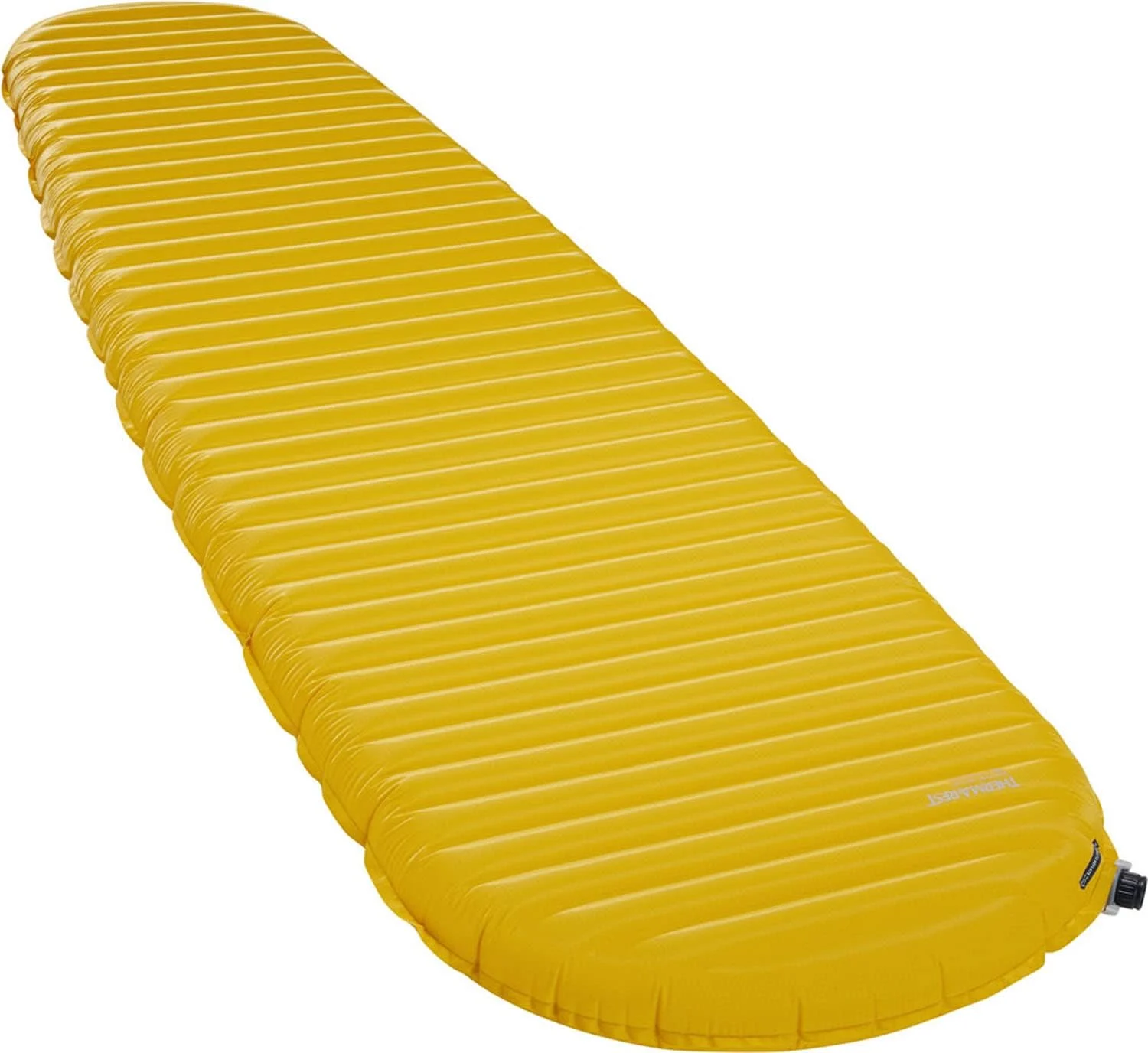
The pad question for motorcycle riders. Packed volume is the second hidden cost. A serious three-season pad takes up almost as much pannier space as the bag itself, and our pannier capacity guide explains why that matters when you’re allocating litres. The benchmarks are the Therm-a-Rest NeoAir XLite NXT (R 4.5, 354 g) and the Nemo Tensor All-Season (R 5.4, ~510 g). Either one is the right answer for most riders.
A cheap inflatable at R 1.5 under a $400 down bag is the wrong half of the budget. Spend evenly across the system. Our solo motorcycle camping safety post covers why getting cold-weather basics right matters when you’re out of cell range.
Check Therm-a-Rest Pads on Amazon →
Bag Shapes: Mummy vs Hybrid vs Rectangular vs Quilt
Four shapes, four trade-offs, one decisive answer for most riders.
Mummy. Tapered toward the feet, hooded top. Best warmth-to-weight ratio and smallest packed size of any closed bag. Restrictive if you turn at night or sleep on your side. This is the default for motorcycle camping and what 90% of the picks below are.
Hybrid / spoon-shape. Wider at the shoulders and hips, taper at the feet. The NEMO Disco Endless Promise is the genre-leader. Best pick for side sleepers and riders who toss. Costs roughly 10% more packed volume than a mummy of the same rating — usually worth it for the sleep quality.
Rectangular. Most internal room, worst thermal efficiency, largest packed size. Skip for motorcycle camping unless you only do mid-summer trips and you want one bag for the bike and the back of the car.
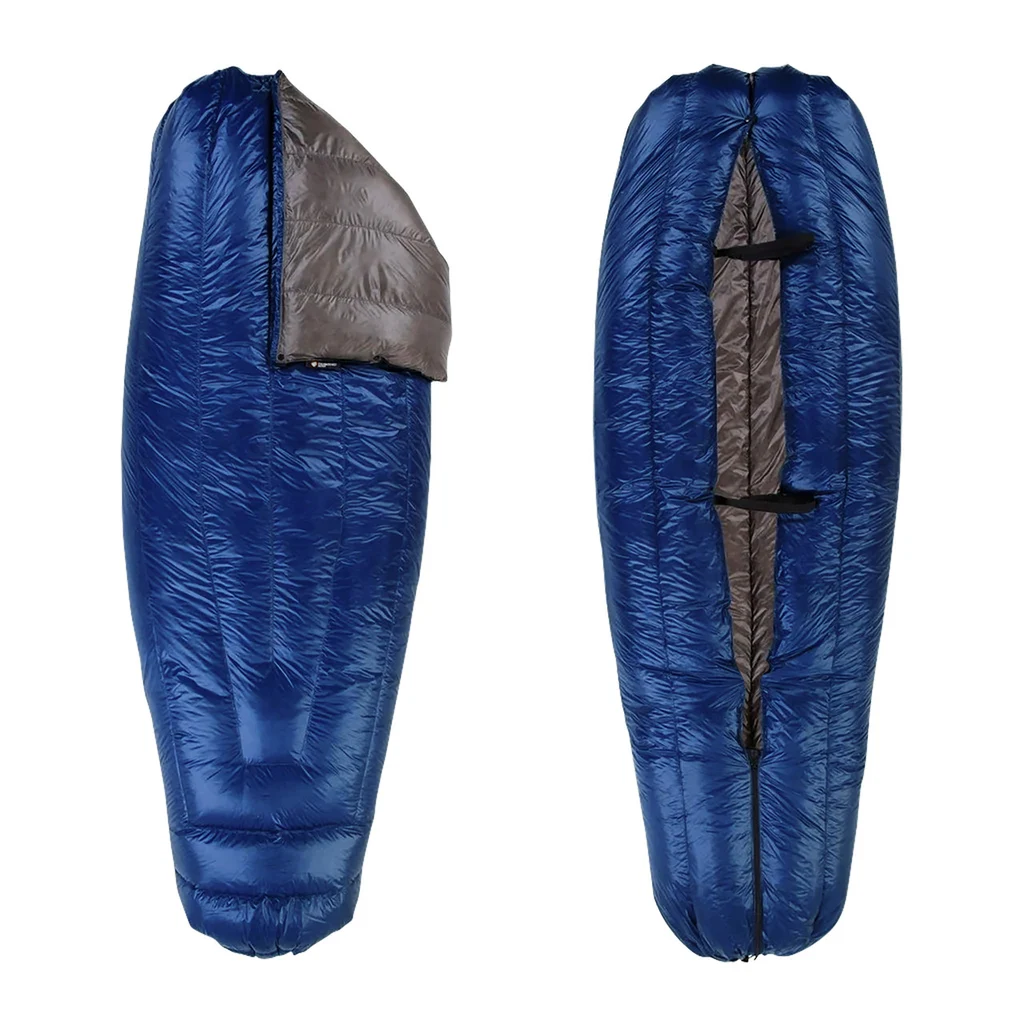
Quilt (no zipper, no hood). Removes the compressed insulation under you that wasn’t insulating anyway and clips to your pad with straps. Saves roughly 30% weight versus an equivalent bag at the same warmth. Best warmth-per-ounce of any system. Brands worth knowing: Enlightened Equipment, Katabatic, Sea to Summit Ember. There’s a real learning curve — the first few nights you’ll cinch wrong and let in drafts — but for committed long-trip riders, including most riders doing the Trans Euro Trail or other multi-week routes, the weight and volume savings pay for the learning.
The Best Sleeping Bags for Motorcycle Camping 2026
Seven picks across three price tiers, plus a quilt alternative. Each one has been chosen on published EN/ISO specs and on consistent rider reports rather than marketing claims. Skip to the tier that matches your budget — the picks within each tier are listed in order of which most riders should consider first.
Budget Tier (Under $100)
Teton Sports Celsius — Best Budget Pick
Synthetic insulation, 32°F / 0°C Limit rating, around 5 lb (2.27 kg), packs to roughly 7” x 15” (18 x 38 cm) with the included compression sack.
The most-bought budget motorcycle camping bag on Amazon, and it earns its place: works as advertised at the rated temperature, includes a usable compression sack rather than the oversized stock cinch most budget bags ship with, and survives being shoved into a pannier every night for two seasons. The hood and draft collar are basic but present, which is more than the cheaper bags in this tier offer. This is the bag to buy if “the bag” is the line item slowing your first trip.
NOT for: anyone planning trips colder than 5°C / 41°F, or any rider whose pannier space is already tight — packed volume is the weak point.
Check Teton Celsius on Amazon →

Coleman Brazos 20 — Best Budget Alternative
Synthetic, 20-30°F (-6 to -1°C) marketed range, machine washable, available in nearly every region globally.
Cheaper than the Teton and slightly more constricted in the cut, which actually helps warmth at the cost of room to turn. The standout feature is washability — most synthetic bags survive a wash, but Coleman explicitly designs for it, which matters across a long trip. Treat the published “20°F” rating as optimistic in the absence of an EN/ISO number; in real-world use it sleeps closer to 30-35°F (-1 to 2°C) Comfort.
NOT for: serious shoulder-season trips, or anyone who values published lab ratings.
Check Coleman Brazos on Amazon →

Mid-Range Tier ($150-300)
Kelty Cosmic Down 20 — Best Mid-Range Down
550-fill DriDown, 19°F / -7°C Limit rating, 2 lb 11 oz (1.22 kg), packs to 7” x 14” (18 x 36 cm).
This is the “first real down bag” most riders should buy. Warm enough for shoulder-season Europe, half the packed volume of any synthetic at the same price, and the DriDown treatment means an accidental soak isn’t the end of the night. The 550 fill power keeps the price honest at the cost of some bulk and weight compared to the premium tier — a fair trade.
NOT for: extended trips through known-wet regions (the DWR treatment helps but isn’t true hydrophobic down), or riders who already know they want the lighter packed size of an 850-fill bag.
Check Kelty Cosmic Down on Amazon →
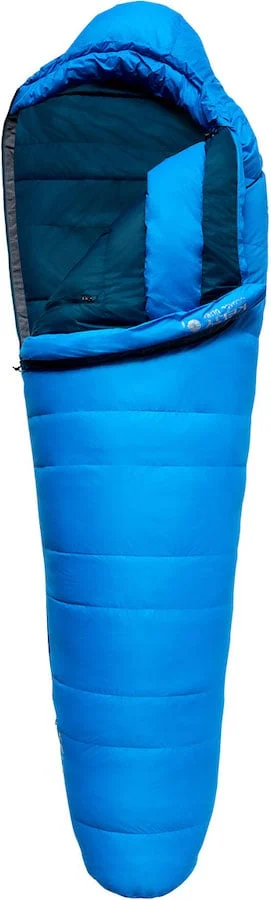
NEMO Disco Endless Promise 15 — Best for Side Sleepers
650-fill PFC-free hydrophobic down, 15°F / -9°C Limit rating, 2 lb 12 oz (1.25 kg), spoon-shaped cut.
The bag for riders who hate mummy bags. The spoon shape gives real room at the shoulders and hips for side sleeping and tossing — a sleep-quality difference that’s hard to appreciate until you’ve spent a week in a tight mummy on hardpack. Endless Promise is NEMO’s program for taking the bag back at end-of-life for recycling, which is rare in the category and worth supporting. The PFC-free DWR is a quieter but real upgrade over older hydrophobic treatments.
NOT for: weight obsessives or riders with very tight pannier space — it’s slightly bulkier than mummies of equivalent warmth.

Premium Tier ($350+)
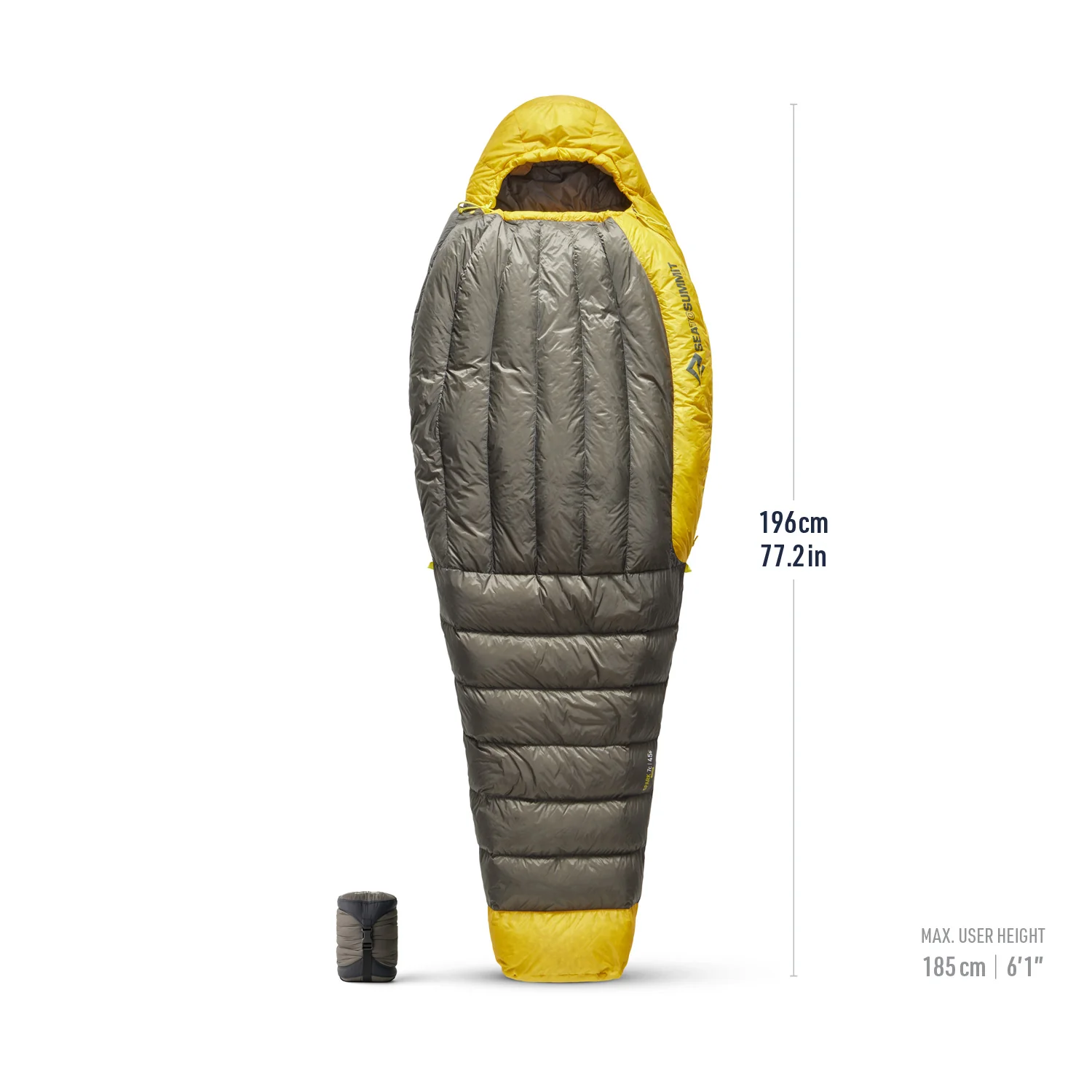
Sea to Summit Spark 15 — Best Overall for Motorcycle Camping
850-fill goose down with Ultra-Dry hydrophobic treatment, 29°F / -1.6°C Comfort, 17°F / -8°C Limit, 1 lb 9.7 oz (725 g), packs to 6.8 L.
The packed size is the headline. This bag fits in the corner of a side pannier with room left for a stove and a layer. Rider reports from multi-month trips across the Trans Euro Trail and the Balkans consistently rate it the best balance of warmth, weight, and pack size in the category. For anyone who tours frequently and has the budget once, this is the bag that ends the search.
NOT for: someone who shoves bags into panniers roughly. The 10-denier shell is genuinely delicate and lives in a dry bag, not loose against the pannier wall.
Check Sea to Summit Spark on Amazon →
Therm-a-Rest Hyperion 20 — Best Ultralight
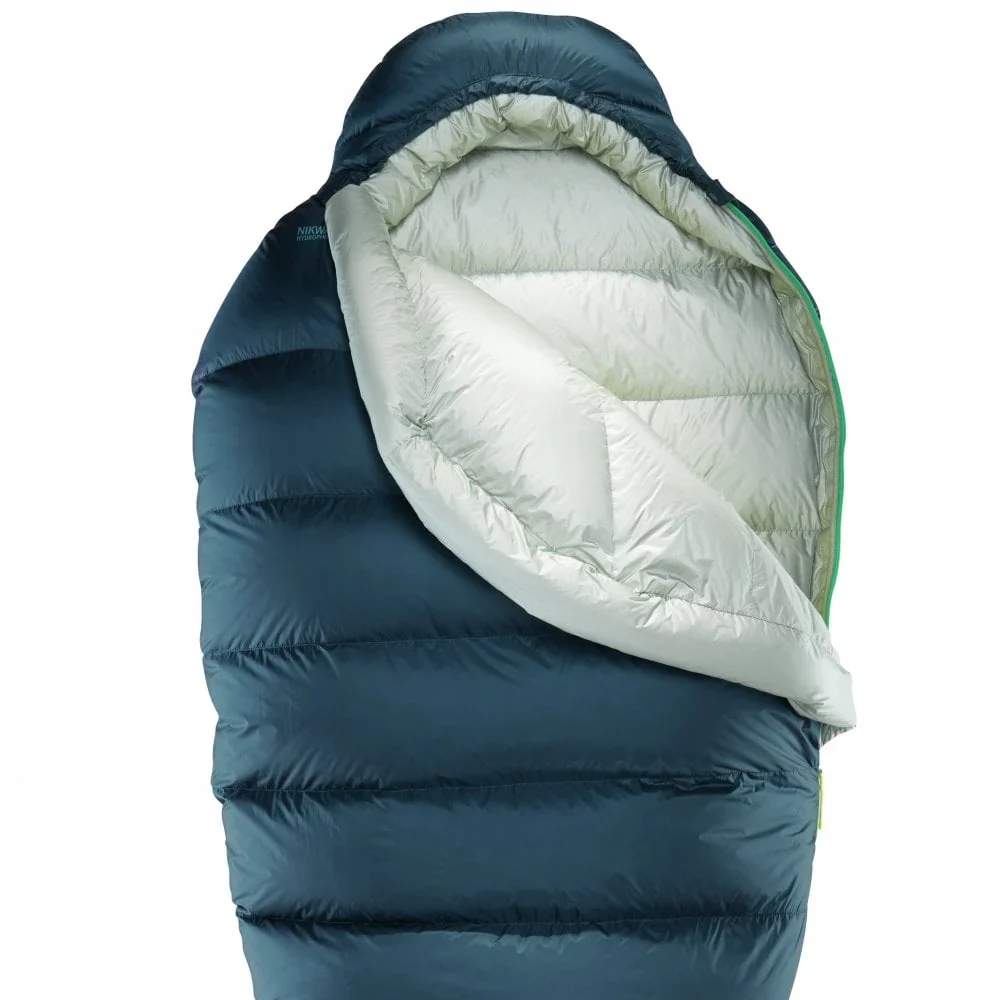
900-fill hydrophobic Nikwax down, 32°F / 0°C Comfort, 20°F / -7°C Limit, 1 lb 5 oz (595 g), packs incredibly small.
The lightest road-tested bag in this guide. Premium materials throughout — the shell, the draft tubes, the zipper — and rider reports consistently say it sleeps warmer than the spec suggests. Worth the price if every ounce in the panniers matters and you’re not asking the bag to handle truly cold nights.
NOT for: cold sleepers or larger riders. The cut is genuinely narrow and the 20°F Limit is not a -10°C bag in practice.
Check Therm-a-Rest Hyperion on Amazon →
Quilt Alternative
Enlightened Equipment Revelation 20 — Best Quilt for Riders
850-fill hydrophobic down, configurable length, width, and overstuff, base 20°F / -7°C Limit configuration.
The committed long-trip rider’s pick. Saves roughly 30% weight versus an equivalent mummy bag by eliminating the compressed insulation under you that wasn’t doing anything. The strap system fits to your pad so drafts stay manageable once you learn the cinch. EE builds these to order, so expect a wait — but the customization (length, fill weight, fabric weight) is what makes them worth it.
NOT for: first-time campers, very cold sleepers, or anyone who doesn’t want to spend two nights learning the system before trusting it on the road.
Check Backpacking Quilts on Amazon →
How to Pack a Sleeping Bag on a Motorcycle
The unsexy half of bag ownership, and the one that decides whether your $400 bag lasts ten years or two.
The compression sack. Stock sacks from budget brands are oversized — they ship cheap to keep the unit price down. Get an aftermarket compression sack (Sea to Summit Ultra-Sil and Granite Gear are the obvious picks) and you’ll drop the packed volume by 30-40%. For down bags, only compress on the road. At home, store the bag loose in the large mesh sack that comes with most premium bags, or hung in a closet. Compressed down loses loft over months — once it’s gone, it doesn’t come all the way back.
Where it goes in the panniers. Inside a dry bag, inside the pannier. Always. Even with hydrophobic down. Aim for the center of a side pannier — protected from impact in a low-speed drop, and away from the exhaust-side heat. On a soft luggage setup or in a tank bag, the bottom-front position works well: it acts as cushioning for harder gear above it and stays out of the wettest splash zone. Our breakdown of how to pack for a two-week trip covers the rest of the load order.
The rain reality. Panniers leak. Even aluminum ones leak through the latches in monsoon rain after a few seasons of seal wear. A $10 lightweight dry bag inside the pannier saves a $400 sleeping bag, and the math gets easier from there.
The 4 Mistakes That Cost You a Night’s Sleep
-
Buying for the marketed number, not the comfort number. A “20°F” tag almost always refers to the Limit temperature, where a curled-up 73 kg man can sleep without shivering. If you sleep cold, or weigh less, or like to stretch out — you’ll be miserable at 25°F in that bag. Buy for the Comfort rating, with 5-10°C of margin below the coldest forecast night.
-
Cheap pad under an expensive bag. Your pad’s R-value is the floor the bag is sitting on. R 1.5 under a $400 down bag is $400 of insulation with a hole in the bottom of it. Spend evenly across bag and pad; if the budget only stretches to one premium item, the pad is the better choice for cold nights.
-
Storing down compressed. Down clusters lose loft when squashed for weeks at a time, and lost loft is lost warmth that never fully returns. Loose storage at home, compressed only on the road. Mesh sacks are designed for this and ship with most premium bags.
-
Ignoring fill weight. A “premium 850 fill power” bag with 12 oz of down is colder than a “basic 650 fill” bag with 25 oz. Both numbers matter — fill power tells you the quality of each ounce; fill weight tells you how many ounces you got. If a brand only publishes one, it’s usually because the other is unflattering.
The Take-Home
A sleeping bag is half a sleep system. Buy the bag for the temperatures you’ll actually face — Comfort rating, with 5-10°C of margin — pair it with a pad whose R-value matches the season, and store the bag loose between trips. Those three habits handle 90% of why riders wake up cold.
Pair the bag with the right tent and pannier setup and the rest of your kit gets easier. The ultralight tent picks are the natural next step once the sleep half is sorted.
Frequently Asked Questions
Is down or synthetic better for motorcycle camping in Europe?
Hydrophobic down for most three-season trips — the packed volume advantage matters more on a motorcycle than anywhere else, because pannier litres are the constraint nobody warns you about until your fifth night. A modern DWR-treated down bag (DownTek, Ultra-Dry, Nikwax) closes most of the wet-weather gap that used to be the reason to choose synthetic. Synthetic only wins if you're specifically going to known-wet regions for weeks — Scotland in October, Lofoten any time of year, the Atlantic coast in shoulder season — or if a tight budget puts a real down bag out of reach this season.
What temperature rating do I need for European summer touring?
A bag with a Comfort rating around 5°C (40°F) covers most June to August trips across Western and Southern Europe. For shoulder seasons (April-May, September-October) bump that to -1°C / 30°F Comfort so you have margin when a front comes through. For nights above 8°C (46°F) just unzip the bag and use it as a quilt over your legs — that's why a half-zip mummy is worth the extra weight over a top-bag. Avoid buying for the absolute coldest night you might ever face; you'll cook in the bag for 90% of the trip.
Can I use a regular sleeping bag for motorcycle camping?
Yes, but you'll pay in packed volume and that cost compounds across a trip. A car-camping rectangular synthetic bag takes up roughly four times the space of a 30°F / -1°C down mummy of equivalent warmth. For one or two overnight trips a year you can get away with it strapped to the rear rack in a dry bag. For multi-week tours, the pannier space you lose to the bag is space you can't use for layers, tools, or a bigger sleeping pad — and the pad almost always matters more.
How do I know if a sleeping bag's temperature rating is honest?
Look for 'EN 13537' or 'ISO 23537' on the spec sheet — those are the only standardized lab tests. Reputable brands publish three numbers: Comfort, Limit, and Extreme, all measured the same way on a heated manikin on a standardized R-4.8 pad. If a bag publishes only one number with no standard reference, treat that number as marketing-optimistic and discount it by 5-8°C for real-world comfort. Most Amazon-only mummy bags with 'mil-spec' or '4-season' labels fall into this category — buy with a margin or buy from a brand that publishes the test.
Do I need a sleeping bag liner?
Useful, not essential. A silk or thermolite liner adds roughly 3-8°C of warmth depending on the material, keeps body oils off the down (down bags are hell to wash and lose loft each time), and doubles as a thin sheet when nights are too warm for the bag itself. The Sea to Summit Reactor liners are the benchmark and weigh under 250 grams. If you're choosing between spending $60 on a liner or $60 more on a warmer bag, get the warmer bag — but a liner is the cheapest legitimate way to push a $200 bag into shoulder-season territory.