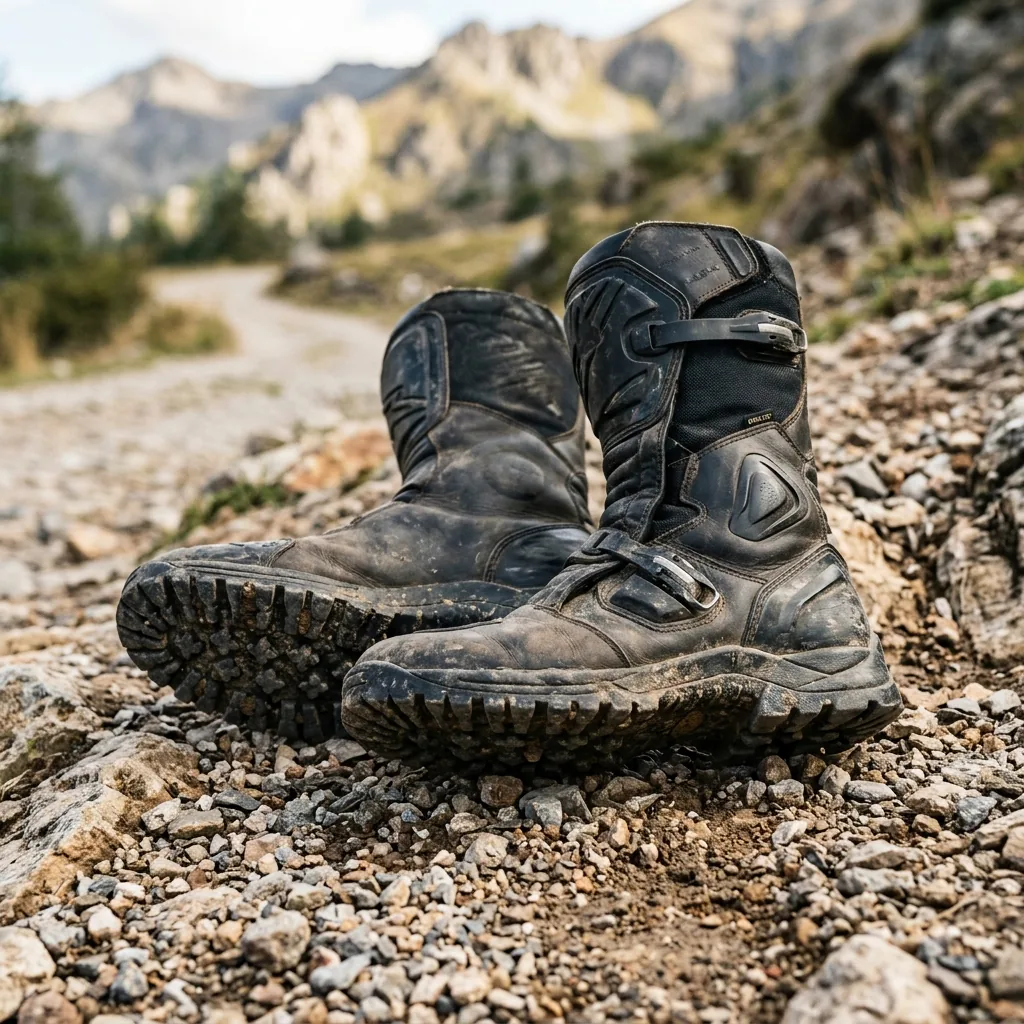
Boot choice is the gear decision riders underestimate the most. Helmets and jackets get the marketing attention. Gloves and pants get the second-tier focus. Boots get whatever’s left over — which is exactly why most riders end up with the wrong boots for their actual riding.
The right adventure motorcycle boot has to do four jobs: protect the foot in a crash, keep water out, allow control of the bike, and remain walkable for the hours you’ll spend off the bike on a long trip. Get any one of these wrong and the boot becomes the gear you complain about every day.
This best adventure motorcycle boots 2026 guide covers five boots that handle these requirements well, the certification standards that matter, and the maintenance routine that decides whether any waterproof boot stays waterproof long-term.
Introduction: Why Your Boot Choice Matters More Than Most Gear
A motorcycle boot has to function as part of three different activities. While riding, it operates controls and provides protection. During a stop, it’s a hiking boot — for walking to fuel, food, restrooms, viewpoints. In a crash, it’s the last line of defence between your ankle and the asphalt.
Most boots optimise for one of these and compromise the others. Premium boots optimise for all three, which is what you’re paying for.
Wear the wrong boot for two weeks of touring and you’ll know it. Wear the right boot and you’ll forget you have feet.
Touring ADV vs Off-Road ADV: Two Different Boots
The single most important distinction in the market.
Touring ADV boots — Sidi Adventure 3, Daytona Road Star GTX, Forma Adventure, Alpinestars Corozal, TCX Infinity 3. Tall enough to cover the shin, supple enough to walk in, waterproof, with rotational ankle support and reinforced toe and heel. Look like a tall hiking boot with armor.
Off-road ADV boots — Sidi Crossfire 3 SRS, Alpinestars Tech 7 Enduro, Gaerne SG-12. Rigid plastic shell, buckles instead of laces, motocross-style protection at the cost of all walkability. The right boot for serious single-track and enduro-pace off-road. The wrong boot for any trip that involves walking around towns.
If you’re doing 70% touring and 30% off-road, get a touring ADV boot. If you’re doing 70% off-road and 30% touring, get an off-road boot and accept that you’ll change shoes at camp. Trying to split the difference produces boots that do neither job well.
CE Level 1 vs Level 2: What the Certification Means
CE EN 13634 is the European motorcycle boot standard. Two levels exist.
Level 1: minimum protection — basic impact, basic abrasion, minimum cut resistance.
Level 2: enhanced protection — higher impact energy, longer abrasion times, stronger ankle bracing, sole crush resistance.
For touring at any speed above 80 km/h, Level 2 is the right floor. For off-road riding, Level 2 is essentially mandatory — the protection difference matters most in the impact scenarios off-road creates. Almost every premium ADV boot in 2026 is Level 2 by default.
Waterproofing: Gore-Tex vs Proprietary Systems
Two waterproofing approaches dominate.
Gore-Tex: licensed external membrane, manufactured to Gore’s standards, tested to a public spec. Long-term reliability is excellent — Gore-Tex boots tend to stay waterproof for 5+ years with reasonable care.
Proprietary membranes — TCX T-Dry, Sidi WP, Alpinestars Drystar: brand-developed alternatives that perform comparably when new but typically develop pinhole leaks 2-3 years earlier than Gore-Tex in real-world testing.
Gore-Tex adds $50-100 to the boot price. For a boot you’ll wear 5+ years, that premium pays back. For a budget boot you’ll replace in three years anyway, proprietary is fine and the price savings are real.
Best Adventure Motorcycle Boots List 2026
Five boots covering the full price and use-case spectrum. Weights are per boot (one foot).
- Sidi Adventure 3: benchmark touring ADV, Gore-Tex (850 g each)
- Daytona Road Star GTX: premium German Gore-Tex (900 g each)
- Forma Adventure: mid-price value option (780 g each)
- Alpinestars Corozal Adventure Drystar: solid waterproofing (760 g each)
- TCX Infinity 3 Waterproof: budget pick at $150 (720 g each)
1. Sidi Adventure 3
Around $550. The benchmark touring adventure boot. Italian build, Gore-Tex membrane, CE Level 2, articulated ankle, walkable enough for a full day off the bike. The standard against which other touring ADV boots get compared.
The fit runs slightly narrow — riders with wide feet should size up half a number or look at the Forma Adventure. Owners on ADVRider.com routinely report 30,000-50,000 km of trouble-free use from a single pair.
Shop Sidi Adventure 3 on Amazon →
2. Daytona Road Star GTX
Around $700. The premium German alternative. Gore-Tex, Daytona’s own ankle articulation system, CE Level 2, hand-stitched in Germany. The fit and finish is one tier above the Sidi.
The Daytona is the boot for riders who treat boots as a 10-year investment. The build quality genuinely supports that timeline. The price is the obvious drawback.
3. Forma Adventure
Around $250. The mid-price value pick. CE Level 2, Forma’s Drytex waterproof membrane (proprietary), full-grain leather. Comparable protection to the Sidi at half the price, with the trade-off of slightly faster wear over 5+ year ownership.
For a rider doing 2,000-5,000 km a year, the Forma is the smart spend. The premium options matter most for higher-mileage riders.
Shop Forma Adventure on Amazon →
4. Alpinestars Corozal Adventure Drystar
Around $300. Alpinestars’ touring ADV entry. Drystar membrane (proprietary), CE Level 2, slightly sportier styling than the Sidi or Forma. The fit suits intermediate-width feet well.
The waterproofing is adequate but degrades faster than Gore-Tex options. For riders in mostly dry climates, this isn’t a real issue. For riders in the UK, the Pacific Northwest, or alpine regions, lean toward Gore-Tex.
5. TCX Infinity 3 Waterproof
Around $150. The budget pick. CE Level 1 (not Level 2), TCX T-Dry membrane, lighter construction. Real waterproofing at a price where most boots offer plastic and hope.
The right first ADV boot for a new rider or for a backup pair. The protection ceiling is lower than the Sidi or Daytona. Don’t expect this boot to be your main boot for hard off-road or high-speed touring.
Walkability: The Factor Nobody Mentions
Most boot reviews focus on protection and waterproofing. They almost never mention walkability, which is the factor that decides whether you’ll actually wear the boot at every stop.
A long touring day might include: a 15-minute walk to a restaurant, an hour wandering an old town, a kilometre of hiking to a viewpoint, multiple stops at fuel stations, walks around campsites. That’s two to three hours on your feet, in motorcycle boots.
The Sidi Adventure 3 and the Forma Adventure are the most walkable premium options. The Daytona is also good. The TCX Infinity 3 is light enough to walk in for hours.
Pure off-road boots — Sidi Crossfire 3 SRS, Gaerne SG-12 — are essentially impossible to walk in comfortably. They’re not meant to be. If your trip involves walking, don’t bring these.
Boot Care and Waterproofing Maintenance
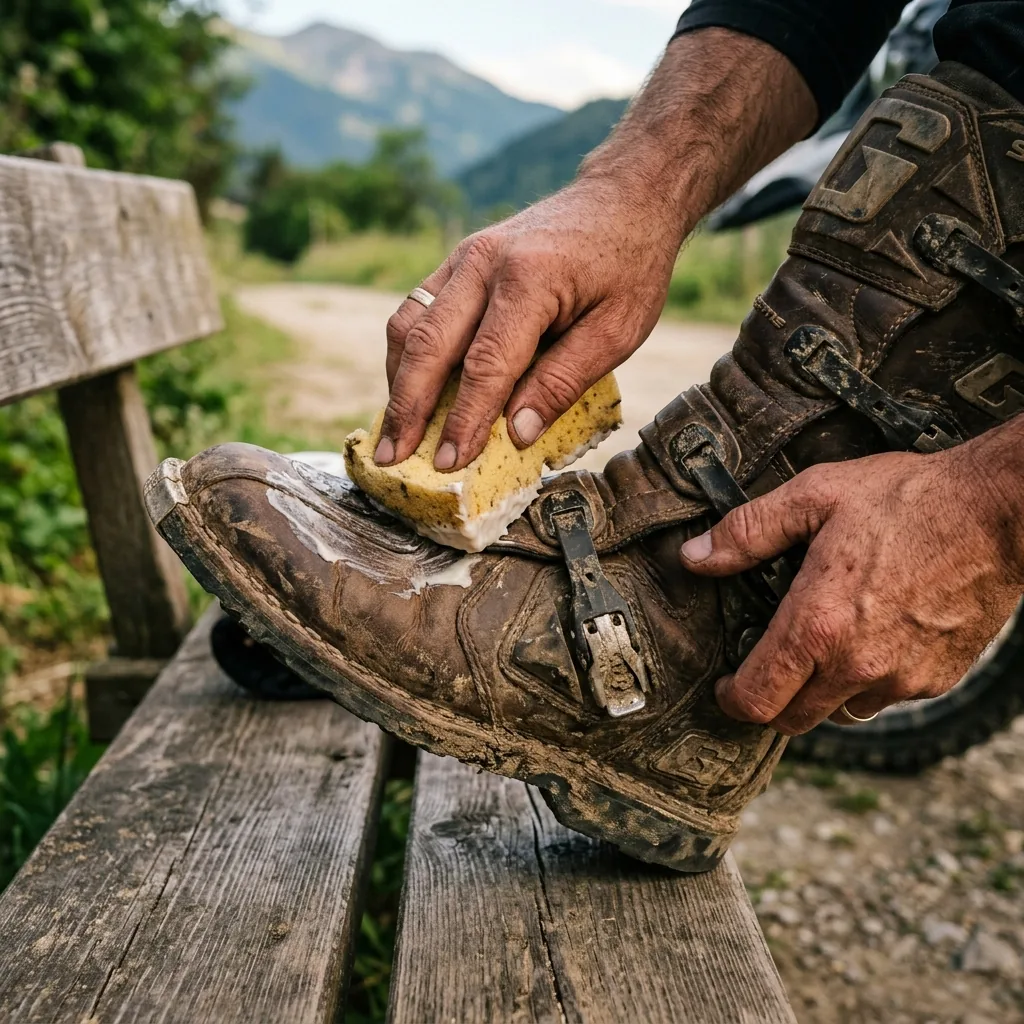
The single most important boot habit. Twice a season at minimum:
-
Clean the boots. Remove dried mud with a soft brush. Wipe with a damp cloth. Let dry fully (24 hours minimum) before treating.
-
Treat the leather. Nikwax Waterproofing Wax for Leather is the standard. Apply evenly with a sponge or cloth. Work into seams and stitching. Excess wipes off after 30 minutes.
-
Re-treat the membrane. For Gore-Tex boots, Nikwax also makes a fabric-specific treatment. For proprietary membranes, follow the manufacturer’s specific recommendation.
-
Let cure overnight. Don’t ride the boots wet from treatment — the wax needs time to bond with the leather.
Skip this routine and a $500 waterproof boot becomes a $500 wet sock in 36 months. Do this routine and the same boot stays waterproof for 6-8 years.
Shop Nikwax Boot Waterproofing on Amazon →
FAQ
For more adventure gear comparisons, see our Klim Badlands Pro jacket review and best adventure motorcycle helmets 2026 guide.
Disclosure: Some of the links in this article are affiliate links. If you buy gear through them, we may earn a small commission at no extra cost to you. It helps fund the road trips that make these independent gear comparisons possible.
Frequently Asked Questions
What's the difference between touring and off-road adventure motorcycle boots?
Touring ADV boots prioritise walkability, waterproofing, all-day comfort, and easy on-off — they look more like hiking boots. Off-road ADV boots prioritise impact protection, ankle bracing, and shin protection — they look more like motocross boots, with rigid plastic shells and buckles. Touring boots are for riders doing 60% pavement and 40% gravel. Off-road boots are for riders attempting serious single-track. Most riders need one or the other, not both.
Is CE Level 2 boot certification worth paying for?
Yes, if you ride faster than 80 km/h or off-road regularly. CE Level 2 boots resist higher impact forces, longer abrasion, and stronger crushing than Level 1. The cost difference is typically $50-150. The injury difference in a real off in unfortunate circumstances can be a broken ankle versus a sprain. For a boot you'll wear for the next five years, Level 2 is the right floor.
Gore-Tex or proprietary waterproof membranes in motorcycle boots?
Gore-Tex is the more reliable long-term choice. Proprietary membranes (TCX T-Dry, Sidi WP) work well when new but tend to develop leaks 2-3 years sooner than Gore-Tex in real-world use. Gore-Tex adds $50-100 to the boot price. For a boot you'll wear for 5+ years, the Gore-Tex premium pays back. For a boot you'll replace in 2-3 years anyway, proprietary is fine.
How important is walkability in adventure motorcycle boots?
More important than most buyers realize. On a long trip you'll spend hours walking — to restaurants, around campsites, through tourist sites, to view the bays you rode to see. A boot you can't comfortably walk in becomes a boot you take off at every stop, which removes a layer of protection at exactly the moments you might slip. The Sidi Adventure 3 and Forma Adventure are the most walkable premium options. Pure off-road boots like the Sidi Crossfire 3 are uncomfortable to walk in by design.
How often should waterproof motorcycle boots be re-treated?
Twice a season at minimum, more often if you ride in heavy rain or mud frequently. The DWR coating on the outer leather wears off, and once the outer wets out, the inner membrane has to do all the work and eventually fails. Nikwax Waterproofing Wax for Leather is the standard treatment. Clean the boots first, dry fully, apply evenly, let cure overnight. Skip this step and a $500 boot becomes a $500 wet sock in three years.