
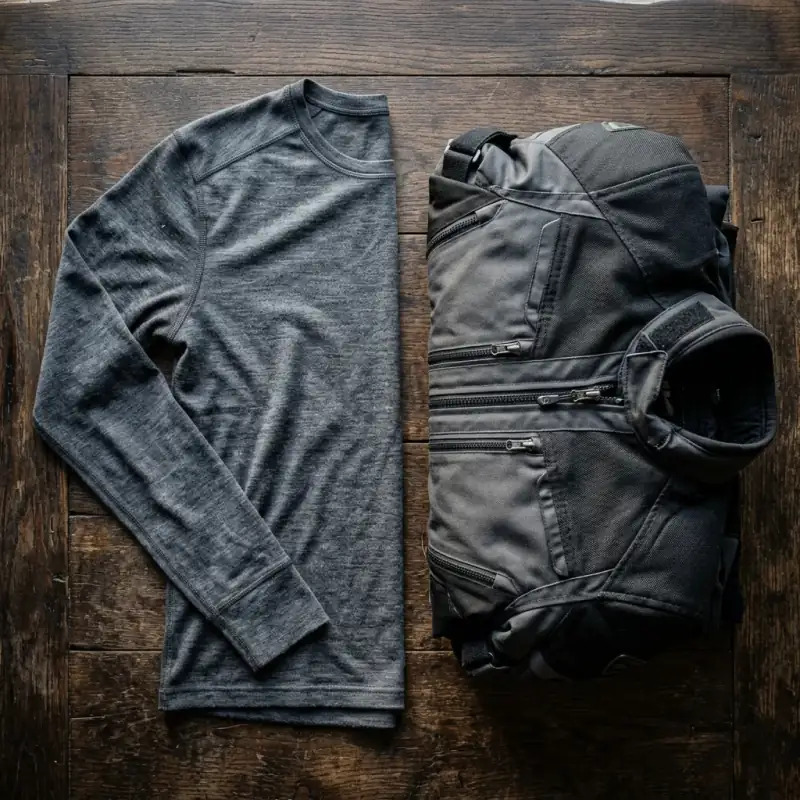
There is one number that tells you how warm a base layer is, and on most merino it is hiding in plain sight: it is the number in the product’s name.
Merino 150. Merino 200 Oasis. Merino 250. Those are fabric weights in grams per square metre, and because the whole industry uses the same scale you can line a Smartwool up against an Icebreaker against a budget brand and know what you are trading. How openly each brand states it varies — Minus33 puts “245 g/m²” straight in the spec table, while Icebreaker’s and Smartwool’s own product pages carry the number only in the model name — but the scale itself is consistent, which is what makes it useful.
What you cannot compare is a garment sold as “thermal underwear” with no number at all, which is most of what gets marketed to riders.
Shop by that number and the category gets simple. There is also one thing about riding that changes which number you want, and it inverts the advice on every hiking site.
Disclosure: some links below are affiliate links. If you buy through them we may earn a small commission at no extra cost to you.
Why riding needs a heavier layer than walking
Every layering guide ever written assumes you are moving. Hike uphill in 5 °C and you generate a lot of heat, so the standard advice — start slightly cold, you will warm up — is correct. The base layer’s main job in that scenario is moving sweat away fast enough to stop you getting chilled when you stop.
Riding is the opposite situation, and it is genuinely unusual: you are almost completely sedentary, outdoors, in a permanent gale. Your body produces very little extra heat, and the airstream removes it faster than any hiking scenario ever will.
That is why riders who buy a lightweight base layer on the strength of a hiking review are often disappointed. It is doing exactly what it was designed to do, for someone who is working.
Minus33 puts numbers on the same idea for its midweight top: roughly 30 °F to 60 °F while inactive, against 30 °F to 0 °F while active. Two ratings for one garment, thirty degrees apart, decided entirely by whether you are moving. On a bike you are in the inactive column, in wind.
The practical translation: whatever weight you would pick for walking, go one band up for riding.
What the weights mean
| Weight | Typical use | Example |
|---|---|---|
| ~150 | Cool mornings, shoulder season, riders who run hot, under a heated liner | Smartwool Classic All-Season |
| ~200 | The winter all-rounder for most riders | Icebreaker Merino 200 Oasis |
| ~245–250 | Genuinely cold days, slow traffic, low-output riding | Minus33 Chocorua Midweight |
Three honest wrinkles, all worth knowing before you take any number literally.
Only one of those brands actually prints the number. Minus33 publishes it outright for the Chocorua Midweight — 245 g/m², 18.5 micron, 100% merino. Smartwool describes the Classic All-Season fabric as a nylon core wrapped in merino wool and names the collection Merino 150, without stating a g/m² figure anywhere on the page. Icebreaker states 100% merino and calls the Oasis a merino jersey, with the 200 living in the model name rather than the spec sheet. Meriwool’s Merino 250 sits in the same band as the Minus33, but that figure was measured by OutdoorGearLab rather than published by the brand. So read the left column as the band a garment belongs to, not as a number every maker stands behind.
Retailers and manufacturers do not always agree. The Minus33 Chocorua is listed at 230 g/m² by several stockists and at 245 g/m² on Minus33’s own product page. The gap is small enough not to move the garment out of its band, but it is a good illustration of why the manufacturer’s page is the figure worth trusting.
And the number describes the fabric, not the garment. It says nothing about fit, cut, sleeve length or where the seams fall — and on a motorcycle those decide comfort at least as much as warmth does.
Merino or synthetic
The argument is narrower than the internet makes it.
Merino’s advantage is odour. Wool is naturally odour-resistant and synthetics are not, which is the reason merino dominates multi-day use. Treat the specifics carefully, though: the strong claims here come from the brands themselves, and the independent testing we could find records odour resistance as a property of the fibre rather than publishing a measured comparison. What is not in doubt is the practical consequence — on a two-week trip with no laundry, it is the difference between packing two base layers and packing five, which on a motorcycle is a pannier-space question as much as a comfort one.
Synthetic’s advantages are price and durability, and the durability one is measured. OutdoorGearLab’s base-layer testing puts it bluntly: thick synthetic base layers are the most durable, while 100% merino base layers — regardless of thickness — tend to test as the least durable. Synthetics also dry faster; merino is the slower-drying fibre of the two, though still fast compared with most textiles.
That durability gap is exactly why blended fabrics exist at the light end. Smartwool builds its 150 around a nylon core wrapped in merino, because the finest wool on its own does not survive being the layer that rubs against everything.
And the material that is not in the argument at all is cotton. It absorbs sweat, holds it against your skin and cools you continuously for the rest of the day. Our cold-weather riding guide goes into why that is the single most common and most avoidable cold-riding mistake.
The armour problem
Here is the rider-specific detail that outdoor guides never cover.
Insulation works by trapping air. Compress it and you lose most of what it was doing. On a motorcycle, your layers are squashed by a jacket, often a back protector, and shoulder and elbow armour — so the loft you paid for is exactly where the pressure is.
Two consequences worth building your kit around:
- Two thin layers beat one thick one. Not a rule of thumb — a consequence of the compression. It also gives you something to shed at a fuel stop, which matters more than it sounds, because sweating into your base layer at a stop is how you get cold twenty minutes later.
- Close-fitting, not compressive. The layer has to sit against your skin to work, but it also has to let you reach the bars with a jacket and armour over the top. Try that movement before the tags come off.
The seam question follows from the same physics. Look for flatlock seams, which lie flush instead of standing proud — those are the ones that do not press a ridge into your shoulder after two hours under an armour pocket. Most quality merino tops use them, but it is worth confirming on the listing, because it is a detail brands mention inconsistently.
What to buy
- Cool mornings and shoulder season: a 150-weight merino such as the Smartwool Classic All-Season, which is the band that stays comfortable when the day warms up. This is also the right choice under a heated liner, where the base layer’s job is comfort and moisture rather than insulation.
- The one to own if you own one: a 200-weight merino. The Icebreaker Merino 200 Oasis is the reference point in this band — Icebreaker states 100% merino and describes it as a merino jersey — and 200 is the weight that covers most of an autumn-to-spring riding season in temperate Europe.
- Genuinely cold riding, or a tight budget: the 250 band. The Meriwool Merino 250 is 100% merino at the midweight standard — OutdoorGearLab measures it at 250 g/m² — and it is consistently the cheaper way into full-weight merino. The Minus33 Chocorua sits in the same band and is the one that publishes its figure: 245 g/m², 18.5 micron.
Check Meriwool Merino 250 on Amazon →
Check Icebreaker Merino 200 Oasis on Amazon →
Check Minus33 Chocorua Midweight on Amazon →
Sizing note before you order: base layers are sold in size-and-colour variants and the same model can appear under several listings. Check the size chart on the listing you land on rather than assuming your usual size carries across brands.
What a base layer cannot do
It cannot stop wind. That is worth stating plainly, because it is where riders most often misdiagnose a cold day.
A base layer manages what happens next to your skin. A mid layer traps air. The outer layer stops the airstream stripping the heat out of both — and at road speed, an insulating layer that is not windproof is close to useless. If your riding jacket is not genuinely windproof, a cheap packable rain oversuit over the top will do more for a cold ride than any base layer upgrade.
And if your hands and feet are the problem, no amount of torso layering fixes that directly — although warming your core does improve both as a side effect, because a cold body restricts blood flow to the extremities first. The heated gear guide covers where that money goes furthest, heated grips vs heated gloves settles which of the two you need, and the heated glove guide works out how much heat each pair actually produces.
Related guides
- How to ride a motorcycle in cold weather — the full layering system, and what wind actually does to it.
- Best heated motorcycle gear — where to spend first once layering runs out of road.
- How to wash motorcycle riding gear — including why the detergent you use on a base layer matters to the jacket over it.
- Best autumn motorcycle routes in Europe — the season this kit is bought for.
Frequently Asked Questions
What weight base layer do I need for winter motorcycling?
Heavier than a hiker would choose for the same air temperature, because you are not generating heat. Merino is sold in fabric-weight bands measured in grams per square metre, and the number usually sits in the product name: roughly 150 for cool but mild conditions, 200 as the winter all-rounder, and 250 for genuinely cold days. A hiker in 5°C typically reaches for the 150 because they are producing body heat with every step; a rider at the same temperature is sitting still in a 100 km/h airstream and will usually want the 200 or the 250. Minus33 publishes a useful sanity check for its midweight: it rates the garment for roughly 30°F to 60°F while inactive, against 30°F to 0°F while active. Riding is the inactive column.
Is merino or synthetic better for motorcycle base layers?
Merino for most riders, synthetic if you prioritise durability and price. Merino's advantage is odour resistance, which is a property of the fibre rather than a treatment, and it is what makes a multi-day trip work — the difference between packing two base layers and packing five. Be aware that the strongest versions of that claim come from the brands themselves; independent testing tends to record it as a fibre property rather than publish a measured head-to-head. The durability side is measured, and it runs the other way: OutdoorGearLab's testing finds thick synthetics the most durable and 100% merino, at any thickness, the least. That is exactly why several brands wrap their lightest merino around a nylon core. The one material that is not in the argument is cotton, which holds sweat against your skin and strips heat continuously.
Should a base layer be tight or loose?
Close-fitting, and this matters more on a motorcycle than in most other cold-weather activities. A base layer works by sitting against the skin, so a loose one leaves gaps that convect heat away and does a worse job of moving moisture. But there is a limit specific to riding: the layers on a bike are compressed by a jacket, a back protector and shoulder and elbow armour, and insulation only works when it can trap air. A very thick base layer squashed under armour loses much of the loft you paid for, which is why two thinner layers usually beat one thick one under riding gear. Buy close-fitting rather than compressive, and check you can still move your arms fully to the bars.
Do you need a motorcycle-specific base layer?
Rarely, and the honest reason is that motorcycle-branded thermals usually give you less to compare than outdoor ones. Merino is sold on a shared weight scale — the 150 / 200 / 250 in the name — and some brands go further and publish the figure outright, as Minus33 does with 245 g/m² and an 18.5 micron fibre. A lot of gear sold as motorcycle thermal underwear carries no number at all, which makes comparing two of them impossible. Where riding-specific pieces genuinely earn their price is in cut — longer sleeves and a longer tail that stays put when you reach for the bars, flat seams positioned so they do not sit under armour, and sometimes a windproof panel across the chest. If a rider-specific top gives you those and publishes its specification, it is a fair buy. If it just says 'thermal', an outdoor base layer at a known weight is the better-informed purchase.
Can you wash a merino base layer normally?
Follow the garment label, and treat merino as the fragile item in the wash rather than the tough one. Most modern merino base layers are machine washable and many are sold on exactly that convenience, but check the garment's own label rather than a retailer listing — heat, agitation and the wrong detergent are what shorten a fine-wool garment's life. Wash cool, avoid fabric softener, and be aware that the same detergent residue that ruins a waterproof jacket's water repellency is worth keeping out of your whole riding wardrobe. Our guide to washing riding gear covers the detergent problem in detail, and the short version applies here too: liquid, mild, no softener.