
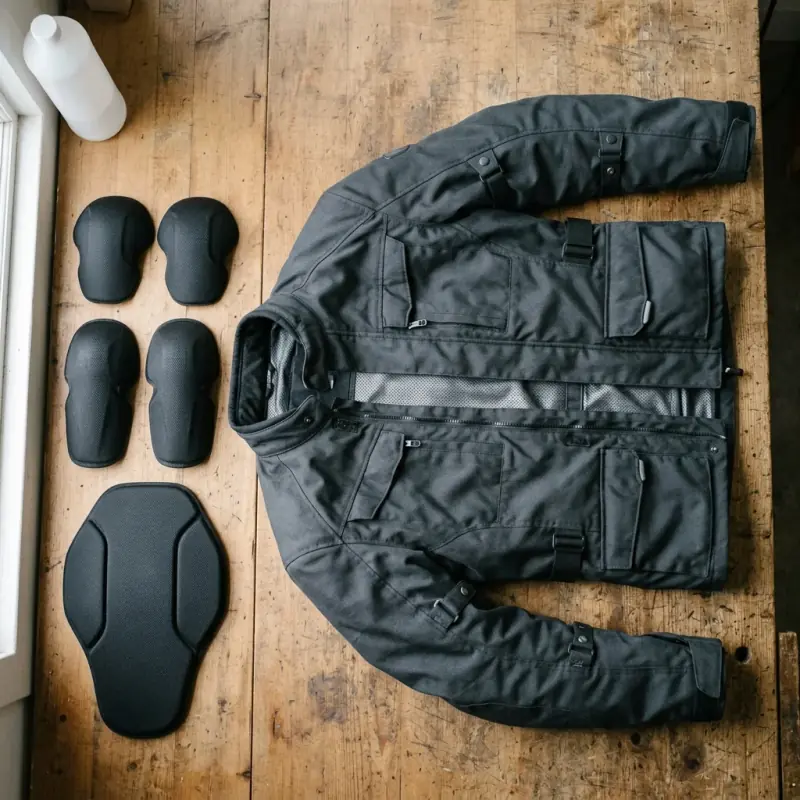
Riding gear rarely dies. It gets washed to death.
A jacket that “started leaking in its third season” has usually not failed at all — it has been through a machine with the wrong detergent, or dried the way a different type of jacket wants to be dried. And the confusing part is that the advice riders repeat to each other is genuinely correct, for one specific kind of garment, and genuinely wrong for the other.
This is the version with the manufacturers’ own instructions attached, because on this subject they disagree with each other in a way that matters.
The one question that changes every other answer
Waterproof riding jackets come in two broad constructions, and they are cared for differently.
Laminate (the membrane is bonded to the outer shell). This is GORE-TEX Pro and most premium adventure kit — the waterproof layer is part of the outer fabric, so the outside of the jacket is the waterproof surface.
Drop-liner (the membrane hangs inside, often removable). This is most mid-price textile gear. The outer shell is just fabric; the waterproofing is a separate layer behind it.
The distinction matters because of what a dryer does. GORE-TEX’s care instructions ask for heat: after washing, “tumble dry for a further 20 minutes to reactivate the durable water repellent”. REV’IT! gives the same instruction for its GORE-TEX garments — a 40 °C wash, then 20 minutes of tumble drying — and then, on the same page, tells owners of its standard textile garments to drip dry at room temperature and, in capitals, not to put the garment in a dryer.
So the single most-repeated piece of gear-care advice on the internet is manufacturer instruction for one kind of jacket, and — on the other — the exact thing that garment’s own maker tells you in capitals not to do.
If you do not know which you own, the label inside the jacket does. REV’IT!‘s own guidance is to read the label in each layer separately, because a jacket with a zip-in liner can have two different sets of instructions living inside it.
Take the armour out — and do not wash it
Armour comes out before anything else, and it does not go in the machine.
D3O — whose inserts are in a very large share of riding gear — publishes care instructions that are unusually blunt about this. Protectors should be removed from the garment and wipe-cleaned only, with a damp cloth. Dry them at room temperature in a ventilated space; no hair dryers, no heaters. And, oddly specific but worth obeying: never fold your D3O product. The consumer care sheet adds that you should never launder the protectors or use cleaners and detergents on them, because doing so can cause irreparable damage and severely reduce how well the armour performs.
Other armour brands differ in the details, so read the label. But the safe default across the category is identical: out, wipe, air dry flat.
There is a second reason to remove it that has nothing to do with the armour. Hard inserts tumbling loose in a drum abrade the inside of the jacket — which, on a laminate garment, is the membrane. Both KLIM and REV’IT! also tell you to close every zip and hook-and-loop fastener before washing for the same reason: an open Velcro tab is a cheese grater for three hours.
Why household detergent is the actual villain
Here is the failure mechanism, because once you understand it the rules stop being arbitrary.
A waterproof jacket does two separate jobs. The membrane stops liquid water. The DWR — durable water repellent — is a finish on the outer face fabric that makes water bead up and roll off before it can soak in.
When the DWR stops working, the outer fabric “wets out”: it absorbs water and goes dark and heavy. The membrane is still doing its job perfectly, and you still get wet, because a saturated outer layer stops vapour escaping, so your own sweat condenses on the inside. It feels exactly like a leak. It is not one.
Ordinary detergents accelerate this, because they are designed to leave the fabric attractive to water — that is what makes clothes feel soft. Nikwax’s position is that regular detergents leave behind residues that attract water. GORE-TEX’s instruction list bans powder detergents, fabric softeners, stain removers and bleach outright, and asks for a small amount of liquid detergent instead. KLIM goes one step further and asks for an additional wash and rinse cycle with no soap at all, to get every trace of it out of the fabric.
That is why the technical washes exist. They are not a premium version of laundry liquid; they are a cleaner engineered not to leave the residue behind.
Disclosure: some links below are affiliate links. If you buy through them we may earn a small commission at no extra cost to you.
Check Nikwax Tech Wash on Amazon →
The wash, step by step
- Empty the pockets and strip the jacket. Armour out. Zip-in thermal and waterproof liners out — they get washed separately, to their own label.
- Close everything. Main zip, pocket zips, vent zips, cuff and collar hook-and-loop. Both KLIM and REV’IT! ask for this.
- Clean the machine first if it has seen fabric softener. Residue in the drum ends up on your jacket. A rinse cycle on empty is enough.
- Use a technical liquid wash. Nikwax Tech Wash, or the brand’s own — REV’IT! specifies its own Textile Wash; KLIM asks for a mild liquid detergent. Never powder.
- Set the right temperature. GORE-TEX and REV’IT!‘s GORE-TEX garments: 40 °C, warm permanent-press cycle. REV’IT!‘s standard textile garments and riding jeans: 30 °C maximum, gentle cycle. GORE-TEX also asks you to rinse twice and minimise spinning.
- Dry it the way that garment wants to be dried. Laminate GORE-TEX: line dry or tumble dry warm and gentle, then a further 20 minutes in the dryer to reactivate the DWR. Standard textile: hang it up at room temperature and keep it out of the dryer entirely.
If you have no dryer and the garment is one that wants heat, GORE-TEX’s published alternative is to iron on a gentle setting with a towel or cloth between the iron and the jacket, and no steam.
Reproofing: when, and with what
Washing restores breathability. It does not create new water repellency once the original finish has worn off.
The test is free. Take a clean, dry jacket, splash water across the shoulders and forearms — the places wind and rain hit hardest — and watch. Beading and running off means the DWR is alive. Soaking in and darkening the fabric means it is gone.
GORE-TEX frames the same test as its own maintenance trigger: when water no longer beads and runs off after washing, reapply a DWR treatment. Nikwax’s guidance on frequency is that you can clean a garment with Tech Wash three to five times before the waterproofing needs reapplying.
Two formats, and the choice between them is not really about performance:
- Wash-in goes into the machine after the cleaning cycle and coats everything, inside and out. Simplest, most even coverage. The caveat is that on a garment with a mesh or insulated liner, coating the inner surfaces too can cost you some breathability — which is why Nikwax itself suggests the spray-on version when you are not sure what the inner liner is made of.
- Spray-on treats only the outer face. More work, more control, and the right answer for a jacket with a fixed liner. Nikwax’s instruction is to spray it evenly onto a clean, wet garment from about 15 cm, wait four to five minutes, remove the surplus with a damp cloth, then hang dry — or tumble dry low if the care label allows.
Check Nikwax TX.Direct Wash-In on Amazon →
Check Nikwax TX.Direct Spray-On on Amazon →
One detail worth knowing before you buy: some reproofers are heat-activated and some are not. KLIM and GORE-TEX both point owners at spray-on treatments like Revivex, which are activated in the dryer — so on a garment that must not be tumble dried, a heat-activated product is the wrong choice. Nikwax states the opposite for its own spray-on: the repellency develops on air drying, so tumble drying is not required. Match the product to what the label lets you do with the jacket — on a garment that must never see a dryer, a heat-activated reproofer is the wrong purchase.
Boots, gloves and leather
Textile riding boots and gloves follow the same logic with one addition: leather needs feeding as well as proofing, and that is a separate product from a fabric DWR. Our adventure boots guide covers the leather side in more detail, including how often the outer treatment realistically needs redoing.
The one rule that carries across all of it: the outer wetting out is the failure, not the membrane. Once you can spot it, everything else in gear care is just the maintenance schedule that follows.
What this is actually worth
A laminate adventure jacket is a four-figure purchase. The care regime that keeps it working is a bottle of technical wash, a bottle of reproofer, and a habit of reading the label in each layer.
The riders who replace jackets every few seasons are not unlucky, and the fabric is rarely at fault. Household detergent and the wrong drying instruction will finish off a good jacket faster than any amount of rain.
Related guides
- Best adventure motorcycle jackets — what you are protecting, and which constructions this care regime applies to.
- Best motorcycle rain gear — why an oversuit still earns its place over a waterproof jacket.
- Motorcycle camping in the rain — the same wetting-out problem, applied to tents and sleeping bags.
- How to store a motorcycle over winter — the other end-of-season job, and the one that actually costs money if skipped.
Frequently Asked Questions
Can you machine wash a motorcycle jacket?
Most of them, yes — but which cycle depends on what the jacket is, and the two main types want opposite treatment. REV'IT! publishes both sets of instructions: a GORE-TEX garment goes in at 40°C on a warm permanent-press cycle and is then tumble dried for 20 minutes to reactivate the water repellency, while a standard textile garment goes in at a maximum of 30°C on a gentle cycle and must never go in a dryer at all. Before either, all armour and any zip-in liners come out, every zip and hook-and-loop fastener is closed so it cannot abrade the fabric, and you use a technical liquid wash rather than household detergent. Getting the jacket type wrong is the most common way riders damage gear they were trying to look after.
Why is my motorcycle jacket suddenly letting water through?
Usually the membrane is fine and the outer face fabric has 'wetted out'. A waterproof jacket has two systems: the membrane that blocks liquid water, and a durable water repellent (DWR) finish on the outer fabric that makes water bead and roll off. When the DWR wears down — or when detergent residue coats the fabric — the outer face soaks up water instead of shedding it. That saturated outer layer feels cold and wet from the inside and kills breathability, so sweat condenses inside and you get damp anyway. GORE-TEX's own care guidance treats it as a maintenance signal: when water no longer beads and runs off after washing, reapply a DWR treatment. In other words, a jacket that seems to be leaking is usually a jacket asking to be cleaned and reproofed, not replaced.
Do you take the armour out before washing?
Yes, and with D3O armour it is not optional. D3O's own care instructions say the protectors should be removed from the garment and wipe-cleaned only, with a damp cloth, then dried at room temperature in a ventilated space — no hair dryers or heaters — and never folded. Their consumer care sheet goes further and tells owners not to launder the protectors or use detergents on them, because it can cause irreparable damage and reduce how well the armour works. Other armour brands vary, so check the label, but the safe default across the category is the same: armour out, wipe clean, air dry flat. Removing it also protects the jacket, since hard inserts tumbling around a drum abrade the inner membrane.
Can you use normal laundry detergent on riding gear?
No, and this is the mistake that quietly ruins the most gear. Household detergents — powders especially — and fabric softeners leave behind residues that attract and hold water, which is the exact opposite of what a water-repellent outer needs. GORE-TEX's own instructions are explicit: use a small amount of liquid detergent, and do not use powder detergents, fabric softeners, stain removers or bleach. KLIM says the same and adds a second wash and rinse cycle with no soap at all to make sure nothing is left in the fabric. Technical washes such as Nikwax Tech Wash or a brand's own textile wash exist because they clean without leaving that residue behind.
How often should riding gear be washed and reproofed?
Wash when the outer is visibly dirty or has stopped beading water, which for most touring riders is a couple of times a season and more often if you commute through traffic film and road salt. Reproofing is less frequent than washing: Nikwax's own guidance is that a garment can be cleaned three to five times with Tech Wash before it needs the waterproofing treatment reapplied. The practical test costs nothing — splash water on the shoulders and sleeves of a clean, dry jacket. If it beads and rolls off, the DWR is alive and a wash is all it needs. If it soaks in and darkens the fabric, it is time to reproof.